





News
Are Candles Bad for You? What Burning One Puts in Your Air, and What the Evidence Supports

Oct
Health & Evidence
Are candles bad for you? A lit candle is a small fire in a closed room, and it puts combustion gases, fine particles and evaporated fragrance into the air you breathe. The most detailed chamber study we found put most of those levels below indoor guideline values, with a few exceptions. The harm with the clearest numbers behind it is fire.
Key takeaways
One question here: what burning a candle does to the people in the room, not what the label words on the jar mean.
- Burning adds combustion products to the air. A 2021 chamber study ran 24 burns and tracked gases, benzene, formaldehyde, fine particles and fragrance.[1]
- Most modeled levels sat below guideline values. The exceptions, in some cases, were nitrogen dioxide, acrolein and benzo[a]pyrene.[1]
- Mild asthma, mild response. Five hours of candle smoke produced what a double-blind trial called “mild inflammation.”[5]
- We found no study showing candles cause cancer in people. Even a forty-year, eight-hours-a-day worst-case model landed near the usual risk threshold.[6]
- Fire is the harm with the hardest numbers. US fire departments responded to an average of 7,610 home candle fires a year in 2014 to 2018.[12]
Are candles bad for you? Burning one adds combustion gases, fine particles and fragrance to indoor air; the measured effects in studies so far are small, and the harm with national casualty numbers is fire. What it does to you depends on how many are lit, for how long, in how much air, and on whether your airways react to smoke or scent.
01Are Candles Bad for Your Health? The Short Answer
Are candles bad for your health? In ordinary home use, the measured answer is: mildly, for some people, and mostly through the same routes as any indoor flame. We found no published study showing that occasional candle use causes a disease in people. Several have shown that burning one adds pollutants to a room, and one controlled trial found a small inflammatory response in young adults with asthma.[5]
The cautious public-health position is simple. The American Lung Association puts it under the first step of indoor air control, eliminating the source: “Avoid burning indoors: fires, candles and incense can release pollutants into the air.”[2] That is advice about lowering exposure, not a finding that a candle on the table is poisoning anyone.
| Question | Short answer | What the answer rests on |
|---|---|---|
| Are candles harmful? | They add combustion pollutants to indoor air | A 24-experiment chamber study[1] |
| Is burning candles bad for your health? | A small airway response in mild asthma | One randomized double-blind trial, 36 people[5] |
| Do candles cause cancer? | Not shown in people; modeled risk is low | Two risk assessments; no human cancer study found[6][7] |
| Are candles poisonous? | The wax is considered nonpoisonous | MedlinePlus medical encyclopedia[9] |
| Can candles make you sick? | Irritation and headaches are documented effects | EPA and American Lung Association pages[10][3] |
| Can candles cause allergies? | Scent can trigger asthma; additives can irritate skin and eyes | AAFA and MedlinePlus[11][9] |
| Are candles safe? | The best-documented harm is fire | NFPA national fire data[12] |
| What lowers the exposure? | Fewer burns, more air, no flame | ALA advice and the ventilation results[2][6] |
02Are Candles Harmful? What Burning One Puts in Your Air
Are candles harmful to the air in a room? They add to it, measurably. The most detailed test we found, Salthammer and colleagues’ 2021 study in Environment International, burned four waxes and five fragrances, plus unscented controls, across 24 experiments in an 8 cubic meter chamber, and monitored “carbon monoxide, carbon dioxide and NOx, organic compounds, such as formaldehyde, benzene, and polycyclic aromatic hydrocarbons, PM2.5 and ultrafine particles.”[1]
The team converted emission rates into typical room concentrations and compared them with indoor guidance values, several from the World Health Organization: “In most cases, the calculated indoor concentrations were well below the respective guidance and reference values. The exceptions observed in some cases for nitrogen dioxide, acrolein and benzo[a]pyrene are discussed critically.”[1] The European, US and Latin American candle trade associations funded and advised the study, and fragrance houses sat on its advisory committee. Two of the five authors are from the European Candle Association and the fragrance house Arylessence; the paper states that the authors have no known competing interests.[1]
Which wax is in the jar is a separate argument, worked through in our pages on whether soy candles are toxic and whether paraffin wax is toxic.
Carbon monoxide, the gas people fear most, has its own arithmetic on our page about how much carbon monoxide a candle releases. For particles, the EPA names “burning of candles” among the combustion activities that generate indoor particulate matter, and warns that small particles “can get deep into your lungs, and some may even get into your bloodstream.”[4]

03Is Burning Candles Bad for Your Health? What Happened When People Breathed It
Is burning candles bad for your health once a person, not a chamber, is breathing it? One trial tested exactly that and found a small effect. In 2023, Laursen and colleagues reported a randomized double-blind crossover study in Particle and Fibre Toxicology: 36 non-smoking young adults with mild asthma each spent five hours breathing candle emissions, cooking emissions, or clean filtered air.[5]
The candle sessions averaged 89.8 micrograms of PM2.5 per cubic meter, with the most common particle size around 8 nanometers.[5] Blood markers of inflammation showed “no or weak associations” with the exposures. The conclusion: “Together, the results show the existence of mild inflammation following cooking and candle exposure.”[5]
The trial used five hours of exposure, a high particle level and a group chosen because their airways are already sensitive, and the result was mild. It does not show that a candle at dinner harms a healthy adult, or that it cannot. It fits what the American Lung Association lists for indoor particles in general, including “Coughing and wheezing” and “Worsening of asthma and other chronic lung diseases.”[3]
What the measurements show
- Burning adds gases and fine particles to a room
- Most modeled levels sit below indoor guidance
- A few compounds exceeded it in some cases
- Sensitive airways show a mild response after five hours of heavy exposure
What they do not show
- That occasional use causes disease
- That candles cause cancer in people
- What happens in children, older adults or people with heart disease
- Decades of daily burning in a real home, which no study we found has followed
04Do Candles Cause Cancer?
Do candles cause cancer? We found no study showing that they do in people, and the two risk assessments we found put the modeled risk low. The compounds monitored in candle smoke include benzene, which the International Agency for Research on Cancer classifies as “carcinogenic to humans,” according to the American Cancer Society,[8] and benzo[a]pyrene, one of the three compounds that exceeded indoor guidance in some of the chamber burns.[1] A carcinogen being present is the start of a risk calculation, not the end of one.
The most demanding calculation we found is a 2026 Toxics study by Chen and colleagues. They burned scented candles at three humidity levels and three ventilation rates, then estimated lung cancer risk for an extreme case: aromatherapy workers exposed eight hours a day, 250 days a year, for forty years. The mean incremental lifetime lung cancer risk ranged from 2.19 to 7.66 in ten million. At the 95th percentile, the worst condition (the lowest ventilation, at 75 percent humidity) reached 1.20 in a million, just over the common one-in-a-million threshold.[6]
Source: Chen, Shih, Kuo and Tsai, Toxics, 2026, converted from scientific notation to cases per million.[6] One study, one chamber, one occupational scenario. Retrieved October 29, 2026.
An older assessment points the same way. In 2014, Petry and colleagues modeled consumer exposure to scented candle emissions and concluded in Regulatory Toxicology and Pharmacology: “Under normal conditions of use scented candles do not pose known health risks to the consumer.”[7] Note the word “known.” Neither paper followed real people for decades. What the Chen team stressed was ventilation: more air exchange lowered the modeled risk.[6]
05Are Candles Poisonous?
Are candles poisonous? Not in the usual sense of the word. The MedlinePlus medical encyclopedia lists beeswax, paraffin, synthetic and vegetable-oil waxes as the ingredients in question, then states that “Candle wax is considered nonpoisonous.”[9] The same entry flags the added scent and color as the part that can cause a reaction, which is a different problem from poisoning.
Most people who type the word mean the smoke, which is the dose question from section two. One old worry is settled by regulation: US rules cap the lead in metal-cored wicks, set out in our page on the US rule on lead-core wicks, so a compliant candle sold in the US today should not be a lead source.
06Can Candles Make You Sick?
Can candles make you sick? They can make some people feel unwell, through the documented effects of the pollutants involved. The EPA lists the health effects of volatile organic compounds, the family that includes formaldehyde, benzene and many fragrance chemicals, starting with “Eye, nose and throat irritation; Headaches, loss of coordination and nausea.”[10]
That list is what the compounds can do at sufficient exposure, not a measurement of one candle. If a candle-lit room reliably leaves you with a heavy head or a scratchy throat that clears once you leave, the fragrance is the first suspect rather than the wax, a mechanism we unpack in our piece on why scented candles give some people headaches. If it keeps happening, blow it out, air the room and ask a doctor.

07Can Candles Cause Allergies?
Can candles cause allergies? Two separate things get called an allergy here, and both are documented. The first is airway: the Asthma and Allergy Foundation of America states that “Any kind of scent can potentially trigger asthma symptoms. These can include scented candles, fragranced potpourri, perfumes, wax warmers, and cleaning supplies.”[11] Whether a scent reaction in the airway counts as an allergy at all is taken up on the headache page linked in section six, so this page leaves it there.
Wax warmers are on that list beside candles, because the trigger is the scent, and scent does not need a flame. The second kind is contact. MedlinePlus notes that the scent or color additives in candles can cause allergic reactions such as “rash or blistering of the skin, or swelling, tearing or redness of the eye.”[9] That is a reaction to touching the wax, not to the air.
08Are Candles Safe? The Harm With the Clearest Numbers Is Fire
Are candles safe? For the air in the room, the studies above found small effects; for fire, there are national counts. The National Fire Protection Association reports that in 2014 to 2018, US fire departments responded to an average of 7,610 home structure fires started by candles each year, which caused an annual average of 81 civilian deaths, 677 injuries and $278 million in direct property damage.[12]
The causes are ordinary. Three of every five candle fires started when something that could burn was too close to the flame, and in 16 percent the candle was unattended or abandoned.[12] Of all the harms on this page, this is the only one with national casualty counts behind it, and the household version, with children and pets in the room, is on our page on candle safety around kids and pets.
09How to Cut What a Candle Puts in Your Air
The American Lung Association’s order is eliminate first, then reduce,[2] and its particle page adds a habit anyone can start tonight: “Open doors and windows for 15 minutes each day.”[3] In the cancer-risk modeling, more air exchange lowered the modeled exposure.[6]
Clear a burn zone around the flame
Move curtains, bedding, paper and decorations away from the flame.
Never leave it lit in an empty room
Blow it out before you leave or lie down.
Give the room air
Open a door or window while it burns and afterwards.
Burn fewer, for less time
One wick for an hour is a different exposure from three wicks all evening.
If scent bothers you, drop the scent
If scent is what sets off your asthma or headaches, a flame-free heat source does not remove it; less scent does.
10What This Page Cannot Settle
Three gaps sit under everything above. We found no study that followed people burning candles at home for decades, so every long-term statement here is a model.[6][7] The only controlled human trial tested young adults with mild asthma for five hours, not children, older adults or people with heart disease.[5] And the chamber study was funded by candle trade associations and two of its authors work in the candle and fragrance trade, which does not make it wrong but is worth knowing.[1]
The reader matters too. Asthma, a chronic lung or heart condition, or a pregnancy turns a general question into a personal one for a clinician; the pregnancy version is set out in our page on burning candles while pregnant.
11The Flame-Free Route, and What It Does Not Change
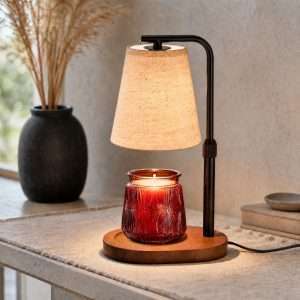
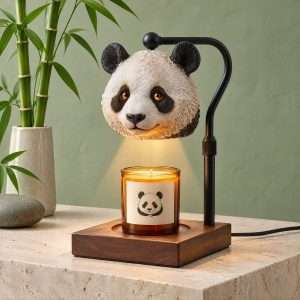
There is one way to keep a jar candle and never light it. An adjustable candle warmer lamp melts the top of the jar with a bulb in the shade above it, so the wick is never lit and there is no open flame in the room.

The lamp does not remove the fragrance. AAFA lists wax warmers next to scented candles as asthma triggers,[11] and a warmed scented jar still scents the room, which is the point of it. The compound-by-compound comparison is on our page about what warming instead of burning changes. If scent is your problem, the fix is less scent, however you heat it.

A burning candle adds combustion gases, fine particles and fragrance to a room. Most measured levels sit below indoor guidance, with some exceptions; we found no study showing candles cause cancer in people; and the harm with national casualty numbers is fire.
The short below opens in a bubble bath, with a row of white jar candles along the tub rim and three more on the windowsill, as a notification from Mom slides in: CANDLES ARE TOXIC!!!!!!!!!! A video call follows, and her mother squints at the screen, pulls the phone close and presses a hand to her chest. In the tub the woman tips her head back and rolls her eyes, then reads from her phone. In a white robe she opens the window; the breeze lifts the curtain over the jars on the sill, and she moves them one by one to the tub rim before tucking the curtain up. In the living room her mother walks in, then leans in close to a warmer lamp with a glass shade glowing over a jar candle. She types on her phone and sends the article to the family; the daughter’s phone lights up and she slides down the sofa.
Frequently asked questions
Five questions the sections above leave open. None of this is medical advice.
Is it bad to burn candles every day?
It has not been shown to be, and we found no study that followed people burning candles daily in real homes for years, so the honest answer is that it depends on the dose. The closest substitute is the forty-year worst-case model in section four, which assumed a full working day of scented candle smoke, five days a week, and still landed near the usual risk threshold rather than far above it. That is a ceiling built for workers, not a household estimate. If a candle is part of every evening, the dose is set by three things you control: how many wicks are lit, how long they burn, and how much fresh air the room gets while they do. In the 2026 modeling, raising the air exchange rate lowered the modeled exposure, and the American Lung Association's general advice is to cut indoor burning first.
Why are candles in the bedroom riskier?
Because the bedroom is where people fall asleep with one still burning. In the National Fire Protection Association's analysis of US home candle fires from 2014 to 2018, candles in the bedroom caused a disproportionate number of fires and fire deaths, and sleep was a factor in 10 percent of the fires, 15 percent of the fire deaths and 22 percent of the injuries. A sleeping person cannot notice a curtain drifting into a flame, a jar burning down to the glass, or a pet knocking the candle over. None of that depends on the wax or the brand, and no label changes it, so blow the candle out before you lie down, every time. If you want a light on in the bedroom overnight, choose one with no flame, and follow the instructions for whatever appliance it is.
How long should you air out a room after burning a candle?
Air it while the candle burns, not only afterwards, because ultrafine particles are highest in the first half hour to hour. In the 2021 chamber study, the initial phase of burning, lasting 30 to 60 minutes, showed significantly increased concentrations of ultrafine particles, while carbon monoxide, carbon dioxide, nitrogen dioxide and formaldehyde were not initially increased. The American Lung Association's general rule for homes is to open doors and windows for 15 minutes each day, and in the 2026 cancer-risk modeling, a higher air exchange rate lowered the modeled exposure. There is no official airing time for candles specifically, so a practical routine is a reasonable reading of those findings: open a door or window when you light it, keep it open through the first hour, and give the room another quarter of an hour once the candle is out.
What should you do if a child swallows candle wax?
Call Poison Help at 1-800-222-1222, which works from anywhere in the United States, and tell them what the candle was and how much seems to be missing. The MedlinePlus medical encyclopedia describes candle wax as nonpoisonous and says recovery is very likely, which is reassuring after a small bite. It also gives two reasons not to ignore it: a large amount swallowed can cause a blockage in the intestines, and the scent and color additives can cause an allergic reaction. The poison center can tell you whether anything more is needed. Keep the candle or its label nearby when you call, since it answers the first questions they will ask.
Are candles more dangerous in winter?
For fire, yes. The National Fire Protection Association reports that December is the peak month for home candle fires, followed closely by January, with 11 percent of incidents in each. Holiday decorations explain part of it: 12 percent of December candle fires began with decorations, against 4 percent in the rest of the year, and almost three times as many candle fires are reported on Christmas as on an average day. For air, winter adds a quieter factor, because windows stay shut. In the cancer-risk modeling discussed in section four, the lowest air exchange rate was the condition that pushed exposure highest. Keep candles well clear of wreaths, garlands and trees, and keep a door or window cracked while one is lit, even on a cold night.

Candle Warmer Lamps
A candle heat lamp works from above. The bulb sits inside the shade, a few inches over your jar, and the warmth of that candle warmer light melts the top layer of wax so the scent fills the room.
Browse candle warmer lampsSold and shipped by GODONLIF — free shipping within the contiguous US. Prices are shown on each product page.
Sources and evidence limits
Each link below was opened before publication.
- Salthammer, T. et al., “Measurement and evaluation of gaseous and particulate emissions from burning scented and unscented candles,” Environment International 155, 106590, 2021 (DOI 10.1016/j.envint.2021.106590). The 24 experiments, compounds, guideline comparison and quoted conclusion; funded by European, US and Latin American candle associations; author affiliations including the European Candle Association and Arylessence. candles.org: 2021 chamber study (Retrieved October 29, 2026).
- American Lung Association, “Source Control,” page dated November 2023. The quoted advice to avoid burning indoors. lung.org: source control (Retrieved October 29, 2026).
- American Lung Association, “Particulate Matter Indoors,” page dated November 2023. Candles as a particle source, the health effects listed and the fifteen-minute advice. lung.org: particulate matter indoors (Retrieved October 29, 2026).
- US Environmental Protection Agency, “Indoor Particulate Matter,” page revised August 2026. Burning candles as a particle source; the quoted sentence on small particles. epa.gov: indoor particulate matter (Retrieved October 29, 2026).
- Laursen, K. R. et al., “Airway and systemic biomarkers of health effects after short-term exposure to indoor ultrafine particles from cooking and candles,” Particle and Fibre Toxicology 20, 26, 2023 (DOI 10.1186/s12989-023-00537-7). Participants, exposure levels and both quoted findings. pmc.ncbi.nlm.nih.gov: candle exposure in mild asthma (Retrieved October 29, 2026).
- Chen, C.-Y.; Shih, C.-L.; Kuo, Y.-C. & Tsai, P.-J., “Emissions of Polycyclic Aromatic Hydrocarbons (PAHs) from the Use of Scented Candles Under Different Environmental Conditions,” Toxics 14(7), 565, 2026 (DOI 10.3390/toxics14070565). Scenario, test conditions, risk values and the ventilation finding. pmc.ncbi.nlm.nih.gov: PAHs from scented candles (Retrieved October 29, 2026).
- Petry, T. et al., “Human health risk evaluation of selected VOC, SVOC and particulate emissions from scented candles,” Regulatory Toxicology and Pharmacology 69(1), 55-70, 2014 (DOI 10.1016/j.yrtph.2014.02.010). The quoted conclusion. hero.epa.gov: scented candle risk evaluation (Retrieved October 29, 2026).
- American Cancer Society, “Benzene and Cancer Risk,” page dated July 2026. The IARC classification of benzene. cancer.org: benzene and cancer risk (Retrieved October 29, 2026).
- MedlinePlus Medical Encyclopedia, US National Library of Medicine, “Candles poisoning,” entry dated October 2025. The nonpoisonous wording, waxes listed, additive reactions and blockage note. medlineplus.gov: candles poisoning (Retrieved October 29, 2026).
- US Environmental Protection Agency, “Volatile Organic Compounds’ Impact on Indoor Air Quality,” page revised June 2026. The quoted health-effect list and the indoor comparison. epa.gov: volatile organic compounds indoors (Retrieved October 29, 2026).
- Asthma and Allergy Foundation of America, “Improving Indoor Air Quality,” medical review October 2024. The quotation on scent and asthma, with wax warmers listed beside scented candles. aafa.org: indoor air quality (Retrieved October 29, 2026).
- Ahrens, M., “Home Candle Fires,” National Fire Protection Association, May 2020. The 2014 to 2018 averages, fires per day, cause shares and the seasonal and sleep figures. nfpa.org: home candle fires report (Retrieved October 29, 2026).
You may also like


