


News
Can a Candle Heat a Room? What One Flame Actually Puts Out, and Why the Clay-Pot Heater Doesn’t Change It

Oct
Heat & Arithmetic
Can a candle heat a room? Not in any way a thermostat would notice. One ordinary jar candle releases roughly 35 to 56 watts of heat, a plug-in heater on its top setting runs at 1,500, and the clay flower pot in the viral videos only changes where those few watts go. This page does the arithmetic from measured numbers, then follows it to the fire and air figures that arrive long before the room gets warm.
Key takeaways
One question here: how much heat a flame adds to a room, counted in watts. How hot the flame itself burns is a different number, and section three keeps the two apart.
- Do candles warm a room? Barely. In 2021, a chamber study measured ordinary 8-ounce jar candles burning 2.89 to 4.57 grams of wax an hour;[1] at the heat per gram NIST measured for candle wax, that is about 35 to 56 watts.[2]
- A plug-in heater is 1,500 watts. Natural Resources Canada puts portable electric heaters at 500 to 1,500 watts,[3] so matching the top setting takes roughly 27 to 43 jar candles. One adult sitting still gives off about 120 watts.[4]
- The clay pot moves heat; it does not make any. Energy is conserved in every process,[5] so a pot over tea lights can only store and re-release the watts the flames already produced.
- The risks arrive first. Over 2020 to 2024, more than half of US home candle fires started when something that could burn sat too close to the flame.[6] Two dozen open flames give that a lot of chances.
Two kinds of people type this question once the nights turn cold. One is looking at the heating bill and wondering whether the candles already on the coffee table could carry part of the load. The other has watched a video of tea lights under an upturned clay pot and wants to know whether it works before building one. Both deserve a number rather than a shrug, and the number exists. Fire researchers have measured how fast candles burn and how much heat each gram of wax releases, and those two measurements are all the answer needs.
01Do Candles Heat a Room? The Watts Behind One Flame
Do candles heat a room? In the strict sense, yes: every gram of wax a flame burns ends up as heat somewhere in the house. In the sense anyone means, no, because the rate is tiny. An ordinary jar candle releases heat at about 35 to 56 watts, which the next section works out from measured burn rates.[1][2] That is less than half of what one adult gives off sitting still, which a university physics text puts at about 120 watts for a 76-kilogram man.[4]
The useful comparison is the room’s side of the ledger. Heater makers size electric heat by floor area, and Ontario’s provincial energy-saving program repeats their rule of thumb: about 10 watts of heating capacity per square foot.[7] A 150-square-foot bedroom on that rule wants roughly 1,500 watts on a cold night. One candle covers about 2 to 4 percent of it. You would not see that on a thermometer across the room, and you would not feel it unless your hands were close to the flame.

02How Much Heat Does a Candle Produce?
How much heat does a candle produce? Take the grams of wax it burns in an hour and multiply by the energy each gram releases. That is the equation fire researchers use for a candle flame, and both halves of it have been measured.
The energy per gram comes from the National Institute of Standards and Technology. In 2005, Hamins, Bundy and Dillon published a characterization of candle flames in the Journal of Fire Protection Engineering. They measured an effective heat of combustion of 43.8 kilojoules per gram for paraffin candle wax, and a near-identical 43.7 on average across eight wax formulations. Their 21-millimeter paraffin taper burned 0.105 grams a minute, which they calculated as a steady heat release of 77 watts, give or take 9.[2]
The burn rate for the candle most people own comes from a jar. In 2021, Salthammer and colleagues at Germany’s Fraunhofer WKI reported in Environment International on single-wick glass jars of about 240 milliliters, roughly 8 fluid ounces, poured in palm, paraffin, soy and stearin with five fragrance families. Averaged over seven-hour burns, the jars consumed between 2.89 and 4.57 grams of wax an hour.[1] It is the same study our page on where candle wax goes relies on, so the two pages agree on the fuel.
Put the halves together and one jar candle releases about 35 to 56 watts. In heating units, Natural Resources Canada’s conversion of one kilowatt-hour to 3,412 British thermal units[3] makes that about 120 to 190 BTU an hour.
| Source of heat | Burn rate or rating | Heat, watts | Heat, BTU per hour |
|---|---|---|---|
| Jar candle, slowest in the 2021 study (stearin)[1] | 2.89 g of wax an hour | 35 | 120 |
| Jar candle, unscented paraffin[1] | 4.43 g an hour | 54 | 184 |
| Jar candle, fastest in the study (paraffin)[1] | 4.57 g an hour | 56 | 190 |
| Paraffin taper, NIST 2005[2] | 0.105 g a minute (6.3 g an hour) | 77 | 263 |
| One adult sitting at rest[4] | Metabolic rate | 120 | 409 |
| Portable electric heater, top setting[3] | Rated power | 1,500 | 5,118 |
Two cautions keep this honest. The 43.8 figure was measured on paraffin, and the jar study also burned soy, palm and stearin; we found no matching measurement for those waxes from a comparable source, so read their watt figures as approximate. And the study’s wicks were chosen to burn at 3.5 to 4.5 grams an hour without visible soot,[1] so the candle on your own table may run a little faster or slower. Neither caveat changes the order of magnitude, and the order of magnitude is the whole answer.
03Why a Very Hot Flame Still Makes a Small Heater
Because temperature and heat are different measurements. Temperature says how hot the flame is, and our page on how hot a candle flame actually gets covers that number; heat output says how much energy leaves it every second. A candle flame is very hot and very small. It burns a few grams of fuel an hour, and a few grams an hour at any temperature comes to a few dozen watts.
Where that energy goes matters as much as how much there is. NIST measured the share of a candle flame’s heat that leaves as radiation at 0.17, plus or minus 0.01.[2] The rest travels in the plume of hot gas rising off the flame, and the same team found that plume was only about 25 millimeters wide at 6 to 8 centimeters above the candle’s base. The energy goes up in a narrow column instead of out across the room.
Run the fastest jar candle through that split and fewer than 10 of its 56 watts travel sideways as radiation. The other 46 or so rise with the hot gas and thin out into the room air, which is why a candle’s warmth is something your hands find near it and a chair across the room never does.
04How Many Candles to Heat a Room? The Count Against One Space Heater
About 27 to 43 jar candles to match one plug-in heater on its top setting, or roughly 20 tapers. Natural Resources Canada’s 2003 guide to electric heating puts portable heaters at 500 to 1,500 watts and treats them as auxiliary or temporary heat.[3] Ontario’s energy-saving program adds that heaters sold as whole-room units are about 1,500 watts because that is as much as a household wall outlet can safely supply.[7] Divide 1,500 by 56 and by 35 and you have the range.
Scale the room and the count scales with it. On the 10-watts-per-square-foot rule,[7] a 300-square-foot living room wants about 3,000 watts, which is 54 to 85 jar candles burning at once. Two people on the sofa, at roughly 120 watts each,[4] are already putting out more than four of the fastest jar candles combined. The textbook that supplies that figure notes that by far the largest share of the energy a body converts goes to thermal energy, which is why a crowded room gets noticeably warmer long before a candlelit one would.[4]
Sources: burn rates from Salthammer et al., Environment International, 2021;[1] heat per gram and the taper from Hamins et al., Journal of Fire Protection Engineering, 2005;[2] resting adult from College Physics 2e, OpenStax, 2022;[4] heater rating from Natural Resources Canada, 2003.[3] Candle watts are our multiplication of two measured quantities, not a direct measurement. Retrieved October 12, 2026.
The rule of thumb is a sizing rule, not a measurement of your room: a drafty room loses more, a well-sealed one less. Halve the heat loss and you halve the count, and it still lands in the dozens.
05How to Heat a Room With a Candle, and What the Clay Pot Actually Changes
How to heat a room with a candle is the question the clay-pot videos answer with a picture, and physics answers it with a sentence: you cannot get more heat out of the wax than the wax contains. A standard university physics text states the law of conservation of energy in one line: total energy “may change in form or be transferred from one system to another, but the total remains the same.”[5] The heat a tea light releases is set by how much wax it burns and the energy in each gram.[2] An upturned pot changes neither.
What the pot does change is where the heat goes and when. Most of a flame’s output rises in that narrow plume;[2] a pot set over it intercepts the plume, soaks the heat into the clay and gives it back from a larger, cooler surface, partly as radiation you can feel at arm’s length and partly after the flames are out. Sit right beside it and that spot can feel warmer than four bare tea lights would. The room receives exactly the same number of watts either way. Generously give each of four tea lights the top figure measured for a full 8-ounce jar, and the pot has about 220 watts to work with, less than a sixth of one plug-in heater.

Four tea lights on a plate
- Heat set by the wax burned each hour
- Flames in plain view on the table
- Most of the heat rises in a narrow plume
- Each flame needs a foot of clear space
The same four under a clay pot
- Exactly the same heat, released more slowly
- A warm clay surface to sit beside
- Open flames hidden under hot ceramic
- Heat under the tea lights can weaken what they stand on
That last line is not hypothetical. On November 30, 2022, a homemade heater of tea lights and terracotta pots failed in a fourth-floor flat in Derby, England, and around 50 other residents were evacuated. The fire service’s investigator reported that “the heat released from the base of the tea lights was enough to weaken the terracotta plates they were placed on, causing the homemade device to collapse and the melted wax to ignite.”[8] The pot adds hot ceramic and a hidden flame to the table and not a single watt to the room, which is why this page judges the rig rather than showing how to build one. Its household cousin, a tea light under a dish of wax, has a recall record of its own, covered in our look at cord-free tea light warmers.
06Will Candles Heat a Room Before Something Else Goes Wrong?
Will candles heat a room if you simply light enough of them? Not before two other numbers catch up with you. The first is fire. The National Fire Protection Association puts US home candle fires at an estimated 5,894 a year over 2020 to 2024, with 63 deaths and 532 injuries a year, and says more than half started when something that could burn was too close to the lit candle.[6] Its own safety sheet asks for at least a foot between a candle and anything that can burn, and names December as the peak month for candle fires.[9] Twenty-seven flames with a foot of empty space around each is not an arrangement most living rooms can hold.
The second is the air. Our page on candles and carbon monoxide ran the emissions arithmetic for a closed bedroom of about 800 cubic feet and found that four to six copies of the highest-emitting candle measured already cross the World Health Organization’s long-term guideline values there, a precautionary line rather than a poisoning level, while holding the level at which a certified alarm must sound would take about 41 of them.[10] That second count sits inside the range it would take to match one heater. Put plainly, long before a room full of candles got warm, it would hold more flames than anyone can watch and more combustion gas than a closed door should keep in.

07What About a Power Cut, When the Heat Goes Off?
A power cut is exactly when people reach for candles, and the fire figures for it are grim. NFPA’s candle safety sheet is blunt: “Have flashlights and battery-powered lighting ready to use during a power outage. Never use candles.”[9] The National Candle Association, citing NFPA, reports that more than 20 percent of candle fires involving fatalities occur during a loss of power, and even the trade body’s own advice on that page is to use a flashlight rather than walk around with a candle.[11]
One thing needs saying because we sell the lamps on this page: a warmer lamp is no help in an outage. It plugs into the wall, so when the power goes it goes dark with everything else, and it never heated the room to begin with. For light, use what NFPA names, a flashlight or battery lantern set out in advance.[9] For heat, use what your heating system, utility and local emergency guidance allow, not a table of candles.
08Do Candles Warm Up a Room? What They Give a Cold Evening Instead
Do candles warm up a room? Not by any measure a thermometer would record, and yet people reach for them on cold nights for a reason worth taking seriously. What a candle gives a winter evening is a point of light and a smell in one corner: the sense that someone is home. That is real, and it is not temperature. Whether warm-colored light at least makes people feel warmer has been tested, and the climate-chamber study cited in our page of warm and cozy bedroom ideas found no meaningful effect, so we claim none here.
Heat and a lit corner are two different jobs. Heat belongs to the heating system and to whatever stops the room losing it; the corner belongs to light and scent, and neither needs a flame. Our page on what the word hearth used to mean draws the same line between heating a house and marking one place in it where people want to sit.
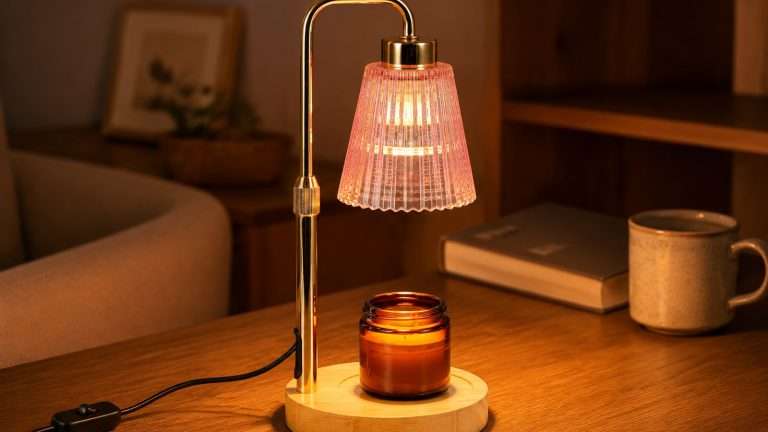
What people are really trying to keep on a cold night is one lit, scented corner near where they sit, and that is the job of the flameless lamps we group as cozy living room decor, none of which heats a room either. In the one pictured below, the bulb inside an amber glass bell melts a shallow pool across the top of an ordinary jar candle, so the scent reaches the corner and the wick is never lit.

09What This Page Cannot Settle
Every watt figure above is our calculation, not a measurement of your candle. The heat per gram was measured on paraffin by NIST;[2] the burn rates come from jar candles individually wicked to burn cleanly in a test chamber, in a study supported by candle trade associations.[1] Bigger wicks burn faster and other waxes may release a little less per gram, which moves the result by tens of percent, not by the factor of thirty it would take to turn a candle into a heater.
The room side is softer still. Ten watts per square foot is a sizing rule of thumb, not a heat-loss survey of a real house.[7] We have not tested a clay-pot rig ourselves, so that section rests on the conservation of energy and NIST’s plume measurements rather than on a test of the device.[5][2] Nothing here is fire-safety or heating advice for a particular home; your local fire service and a heating professional are the people for that.
The short below opens in a living room. He is on the sofa in a knit hat, holding an upturned clay pot over the coffee table next to a small white box, when she lifts the pot away, sets it on the floor and sits down on his lap; then she slips the box into the coffee table drawer. She turns on the oil-filled radiator by the wall, and its indicator light comes on. He turns the pot the right way up, she hands him a potted plant to set inside it, and the pot goes back on the coffee table as a planter. He takes off his hat and hangs it on a hook by the door. Later, a candle warmer lamp is on behind the sofa, its bulb over a jar candle; he walks in, she gestures toward the lamp, and he sits down beside her.
Frequently asked questions
Five questions that come up once the watts are on the table.
How many BTU does a candle produce?
About 120 to 190 BTU an hour for an ordinary 8-ounce jar candle, and roughly 260 for a slim paraffin taper. Over a four-hour evening, one jar candle puts about 480 to 760 BTU into the room in total. A plug-in heater on its top setting delivers around 5,100 BTU every hour, so a whole evening of one candle comes to roughly a tenth to a seventh of what the heater gives in sixty minutes. If a listing or a video quotes a much bigger number for a single candle, ask how it was measured: a flame can only release the energy in the wax it burns, and a candle burns only a few grams an hour.
Do candle heaters work?
Not as heaters. A so-called candle heater, usually tea lights under an upturned clay pot, gives off exactly the heat its flames produce and no more; the pot only stores that heat and hands it back from a larger surface, which can make the spot right beside it feel warmer for a while. The room as a whole gets the same few dozen watts per flame it would have had without the pot, along with hot ceramic and flames hidden from view. Some people also use the phrase for a candle warmer lamp, the kind we sell. That is a different device with a different job: its bulb melts the top of a jar candle so the scent comes out without a flame. It warms the wax, not the room.
Are candles an efficient way to heat a room?
In the narrow sense, yes, and it does not help. A candle has no flue or chimney, so every watt its flame releases stays in the room. The same holds for plug-in heaters: Ontario's Save on Energy program notes that any electric heater is 100% efficient at converting electricity to heat. Efficiency is not where a candle falls short; size is. When two sources each turn all of their fuel into room heat, the only thing left to compare is how much fuel they go through, and a jar candle burns a few grams of wax an hour while a plug-in heater draws up to 1,500 watts from the wall. A perfect conversion of a small input is still a small output, so no amount of efficiency closes a gap measured in dozens of candles.
Is it all right to leave candles burning overnight to take the chill off?
No. NFPA's candle safety sheet says to blow out all candles when you leave the room or go to bed, and to avoid using candles in the bedroom and other areas where people may fall asleep. On the heat side, following that costs almost nothing. A single jar candle adds a few dozen watts, a few percent of what one plug-in heater delivers, so a flame left burning through the night trades an unwatched fire risk for warmth nobody under the covers would notice. If a bedroom is too cold to sleep in, the fix belongs with the heating, the drafts or the bedding, not with a flame on the nightstand.
Would a big pillar candle heat a room better than a jar candle?
A little better, and nowhere near enough to change the answer. A candle's heat output follows the grams of wax it burns each hour, so a bigger flame puts out more. The 2021 jar study notes that a comparable study of pillar candles measured burn rates of 4.7 to 7.1 grams an hour; at the heat per gram NIST measured for candle wax, that works out to roughly 57 to 86 watts. Even at the top of that range, it would take about 17 pillars burning at once to match one plug-in heater. A faster burn also means more combustion gas: the same jar study found carbon dioxide output rose almost in a straight line with burn rate. More flame buys more fumes as well as more watts.

Candle Warmer Lamps
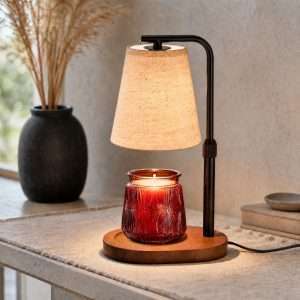
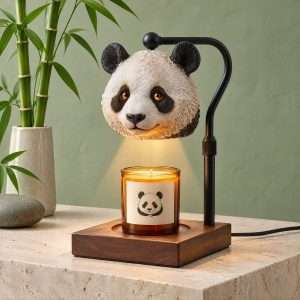
A candle heat lamp works from above. The bulb sits inside the shade, a few inches over your jar, and the warmth of that candle warmer light melts the top layer of wax so the scent fills the room.
Browse candle warmer lampsSold and shipped by GODONLIF — free shipping within the contiguous US. Prices are shown on each product page.
Sources and evidence limits
The heat figures multiply a NIST fire-research measurement by a peer-reviewed chamber study; heater ratings come from Natural Resources Canada and Ontario’s energy-saving program; physiology and physics from an open university textbook; fire statistics and guidance from NFPA, a UK fire service and the National Candle Association. Each link was opened on October 12, 2026.
- Salthammer, T.; Gu, J.; Wientzek, S.; Harrington, R. & Thomann, S., “Measurement and evaluation of gaseous and particulate emissions from burning scented and unscented candles,” Environment International, volume 155, article 106590, 2021. Source for the 240 ml single-wick glass jars, the 2.89 to 4.57 g/h burn rates in Table 3 (4.43 g/h unscented paraffin), the 3.5 to 4.5 g/h soot-free wick target, the 4.7 to 7.1 g/h pillar comparison and the near-linear link between burn rate and carbon dioxide output. Supported by candle trade associations. candles.org: full text (PDF) (Retrieved October 12, 2026).
- Hamins, A.; Bundy, M. & Dillon, S. E., “Characterization of Candle Flames,” Journal of Fire Protection Engineering, volume 15, pages 265-285, November 2005 (DOI 10.1177/1042391505053163), National Institute of Standards and Technology. Source for the heat-release equation, the 43.8 and 43.7 kJ/g heats of combustion, the 0.105 g/min burn and 77 W output of a 21 mm paraffin taper, the 0.17 radiative fraction and the plume width. Tapers, not jars. tsapps.nist.gov: characterization of candle flames (PDF) (Retrieved October 12, 2026).
- Natural Resources Canada, Office of Energy Efficiency, Heating with Electricity, 2003. Source for portable electric heaters at 500 to 1,500 watts as auxiliary or temporary heat, and for one kilowatt-hour equalling 3,412 Btu of heat, the conversion used throughout. natural-resources.canada.ca: heating with electricity (PDF) (Retrieved October 12, 2026).
- Urone, P. P. & Hinrichs, R., College Physics 2e, section 7.8, Table 7.5, OpenStax, 2022. Source for 120 W for a 76 kg male sitting at rest and for most of the body’s energy conversion ending as thermal energy. openstax.org: work, energy, and power in humans (Retrieved October 12, 2026).
- Urone, P. P. & Hinrichs, R., College Physics 2e, section 7.6, “Conservation of Energy,” OpenStax, 2022. Source for the quoted statement of the law. openstax.org: conservation of energy (Retrieved October 12, 2026).
- National Fire Protection Association, “Candles,” statistics for 2020 to 2024. Source for 5,894 home candle fires, 63 deaths and 532 injuries a year, and more than half starting with something that could burn too close. nfpa.org: candles (Retrieved October 12, 2026).
- Independent Electricity System Operator (Ontario), Save on Energy, “Space heater buying guide.” Source for the 10 watts per square foot rule of thumb, for whole-room heaters being about 1,500 watts, the most a household outlet can safely supply, and for the FAQ statement that any electric heater is 100% efficient at converting electricity to heat. A sizing rule, not a heat-loss measurement. saveonenergy.ca: space heater buying guide (Retrieved October 12, 2026).
- Derbyshire Fire & Rescue Service, “Firefighters issue safety warning over viral social media trend after flat fire in Derby,” posted December 6, 2022. Source for the November 30 incident, the evacuation of around 50 residents and the quoted finding. One incident. derbys-fire.gov.uk: tea light and terracotta pot heater fire (Retrieved October 12, 2026).
- National Fire Protection Association, “Candle Safety” tip sheet, 2025. Source for the one-foot clearance, blowing candles out before bed, avoiding candles where people may fall asleep, December as the peak month and the quoted power-outage instruction. nfpa.org: candle safety tip sheet (PDF) (Retrieved October 12, 2026).
- GODONLIF, “Do Candles Release Carbon Monoxide?” Source for the closed-bedroom arithmetic in section six. Our own page, calculated from the 2021 chamber study above; the least authoritative source here. godonlifstore.com: do candles release carbon monoxide (Retrieved October 12, 2026).
- National Candle Association, “Fire Safety Tips to Follow During Power Outages,” 2018. Source for the figure, attributed there to NFPA, that more than 20 percent of candle fires involving fatalities occur during a loss of power, and for the flashlight advice. A trade association page. candles.org: fire safety during power outages (Retrieved October 12, 2026).
You may also like