News
Can You Use a Candle Warmer in a Hotel Room — and Can You Light a Candle in a Hotel Room at All?

Sep
Travel & Rules
Can you light a candle in a hotel room? Almost certainly not — all seven published lodging policies read for this page prohibit open flame, and four of them charge it as a smoking violation. A flameless warmer is a different question with a different answer: usually fine, never guaranteed, and settled in about ten minutes by checking three separate clauses rather than one.
Key takeaways
This page is about permission, not performance. If you want to know what the device is before you argue about whether you may bring one, start with our plain-English guide to what a candle warmer lamp is.
- The flame answer is easy and the warmer answer is not. All seven policies read here prohibit candles or open flame. None of them names a flameless warmer as permitted — not one says yes, and not one says no.[3]
- Four of seven ban by smell, not by fire. The LINE prohibits “essential oils (including diffusers and vaporizers) or any other items or fragrances” under a heading called Noxious Odors — a sentence with no flame in it that still reaches a device with no flame in it.[3]
- Five of seven restrict personal appliances in a separate clause that has nothing to do with candles, usually worded around heating food.[4]
- Enforcement is a charge, not a conversation. Five policies name a figure between $250 and $500, and Great Wolf Lodge charges a minimum $250 for “engaging in any activity that activates the local or property fire alarm” — the alarm itself, regardless of cause.[9]
There is a version of this question you can settle from an armchair and a version you cannot. The first is about fire, and the trade press, the front desk and every message board agree on it. The second is about a small electric lamp that produces no fire at all, and it turns out that almost nobody who writes hotel policy has ever considered it. What follows is seven real lodging policies read line by line, the three separate sentences in them that can catch a warmer, the reason hotel enforcement lands on your card instead of in a conversation, and a way to get a straight answer for the room you have actually booked. The device in all three of those sentences is a small one: a small crystal-and-wood warmer lamp sits on a guest-room nightstand without rearranging it. Whether a given lamp suits a given bedside table is arithmetic rather than luck, set out in our guide to what size lamp a bedside table can take.
01Can You Light a Candle in a Hotel Room, and Can You Use a Warmer Instead?
Can you light a candle in a hotel room? No, in essentially every property that has bothered to publish a rule. Every one of the seven policies quoted below prohibits candles or open flame, and four of them do something more consequential than prohibit it: they file it under smoking, which is where the expensive fees live. theWit, a chain-affiliated boutique hotel in Chicago, lists “candle burning” in the same sentence as cigarettes, hookahs and vape pens, and attaches a $500 cleaning fee to that sentence.[7] The question of whether you can you light candles in a hotel is therefore not really a fire question at the front desk. It is a billing question, and the answer has been standardised across the industry for years.
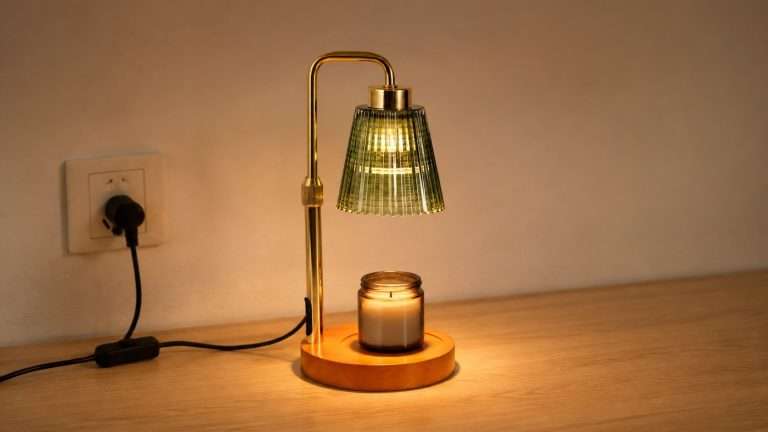
A candle warmer lamp is a genuinely different object, and the difference is mechanical rather than semantic. A 50 W halogen GU10 or MR16 bulb sits above the jar and holds the top layer of wax at roughly 100 to 160 °F (38 to 71 °C), which is enough to release fragrance and nowhere near enough to ignite anything; there is no wick to light and no combustion at any point.[13] So a clause aimed at flame does not reach it. The trouble is that hotel clauses are not all aimed at flame — and the honest summary of our reading is that a warmer usually sits outside the rule, occasionally sits squarely inside it, and is almost never mentioned by name in either direction.

One more thing is worth knowing before you read further, because it explains the shape of the entire internet on this topic. Type the search term candles in hotel room into a search box and the first page is mostly forum threads — a Reddit question, a Quora answer, a message board for theme-park regulars. That is not an accident of ranking. It is what a search engine does when there is a live question and no authoritative document to point at, and it is exactly the situation the next six sections try to fix with published text instead of anecdote.
02What Are Hotel Fire Rules Actually Aimed At?
They are aimed at ignition sources in a building full of sleeping strangers, and the underlying numbers make the reasoning legible. In 2026, the U.S. Fire Administration’s hotel and vacation rental fire safety guidance put the national figure at an estimated 3,900 hotel and motel fires each year, causing 15 deaths, 100 injuries and $100 million in property losses, and named cooking as the leading cause.[1] The agency’s underlying topical report, drawn from National Fire Incident Reporting System data, attributes 46 percent of those fires to cooking, with electrical malfunction and heating at 7 percent each, and records that 73 percent of hotel and motel fires stay confined to the object where they started.[2]
Read those two numbers together and the policy stops looking like fussiness. A hotel is not claiming candles are its biggest fire risk — the evidence says the kitchen is, as it is on almost every campus and in almost every home. What a hotel is doing is removing the one ignition source that is purely decorative, because it cannot stop guests from cooking and it can trivially stop them from burning things. It is worth being straight about a gap here: the USFA report does not break out candles as a separate cause for hotels, and we found no published figure that does, so this page gives you no candle percentage at all rather than borrowing one from residential statistics that describe a different building.
The same agency’s advice to travellers is worth following whatever you decide about fragrance: stay somewhere with hard-wired smoke alarms and sprinklers in each guest room, read the evacuation plan, and find the two closest exits from your room before you unpack anything.[1] If the question on your mind is the earlier one — whether the jar itself can travel with you at all — that belongs to our guide on taking candles on a plane, and this page picks up where it lands.
03One Device, Three Sentences That Can Catch It
A workplace question, as our page on using a candle warmer at the office shows, is usually about which rulebook governs. A hotel question is not: there is only one document, the property’s own published policy, and everything turns on how that single page is worded. Across the seven we read, a warmer can be caught by three quite different sentences, and they live in different paragraphs under different headings. Anyone who searches the page for the word “candle” and stops there will read only the first of them.
The flame sentence is the one everybody expects, and it is the one a warmer does not break. Great Wolf Lodge writes that “Smoking, vaping, burning of candles, incense, or any other open flames is not permitted.”[9] Eden Resort & Suites in Lancaster, Pennsylvania writes that, apart from an in-room fireplace or the outdoor fire pit, “fires or flames (including fireworks and candles) are not permitted anywhere on hotel property.”[8] Both sentences describe combustion. Neither reaches a bulb.
The smell sentence is the one that surprises people, and the one regular travellers on the forums have been describing for years without being able to point at the text. Here is the text. The LINE, which operates hotels in Los Angeles, Washington DC and Austin, puts it under a heading called Noxious Odors: “Any items that cause a strong smell, including but not limited to, candles, incense, essential oils (including diffusers and vaporizers) or any other items or fragrances are strictly prohibited,” with eviction and no refund as the stated consequence.[3] Three further properties share a near-identical line — “Candle, incense, essential oils (diffusing, vaporizing, etc.) are prohibited” — at the Inn at Union Square in San Francisco, at Wilson Lake Inn in Maine, and at Colonial Hotel & Resort.[5][6] A device whose entire purpose is to put fragrance into a room is inside that sentence, flame or no flame.
The appliance sentence is the third and the vaguest. Colonial prohibits “the storage or use of any personal cooking or heating devices, combustibles or fireworks in guest rooms.”[4] Eden lists “coffee maker, hot plate, toaster oven, water heater, rice cooker, grill, burner, heating appliance, iron, or any other item intended for cooking or heating.”[8] Great Wolf reaches furthest, banning “food warming appliances” and then adding “any electrical device that Great Wolf deems unsafe.”[9] Most of this language is anchored to food, which is why a lamp that warms wax sits in a grey area rather than plainly inside or outside. Grey areas are precisely what you ask about rather than guess at.
Campus housing
Of seven published residence-hall policies we read for a companion page, four name a flameless or electric warmer as permitted. The ban is drafted around ignition, so a device with no ignition often falls outside it by design.
Hotels and rentals
Of the seven lodging policies here, none names a flameless warmer either way. Four instead draft the ban around smell, which reaches a device that never lights anything at all.
That contrast is the single most useful thing on this page, and it cuts against the intuition most people arrive with. A student can often resolve this by reading; the method is set out in our companion piece on how campus housing handles the same question. A hotel guest usually cannot, because the document was not written with the device in mind.

04What Do Seven Published Policies Say About Candles in Hotels?
We read seven published lodging policies on the properties’ own pages rather than through aggregator summaries, looking for what they say about candles in hotels and about everything adjacent to a warmer. The spread below is the finding. Treat it as a map of how these documents get drafted, not as a survey: seven is far too small a sample to describe American hospitality, the group was hand-picked to show the range, and any policy page can be rewritten without notice. Anyone asking can you light a candle in a hotel room will find the answer in column two of every single row; anyone asking about a warmer will find it in none of them.
| Property | Candles / open flame | Flameless scent devices | Personal appliances | Stated fee |
|---|---|---|---|---|
| theWit (Chicago) | Candles and incense prohibited; “candle burning” sits inside the smoking prohibition[7] | Not named | Not addressed | $500 cleaning fee |
| The LINE (LA, Washington DC, Austin) | Candles named under “Noxious Odors” | “essential oils (including diffusers and vaporizers) or any other items or fragrances”[3] | Not addressed | Eviction, no refund |
| Colonial Hotel & Resort | “candle burning” listed with smoking | “Candle, incense, essential oils (diffusing, vaporizing, etc.) are prohibited”[4] | “any personal cooking or heating devices” | Fines and eviction |
| The Inn at Union Square (San Francisco) | Open fires and flames prohibited anywhere on hotel property | Same essential-oils sentence[5] | Cooking appliances prohibited; warns against covering lamps or electrical appliances | $250 cleaning fee |
| Wilson Lake Inn (Maine) | Prohibited, treated as a smoking violation | Same essential-oils sentence[6] | Cooking appliances prohibited — full kitchens in studios and suites excepted | $300 restoration fee |
| Eden Resort & Suites (Lancaster, PA) | “fires or flames (including fireworks and candles)” barred property-wide[8] | Not named | Long list ending “any other item intended for cooking or heating” | $250 to $500 |
| Great Wolf Lodge | “burning of candles, incense, or any other open flames is not permitted” | Not named | “food warming appliances” plus “any electrical device that Great Wolf deems unsafe”[9] | $250 minimum |
Our own count across the seven published policies in the table above. A hand-picked sample chosen to show the range of drafting, not a representative survey. Retrieved September 6, 2026.
The bar that is missing from that chart is the one that matters most: zero of seven explicitly permit a flameless warmer. On a campus, reading the handbook frequently ends the argument, because housing offices have thought about these devices and written them down. In lodging, reading the policy usually leaves you exactly where you started, because nobody drafting it had a wax warmer in mind. That is not a reason to give up on documents. It is a reason to plan on asking, which is cheaper and faster here than anywhere else.
05How Do You Get an Answer Before You Pack?
You ask a human, and the reason that works is structural rather than lucky: a hotel is the only place in this family of questions that staffs a desk around the clock. A housing office answers on weekdays and an employer routes you through facilities, but the property you have booked has somebody reachable tonight who can look at the room type you are in. So the method below spends three minutes on documents and then stops looking, rather than reading to the bitter end.
Read the property’s own policy page, not the booking site
Travel-agency listings paraphrase; the hotel’s own policies page is the text that governs. Check the confirmation email too, since some chains attach the house rules to it.
Search three words, not one: candle, flame, appliance
The third one is the clause most people never reach, and it lives in a different paragraph under a different heading. Note any wording about heating devices while you are there.
Then search for a smell clause: odor, fragrance, essential oil, diffuser
If you hit one of these, stop. A smell clause does not care whether anything is lit, so a warmer is inside it and no amount of arguing about flame will move that.
If it is silent, call or message the desk before you pack
Ask about the device, not the category, and give them enough detail to say yes. Silence in a policy is genuinely ambiguous here, not a quiet permission.
Get the yes in writing and keep it until you check out
An email or an app message costs nothing and settles any dispute at the desk on your last morning, which is when hotel disagreements actually happen.
The wording of step four does most of the work, so here is a sentence that has all three clauses built into it:
I’d like to bring a small electric candle warmer lamp — a 50 W bulb above a jar, nothing lit, no flame, and it switches itself off on a 12-hour timer. Is that allowed in the room, and does your policy treat scented items differently from open flame?
That question is specific enough to be answered by whoever picks up, and it asks about fragrance separately from fire, which is the distinction the desk will otherwise collapse. Ask before you buy or pack rather than after, because a device already in your suitcase is a device you will be tempted to argue for. And if the answer is no, take it at face value — a hotel is not a negotiation, and a refusal at reception costs you nothing compared with a charge after checkout. One thing this page deliberately does not settle is how to run a warmer where the outlet situation is awkward; that belongs to our guide to cordless and battery candle warmers.

06Will a Warmer Set Off the Smoke Alarm, the Sprinklers, or the Sensor?
Start with the sprinklers, because that is the fear people actually carry and it is the easiest to dismiss. Sprinkler heads respond to heat and nothing else. In 2026, Cintas described the mechanism plainly: a sprinkler activates when heat raises the temperature at an individual head high enough to trigger a heat-sensitive element, standard-response heads commonly rate between 135 and 165 °F, and typical commercial sprinklers respond only to heat, with smoke and alarm systems unable to trigger them directly.[11] Those degrees are measured in the air at the ceiling, not on your nightstand, and a wax pool sitting at 100 to 160 °F two metres below moves the ceiling temperature by nothing at all.
Guest-room smoke detection is more interesting, because a hotel is wired differently from a house. Writing for Security Info Watch in 2014, fire-alarm engineer Greg Kessinger set out the standard arrangement: activation of a guest-room smoke sensor “shall immediately and automatically sound an alarm … within the room of incident and annunciate at the front desk.”[10] Two consequences follow. Your room alarm does not evacuate the building — that job belongs to corridor detection, which is watching for smoke that has already left your room. And the front-desk annunciation is an owner’s option rather than a code requirement, which is why some properties know instantly and others do not know at all. Where the real cost sits is contractual: Great Wolf charges a minimum $250 and reserves the right to evict for “engaging in any activity that activates the local or property fire alarm.”[9] The alarm going off is the billable event. Whether there was a fire is a separate conversation.
A sprinkler head
Responds to heat and nothing else, at 135 to 165 °F measured in the air at the ceiling. Smoke cannot trigger it and neither can an alarm system. A wax pool two metres below moves that temperature by nothing.
A guest-room smoke alarm
Responds to what combustion puts in the air, and sounds inside your room rather than evacuating the building. Corridor detection is what raises the alarm on the floor, and it watches for smoke that has already left your room.
The In-Room Sensor Nobody Warns You About
There is a newer device in some rooms, and it is the strongest argument on this page for restraint with fragrance. In February 2026 The Points Guy reported on Rest sensors, which detect “the presence of combusted or vaporized substances, including tobacco, marijuana, and vaping products” and appear at properties including The Strat, Kimpton Palladian and Home2 Suites. Guests have been billed $396 to $566 on the strength of an alert, one couple $500, often automatically after checkout with no room inspection; documented false triggers include hairspray used with a curling iron, residue left by a previous guest, and smoking in an adjacent room. A Rest spokesperson told the publication the company “strongly encourage[s] our partners to exercise discretion in enforcement and to be mindful of broader environmental factors and guest context.”[12]
We want to be precise about what that does and does not mean, because it would be easy to overclaim in either direction. Nobody has published a test of whether a wax warmer triggers one of these sensors, and this page is not going to assert one. What is documented is that they read aerosols in the air and have been set off by aerosols that had nothing to do with smoking. The sensible reading is that a heavily scented room is a room where you are relying on a stranger’s discretion, so keep the lamp on a desk or nightstand rather than high on a shelf near the ceiling, run it on a low setting for an hour rather than all evening, and do not leave it going while you are out — the reasoning there is worked through in our piece on leaving a warmer on overnight. Placement in general, in any room you do not own, follows the same logic we set out in where to put a warmer lamp.
07Airbnb and Vacation Rentals: the House Rules Are the Whole Law
On the rental side there is no policy to look up, and that is not an oversight you can work around — it is the design. Airbnb’s safety requirements for homes tell hosts to maintain smoke and carbon monoxide detectors and to state whether they are present; its responsible-hosting guidance for the United States tells them to provide a working fire extinguisher and meet local safety codes; its guest expectations tell you to “review and comply with all standard rules set by the host on the listing page.” Across all three pages, the words candle and open flame do not appear once.[14] The binding text for your stay is the House Rules on that specific listing, written by one person about one property.
Knowing why hosts write what they write makes those rules easier to read. In a 2022 thread on the Airbnb Hosts Forum, the stated reasons were not fire codes at all. One host wrote “Unfortunately my insurance won’t allow an open flame. Please don’t use any candles or other flammable items”; another set “a rule of no open flames in the house or within 6' of the structure outside”; a third framed the whole issue around guests rather than fire, asking visitors to “respect that this is a scent free rental” because “we request nothing scented be used while you are here.”[15] Those are forum posts and not authority, but they explain something the hotel policies also showed: insurance produces flame rules, and guest sensitivity produces smell rules, and a listing can easily have the second without the first.
Message the host inside the platform rather than by text, so the answer lives in the booking record, and give them an easy exit: something like “I’d bring a small flameless wax warmer — happy to skip it if you’d rather I didn’t” gets a yes more often than a demand for a ruling. And be aware that the money works differently here than in a hotel. A hotel charges a published fee; a host files a damage claim, and the recurring wax complaint in host forums is not fire but spillage onto a wooden table, a rug or bedding. Which is why the last thing to get right is the part after you stop using it.
08Before You Check Out, and What We Cannot Promise You
Three habits cover almost everything that goes wrong, and the first is about sequence rather than care. Switch the lamp off the night before you leave, not on the morning you leave: melted wax needs time to return to solid, and a jar that is still liquid when it goes into a suitcase is a leak rather than a candle. Second, protect the surface underneath from the start. The one place a warmer can genuinely mark a room is the ring where the jar meets the furniture, and a saucer or small tray removes that risk entirely — but never improvise with a towel or cloth, since the Inn at Union Square’s policy warns specifically that covering lamps or other electrical appliances can cause overheating and start a fire.[5] Third, do a deliberate sweep of the nightstand and the outlet behind it. A lamp left plugged in beside the bed is the item most likely to stay in the room after you have gone.
Now the limits, because a page about permission that pretends to certainty is worse than useless. The seven policies quoted here bind seven properties and nobody else; several are undated, so any of them may have been revised without a visible signal. We could not read a single corporate-level guest-room candle clause: the one chain-level smoke-free policy we could read does not mention candles at all, and three other major chains’ sites refused automated access entirely, which is why every quotation above comes from an individual property. That also means this page carries no chain-wide fee figures — the amounts circulating online for major brands are ones we could not verify against a first-party page, so we have left them out. Nobody has tested whether a flameless warmer trips an in-room air-quality sensor, and we have not tested it either. The wax temperatures are manufacturer guidance rather than independent measurement, explained further in how hot a candle warmer actually gets. And nothing here is legal advice or a reading of your reservation terms: the only document that governs your room is the one that property publishes today.

The 44-second short below follows the same order this article does. It opens on the half that is already settled: all seven published lodging policies read for this page prohibit candles or open flame, and enforcement is a charge rather than a conversation — five of them name a figure between $250 and $500, and theWit in Chicago lists candle burning in the same sentence as cigarettes, hookahs and vape pens with a $500 cleaning fee attached to it. The short then turns to the half that removing the flame does not settle. Four of seven ban by smell, not by fire, and a device whose entire purpose is to put fragrance into a room is inside that sentence, flame or no flame; five of seven separately restrict personal appliances in a paragraph that never mentions candles at all. It closes on the practical part: which three words to search in a property’s own policy page before you pack, and why any yes is worth having in writing.
Frequently asked questions
These cover the situations the sections above do not reach — the enforcement side, the room types where the rules shift, and the two questions people ask most often once the flame answer disappoints them.
Are candles allowed in hotels if I never light them?
Usually not, and the wording is the reason. Several published policies prohibit candles as objects rather than as fires: theWit lists candles alongside balloons, confetti and rose petals among items simply not permitted in guest rooms, which is a possession rule and not a burning rule. Others reach the same place from the opposite direction, treating anything scented as a smoking violation whether or not it is alight. The practical consequence is that an unlit decorative jar sitting on a nightstand can technically breach the rules at some properties, and that bringing a warmer does not launder that jar into legality where the candle itself is the prohibited item. If the policy names candles as items, ask about the jar separately from the device.
Can you burn a candle in a hotel room if you blow it out before housekeeping arrives?
No, and timing does not help you, because the thing being detected is not the flame. Four of the seven policies read for this page treat a candle as a smoking violation, and smoking violations are assessed on what the room smells like after you leave rather than on what anybody witnessed. That is why the fees are described as cleaning or restoration charges, ranging from $250 to $500 across those policies, and why they are commonly applied after checkout. Soot on the ceiling above a jar, wax on a surface and a lingering fragrance all outlast the flame by hours. Extinguishing a candle early changes the fire risk and changes nothing about the billing.
Will housekeeping report a candle warmer they find in the room?
We have not found a published hotel procedure that answers this, so treat what follows as reasoning rather than a rule. The variable you can actually control is whether the device is running while the room is empty, because an unattended powered appliance reads as a risk at a glance in a way that a switched-off object does not, and the published policies quoted on this page consistently treat unattended heat as the serious category. Two things reduce the chance of a conversation you did not want. Switch the lamp off when you leave the room, since an appliance that is off is furniture and an appliance that is on is a decision somebody has to make. And if you got permission at the desk, say so at check-in so it is on the reservation rather than only in your inbox.
Do the rules change in an extended-stay suite or a room with a kitchenette?
The appliance clause usually relaxes and the scent clause usually does not, which is the distinction worth carrying. Wilson Lake Inn prohibits cooking appliances in guest rooms but excepts the full kitchens in its studios and suites, and that pattern is common across extended-stay formats: once a property has fitted a hob and a microwave, a blanket ban on personal heating devices no longer makes sense. What does not move is the sentence about candles, incense and essential oils, because that clause exists to protect the next guest from a smell rather than to prevent a fire. So a kitchenette is a good sign for the appliance question and no signal at all for the fragrance question.
If the property says no, what flame-free option is least likely to be refused?
Something that adds no fragrance at all, which is an unsatisfying answer but an honest one. The policies that reach a warmer reach it through smell, and a smell clause written as broadly as The LINE's covers diffusers, vaporizers and sprays just as comfortably as it covers a candle, so swapping one scent source for another does not solve a fragrance-based refusal. Flameless LED candles are the reliable exception because they produce light and nothing else. Below that, opening a window and using a sealed sachet in a drawer is genuinely different from filling the air. Nothing on that list matches a warmed jar for scent in a closed room, and it is more useful to know that in advance than to buy three substitutes hoping one behaves like the original.
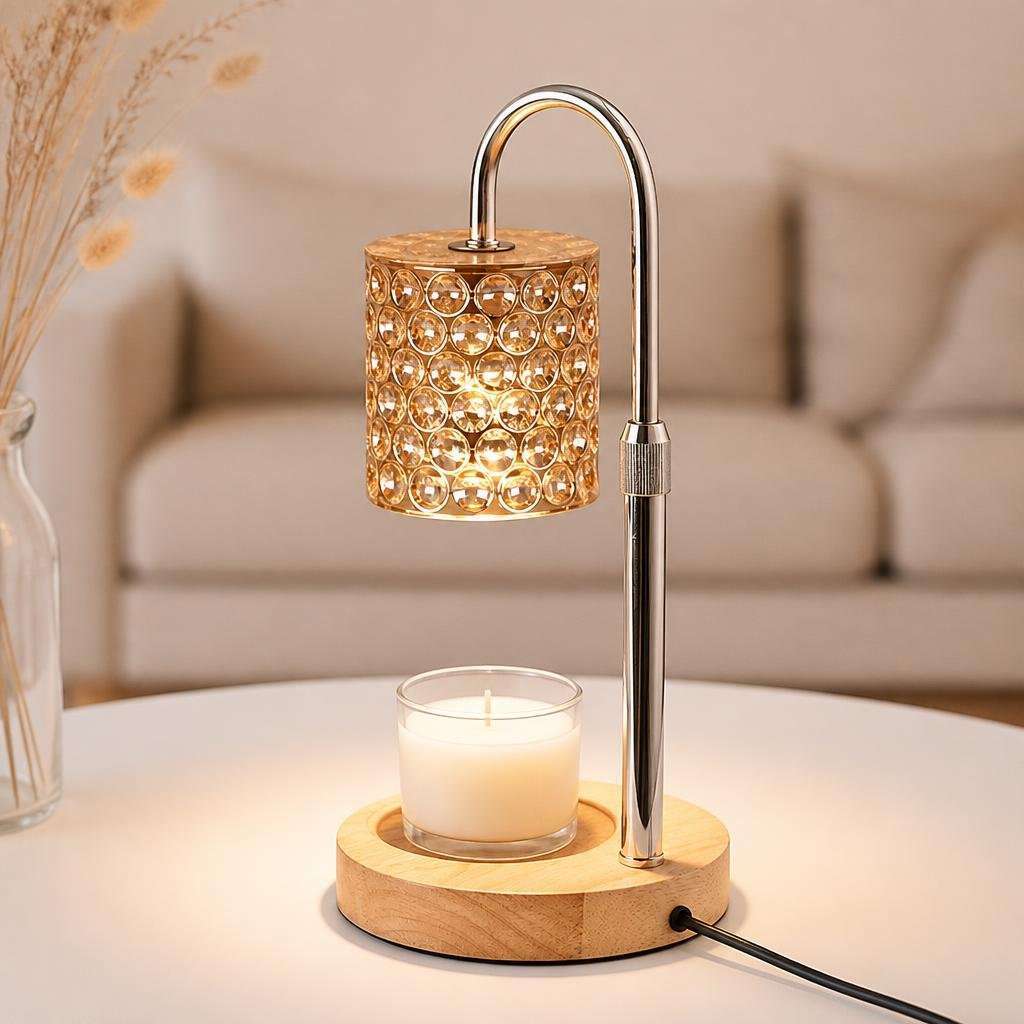
GODONLIF Round Crystal and Wood Small Candle Warmer Lamp
A small candle warmer lamp whose shade is built from rows of round crystals, set on a round natural wood base. Height adjustable, dimmable, and on a timer, and it melts a jar candle with a bulb instead of a wick.
See the small crystal-and-wood lampBrowse all Candle Warmer Lamps →
Sold and shipped by GODONLIF — free shipping within the contiguous US. Price and availability are shown on the product page.
Sources and evidence limits
Fire statistics come from the U.S. Fire Administration; every policy quotation is taken from the property’s own published page rather than a secondary summary; forum posts are labelled as such and carry no authority. Operating temperatures are manufacturer guidance, the least authoritative tier used here. Each link was opened on September 6, 2026.
- U.S. Fire Administration, “Hotel and Vacation Rental Fire Safety” (the 3,900 fires, 15 deaths, 100 injuries and $100 million figures, cooking named the leading cause, and the traveller guidance on alarms, sprinklers and exits). usfa.fema.gov — hotel and vacation rental fire safety (Retrieved September 6, 2026).
- U.S. Fire Administration, “Hotel and Motel Fires,” Topical Fire Report Series, reported by EHS Today (cooking 46 percent, electrical malfunction and heating 7 percent each, 73 percent of fires confined to the object of origin, and no separate breakout for candles). ehstoday.com — USFA hotel and motel fires topical report (Retrieved September 6, 2026).
- The LINE, “Policies & Procedures,” section 11, Noxious Odors (the prohibition on candles, incense, essential oils, diffusers, vaporizers “or any other items or fragrances,” with eviction and no refunds; covering the Los Angeles, Washington DC and Austin properties). thelinehotel.com — policies and procedures (Retrieved September 6, 2026).
- Colonial Hotel & Resort, “Hotel Policy” (the essential-oils prohibition, the smoking clause naming candle burning and diffused plant-based oils, and the ban on “any personal cooking or heating devices” in guest rooms). colonialhotel.com — hotel policy (Retrieved September 6, 2026).
- The Inn at Union Square, San Francisco, “Hotel Policy & House Rules” (the essential-oils prohibition, the property-wide open-flame ban, the cooking-appliance ban, the warning that covering lamps or other electrical appliances can cause overheating, and the $250 cleaning fee). unionsquare.com — hotel policy and house rules (Retrieved September 6, 2026).
- Wilson Lake Inn, Maine, “Policies / House Rules” (the essential-oils prohibition classified as a smoking violation with a $300 restoration fee, and the cooking-appliance ban excepting full kitchens in studios and suites). wilsonlakeinn.com — policies and house rules (Retrieved September 6, 2026).
- theWit, Chicago, “House Policies / House Rules” (candles and incense listed among prohibited items, “candle burning” placed inside the smoking prohibition, and the $500.00 cleaning fee). thewithotel.com — house policies and house rules (Retrieved September 6, 2026).
- Eden Resort & Suites, Lancaster, Pennsylvania, “Policies” (the property-wide ban on fires or flames including candles, the prohibited-appliance list ending “any other item intended for cooking or heating,” and the minimum $250 and $500 fees). edenresort.com — policies (Retrieved September 6, 2026).
- Great Wolf Lodge (Great Lakes Services, LLC), Terms, fire safety section (the open-flame prohibition, the ban on electrical heating appliances including “food warming appliances” and “any electrical device that Great Wolf deems unsafe,” and the minimum $250 charge for activating the fire alarm). greatwolf.com — terms (Retrieved September 6, 2026).
- Greg Kessinger, “Get the most out of hotel and motel smoke and fire annunciation devices,” Security Info Watch, October 2014 (guest-room sensor activation sounding within the room of incident and annunciating at the front desk, that annunciation being an owner option rather than a code requirement, and the Class E circuit classification under NFPA 72). securityinfowatch.com — hotel and motel smoke and fire annunciation (Retrieved September 6, 2026).
- Cintas, “What Causes a Fire Sprinkler to Activate” (activation by heat at an individual head, the 135 to 165 degree standard-response range, and the statement that typical commercial sprinklers respond only to heat). cintas.com — what causes a fire sprinkler to activate (Retrieved September 6, 2026).
- The Points Guy, “These nonsmoking hotel guests got charged smoking fees,” February 2026 (what Rest sensors detect and where they are installed, the $396 to $566 charges applied after checkout without inspection, the documented false triggers, and the Rest statement on enforcement discretion). thepointsguy.com — nonsmoking guests charged smoking fees (Retrieved September 6, 2026).
- GODONLIF, “How Hot Does a Candle Warmer Get?” (halogen bulb wattage and the 100 to 160 °F / 38 to 71 °C wax-pool band, merged there across manufacturer guidance). godonlifstore.com — how hot does a candle warmer get (Retrieved September 6, 2026).
- Airbnb Help Center, “Safety requirements for homes,” “Responsible hosting in the United States” and “What’s expected of guests” (detector and extinguisher requirements, the instruction that guests comply with the host’s listed rules, and the absence of any mention of candles or open flame across all three pages). airbnb.com — safety requirements for homes (Retrieved September 6, 2026).
- Airbnb Hosts Forum, “Do you make rules about candles and other scented products?” thread, 2022 (the three host posts quoted in section 07). Forum opinion from individual hosts, not authority, cited only as evidence of why hosts draft the rules they do. airhostsforum.com — rules about candles and scented products (Retrieved September 6, 2026).
Further reading on this site — background rather than evidence cited above: how warmer lamps became a decor object covers the design side this page ignores, and using a warmer lamp as a night light is the closest thing to a hotel use case we have written.
Evidence limits: the seven lodging policies are the published rules of seven properties read on one day, hand-picked to show the range of drafting rather than to represent the industry, so the chart counts describe this sample and nothing beyond it. Several documents are undated and one property sits outside the United States, so neither currency nor national applicability can be assumed. No corporate-level guest-room candle clause could be read for the major chains — three chain sites refused automated access, and the one chain smoke-free policy we could read does not address candles — so no chain-wide rule or fee is asserted anywhere above. The USFA figures cover fires from all causes and are not a measurement of candle risk; we found no published figure isolating candle-started fires in lodging. No published test exists of whether a flameless warmer triggers an in-room air-quality sensor, and we have not run one. Warmer temperatures are manufacturer guidance, not independent measurement. Nothing here is legal advice, a reading of any reservation contract, or a statement that a particular property permits any particular device.
You may also like