News
Christmas Tree With Candles: What a Real Flame Does to a Drying Tree, and What to Put There Instead

Sep
Seasonal Safety
Can you put real candles on a Christmas tree? Our answer is no: put nothing warm on the tree, not a wax candle in a clip and not a taper in a counterweight holder. A Christmas tree with candles is a real German custom, and it worked under conditions almost nobody reproduces now: a small tree, a short evening, an adult standing beside it. What changed is the tree, which spends three weeks in a heated room losing the water that kept it from burning; in a federal burn test, a dry Douglas fir took the furnished corner around it to peak heat thirty-one seconds after it lit.
Key takeaways
One object, one question: a cut conifer losing water in a heated room, and whether a flame belongs on it. Adjacent ground lives elsewhere — candles around children and animals in our page on candle safety with kids and pets, the mantel across the room in styling a fireplace with candles.
- The tree is fuel, not furniture. A heat source such as a candle or equipment too close to the tree accounted for 26 percent of home Christmas tree fires and 80 percent of the deaths.[2]
- Water is the whole variable. Three attempts to light a watered Douglas fir failed; its dry twin lit first time and took the furnished corner around it to 7,362 kilowatts thirty-one seconds later.[1]
- The danger is back-loaded. Tree fires climb as the season runs on, because the tree dries as it stands.[4] More than a third land in January, after the presents are gone.[2][3]
- Losing the flame does not lose the evening. The low warm point of light and the smell of the room both survive on the table beside the tree, where nothing is fuel and nothing needs watching.
Search this and you get two kinds of page: nostalgic ones with sepia photographs, and craft ones explaining how to clip a taper to a branch. Neither writes down the fact that decides the answer. The object is not a decoration; it is several kilograms of dead conifer drying in the warmest room of the house.
01Christmas Tree With Candles: The Short Answer
Put nothing warm on the tree. Not a wax candle in a clip, not a taper in a counterweight holder, not a lantern balanced on a branch. That is a harder line than the one drawn around most household flames, drawn for a reason that is not carelessness: a cut conifer in a heated room is a fuel whose ignitability changes week by week, so the judgment you make on the first evening does not hold on the twentieth. Every other candle in the house sits next to something flammable. This one sits inside it.
The honest version of the old practice is narrow, and it is what people are picturing. A small tree, freshly cut, lit for a few minutes on one or two evenings, with an adult in the room and water within reach. Reproduce all of that and the risk drops a long way. Reproduce none of it, which is what a modern living room does by default, and you have built the arrangement the statistics are made of.
02The German Christmas Tree With Candles, and the Conditions It Depended On
The custom is genuinely old and genuinely German. Smithsonian Gardens dates the tradition as we know it to sixteenth-century Germany, “when devout Christians began bringing trees into their homes and decorating them,” and calls the attribution of the first lights to Martin Luther “a widely held belief” rather than a documented event.[8] Keep that hedge. The candles are real history; the founding anecdote is folklore.
What is documented is the hardware, and the hardware says what people were worried about. Writing for The Henry Ford in 2013, Saige Jedele notes that early households “used wire to secure thicker candles, ‘glued’ them to the tree with melted wax, or stuck them to branches using tacks or stick pins.” Then come the patents, each fixing one failure: in 1867 the bobeche, a small dish to catch running wax; on Christmas Eve of that year a counterweight holder from New Jersey inventor Charles Kirchhof, hooked over a branch with a weight beneath to keep the candle upright; in 1879 Frederick Arzt’s spring clip.[7]
Read that sequence as an engineering log and it says: the wax ran into the foliage and the candles fell over. Households in 1870 were not relaxed about this. They bought successive generations of hardware, then by the 1930s switched to electric lights anyway[7] — about fifty years after the first US patents for them.[8] Nobody legislated it. People simply preferred not to.
03What Happens to a Cut Tree After Two Weeks in a Heated Room?
It stops being the thing that cannot be lit and gradually becomes the thing that goes up in half a minute. NC State Extension states the starting condition in one line: “A fresh tree is full of water. A fresh tree will not burn even when exposed to a flame or spark.”[6] That is how a tree arrives, if it was handled properly. It is not how it stays.
The mechanism is a water budget with one inflow and one outflow. The inflow is the stand: Penn State Extension specifies a basin providing “1 quart of water per inch of stem diameter,” at least a gallon for most trees, refilled daily because “a cut tree will absorb a surprising amount of water, particularly during the first week.”[5] The outflow is the room, pulling water out through every needle for as long as the tree stands. Penn State’s own remedy is blunt: turn the heating down, since “lowering the room temperature will slow the drying process.”[5]

Neither of the two usual failures feels like negligence. A tree can arrive dry — NC State notes one left in sun or wind can lose “up to half its water in a single day.”[6] Or the stand runs dry for an afternoon, and dry trees “can take a day or two before taking up water” again.[6]
| Where it goes wrong | What is happening | What fixes it | Why it matters here |
|---|---|---|---|
| It dried before it got home | Sun or wind on a lot, with no water[6] | Ask how it was kept; recut the base | It starts at its driest, and drinking restarts slowly[6] |
| The stand is too small | Reservoir empties overnight in week one | A quart per inch of stem diameter[5] | One dry morning can cost days of uptake[6] |
| The level drops below the cut | Uptake stops while water still shows | Read the line against the trunk, daily[5] | The invisible failure: the stand looks wet |
| It stays up into January | Weeks of warm dry air, uptake near zero | An exit date set in the first week | More than a third of tree fires land there[2] |
04What Did Fire Researchers Measure When They Lit One?
The clearest experiment here is a paired one. The National Institute of Standards and Technology took two Douglas firs of about 7 feet (2.1 m), kept one watered and let the other dry, and tried to set fire to both. The watered one had been “placed in a bucket of water within 3 hours of being harvested” after a fresh cut near the base. Three ignition attempts were made, with the source and adjacent fuel varied each time, and the result is flat: “no sustained ignition of the tree was achieved.”[1]
The dry tree lit on the first attempt, and the burning corner reached a peak heat release rate of 7,362 kilowatts thirty-one seconds later, releasing 938 megajoules over the test.[1] That number is the whole corner, not the conifer alone: NIST rebuilt the same mockup for both tests, with an upholstered wing chair, a wood table, a shelf, a carpet and a painting in it, and the hood measured everything burning under it.[1] Seven thousand kilowatts is hard to picture, so anchor it to the clock instead: half a minute after the first flame, a corner of a furnished living room was fully involved.
What the pair rules out is the compromise most people are reaching for: that a real flame is fine if you are careful. The variable with authority here is not attention but moisture, and a household loses control of it gradually and invisibly. A careful person with a tree on day twenty is running a bigger risk than a careless one on day two, and neither can see the difference by looking.
05How Often Do Christmas Trees With Candles Start a Fire?
Rarely, and the rarity is the least interesting part. In its fact sheet covering 2011 to 2015, the National Fire Protection Association counted an annual average of 200 US home structure fires beginning with a Christmas tree, causing 6 deaths, 16 injuries and $14.8 million in damage; candles started 8 percent of them.[2] Its 2020 to 2024 window, reported in January 2026, puts the average at 143 fires a year, with 7 deaths, 13 injuries and $15 million in damage, 35 percent of them in January.[3]
Now the part that changes the reading: these fires are disproportionately lethal. One in every 32 home Christmas tree fires resulted in a death, against one in every 143 reported home fires generally.[2] The US Fire Administration found the same from a different dataset two decades earlier: when a Christmas tree is the first material ignited, “dollar loss per fire is three times higher and fatalities per fire are eight times higher than fires ignited by other materials.”[4]
Source: US Fire Administration, “Residential Structure Fires During the Winter Holiday Season,” figure 2, three-year NFIRS average for 1996–98.[4] An older dataset than the NFPA figures above, quoted for the comparison between ignition types, not the current rate. Retrieved September 26, 2026.
Two further lines from that federal report explain the shape of the season. Tree fires rise as the weeks pass “because trees (and other plant-like decorations) dry out and become more combustible,” and candle fires across the house “increase fourfold during the holiday season.”[4] Those two curves climb together through December, in the same rooms, which is why the association now spends its January publicity asking people to take the tree down rather than be careful with it.[3]
06Clip On Candles for Christmas Tree Branches: What Did the Hardware Actually Fix?
It fixed the two problems it was built for and left the one that matters. The bobeche caught the wax. The counterweight was meant to hold the candle upright when the branch moved. The spring clip was the light, reliable version of the same idea.[7] None of that touches the actual hazard, which is not a drip or a tilt: the flame is inside the fuel from the moment it is lit, with three feet of dry foliage above it acting as a chimney.
There is a second failure no patent addressed. A clip grips a branch, and the branch changes: needles shed, the wood stiffens as it dries, and the load shifts against it. The grip that was firm on the day the tree went up is holding a different object three weeks later, just as the material around it becomes easiest to ignite.
A wax candle in a clip-on holder
- Gives the exact light people are picturing
- An ignition source inside the fuel, by design
- Cannot be left for a minute, let alone an evening
- Grip and drip both change as the branch dries
- Nothing in the fire record supports the arrangement
A battery or LED clip-on light
- No flame, no wax, no heat worth measuring
- Survives a knock, a draft and a cat
- Still wiring and a battery on a drying tree
- Guidance still says switch it off when the tree is unattended[5]
- Produces no scent whatsoever
The caveat that matters is in the right-hand column: swapping wax for a battery removes the flame, not the electrical hazard. Electrical distribution or lighting equipment was involved in 40 percent of home Christmas tree fires, five times the candle share.[2] Penn State allows that LED lights “generate less heat than older types of lighting” while still instructing readers to “always turn the lights off when the tree is unattended.”[5] Cold light wins here as it does for a candle inside a carved pumpkin, by a different mechanism, and the tree keeps a residual risk the pumpkin never had.

07Where Do the Glow and the Smell Belong Instead?
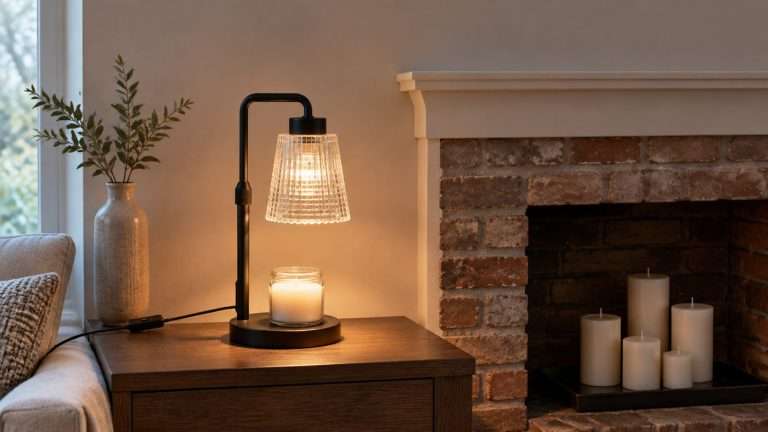
On the flat surface nearest the tree, which in most rooms is already bare: a console, a side table, the end of a bookshelf. A lamp there stands on something that is not fuel, at adult height, near a socket, where a knock moves it sideways rather than into three feet of dry conifer. What people want from the old custom — a low warm point of light at the edge of vision — survives the move. What does not survive is the supervision.

The tree itself then has a short routine, in this order because each step protects the next.
Ask how it was kept, not when it was cut
Sun or wind on the lot without water matters more than the cut date; a dry tree then takes a day or two to start drinking.[6]
Size the stand before you fill it
A quart per inch of stem diameter, at least a gallon. A small basin empties overnight in the thirstiest week.[5]
Read the level against the trunk, not the basin
Water in the stand means nothing if the cut no longer stands in it. Check that line daily.[5]
Give the tree a leaving date
Put it on the calendar in the first week, before the drift sets in.[3]
Keep every heat source on the furniture
Nothing warm clipped, hung or balanced on a branch; candles in sight and out before you leave the room.[9]
The smell is the part people forget to reassign, because on a tree it never came from the flame anyway. A burning wick gives off little but combustion; the scent of a room in December comes from the tree, from cooking, and from whatever jar is open. Move that jar to the same table, warm it from above with a bulb, and the fragrance runs all evening at a strength you set, with nothing to put out. Its temperature band is in our page on how hot a warmer lamp gets, and running one overnight is in our page on leaving a warmer on overnight.
With the branches off limits, the part of the ritual that survives is Christmas candle decor that stands on the furniture and runs on a bulb rather than a wick.

08What This Page Cannot Settle
Three gaps, named rather than buried. The NIST pair is two trees, not a sample: it demonstrates the mechanism and says nothing about how outcomes are spread across the millions of trees in American rooms each December; the furnishings were never weighed, so the tree’s own share of that peak is unknown.[1] The fire statistics count trees as the first material ignited, so the 8 percent candle share is a share of a small number, and nobody publishes how many households still light a tree at all.[2] And the federal report with the sharpest comparison between ignition types rests on incident data from the late 1990s, so read the chart as the shape of the hazard, not the current rate.[4]
Two things are not in dispute. The severity is real whatever the incidence,[1] and the variable that governs it drains away on its own, which is why the water line is worth reading daily.[6] Local fire rules take precedence over anything here.
The short below is the thirty-second version of this page. Section one gives the short answer, and it is a hard line: put nothing warm on the tree. A cut conifer in a heated room is a fuel whose ignitability changes week by week. Section two traces the custom to sixteenth-century Germany and keeps its one hedge: the candles are real history; the founding anecdote is folklore. Section three is what two weeks of central heating does to a cut tree: it stops being the thing that cannot be lit and gradually becomes the thing that goes up in half a minute. Section four is the federal burn test, a watered Douglas fir that three attempts could not light beside a dry twin that lit first time, and its lesson: the variable with authority here is not attention but moisture, and a household loses control of it gradually and invisibly. Section five is how often it happens, which is rarely, and then the part that changes the reading: these fires are disproportionately lethal. Section six asks what the clip-on hardware fixed: it fixed the two problems it was built for and left the one that matters. Swapping wax for a battery removes the flame, not the electrical hazard. Section seven moves the glow and the scent to the flat surface nearest the tree and gives the tree itself a five-step routine; the smell is the part people forget to reassign, because on a tree it never came from the flame anyway. Section eight closes the article on what it cannot settle, two trees rather than a sample and a chart built on incident data from the late 1990s, and on one plain instruction: local fire rules take precedence over anything here.
Frequently asked questions
These answers stay inside what the cited sources establish. What follows is ground the sections above did not need to cover.
Candles on Christmas tree history: how long were the candles actually lit for?
Nobody recorded a standard duration, and the museum record is the closest thing to an answer. The Henry Ford's collection notes say Christmas tree candles were "lit rarely and only for a short amount of time," and give that as the reason painted, decorative holders were an attractive feature: the hardware was looked at far more often unlit than lit. The rest of the hardware points the same way. Counterweighted holders were heavy enough that they "couldn't be hung from small or dry boughs and caused even healthy branches to droop, sometimes sending a lighted candle tumbling into the tree or onto the floor." That is not an arrangement a household left running while the room emptied.
Are real candles on a christmas tree ever safe if an adult stays in the room?
Supervision lowers the chance of a fire starting and does almost nothing about what happens once one does, which is why no US fire authority endorses the arrangement. Attention catches a tipped candle or a child reaching. It does not shorten the interval between a caught needle and a room at full burn, and in the federal burn test the dry specimen took the corner it stood in to peak half a minute after ignition. There is also a detail specific to December that supervision cannot fix: the floor under a tree is usually covered in wrapped paper boxes and a fabric skirt, so the fuel is not only above the flame but underneath it. If you are set on a real flame at all, it belongs on a table across the room rather than anywhere on the branches.
What did a christmas tree lit with candles actually look like, and can you get that look now?
A christmas tree lit with candles was dimmer and sparser than the photographs suggest, because long exposures flatter it. The candles were thin tapers held at the outer tips of branches, where the flame sat clear of the foliage above, so the effect was a loose scatter of small moving points rather than an evenly bright tree. Two things produced the feeling people remember: the light was low in color temperature, and there was not much of it, so the rest of the room stayed dark. Both are reproducible without fire. Use fewer sources than you think you need, keep them warm rather than white, and put them low, at table height or below. A bright tree covered in cool white light is the version that does not feel like the memory.
Is it any safer to put candles on an artificial tree?
No, and it removes the only protective factor a real tree has. A cut conifer can be kept full of water, and a tree full of water is very hard to ignite; an artificial tree has no such dial to turn, so its behavior on day twenty is the same as on day one. The US Consumer Product Safety Commission advises looking for the fire-resistant label when buying one, and that label describes a material that resists ignition and slows flame spread rather than a tree that will not burn. Melting plastic also brings its own problem, since it drips and produces dense smoke in a room people are sitting in. The practical position is the same for both kinds of tree: the branches carry no heat source at all.
How can I tell whether my tree has already dried out?
The check with real evidence behind it is the stand, not the needles: a tree that has stopped drinking has stopped defending itself, and the water line is the one reading that does not depend on judgement. Uptake falling away to nothing is the signal to act on. The hand tests are a second opinion, and they run the opposite way to most people's instinct. NC State Extension describes a very fresh needle as one that snaps cleanly when bent, like a fresh green bean, while a needle that has lost water bends rather than breaks. Interior needles shed even on a moist tree; heavy shedding from the outer growth does not. A tree shedding freely and taking no water is safest outside.
What are the best candles to use on a Christmas tree?
None with a wick: on this page's reading the branches carry no heat source at all, so the useful question is which light goes on the tree and where the candle goes instead. On the tree, a battery or LED clip-on light gives the small point of light without a flame or wax, though it is still wiring and a battery on a drying tree, and Penn State Extension's guidance is to switch tree lights off whenever the room is empty. The candle moves to the nearest flat surface, a console or a side table, where nothing is fuel; warmed from above by a bulb, the jar gives the room its December smell with nothing to put out.

GODONLIF Gold Candle Warmer Lamp with Christmas Bell Shade
A gold candle warmer with a bell for a shade: the bell hangs between two twisted green stems that meet in a leafy loop at the top, tied off with a red-and-green tartan bow, red berries and two small gold jingle bells. It stands on a round gold base with a black foot ring, and the bulb inside the bell melts a jar candle from above with no flame. The dimmer and the timer are both on the cord.
Shop the Christmas bell warmer lampBrowse all Christmas Gift Ideas →
Sold and shipped by GODONLIF — free shipping within the contiguous US. Price and availability are shown on the product page.
Sources and evidence limits
Burn-test figures from a federal standards laboratory; statistics from a national fire association and the federal fire administration; tree care from two university extension services; history from museum and Smithsonian records. Each link opened September 26, 2026.
- National Institute of Standards and Technology, “Dry Tree Fire Hazard,” November 8, 2017 experiments published as NIST Technical Note 2131, December 2020. The paired Douglas firs, the three failed ignitions, and the 7,362 kW peak at 31 seconds for the tree and the furnished room corner it stood in. Two specimens, not a sample. nist.gov — dry tree fire hazard (Retrieved September 26, 2026).
- National Fire Protection Association, “Home Christmas Tree Fires,” research fact sheet dated November 2017 covering 2011–2015, read here as the copy published by the Cosumnes Community Services District. Every NFPA figure above: the annual averages, the 8 percent candle and 40 percent lighting-equipment shares, the 26 and 80 percent heat-source figures, the one-in-32 death rate and the January share. cosumnescsd.gov — NFPA home Christmas tree fires (Retrieved September 26, 2026).
- International Fire and Safety Journal, “NFPA warns home fires risk rises as Christmas trees stay up into January,” January 5, 2026, reporting association figures for 2020–2024: 143 fires, 7 deaths, 13 injuries and $15 million a year, 35 percent of them in January. A trade report of a release, not the underlying data. internationalfireandsafetyjournal.com — NFPA tree fire warning (Retrieved September 26, 2026).
- US Fire Administration, Federal Emergency Management Agency, “Residential Structure Fires During the Winter Holiday Season,” Topical Fire Research Series, volume 3, issue 2, December 2002. The chart (figure 2), the three-times and eight-times comparison, the fourfold holiday rise in candle fires and the drying-season statement. Incident data for 1996–1998. usfa.fema.gov — winter holiday residential fires (Retrieved September 26, 2026).
- Bates, Rick, Cotrone, Vincent and Feather, Sandy, “Tips for Selection and Care of Cut Christmas Trees,” Penn State Extension, page carrying a revision stamp of September 2025. The quart per inch of stem diameter, the one-gallon stand, first-week absorption, the water line against the trunk, the room-temperature effect and the LED guidance. Practice guidance, not a fire test. extension.psu.edu — care of cut Christmas trees (Retrieved September 26, 2026).
- Owen, Jeff and Sidebottom, Jill, “Freshness, Fire Safety and Your Tree,” NC State Extension Christmas Trees portal, page carrying a revision stamp of December 2017. The fresh-tree-will-not-burn statement, the half-its-water-in-a-day figure and the rehydration lag. christmastrees.ces.ncsu.edu — freshness and fire safety (Retrieved September 26, 2026).
- Jedele, Saige, “Candlelit Christmas Trees,” The Henry Ford, December 23, 2013. The early attachment methods, the 1867 bobeche patent, Kirchhof’s counterweight holder, Arzt’s 1879 spring clip and the 1930s switch to electric lights. A museum collections post drawing on patent and object records. thehenryford.org — candlelit Christmas trees (Retrieved September 26, 2026).
- Smithsonian Gardens, “The History of the Christmas Tree,” December 18, 2013. The sixteenth-century German origin, the Martin Luther attribution as a widely held belief, and the 1882 US patents for electric tree lights. An institutional blog post, not a peer-reviewed history. smithsoniangardens.wordpress.com — history of the Christmas tree (Retrieved September 26, 2026).
- US Consumer Product Safety Commission, “CPSC Is Working to Keep Families Safe this Holiday Season,” news release dated November 21, 2022. Watering a live tree, the fire-resistant label on artificial trees, and keeping burning candles in sight and out before leaving the room. Consumer guidance, not incident data. cpsc.gov — holiday season safety (Retrieved September 26, 2026).
Evidence limits are in section eight. Nothing here is a guarantee about any individual tree, or a substitute for what your own fire service tells you.
You may also like