


News
How to Use a Reed Diffuser: How It Works, How Long It Lasts, and When to Flip the Reeds

Oct
Home Fragrance & How-To
How to use a reed diffuser, in one line: open the bottle, stand six to eight reeds in the oil, flip them once after a couple of hours, then flip them again every week or two. Each section below opens with its answer, then shows where the number comes from and what moves it.
Key takeaways
- Start with six to eight reeds. That is a fragrance supplier’s standard starting point, and more reeds means a stronger scent.[1]
- Flip once on day one, then every one to two weeks. Both editors’ guides cited here land on that interval for the routine flip.[2][3]
- No power, no heat, no flame. Capillary action pulls the oil up the reeds, and it evaporates from the ends that sit in the air.[4][1]
- A small bottle runs about two to three months. That is the supplier’s figure for 1 oz with six to eight reeds in an average room; reed count and airflow move it a long way in both directions.[5]
Most people asking how to use a reed diffuser already own the bottle. It arrived as a gift, or it smelled wonderful in the shop, and the card in the box said little more than “insert reeds.” The questions start a day later, when the room smells faint, or a month later, when it smells of nothing. The answers are short and mechanical, so every section below leads with one.
01How Do You Use a Reed Diffuser? Setup in Five Steps
Uncap the bottle, stand six to eight reeds in the oil, flip them after a couple of hours so the soaked ends face up, and give the room up to a day to fill.[1][2] That is the whole reed diffuser how-to: use the bottle as it came, add the reeds, flip once, then wait.
In 2023, the Real Homes guide How to use a reed diffuser put the first flip at “a couple of hours” after the reeds go in and allowed “up to 24-hours” for the fragrance to begin diffusing properly.[2] If the oil came in a separate bottle, one more rule applies to how to use a reed diffuser: oil goes in first, reeds second. After day one, knowing how to work a reed diffuser mostly means leaving it alone; the only routine job is turning the reeds.
Protect the surface
Set the bottle on a tray or a folded paper towel. Spilled oil can leave stains on wood and fabric that are hard to remove.
Open the bottle
Pull the stopper. If the oil came separately, pour it in now, before any reeds go near it.
Stand the reeds and fan them out
Six to eight is the usual start. Spread the tops so air can move between them.
Flip once after a couple of hours
Lift the reeds out and turn them over, so the dry ends sit in the oil and the soaked ends sit in the air.
Wait a day, then flip every week or two
Let the scent build for up to 24 hours before judging it. After that, turn the reeds every one to two weeks.
Steps one and three come straight from the sources: Real Homes warns that oil spilled on wood or fabric “can leave stains” that are hard, sometimes impossible, to remove,[2] and the supplier says to spread the reed tops “allowing air to flow between them.”[5] The count depends on the room:
| Space | Reeds to start with | Where the number comes from |
|---|---|---|
| Powder room or other small space | 1 to 3 | Homes & Gardens guide, 2026[3] |
| Living room, hallway or larger bedroom | 5 or more | Homes & Gardens guide, 2026[3] |
| Any room, as a general start | 6 to 8 | Supplier guidance[1] |
| Very large room, or you like a strong scent | 7 to 10 | Supplier guidance[5] |
How to Set Up a Reed Diffuser the First Day
On day one the reeds start dry, so give them a couple of hours in the oil and then flip them: the dry ends go into the bottle and the soaked ends go into the air.[2] Expect the room to read faint for the first several hours. The reeds are still soaking up oil at this stage, which is why Real Homes allows up to 24 hours.
Two first-day habits cause most later complaints. Reeds jammed together in the neck act like one thick reed, so fan them; and a bottle tucked behind a lamp or a row of books has little air moving past it, which section four deals with. Judge the scent on day two.
How to Flip Reed Diffuser Sticks, and How Often
Lift the reeds out together, turn them over so the dry ends go into the oil, and repeat every one to two weeks, or once the scent has faded noticeably.[2][3] Hold them over a sink or a paper towel while you turn them, because the soaked ends drip.
That is most of how to use reed diffuser sticks well. In 2023, Real Homes described the flip as a “fresh fragrance burst” that also helps stop the reeds “getting clogged with oil.”[2] In 2026, the Homes & Gardens guide The Best Reed Diffusers for Fall and Winter Home Fragrancing said once a week or once a fortnight “is usually more than enough.”[3]
Why not every day? Each flip lifts the most saturated length of reed into the air, which is why the scent jumps right after; by the same logic, a daily flip spends the oil faster. If only a daily flip lets you smell anything, look upstream: the reed count, the spot, or reeds past their best.

02How Does a Reed Diffuser Work? Capillary Action, No Power
By capillary action: each reed is a bundle of fine channels that pulls the oil upward, and the oil evaporates from the length of reed that sits in the air, with no heat, power or flame involved.[4][1]
The US Geological Survey defines capillary action as movement “within the spaces of a porous material due to the forces of adhesion, cohesion, and surface tension,” the same effect that makes water “climb” a paper towel dipped in a glass.[4] A rattan reed is a natural version of that towel. CandleScience, a candle and diffuser supply company, describes rattan drawing the liquid up “through multiple cells that look like tiny straws bunched together.”[1]
Evaporation happens at the exposed reed surface, so more reeds means more scent and a shorter bottle; in the supplier’s words, “a diffuser with lots of reeds will not last as long as a diffuser with fewer reeds.”[5] And the channels can block: in 2023 Real Homes noted that reeds clog “with dust, excess oil, and general grime” after a few weeks.[2] A clogged reed can stop wicking while oil is still left in the bottle.
What Is a Reed Diffuser? Bottle, Oil, Reeds
A reed diffuser is a narrow-necked bottle of scented liquid with porous sticks standing in it, kept capped until use and scenting a room by evaporation alone.[1][6] What is in a reed diffuser is mostly carrier liquid, with fragrance or essential oil blended in.
The carrier exists because, in the supplier’s words, fragrance or essential oil on its own is “too thick to travel up reed sticks alone,” so it is thinned with a base the reeds can pull.[1] Bases differ. One supplier describes its own as “a blend of silicones and organic compounds” and notes that bases built on ethanol or DPG evaporate “much faster and can clog the reeds.”[5] Poison Control, the US poison center service, states in its reed diffuser advisory that some fragrances contain “up to 70 percent isopropyl alcohol,” with essential oils also common.[6] So what is reed diffuser oil, in practice? A fragrance diluted in a carrier, sold as one liquid, and the carrier helps set how fast the bottle empties.
| Part | What it is | What it does | What goes wrong |
|---|---|---|---|
| Bottle | Glass or metal, narrow neck, stoppered until use[1] | Holds the liquid and the reeds upright | Tips over; oil marks wood and fabric[2] |
| Liquid | Fragrance or essential oil thinned in a base[1] | Climbs the reeds, then evaporates | Fast-evaporating bases can clog reeds[5] |
| Reeds | Rattan with straw-like cells, or fiber[1] | Wick the liquid up by capillary action[4] | Clog with dust and oil over weeks[2] |
If you are choosing scents, the same fragrance families that suit a season suit a reed bottle; our page of essential oil blends for fall lists combinations by drop ratio.
03How Long Does a Reed Diffuser Last? Bottle Size, Reed Count, Room
A supplier’s rule of thumb puts a 1 oz bottle with six to eight reeds at about two to three months in an average-sized room, with bottle size and reed count moving that figure either way.[5]
Published figures stretch well past that. The same supplier’s general guidance says reed diffusers throw scent “often up to three months and sometimes as long as six.”[1] The editors’ guides frame the span from the reed side: in 2023 Real Homes advised switching reeds “around every two to three months” to keep the scent steady, and in 2026 Homes & Gardens put ideal reed replacement at “every four to six months.”[2][3] Read together, the numbers say three things you control set a bottle’s life: how many reeds stand in it, how much air moves past it, and how often you flip.
Sources: Real Homes, How to use a reed diffuser, 2023;[2] Homes & Gardens, The Best Reed Diffusers for Fall and Winter Home Fragrancing, 2026;[3] CandleScience, Reed diffusers 101 and How to Make Reed Diffusers.[1][5] Guidance figures, not controlled measurements; your room can land outside every bar. Retrieved October 17, 2026.
How to Make Reed Diffuser Smell Stronger
Add reeds, flip more often, or move the bottle into gentle airflow; the 2026 Homes & Gardens guide names those three, plus keeping the bottle topped up, as the natural ways to boost a reed diffuser’s throw.[3]
Each one trades oil for strength, so try them one at a time. Replacing reeds is the step people skip. The supplier notes that reed sticks “decrease in performance as they dry out,” that a weakening throw means “it’s likely time to replace your reed sticks,” and that sticks which look dry are the same signal.[1] A clogged reed wicks less however often it is turned, so new reeds in old oil often beat another flip. Fiber reeds are the other lever: in that supplier’s testing they clog less, start dispersing sooner and throw more strongly than rattan.[1] If none of this lifts the room, the room is probably bigger than a passive bottle can cover, which is the question in section five.
04Where to Put a Reed Diffuser: Mid-Room, Off the Floor, Out of the Sun
In the center of the room, a few feet off the ground, near gentle airflow, out of direct sunlight and on a stable surface: that is the placement advice in the 2026 Homes & Gardens guide.[3]
Center and height are about reach. In 2023, Real Homes quoted its home fragrance expert: “Make sure you place it in the center of your room for maximum fragrance throw.”[2] Position matters in the laboratory as well. In 2024, Zhang and colleagues reported in Cell Reports Physical Science, after testing a typical reed diffuser in a full-scale chamber, that airflow simulations showed its position “significantly impacts” how the released compounds spread through a room.[7]
The other conditions protect the bottle and whoever shares the room with it. The Homes & Gardens guide steers away from a bedside or dining table, “very close to where you will breathe and eat,” toward a shelf or countertop “away from where it may risk being knocked over.”[3] Knocking over matters most with pets. The Merck Veterinary Manual classes reed diffusers as passive diffusers that release no droplets, so “unless the diffuser is tipped over, the main hazard to animals is respiratory irritation.”[8] Why cats in particular handle some oil compounds poorly is covered on our page about whether wax warmers are safe for cats.

Bathrooms are the classic spot, and the fan and the steam raise their own questions; our bathroom scent page works through what each one actually does to a fragrance. For a plan that rotates methods room by room, so no single spot has to carry the whole home, see how to make your house smell good without lighting anything.
05Reed Diffuser or Candle Warmer Lamp? When Each One Fits
Keep the reed diffuser when you want quiet, steady background scent with no cord and nothing to switch off; it works by evaporation alone, so its ceiling is low by design. In a hallway, a powder room or a rental where you cannot run a cord, that low ceiling is the point.

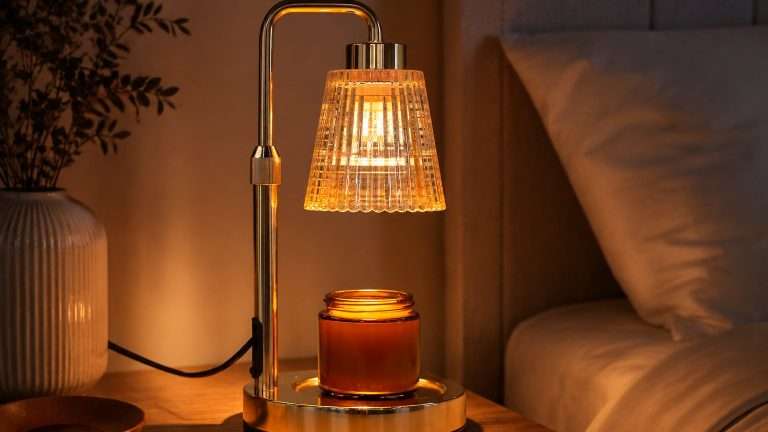
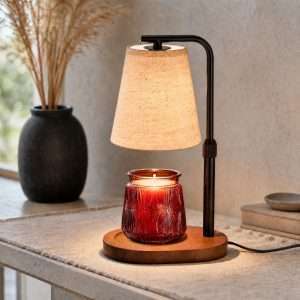
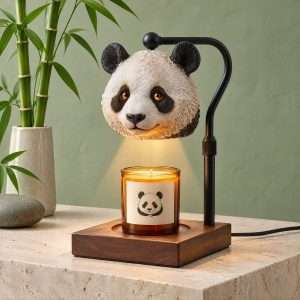
A lamp fits three other wishes: more scent than reeds manage, light to go with it, or a larger room. A warmer lamp melts the top of a jar candle with a bulb overhead, with no flame and the wick left unlit, and the same bulb doubles as a soft light, with a dimmer and timer on some models. If any of those three is why you are reading this, that is the gap our candle warmer lamps were made to fill, using jar candles you may already own. The full side-by-side, including the cases where a diffuser is the better buy, is in our candle warmer vs diffuser comparison.

06What the Number on the Box Cannot Tell You
A label’s lifespan describes one set of conditions: the supplier quoting two to three months for a small bottle adds that it “can vary based on the size of the bottle and the number of reeds used.”[5] Your hallway may differ from their average room, and we found no common standard for how such figures are tested.
Your own nose also adapts. In 2021, Xiao and colleagues reported in The Journal of Physiological Sciences that 68 volunteers breathing a constant odor stopped perceiving it after a median of 377.5 seconds for one test odor by the usual nasal route, a little over six minutes.[9] The study used laboratory odors, but the direction holds: the person who lives with the diffuser is a poor judge of whether it still works.
The third limit is what the scent puts into the air. A passive diffuser still releases compounds: the 2024 chamber study set out to measure a reed diffuser’s effect on indoor air, and at 25°C linalool acetate made up 31.4 to 43.6 percent of the compounds it released.[7] That holds for anything that puts fragrance into a room, a warmer lamp included. One chamber test cannot tell you what that means for your own rooms.
The short version: knowing how to use a reed diffuser comes down to six to eight reeds to start, one flip after a couple of hours, a routine flip every week or two, and a spot in moving air off the floor and out of the sun. Expect two to three months from a small bottle, change the reeds before you blame the oil, and if the room still reads faint after that, a passive bottle may simply be too small for the space.
The short below opens in a kitchen with a butcher-block counter, where a woman with dark curly hair in a cream sweater leans over a glass reed diffuser of amber oil, frowns, pulls the reeds out and holds them over an open steel trash can. A friend in a mustard coat comes in through the front door, breathes in with her eyes closed, then walks up with a paper grocery bag, looking surprised, while the first woman smells the reeds again and stands them back in the bottle. The friend helps her into a camel coat, they head out, and they come back at dusk carrying coffee cups. At the table, while the friend eats bread, she turns the reeds over above a paper towel, then sets the bottle on a small white dish on a wooden table by the front door. A warmer lamp with a cut-glass shade glows on an arched metal stand, throwing light across the wall, and the short ends with the friend bending to smell the reeds by the door before the two of them go out again.
Frequently asked questions
Five questions the sections above leave open.
Do reed diffusers work if you can no longer smell them?
Usually yes, and the quickest check costs nothing. Leave the room for a while, then notice what you smell at the door, or ask someone who has just come in. A fragrance supplier's own guidance puts it bluntly: nose blindness is real, so test a diffuser from different spots and ask family or friends. If a visitor notices the scent, the diffuser is working and your nose has adjusted. If nobody does and there is still liquid in the bottle, the reeds are the likelier culprit, and fresh reeds will usually do more than another flip.
Can you reuse reed diffuser sticks?
With the same oil, for a while; with a new scent, it is better to start fresh. Reeds hold the oil they have soaked up, so old reeds in a new fragrance blend the two, and the Homes & Gardens guide recommends new reeds whenever you refill with a different oil, so they saturate with the new scent. As for how to refill a reed diffuser: the same guide says to wait until the old liquid has fully evaporated and to clean the bottle thoroughly, and Real Homes says to fill it to between half and three quarters full so it does not overflow when the reeds go back in. Then start the reeds exactly as on the first day, including the flip after a couple of hours. One supplier notes that spent reeds can go in the trash, while the leftover liquid should not go down the drain.
Can you put essential oils in a reed diffuser?
Yes, once it is diluted in a diffuser base. The working rule for how to use essential oils in a reed diffuser is to blend the oil into the base before it goes into the bottle, because undiluted oils are too thick for the reeds to pull up on their own. For scale, one supplier's worked example caps the fragrance at 25 percent of the liquid, with base making up the rest, and the limit printed for the specific base you buy is the one to follow. The same supplier warns that going past that limit will likely make the mix separate and may clog the reeds; for a stronger throw, it suggests a few more reeds. Which oils to combine is a separate question; our fall essential oil blends page lists combinations by drop ratio.
Are reed diffusers safe for cats, kids and wooden furniture?
There is no single yes or no, but each of the three comes with a specific risk to plan around. With cats, the question is mostly whether the bottle can be knocked over and the oil licked or groomed off fur; the full answer, including why cats handle some oil compounds poorly, is on our page about whether wax warmers are safe for cats. With children, Poison Control warns that swallowing the liquid can cause vomiting and drowsiness, and that a child who coughs or gags after a sip may have breathed some in, so keep the bottle sealed or well out of reach; the US line is 1-800-222-1222. With furniture, spilled oil can mark wood and fabric for good, so give the bottle a tray.
Can you pause a reed diffuser while you are away?
Yes. Lift the reeds out, lay them on a paper towel or seal them in a bag, and put the stopper back in the bottle; one supplier describes reed diffuser liquid as kept capped until it is ready for use. Expect the room to keep a trace of scent for a while, because the reeds hold oil and go on releasing it after they come out. When you get back, stand the same reeds in again and flip them once, as you did on the first day. If the scent then seems weaker than before, the reeds have probably started to clog or dry out, and a fresh set is the fix.

Candle Warmer Lamps
A candle heat lamp works from above. The bulb sits inside the shade, a few inches over your jar, and the warmth of that candle warmer light melts the top layer of wax so the scent fills the room.
Browse candle warmer lampsSold and shipped by GODONLIF — free shipping within the contiguous US. Prices are shown on each product page.
Sources and evidence limits
The how-to numbers are working guidance from two editors’ guides and a fragrance supplier, not controlled tests; the mechanism, composition, pet and habituation facts come from a federal explainer, a poison center, a veterinary manual and two peer-reviewed studies.
- CandleScience, “Reed diffusers 101: Everything you need to get started with heatless home fragrance,” supplier guidance, undated. Source for the six-to-eight starting count, rattan’s straw-like cells, why oils need a base, the three-to-six-month scent life, signs that reeds need replacing, and fiber versus rattan. Seller guidance, not independent testing. candlescience.com: reed diffusers 101 (Retrieved October 17, 2026).
- Mahoney, B., “How to use a reed diffuser,” Real Homes, April 20, 2023. Source for the first-day timing, the flip interval, clogging, reed replacement, the stain warning and the center-of-room quote. realhomes.com: how to use a reed diffuser (Retrieved October 17, 2026).
- Blackhall, O., “The Best Reed Diffusers for Fall and Winter Home Fragrancing,” Homes & Gardens, revised August 2026. Source for reed counts by space, the flip interval, placement, refills and the ways to boost throw; its product picks are not used. homesandgardens.com: reed diffuser guide (Retrieved October 17, 2026).
- U.S. Geological Survey, Water Science School, “Capillary Action and Water.” Source for the definition and the paper towel example; written about water, the same physics moves a thinned oil up a reed. usgs.gov: capillary action and water (Retrieved October 17, 2026).
- CandleScience, “How to Make Reed Diffusers,” supplier learning page, undated. Source for the 1 oz, two-to-three-month figure and its caveat, reed counts for large rooms, reed spacing, and the note on ethanol and DPG bases; used only for those facts. candlescience.com: reed diffuser guide (Retrieved October 17, 2026).
- Soloway, R. A. G., “Reed diffusers: Household risk,” Poison Control (National Capital Poison Center), undated advisory. Source for the narrow top and the up-to-70-percent isopropyl alcohol figure. poison.org: reed diffusers, household risk (Retrieved October 17, 2026).
- Zhang, X.; He, X.; Zhang, R. et al., “Emissions of volatile organic compounds from reed diffusers in indoor environments,” Cell Reports Physical Science, volume 5, issue 8, article 102142, August 21, 2024 (DOI 10.1016/j.xcrp.2024.102142). Source for the chamber test, the linalool acetate share and the position finding. One diffuser, one chamber. pure.bit.edu.cn: reed diffuser VOC emissions (Retrieved October 17, 2026).
- Benson, K. & Brutlag, A., “Toxicoses From Essential Oils in Animals,” Merck Veterinary Manual, revised March 2025. Source for the passive-diffuser hazard statement. merckvetmanual.com: essential oil toxicoses in animals (Retrieved October 17, 2026).
- Xiao, W. et al., “Differences in olfactory habituation between orthonasal and retronasal pathways,” The Journal of Physiological Sciences, volume 71, article 36, 2021 (DOI 10.1186/s12576-021-00822-0). Source for the 68 volunteers and the 377.5-second median. Laboratory odorants, not a reed diffuser. pmc.ncbi.nlm.nih.gov: olfactory habituation time course (Retrieved October 17, 2026).
Section six lists what this page cannot settle. We do not sell reed diffusers, and no bottle or brand is recommended here.
You may also like