News
Does Incense Relax You? What the Trials Actually Measured, and What You Breathe While It Works

Sep
Ritual & Evidence
Does incense relax you? Partly: breathing a fragrance while sitting still lowers a self-reported anxiety score in small trials, but those trials put a few drops of oil on a napkin and never lit anything, and almost nobody has tested a burning stick on a person. People buy incense sticks for relaxation the way they buy a kettle: as equipment for an evening, not as a treatment. This page answers only whether it works, and leaves whether it harms you to the page that already measured that.
Key takeaways
One question here: does a lit stick do anything for how you feel. What the smoke does to your lungs is a separate question with separate measurements, answered on our page about what incense smoke actually contains.
- The trials people cite did not burn anything. In 2023, a systematic review of eleven randomized trials covering 972 participants found lower anxiety in ten of them, using oil on a patch, a napkin, gauze, a cotton ball, a diffuser or a vaporizer.[1]
- The work that does burn incense runs in animals. A 2022 study exposed mice to agarwood incense smoke nasally, twenty minutes a day for seven days, in a laboratory rig.[2]
- The specialist review says so plainly. Writing about agarwood essential oil in 2022, Chen and colleagues state that “its clinical application is almost non-existent.”[4]
- The clocks are the useful part. In a laboratory test, a constant odor stopped registering in about six minutes,[9] while a stick burns for roughly an hour[8] and an unventilated room can still be carrying the particles a hundred minutes after burnout.[7]
Almost nobody arrives at this question on their first box. They are asking whether two years of lighting one at 9pm has been doing anything, or whether it is a habit with a smell attached. Two years is long enough to feel certain and not long enough to know, because a private routine has no control condition in it. The published work has one, and it points somewhere more specific than yes or no.
01Do Incense Sticks for Relaxation Actually Work?
Partly, and the halves separate cleanly. There is real evidence that breathing a fragrance while sitting still lowers a self-reported anxiety score. There is almost none that a burning stick does, because almost nobody has run that experiment on a person. The literature everyone borrows was built on essential oil delivered without combustion, and the borrowing is where the reasoning breaks.
What survives is smaller but not nothing: a timed cue, a fragrance you like, and a habit of stopping. That is roughly the size of claim the published work can carry. The rest of this page is the arithmetic behind it.

02What Did the Inhalation Trials Actually Put in Front of People?
Oil, on something absorbent, for a few minutes. In 2023, Yoo and Park published a systematic review in Healthcare covering eleven randomized controlled trials and 972 participants, 431 of them in the aromatherapy arm; ten of the eleven reported significantly lower anxiety.[1] The value of that review here is not the result but the methods column.
Read the delivery descriptions in the authors’ own words and the gap is obvious. One trial used “two drops of lavender oil on med patches” where “patients inhaled the oil without skin contact for 3 min.” Another used “2 drops of lavender EO on a napkin to inhale for 20 min at a distance of 20 cm.” A third put “5 drops of lavender EO on a sterile gauze or a cotton ball” and had it “inhaled for 5 min.” The two device arms used a diffuser of distilled water at 30 cm and a vaporizer holding twenty drops.[1] No stick. No coal. No plume. Nothing in any of those rooms was on fire.
That is not a technicality: burning changes the material before it reaches you, and the flame-free side of the comparison is worked through in our piece on what the aromatherapy trials measured. That method also has the better paper trail, which makes the federal verdict on it a ceiling for everything below. The National Center for Complementary and Integrative Health states that “it’s unclear whether aromatherapy with lavender oil has benefits for anxiety, stress, symptoms of depression” or other conditions.[5]
| Study | Who or what was exposed | What was delivered | How long | What it can answer |
|---|---|---|---|---|
| Yoo & Park review, 2023[1] | 972 people | Oil on a patch, napkin, gauze or cotton ball; a diffuser at 30 cm; a vaporizer | 3 to 20 minutes a session | Whether inhaling an oil moves an anxiety score |
| Dong et al., 2022[2] | Twelve mice per group | Agarwood incense smoke, lit and collected in a glass vial, delivered nasally | 20 minutes a day for 7 days | Which metabolites shift in a mouse |
| Višić et al., 2018[7] | An empty unventilated room | Sticks burned, then the air counted | Through burnout and 100 minutes after | What the air does, not how anyone felt |
03Has Anyone Tested a Burning Stick on a Person?
Not in a way that answers this question. The closest published work runs in animals and cell lines, and both of the most-quoted studies get described online as though people were involved.
In 2022, Dong and colleagues published a metabolomics study in Drug Design, Development and Therapy: eight-week-old male C57BL/6J mice, twelve to a group, exposed by nasal inhalation for “20 min at a fixed time (9:00) every morning for 7 days,” with the smoke “prepared by lighting the agarwood and collecting in glass vial.”[2] It is careful work, and it is a mouse in a rig on a schedule.
The older headline is stranger. In 2008, Moussaieff and colleagues reported in The FASEB Journal that incensole acetate, a constituent of Boswellia resin, “is a potent TRPV3 agonist that causes anxiolytic-like and antidepressive-like behavioral effects in wild-type (WT) mice,” effects absent in TRPV3 knockout animals; the molecule also activated the channel in HEK293 cells and cultured keratinocytes.[3] That paper is the origin of a decade of posts announcing that science has found incense psychoactive. It tested one purified molecule, in mice and in dishes. Nobody lit a stick and sat down.
The specialist literature is candid about the gap. Reviewing agarwood essential oil for anxiety, depression and insomnia in 2022, Chen and colleagues write in Molecules that beyond aromatherapy products on the market, “its clinical application is almost non-existent.”[4] We looked for a randomized controlled trial in which people burned incense and had their anxiety measured against a control, and did not find one. If it exists we would rather print it than this paragraph.
04Calming Incense and the Four Clocks That Do Not Line Up
Set the evidence aside and look at the timings, because they contradict each other in a way nobody mentions. You light a stick to buy twenty quiet minutes. Four clocks start at that moment, and none is twenty minutes long.
The first is your nose. In 2021, Xiao and colleagues reported in The Journal of Physiological Sciences that when 68 volunteers rated a constant odor once a minute until they could no longer detect it, the median time to full habituation was 377.5 seconds for one of the two test odorants by the orthonasal route, a little over six minutes.[9] The smell you paid for leaves your awareness about a tenth of the way through the stick, and carries on filling the room for anyone who walks in.
The second is the stick. In the 2024 Environmental Science & Technology study of a California residence, sticks were “allowed to burn through a ∼60 min duration” before the source was removed.[8] The third is the room afterwards. In 2018, Višić and colleagues burned incense in a deliberately unventilated room and reported in Air Quality, Atmosphere & Health that total particle counts ran up to thirty times background and were still elevated 100 minutes after the sticks had gone out.[7] What that does to anyone is the other page’s question; here it is only a duration.

Sources: Xiao et al., The Journal of Physiological Sciences, 2021 (377.5 s median, orthonasal);[9] Yoo & Park, Healthcare, 2023;[1] Ofodile et al., Environmental Science & Technology, 2024;[8] Višić et al., Air Quality, Atmosphere & Health, 2018.[7] Four separate studies in four settings, so read the bars as durations rather than a single controlled comparison; the last is a floor, not an endpoint. Retrieved September 23, 2026.
The fourth clock is the one you care about, and it is the shortest: the sit itself. A lit stick is a poor instrument for that window. It reaches full output after you have stopped noticing it, keeps going after you have stood up, and leaves the room finishing the job without you. That is a scheduling problem and not a safety verdict, and it is fixable without giving up the fragrance.
05Why Does It Feel Like It Works Anyway?
Because most of what you built around the stick is doing the work, and none of it needs a flame. Sitting down is an intervention. So are the fixed hour, the dimmed room, and the small act of preparation that says the working day has closed. In 2018, an analysis of more than twelve thousand participants with diagnosed psychiatric disorders, summarized by the National Center for Complementary and Integrative Health, found that for treating anxiety and depression, mindfulness-based approaches “were better than no treatment at all” and “worked as well as the evidence-based therapies”; the same agency reports that in a 2012 national survey “approximately 92 percent” of people who meditate said they did so “to relax or reduce stress.”[6] Those were structured programs in patients, not an evening in a chair, so the transfer carries the same limit this page applies to everything else: deliberate, timed stopping has at least been studied, which is more than the stick can say.
The fragrance sits on the front of that, and what it does is start the clock. Striking a match is the moment the evening changes category; the smell is how you know the change took. That is a job a scent can genuinely hold, and it is not the job any of these trials were testing. It also explains why nobody else’s recommendation transfers: a resin that says temple to one person says school assembly to another.
Two deductions follow, and both point away from the sale. The same agency that calls the benefit unclear notes that inhaled lavender “may cause headache or coughing,”[5] and its meditation page reports a 2020 review in which “about 8 percent of participants had a negative effect from practicing meditation.”[6] Neither is dramatic. Both are reminders that a calming routine is not automatically a benign one, and if a scented room reliably ends with a tight forehead, that pattern belongs in why a scented room causes headaches, not under a stronger blend.

06Stress Relief Incense: What to Change Before You Change the Scent
Change the timing and the source before you change the fragrance, because those are the variables the evidence speaks to. Most people who search for stress relief incense have already tried four scents and concluded none of them worked, when what failed was a twenty-minute intention delivered by a sixty-minute object. Anyone using incense for stress relief can test this in a week, and the test costs nothing.
What the trials delivered
- A fixed dose, counted in drops
- A session with a defined end
- One variable, measured before and after
- A clinic or a lab, not a living room
- Small samples, and authors who say so
What a lit stick delivers
- A strong fragrance, quickly
- A ritual with a visible beginning
- An output curve you do not control
- An hour of burn for a twenty-minute sit
- A room that carries on after you leave
Time the sit before you time the stick
Write down how long you want: fifteen minutes, twenty, forty. That number is the specification. Everything else is equipment chosen to fit it.
Mark the minute you stop smelling it
Glance at a clock when the fragrance drops out of awareness. If it lands near six minutes you are ordinary, and the rest of the burn is not reaching you.
Run one session with nothing lit
Same chair, same hour, same silence, no source at all. If the sit still lands, the fragrance was labeling the hour and not producing it.
Move the source out of your breathing zone
Put it across the room instead of beside the chair, and change nothing else. Many people find the cue survives the distance and the heaviness does not.
Try a heated source and keep the rest fixed
Warming a scented wax from above releases fragrance with no combustion and stops when told to. If the evening still works, the smoke was never the active part.
People who reach step five ask what else changes. Two things: the character of the scent, and the act of lighting something. A warmed wax does not reproduce the resinous edge of temple incense, and pretending otherwise would be silly. What it does reproduce is fragrance on a schedule you set, with a dimmer for strength and a twelve-hour cut-off. The mechanical comparison with the other flameless option sits in our page on a warmer lamp against a diffuser, and if the instinct is to pour neat oil into the melted wax, what that does to essential oils in a warmer is worth knowing before you try it.
07Is There a Best Incense for Meditation?
No, and the reason is structural. A ranking would need head-to-head trials of several materials in one population, measuring one outcome. That comparison has not been run even for essential oils, where the trial base is far larger, and for burning materials it does not exist. Every list of the best incense for meditation you will find is preference, tradition, or a shop’s stock list wearing a lab coat.
What the literature can say about the traditional materials is narrow and worth knowing. Moussaieff and colleagues open their paper by noting that burning Boswellia resin as incense “has been part of religious and cultural ceremonies for millennia and is believed to contribute to the spiritual exaltation associated with such events,” then go looking for a mechanism in mice.[3] Long use is a reason to investigate something. It is not a result.
So rank what you can observe. Does the fragrance suit the length of your practice, or outlast it by forty minutes. Do relaxing incense sticks from the same box give the same intensity next week, or does the batch wander. Is the room usable afterwards. Those are answerable at home in two weeks, and they beat any list. When that last answer keeps coming back no, the fix is not another fragrance but a source that stops when you do, which is the idea behind our shelf of stress relief gifts for adults. Where the sit happens matters more than what burns during it, and how to set up a corner for it on very little money is sorted by cost in our guide to meditation room ideas on a budget.

08What This Page Cannot Settle, and Where a Clinician Comes In
Three gaps sit under everything above. First, no controlled trial of a burning stick in people was found for this page, so everything said above about the fragrance rests on trials of an oil delivered without fire.[1] Second, the animal work cannot cross the species line: neither the mouse rig nor the isolated molecule reproduces a stick in a living room.[2][3] Third, the review closest to the material says the essential oil’s clinical application is almost non-existent.[4]
A fourth limit concerns the reader, not the literature. None of this is written for stress that has started to run your week; that is a conversation with a clinician. The other exclusion is specific to this format: asthma, or any other airway condition, turns the choice between a burning source and a heated one into a medical question, and the measurements it should start from are on our page about the particles a stick puts in a room.
The short version: the anxiety trials people cite for incense delivered essential oil on a patch, a napkin or a cotton ball, never smoke, and no controlled trial has measured calm in people burning a stick. What holds up is the sit, the fixed hour and a fragrance you like as its marker. A twenty-minute intention delivered by a sixty-minute object is a scheduling problem, and that is the one part of this a reader can fix tonight.
The short below keeps to the order this article does. Section one answers in two halves, and the first half is the one with evidence behind it: there is real evidence that breathing a fragrance while sitting still lowers a self-reported anxiety score. The second half is that almost nobody has run the same experiment with a burning stick. Section two opens the methods column of the trials that evidence rests on — oil on a patch, a napkin, gauze or a cotton ball, or a diffuser, for a few minutes at a time: nothing in any of those rooms was on fire. Section three is the search for the missing experiment, which turns up mice, cell cultures and one purified molecule: we looked for a randomized controlled trial in which people burned incense and had their anxiety measured against a control, and did not find one. Section four sets out the four clocks that start when a stick is lit — your nose, the stick, the room afterwards and the sit itself — and says plainly what the mismatch is: that is a scheduling problem and not a safety verdict, and it is fixable without giving up the fragrance. Section five explains why the evening can still feel different, because most of what you built around the stick is doing the work, and none of it needs a flame. Section six turns that into a one-week test at home in five steps, and starts from the order that matters: change the timing and the source before you change the fragrance, because those are the variables the evidence speaks to. Section seven takes up the meditation question and why no ranking exists: that comparison has not been run even for essential oils, where the trial base is far larger, and for burning materials it does not exist. Section eight closes the article on who this page is not written for: none of this is written for stress that has started to run your week; that is a conversation with a clinician.
Frequently asked questions
Five questions the sections above raise without closing. None of this is medical advice.
Is incense for stress and anxiety any different from burning it just to make a room smell nice?
In what it does to the room, no; in what you should expect from it, yes. The physical event is identical either way, so the difference lives entirely in the intention you attach to it and in how you judge whether it worked. A room-scenting session has an easy pass mark: does the hallway smell better than it did. A session aimed at winding down has a harder one, and most people never set it, which is why the habit drifts for years without ever being evaluated. Give it a pass mark before you light anything. Decide what a good session looks like, how long it lasts, and what you would notice if it stopped happening. Anxiety that does not respond to any of this, or that shapes your week, belongs in a doctor's office and not in a decision about sticks.
Should the stick be lit before the sit starts, or once you have sat down?
Light it as the sit begins, not ten minutes ahead of it. The common instinct is to get the room going first, and that spends the only stretch of the burn you will consciously notice: the median time for a constant odor to stop registering was a little over six minutes in the laboratory work, and that count starts when you first smell it, not when you sit. Light it early and the fragrance has already left your awareness by the time you are settled, which is how a box comes to feel weaker than the first one did. Light it as you sit and the same six minutes fall inside the window you set aside. The fifty-odd minutes of burn after that belong to the room either way.
Would an unlit stick, or the raw resin on its own, do anything?
It will scent a small space faintly, and that is worth knowing because it isolates one variable for free. Unburnt material still releases some fragrance at room temperature, which is why a drawer with a box in it smells of the box. What you lose is the intensity that combustion produces, and what you lose with it is the plume, the ash and the burn clock. Treat it as a cheap experiment rather than a recommendation: keep a stick or a piece of resin in a dish on the table for a week of your usual sessions and see whether the evening still lands. If it does, the fragrance was working as a marker at a very low dose, and everything above that dose was being spent on the room rather than on you.
Do cones and coils behave differently from sticks for this?
Yes, mainly on the clock, which is the variable this page argues matters most. A cone concentrates its material into a shorter, hotter burn, a coil is built to run for hours, and a stick in the one 2024 residential study was allowed to burn through roughly sixty minutes. None of that changes what the research can tell you, because no controlled trial of calm has been run on any of the three formats in people. What it changes is fit. If your sit is twenty minutes, a coil is the worst possible match and a partial stick snuffed at the end of the session is a better one. Choosing a format on burn time rather than on marketing copy is the one selection rule this literature actually supports.
The trials used essential oil, so should I just use the oil instead?
That is the closest you can get to the tested condition, which is a reasonable thing to want, with two caveats. The first is that matching the delivery method does not import the result: those trials were small, ran mostly in clinical settings, and the federal health agency that reviews the field still describes the benefit picture for lavender as unclear. The second is that oil behaves differently depending on where you put it, and several common methods work badly or not at all. A few drops on a cotton pad at a set distance is what the trials did, and it costs almost nothing to replicate. Adding neat oil to something heated is a separate question with its own answer, and it is not the one the trials tested.
Why does incense relax me?
Mostly because of what you have built around it. Sitting down at a fixed hour, in a dimmed room, after a small act of preparation, does most of the work, and none of it needs a flame. The fragrance is the marker: lighting the stick is the moment the evening changes category, and the smell tells you the change took. That is also why nobody else's recommendation transfers: a resin that says temple to one person says school assembly to another.
What incense calms anxiety?
None has been shown to. A ranking would need head-to-head trials of several materials in the same people, and that comparison has not been run even for essential oils; for burning materials, no controlled trial in people was found at all. The anxiety trials people quote used lavender oil without a flame, and the federal health agency still calls the benefit for anxiety unclear. Choose a fragrance by what it means to you, and treat anxiety that has started to run your week as a question for a clinician, not a shop.

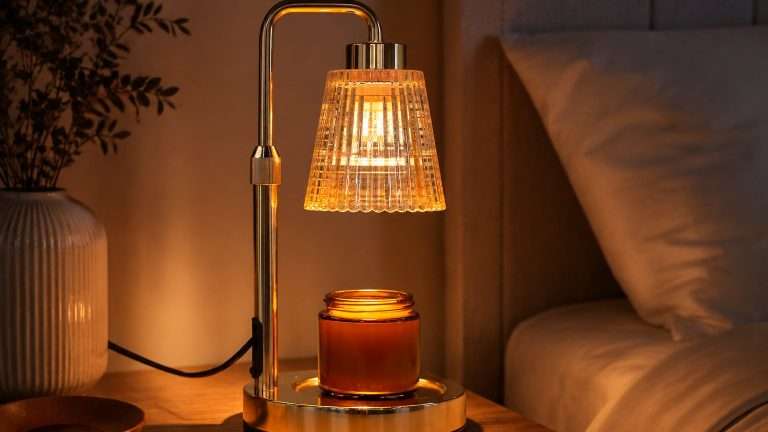
GODONLIF Gold and Wood Dragon Candle Warmer Lamp
Dragon scale glass shade on a gold pole and a solid wood base. Melts jar candles with adjustable brightness and a timer, no flame, and two bulbs come in the box.
Shop the dragon warmer lampSold and shipped by GODONLIF — free shipping within the contiguous US. Price and availability are shown on the product page.
Sources and evidence limits
The efficacy numbers here come from a peer-reviewed systematic review of inhalation trials; the incense-specific findings from two animal studies and a specialist review; the timings from a habituation experiment and two indoor-air studies; agency positions from NCCIH. Each link was opened on September 23, 2026.
- Yoo, O. & Park, S.-A., “Anxiety-Reducing Effects of Lavender Essential Oil Inhalation: A Systematic Review,” Healthcare (Basel), volume 11, issue 22, article 2978, 2023 (DOI 10.3390/healthcare11222978). Source for the eleven trials, 972 participants, the ten-of-eleven result and every quoted delivery method. Inhaled oil, not incense. pmc.ncbi.nlm.nih.gov — lavender inhalation and anxiety (Retrieved September 23, 2026).
- Dong, M. et al., “Discovery of Biomarkers and Potential Mechanisms of Agarwood Incense Smoke Intervention by Untargeted Metabolomics and Network Pharmacology,” Drug Design, Development and Therapy, volume 16, pages 265–278, January 26, 2022 (DOI 10.2147/DDDT.S348028). Source for the mouse strain, the twelve-per-group sample and the quoted exposure protocol and smoke preparation. pmc.ncbi.nlm.nih.gov — agarwood incense smoke in mice (Retrieved September 23, 2026).
- Moussaieff, A. et al., “Incensole acetate, an incense component, elicits psychoactivity by activating TRPV3 channels in the brain,” The FASEB Journal, volume 22, issue 8, pages 3024–3034, 2008 (DOI 10.1096/fj.07-101865). Source for the two quotations and the knockout comparison. One isolated molecule, in mice and cultured cells; nobody inhaled smoke. pmc.ncbi.nlm.nih.gov — incensole acetate and TRPV3 (Retrieved September 23, 2026).
- Chen, X. et al., “Chemical Composition and Potential Properties in Mental Illness (Anxiety, Depression and Insomnia) of Agarwood Essential Oil: A Review,” Molecules, volume 27, issue 14, article 4528, 2022 (DOI 10.3390/molecules27144528). Source for the quoted statement on clinical application. A narrative review, not primary research. pmc.ncbi.nlm.nih.gov — agarwood essential oil and mental illness (Retrieved September 23, 2026).
- National Center for Complementary and Integrative Health (US NIH), “Lavender: Usefulness and Safety,” page carrying a revision stamp of February 2025. Source for the quoted position on benefits and the headache and coughing note. Patient-facing, not primary research. nccih.nih.gov — lavender: usefulness and safety (Retrieved September 23, 2026).
- National Center for Complementary and Integrative Health (US NIH), “Meditation and Mindfulness: Effectiveness and Safety,” page carrying a revision stamp of June 2022. Source for the 92 percent figure, the 2018 analysis of more than twelve thousand participants, and the 8 percent adverse-effect finding from a 2020 review. nccih.nih.gov — meditation and mindfulness (Retrieved September 23, 2026).
- Višić, B.; Kranjc, E.; Pirker, L. et al., “Incense powder and particle emission characteristics during and after burning incense in an unventilated room setting,” Air Quality, Atmosphere & Health, volume 11, pages 649–663, 2018 (DOI 10.1007/s11869-018-0572-6). Source for the up-to-thirty-fold peak and the particles still elevated 100 minutes after burnout. Deliberately unventilated, so it is the worst case rather than a typical room. link.springer.com — incense particle emissions in an unventilated room (Retrieved September 23, 2026).
- Ofodile, J. et al., “Characterizing PM2.5 Emissions and Temporal Evolution of Organic Composition from Incense Burning in a California Residence,” Environmental Science & Technology, volume 58, issue 11, pages 5047–5057, March 4, 2024 (DOI 10.1021/acs.est.3c08904). Source for the quoted sixty-minute burn duration. One residence; its emission figures belong to our air-quality page, not this one. pmc.ncbi.nlm.nih.gov — incense PM2.5 in a California residence (Retrieved September 23, 2026).
- Xiao, W. et al., “Differences in olfactory habituation between orthonasal and retronasal pathways,” The Journal of Physiological Sciences, volume 71, article 36, 2021 (DOI 10.1186/s12576-021-00822-0). Source for the 68 volunteers and the 377.5-second median to complete habituation. Laboratory odorants, not incense. pmc.ncbi.nlm.nih.gov — olfactory habituation time course (Retrieved September 23, 2026).
Section eight lists what this page could not settle. None of it is medical advice, and the air-quality half of the incense question is measured on its own page instead of being re-argued here.
You may also like