






News
What Is a Candle Wick Made Of? Cotton, Paper, Zinc and Wood, and How to Tell Which One Yours Is

Oct
Candle Care & Materials
What is a candle wick made of? In most candles, braided cotton. Some wicks hide a stiff core of paper, cotton or zinc inside the braid so they stay standing in liquid wax, and wood wicks are thin strips of wood. The candle on your table usually shows you which one it has within the first few minutes of a burn, if you know what to look for.
Key takeaways
Three things about the wick: what it is made of, how each kind looks on the flame, and how to look after it.
- Most wicks are braided cotton. In 2005, NIST fire researchers described the wick as a braided or twisted fabric, usually cotton, with the flat braid the most common type; in their test candle it made up less than 0.1 percent of the wax and wick by weight.[1]
- A core is there to hold the wick up. Cored wicks braid around cotton, paper, zinc or tin so the wick stays straight while it burns, according to the National Candle Association.[2]
- The shape on the flame gives it away. A plain cotton braid bends over as it burns, a cored wick stands upright in the pool, and a wood wick burns low and wide with a crackle.[2][8]
- Some tunneling is the wick’s fault, not yours. The association’s first-burn rule is one hour per inch of candle width. If a 3-inch jar gets its 3 hours and the pool still stops short of the glass, the wick is probably too small.[4][3]
Ask what is a candle wick made of while one is burning in front of you, and the wick has already given away most of the answer. A white thread that bends into a hook is doing what it was braided to do. A stalk that stays bolt upright in a deep pool of liquid wax has something stiff inside it. A flat sliver that pops like a log fire is wood. None of these is a defect, and the black ball that can appear on the tip after a long evening is not a fourth kind of wick. The last section covers the one common wick problem that comes from how the candle was made, not from how you burn it.
01What Are Candle Wicks Made Of? The Short Answer
Candle wicks are made of braided, plaited or knitted fiber, and the usual candle wick material is cotton.[1] Some add a core of paper, cotton or zinc inside the braid to keep the wick upright in liquid wax, and wood wicks are thin strips of wood, sometimes layered with cotton or other fiber.[2] The wick is a tiny part of the candle: in the 2005 NIST study it was less than 0.1 percent of the wax and wick together by weight.[1]
So what is a wick, in the candle sense, leaving aside the dictionary and the stock-chart meanings? It is the part that sets how much fuel reaches the flame. The National Candle Association puts the trade-off in two lines: “Different wick sizes allow for different amounts of fuel to be drawn into the flame. Too much fuel and the flame will flare and soot; too little fuel and the flame will sputter out.”[2] The black tip in section five comes from the too-much side, and the tunnel in section six usually from the too-little side.
If the wick in front of you has snapped, drowned or burned down to its metal tab, you have a different problem with different fixes, set out in our guide to what to do when a candle has no wick.
02What Is a Wick Made Of? Cotton, Paper-Core, Zinc-Core and Wood
A wick is one of four things, or a mix of them: plain braided cotton, cotton braided around a paper core, cotton braided around a thin zinc core, or wood. The National Candle Association names cotton, paper, zinc and tin as “the most common core materials,” and wood as a separate family.[2] These are the main types of candle wicks you will meet on a shelf.
Braided cotton is the default. The association describes the flat wick as “usually made from three bundles of fiber” that “curl in the flame for a self-trimming effect,” and the square braid as a rounder, sturdier relative that curls the same way.[2] The taper NIST burned for its 2005 flame measurements carried a flat braid roughly 1 by 2 millimeters across.[1]
Paper core wicks wrap the cotton braid around a thin paper filament. A wick distributor’s catalog says the paper lets the wick “remain rigid in the molten wax pool” and suits slower-burning waxes such as soy, which need extra heat to burn well.[5] Why soy behaves that way comes down to the wax itself, covered in how candle waxes differ.
Zinc core wicks run a fine filament of zinc up the middle of a cotton braid. The same distributor calls the zinc core wick “the most rigid of all cored wick,” notes “its cool flame profile” and its “ability to remain upright in the molten wax pool,” and lists it for tealights, votives, pillars and container candles.[5] Metal cores also carry the one piece of law in this article. Since October 15, 2003, US rules have banned metal-cored candlewicks containing lead (16 CFR §1500.17(a)(13)),[6] and the US rule on lead-core wicks is explained on our label-reading page.
Wood wicks come in more forms than the name suggests. The association describes single-ply, multi-layered, curved and decorative shapes “made from 100% wood, semi-wood, fibrous material or cotton and wood combinations,” popular for their look and “the soft crackling sound they create.”[2] A candle-making supplier’s 2026 guide describes the basic version as a flat strip of wood that replaces the cotton wick of a standard jar candle.[8]

| Wick | Made of | What you see on the flame | Where you usually find it |
|---|---|---|---|
| Braided cotton (flat or square)[2] | Plaited or knitted cotton fiber, a flat braid usually in three bundles | The top bends over into a hook; on a flat braid the curl trims itself | The most common wick of all; NIST’s test taper used a flat braid[1] |
| Paper core[5] | Cotton braid around a thin paper filament | Stays fairly straight in the pool | Votives, pillars and containers, often with soy |
| Zinc core[5] | Cotton braid around a fine zinc filament | Stands upright even in a deep, liquid pool; what the supplier calls a cool flame profile | Tealights, votives, pillars and containers |
| Wood[8] | A flat strip of wood, or wood layered with cotton or fiber | A low, wide flame and a soft crackle | Jar candles, in place of a cotton wick |
What the table cannot tell you is which core a given candle uses, since labels rarely say. The next section reads the wick off the flame instead.
03How to Tell Which Wick Your Candle Has
Light it and watch the first few minutes. A wick that bends over into a hook is plain braided cotton, and the bend is designed in. A wick still standing straight once the pool is liquid has a core inside the braid. A flat strip that crackles and burns with a wide flame is wood.
The bend is the clever part of a cotton wick. Flat and square braids are both made to curl in the flame, and the trade association describes the flat braid’s curl as self-trimming:[2] the tip leans out of the flame’s center and burns off instead of piling up. NIST researchers saw that geometry while measuring a taper in 2005: the wick was curved, the flame tip was not directly over the center of the candle, and more heat reached the side the wick pointed toward.[1] A cored wick gives that up for stiffness. The National Candle Association says the core is there “to keep the wick straight or upright while burning.”[2] Telling paper from zinc by eye is harder, and for most owners it does not matter: something inside is holding the wick up, and the care is the same.
Look before you light it
A flat, thin strip of wood standing in a small metal clip is a wood wick, and you can stop here.
Light it and watch the first few minutes
If the top of a thread-like wick bends over into a hook as the flame settles, it is plain braided cotton doing what it was made to do.
Wait until the pool is liquid
A wick still standing straight in a deep, fully melted pool has a core of paper, cotton or zinc inside the braid.
Check the tip after a few hours
A black ball on the end is carbon, not a fourth kind of wick; section five explains it.
One end of a wick sits in liquid wax and the other in the flame. The National Candle Association describes the trip between them: the flame melts the wax nearest the wick, the liquid travels up the braid, and the heat “vaporizes the liquid wax (turns it into a hot gas)” before it burns.[7] The chart puts numbers on that trip for paraffin, the most common candle wax.[1] Where the wax ends up afterwards is told in where the burned wax goes.
Sources: Hamins, Bundy & Dillon, Journal of Fire Protection Engineering, 2005, Table 1 (literature ranges for paraffin candle wax);[1] National Candle Association, “Candle Science” (outer edge of the flame about 1,400 °C).[7] Ranges compiled from several references, not one measured candle. Retrieved October 14, 2026.
04Wood Wick vs Cotton Wick: The Crackle, the Flame and the Care
The difference you notice first is sound and shape. A wood wick crackles and burns with a low, wide flame; a cotton wick is quiet and burns as a narrow upright teardrop with a curl at the top. One supplier’s 2026 guide sums up the wood version as “a flat strip of wood that burns with a low, wide flame and a quiet crackle.”[8] The care differs too, because only one of the two trims itself.
The crackle is ordinary wood physics at a small scale. Writing for The Conversation in 2019, Western Sydney University researcher Rachael Nolan explained that wood holds water and sap in tiny vessels; heat turns them to steam and gas, and the trapped pockets burst open one by one, “making a mini explosion!”[9] She was writing about firewood, but a wick strip is wood too.
Wood wick
- A soft, irregular crackle
- A low, wide flame that looks like a small hearth
- Does not curl, so the charred end stays until you remove it
- Sensitive to trim height: too long and it floods
- Sized for paraffin, may not burn the same in soy
Cotton wick
- Quiet
- A flat braid curls and trims its own tip as it burns
- Forgiving about small differences in trim
- A narrow flame with no sound or show
- Can mushroom on long burns, like any wick
Care is where they part ways. A flat cotton braid burns off its own tip, so most of its upkeep is the general routine in the next section. A wood wick does not curl, so the blackened end has to come off before you relight. The same 2026 guide is specific about why trim height matters: “A wood wick drowns if it’s too long (trim to about a quarter inch, shorter if it still struggles) and starves if it’s undersized for the jar or the wax is overloaded with fragrance.”[8]
Wood wicks also ask more of the candle maker. The same guide warns that “a wood wick sized for paraffin may not perform the same in soy or soy blends,” which “often require additional testing to achieve a full, even melt pool.”[8]
05Candle Wick Mushrooming: Why a Black Tip Forms After a Few Hours
A black ball on the tip of a wick is carbon, and it usually means the candle has burned longer than the wick can keep up with, not that the wick is broken. In its 2018 burning guide, the National Candle Association says that “burning a candle for too long will cause carbon to collect on the wick, leading it to ‘mushroom,'” and warns that the wick “will then become unstable and produce a dangerously large flame.”[4]
Why do candle wicks mushroom at all? A candle-making supplier’s 2026 wick guide puts it in terms of fuel: a carbon ball “builds on the wick tip when the wick is feeding more fuel than the flame can fully burn,” and it lists three usual causes, a candle left burning too long, a wick that is too large, or a heavy load of fragrance and dye.[3] The material plays a part as well. The same supplier’s FAQ says that “all wicks will produce carbon when they are burning; some more than others,” and that zinc wicks “usually produce more of this” than its cleaner-burning braids.[10] A mushroom on a zinc-core wick late in an evening is closer to normal wear than to a fault.

The fix is a burn schedule. The association asks that candles “do not burn for longer than four hours and cool for at least two hours before relighting,” and that the wick be trimmed to a quarter inch before each light, which takes the carbon cap off with it.[4] If a new candle mushrooms well inside four hours on its first evenings, the wick is probably oversized for that wax and jar, and that size was chosen by the maker, not by you.
The bigger flame a mushroom produces is also one route to the dark smudge that can appear above a candle: too much fuel makes a flame “flare and soot,” in the association’s phrase.[2] Cleaning that up, and stopping it, is covered in our guide to keeping candle soot off the walls.
06Tunneling That Isn’t Your Fault: When the Wick Is Too Small
Use the first burn as a test. The National Candle Association’s rule is that candles “should burn one hour for every 1 inch in diameter,” so a 3-inch jar gets about 3 hours on its first light, inside the association’s four-hour limit.[4] If you gave it the full time and the melted pool still stopped short of the glass, the wick is very likely too small for the jar. That is a sizing decision made where the candle was poured, not a mistake you made.
Supplier troubleshooting tables cover the same ground from the maker’s side. One 2026 wick guide gives two causes for “a ring of unmelted wax against the glass”: “wick too small for the vessel, or a short first burn.” If you already gave the first burn its full time, that leaves the wick, and the guide’s fix for makers is to “size the wick up one step.”[3] You cannot do that to a finished candle. And the association’s warning about what follows applies however the ring formed: “Once a candle has a ‘memory ring,’ it will continue to tunnel for the life of the candle.”[4]
Start with the free fix, and expect it to be partial. The same guide suggests wrapping the jar in foil “to reflect heat down onto the wax ring.”[3] That means a lit candle with foil around warm glass, so stay with it while it burns. It recovers the ring for a session. It does not make the wick any bigger, so a jar that tunneled because of its wick will tend to start again, and the foil becomes a regular chore. The step-by-step version, alongside a hair-dryer method, is in how to fix a tunneling candle.
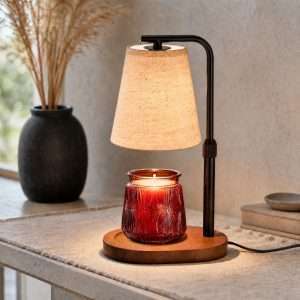
The other route stops asking the wick to reach the glass at all. An electric warmer lamp hangs a bulb over the open jar and melts the wax from the top down, so the surface softens all the way to the glass with the wick left unlit.

That does not repair anything. The wick stays the size it always was, so if you go back to lighting that candle the tunnel will start again, and a lamp gives you no flame to watch. What it does is use the wax a small wick could never reach.

The short below opens from above on a glass jar candle with a deep hole melted down its middle and a thick wall of wax left against the glass, while a hand flips a coin beside it. In a living room, he leans over her as she laughs on the sofa, then picks the jar up off the coffee table and puts it back. In a close-up, a hand sets the jar on the walnut base of a candle warmer lamp with a fluted clear glass shade, its wick dark. The two of them walk off arm in arm, laughing. With the lamp switched on, the bulb glows inside the shade above the jar, and that evening, with the lamp glowing on the sideboard, she sits with a mug while he stands beside her.
Frequently asked questions
Five questions the sections above leave open.
Why does my candle wick keep burning out?
Usually because the flame is getting too little fuel, and when it goes out tells you why. The National Candle Association's rule of thumb is that with too little fuel the flame will sputter out. A wick that dies within the first minute or two may simply have been trimmed too short, or was buried as the last burn cooled; the association's trim length is a quarter inch, so aim for that at the next trim. One that lights well and then fades as the pool spreads is drowning, with the liquid wax flooding the flame, and candle suppliers' troubleshooting tables put that down to a wick too small for the jar. The first is a trimming habit you can change. The second is built into the candle, and no amount of relighting will make that wick any larger.
Is a 1-wick or 3-wick candle better?
Neither is better in general; the right number depends on how wide the jar is. A single wick can only melt so far toward the glass, and one candle-making supplier puts the practical limit at roughly four inches across: past that, one wick often cannot pull a full pool to the edge, and making it big enough to try makes the flame too tall. The same supplier tells makers who switch to several wicks to drop each one a size so the container does not get too hot. So a narrow jar with one wick and a wide jar with three can both be well made. What to look out for is a mismatch, such as a single wick in a wide jar, which tends to leave a ring of wax on the glass however carefully you burn it.
Are wood wicks worth it?
Yes, if the crackle and the low, hearth-like glow are what you light a candle for; no, if you want one you can light and forget. For the first kind of evening, a wood wick gives you something a cotton braid cannot, and the minute spent at each relight becomes part of the ritual. For the second, it is the wrong pick: the burnt tip needs breaking off every time, and a strip trimmed too long, or too narrow for its jar, shows it quickly, by flooding or by struggling to stay lit. A sensible way to find out is to try one small wood-wick jar before committing to a large one, so you learn whether the routine suits you with little at stake. Either way, a wood wick is a different experience from a cotton one, not an upgrade on it.
Does a bigger wick make a candle smell stronger?
Not reliably, and past a point it works against you. A bigger wick draws more fuel, which means a larger flame and a faster burn, but the National Candle Association is blunt about the top end: with too much fuel the flame will flare and soot. Candle suppliers also list an oversized wick among the usual causes of a carbon mushroom on the tip. How strongly a candle scents a space depends on more than flame size, the fragrance in the wax among other things, and a wick that already melts the pool to the glass has done its part. A bigger wick is a decision for the maker, not something to improvise at home.
What is the metal tab at the bottom of a candle wick for?
It holds the wick in place and decides where the burn stops. One candle-making supplier's FAQ tells makers to stick the tab to the bottom of the container so the wick does not move around when the wax is poured, and to hold the top of the wick with a wick bar so it cannot lean to one side as the candle cools. The same supplier says the longer neck on its tabs is deliberate: when the candle burns down to the neck of the tab, the flame goes out by itself, so it does not burn all the way to the bottom of the container and possibly break the glass. That is why a little wax is usually left at the bottom when a jar candle finally goes out. It is the tab doing its job, not the wick failing early.

Candle Warmer Lamps
A candle heat lamp works from above. The bulb sits inside the shade, a few inches over your jar, and the warmth of that candle warmer light melts the top layer of wax so the scent fills the room.
Browse candle warmer lampsSold and shipped by GODONLIF — free shipping within the contiguous US. Prices are shown on each product page.
Sources and evidence limits
Wick descriptions come from the National Candle Association, a NIST paper and two candle-making suppliers; the lead rule from the regulation itself. Each link was opened on October 14, 2026.
- Hamins, A.; Bundy, M. & Dillon, S. E., “Characterization of Candle Flames,” Journal of Fire Protection Engineering, volume 15, pages 265-285, 2005, National Institute of Standards and Technology. Source for the cotton wick and flat braid, the 1 by 2 mm braid, the under-0.1-percent wick mass, the curved wick and the Table 1 paraffin ranges. Tapers, not jars. tsapps.nist.gov: characterization of candle flames (PDF) (Retrieved October 14, 2026).
- National Candle Association, “Elements of a Candle: Wicks.” Source for the wick-size trade-off, the core materials and the flat, square, cored and wooden wick descriptions. candles.org: elements of a candle, wicks (Retrieved October 14, 2026).
- Lone Star Candle Supply, “Candle Wick Guide: Choosing the Right Wick and Fixing Burn Problems,” page dated June 16, 2026. Source for the carbon-ball causes, the two causes it gives for a tunneling ring (a too-small wick or a short first burn) and the foil fix. Supplier guidance for makers. lonestarcandlesupply.com: candle wick guide (Retrieved October 14, 2026).
- National Candle Association, “Your Foolproof Guide to Burning a Candle Correctly,” posted July 27, 2018. Source for the quarter-inch trim, four hours on and two off, one hour per inch on the first burn, mushrooming and the memory ring. candles.org: burning guide (Retrieved October 14, 2026).
- Wicks Unlimited, “Cored Wick” and “Zinc Core Wick.” Source for the paper-core and zinc-core descriptions. A distributor’s product copy. wicksunlimited.com: cored wick and zinc core wick (Retrieved October 14, 2026).
- 16 CFR §1500.17(a)(13), banned hazardous substances, via the Legal Information Institute, Cornell Law School. Source for the 2003 ban on metal-cored candlewicks containing lead. law.cornell.edu: 16 CFR 1500.17 (Retrieved October 14, 2026).
- National Candle Association, “Candle Science.” Source for wax drawn up and vaporized, and the flame’s outer edge at about 1,400 °C. candles.org: candle science (Retrieved October 14, 2026).
- Lone Star Candle Supply, “How to Make Wooden Wick Candles,” page dated June 12, 2026. Source for the wood wick’s flame and crackle, the quarter-inch trim, drowning and starving, and soy sizing. Supplier guidance for makers. lonestarcandlesupply.com: wooden wick candles (Retrieved October 14, 2026).
- Nolan, R. H., “Curious Kids: why does wood crackle in a fire?” The Conversation, November 21, 2019. Source for why wood crackles. About firewood, not wicks. theconversation.com: why wood crackles (Retrieved October 14, 2026).
- Lone Star Candle Supply, “Candle Wicks FAQ.” Source for zinc wicks producing more carbon, multi-wick jars from about four inches across, and the wick tab’s neck. lonestarcandlesupply.com: candle wicks FAQ (Retrieved October 14, 2026).
Evidence limits: supplier guides are trade guidance for candle makers, not independent tests, and makers size wicks differently. The chart’s temperatures are literature ranges for paraffin, not readings from your candle, and we have not tested wicks ourselves. Nothing here ranks one wick type as better for your health than another.
You may also like


