




News
When Were Candles Invented? A Short History of Candles, From Tallow and Beeswax to Paraffin

Oct
History & Materials
When were candles invented? Not on one date, and not by one person: animal fat or beeswax around a wick turns up in more than one ancient civilization. The firmest dated evidence is an Etruscan bronze stand made around 500 BCE to hold candles; after that the story is fuel: spermaceti, stearine, paraffin and, in the 1990s, soy.
Key takeaways
- How old are candles? About 2,500 years, on firm evidence. The Metropolitan Museum of Art dates an Etruscan bronze candelabrum built to hold candles to about 500 to 475 BCE.[1]
- No inventor is on record. Latin named wax and tallow candles, and a Chinese historian described candles in a tomb of 210 BCE; neither says who made the first one.[2][3]
- The fuel changed more than the idea. Tallow and beeswax are the oldest; spermaceti arrived about a century before paraffin, which came into use about 1854.[2]
- A favorite “first” does not hold. Howard Carter’s card on one of the four “candlesticks” from Tutankhamun’s tomb describes twisted linen, with a trace of oil or grease in its cup: a torch, not a candle.[5]
Ask “when were candles invented?” and you expect a date and a name, the way a patent has them. Candles do not work like that. Wrapping a solid fat or wax around a fiber and lighting the fiber is an idea simple enough to be had more than once. What can be dated is the first object or text that still lets someone check, and that is the history here, along with the claims that get repeated without anything underneath them.
01How Old Are Candles? The Dates That Hold Up
Candles are at least about 2,500 years old. The Metropolitan Museum of Art holds a bronze candelabrum made in Etruscan Italy, probably at Vulci, around 500 to 475 BCE, and its catalog entry says candles “similar to modern wax varieties would have been stuck vertically into the four prongs at the top of the fluted shaft.”[1] Latin had words for wax lights and for tallow candles,[2] and in China the historian Sima Qian described candles in the tomb of the First Emperor of Qin, who died in 210 BCE.[3][4]
So when was the candle invented, and when was the first candle made? Earlier than that, almost certainly, because a stand built to hold candles is the end of a process, not its start. Before 500 BCE, the record cited here is a linen torch from Tutankhamun’s tomb, which section seven explains is not quite a candle. After antiquity the story becomes easier to date, because it is a story of fuels, and each new fuel left a record.
| When | Where or who | What burned | How firm |
|---|---|---|---|
| 14th century BCE (Tutankhamun’s burial)[11] | Egypt, Tutankhamun’s tomb | Twisted linen, a trace of oil or grease in its cup[5] | A torch, not a candle |
| About 500 to 475 BCE | Etruria, Italy | Candles on a bronze stand’s prongs[1] | Firm: a dated object |
| 210 BCE | China | Candles of “man-fish” fat in a royal tomb[3] | A later account; animal unknown |
| Roman period | Italy | Wax lights (cereus), tallow candles (sebaceus)[2] | Firm: named in texts |
| 13th century | Paris | Tallow candles made house to house by a guild[2] | Firm: recorded guild practice |
| About 1751 | Newport, Rhode Island | Spermaceti from sperm whales[6] | Firm; earlier imports possible |
| 1825 | Joseph Cambacères | Self-trimming plaited wick[7] | Firm |
| About 1854 | Britain | Paraffin wax[2] | Firm |
| 1990s | United States | Soybean wax[9] | Industry account |
02Who Invented the Candle? Nobody, and More Than One Place
No one invented the candle, and no source on this page names an inventor. In its 1911 edition, the Encyclopaedia Britannica defined a candle as “a cylindrical rod of solid fatty or waxy matter, enclosing a central fibrous wick, and designed to be burnt for giving light,” and named beeswax and tallow as its oldest materials.[2] That takes only a fat or wax that stays solid at room temperature, and a fiber. People in many places had both.
Where did candles come from, then? On the evidence cited here, from at least two regions far apart, with nothing in that evidence linking them: the Mediterranean, where Etruscans set candles on bronze stands and Romans named them in Latin, and China, where a historian of the second or first century BCE described candles in a tomb and used the word for candle without explaining it.[1][3] Where did candles originate before that? The record cannot say. The name points to Rome: the 1911 Britannica derives candle from the Latin candela, from candere, “to glow.”[2] When were candles first invented in the strict sense of a wick inside solid fuel? By about 500 BCE in Italy, and probably earlier, by a margin nobody can measure.
03Ancient Candles: What the First Candles on Record Looked Like
Ancient candles were animal fat or beeswax around a fiber, and the first candles on record are known mostly from what held them, because the candles were burned. The Etruscan candelabrum at the Met stands 61 inches tall, assembled from six solid-cast bronze pieces, with four prongs at the top.[1] A candle went onto a prong, not into a cup, and that matters: a cup can hold oil or a greased twist of fiber, but a spike only works with fuel firm enough to be speared.
Rome left words where Etruria left objects. The 1911 Britannica records that wax lights, cereus, “were known to the Romans,” and that the tallow candle is “mentioned by Apuleius as sebaceus.”[2] In China, Sima Qian’s Records of the Grand Historian says the First Emperor’s tomb held candles made from the fat of the “man-fish,” reckoned to burn a long time without going out (our translation).[3] That is a description of a sealed tomb, not a surviving candle, and section seven weighs it.
04History of Candles in the Middle Ages: Tallow for Most, Wax for the Few
When were wax candles invented? Along with candles themselves, since beeswax and tallow are the two oldest candle materials; what the Middle Ages show is who could afford wax.[2] The 1911 Britannica records that wax candles were “little used, owing to their expense, except for the ceremonies of the church and other religious purposes,” until wax grew cheaper in the fifteenth century and wax candles “began to find wider employment.”[2] That left most households with tallow, which the same entry calls “long an article of domestic manufacture.”[2]
Making candles was a regulated trade. In thirteenth-century Paris a guild of candlemakers went from house to house making tallow candles while another guild made wax ones, and London kept the same split in two livery companies, the Wax Chandlers and the Tallow Chandlers.[2] Tallow candles were dipped: cotton or flax wicks went into melted tallow again and again until the coat was thick enough. Rushes peeled almost to the pith and dipped the same way made rushlights, a light this page counts apart from the candle (section seven).[2]

05Why Did Whale Wax Become the Luxury Candle?
Because it burned brighter than tallow and without tallow’s smell, the US trade association notes, and in the eighteenth century whaling could supply it.[9] Spermaceti, a crystalline fatty substance obtained from the sperm whale, came into use for candles about a century before paraffin.[2] In the Colonial Society of Massachusetts volume Seafaring in Colonial Massachusetts, Richard C. Kugler names a likely pioneer, Jacob Rodriguez Rivera, who began buying “head matter,” the oil and spermaceti taken from the whale’s head, in Newport about 1751 to make candles; no evidence of spermaceti candles made in the colonies before 1750 has been found.[6]
They sold on what tallow lacked. A Boston advertisement of 30 March 1748, possibly for imported stock, offered spermaceti candles “exceeding all others for Beauty” and “emitting a soft, easy expanding light.” They were “considered and priced as a luxury item,” and the Caribbean alone took more than 225,000 pounds a year from 1768 to 1772. In 1761 the eight largest makers formed the “United Company of Spermaceti Candlers,” fixing what they would pay for head matter and the price of candles in New England, an arrangement that “is said to represent one of the first attempted combinations in restraint of trade in American history.”[6]
Spermaceti also became a yardstick. London’s Metropolis Gas Act of 1860 defined one candle-power as the light of a sperm candle, six to the pound, burning 120 grains an hour.[2] The unit outlived the candle it was measured against; candles are now sold on burn time instead, and how long a candle lasts has its own page.
06How Did the Nineteenth Century Remake the Candle?
It changed the fuel twice, fixed the wick and put moulding on machines. About 1815 the chemist M. E. Chevreul found that fats are glycerides, compounds of glycerin with fatty acids, and the stearine industry grew from that: remove the glycerin and the liquid oleic acid, and what remains is a harder candle stock made from tallow or palm oil.[2] The Portable Antiquities Scheme dates the self-trimming plaited wick, which curls into the hottest part of the flame instead of needing scissors, to 1825.[7]
Paraffin wax, from American and Burmese petroleum and Scottish oil shale, came into use for candles about 1854, with 5 to 10 percent stearine mixed in to stop it bending in heat;[2] where each wax softens today is on our candle wax melting point chart. Moulding became continuous: pulling out one set of candles drew fresh wicks into the moulds,[2] and the trade association credits Joseph Morgan with a continuous moulding machine in 1834, one that used a piston to push the candles out as they hardened.[9] The 1911 Britannica describes night-lights, short thick candles calculated to burn six to ten hours,[2] and the glass shades built around them are on our page about what a fairy lamp is.
The shelf of that era survives in a lecture: in the first of the talks Michael Faraday gave young audiences at the Royal Institution, printed as The Chemical History of a Candle, he holds up tallow dips, “a stearin candle,” “a sperm candle,” beeswax, paraffin candles and a new wax “brought from Japan”[8] before following the flame, and where the wax goes when a candle burns has its own page.

Sources: The Met;[1] Sima Qian and UNESCO;[3][4] Kugler;[6] Portable Antiquities Scheme;[7] 1911 Britannica;[2] National Candle Association.[9] Years counted from the record to 2026. Retrieved October 15, 2026.
07Who Made the First Candle? Claims This Page Cannot Settle
Who made the first candle is a question many shop histories answer and none can source, and three versions travel furthest. The first credits Egypt. Egyptians made lights from linen and oil or grease, but the best-recorded examples are not candles: Howard Carter cataloged four “bronze and wood candlesticks” from Tutankhamun’s tomb, and his card on one describes a torch of “a length of linen twisted up,” with a “slight trace of oil or grease in cup.”[5] A linen twist standing in a cup with a trace of oil or grease is close to a candle, but there is no solid fuel around a wick.
The candle trade association is unsteady here too. Its history page says rushlights “had no wick like a true candle,” then that “while the Egyptians were using wicked candles in 3,000 B.C., the ancient Romans are generally credited with developing the wicked candle before that time.”[9] As written, that puts a Roman invention before 3000 BCE, with no source for either half.
What the record supports
- A stand made to hold candles, about 500 BCE
- Latin words for wax and tallow candles
- Candles described in a tomb of 210 BCE
- Separate guilds for tallow and wax candles
What gets repeated as history
- An Egyptian candle, where the objects held linen torches
- Wicked candles in 3000 BCE, with no source
- Whale-fat candles in China, where the text says man-fish
- A named inventor
The second version says the first candles were Chinese and made of whale fat. The source is Sima Qian’s account, and its word is “man-fish,” not whale.[3] Sima Qian lived from about 145 to 95 BCE, born some 65 years after the emperor died,[4] so this is a historian’s description of a sealed tomb, not an inventory. He uses the word for candle without explaining it; he does not say what the man-fish was, and “whale” is an interpreter’s guess that retellings repeat as fact. The third version names a person. No source here names one, and the Etruscan stand was made for candles already common enough to need furniture.
Is there a wick inside solid fuel?
A greased reed or linen twist is a torch or a rushlight.
Is there an object or a dated text?
A catalog entry or a named author can be checked; a shop page usually cannot.
How long after the event was it written?
A museum object is dated by the object; Sima Qian wrote generations after the burial.
Does the repeater cite anything?
A date or an inventor with no source is a story, not a fact.
08From Light to Scent: What Candles Are For Now
Candles stopped being the main way to light a room in stages. The Portable Antiquities Scheme’s guide puts the first slide in the late eighteenth century, when “reliable domestic oil lamps arrived,” then “paraffin and (in urban areas) gas lighting by the middle of the 19th century,” paraffin here meaning lamp oil. Candles stayed on as small portable lights “until the introduction of electricity in the first few decades of the 20th century.”[7]
What came back after electricity was a different product. The National Candle Association dates a rise in interest in candles “as decorative items, mood-setters and gifts” to the mid-1980s, and says the 1990s brought the first new candle waxes in more than a century, starting with soybean wax.[9] What candle wax is made of today has its own page.
Modern rules followed the modern product, including the US ban on lead-cored wicks in our guide to nontoxic candle basics. The larger change is why people light one at all. Read in order, this history runs from fuel for light to fuel for a mood, and electric candle warmers are the most recent answer to that second job: a lamp whose bulb melts the top of a jar candle from above, so the scent and the glow arrive while the wick stays unlit.

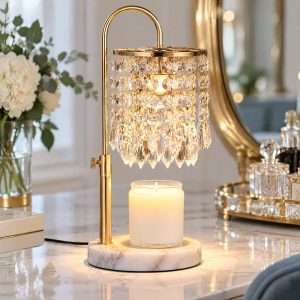
The lamp pictured hangs a dome of cream glass panels and one clear textured panel, set in brass-tone ribs, from a C-shaped arm over a round base. It is a lamp, not a heater, and it changes nothing about the candle except how its top is melted.

The short version: candles were not invented on a date. The firmest early evidence is an Etruscan stand of about 500 BCE, with Latin names for wax and tallow candles and a Chinese account from 210 BCE beside it. After that the story is fuel: tallow and beeswax, spermaceti in the 1700s, stearine and the plaited wick in the early 1800s, paraffin from about 1854, soy in the 1990s. Egyptian candles, whale-fat Chinese candles and a named inventor are the parts that do not hold up.
The short below opens at a dark wooden sideboard, where a grey-haired woman in a cream cardigan pulls open a drawer packed with plain white taper candles and paper-wrapped bundles while a younger man looks on, a brass candle warmer lamp with a glass dome shade standing on the sideboard beside them. She hands him one of the white tapers and he holds it, smiling. She then lifts a jar candle tied with a ribbon out of the drawer; he laughs into his hand, she unties the ribbon, and he lifts off the lid and sets the jar on the round brass base of the lamp. With the lamp switched on, the dome glows above the jar. She takes his face in her hands, passes him a paper-wrapped bundle of tapers, and they hug, and the short ends on her standing alone at the sideboard with the lamp glowing over the jar.
Frequently asked questions
These answers take up questions the sections above leave open; the birthday answer draws on a 2025 National Geographic history.[10]
When were scented candles invented?
No one can put a date on it, because smell was part of what candles were sold on long before fragrance was added for its own sake. Beeswax was prized for a sweet smell where tallow's was acrid, the US trade association notes, and a Boston advertisement of 1748 praised spermaceti candles for their "Sweetness of Scent when extinguished." The scented candle as a mainstream product is far more recent. The National Candle Association dates the turn to the mid-1980s, when "consumer interest in scented candles began to escalate," followed by an unprecedented surge in the popularity of candles in the 1990s. So candles that smelled pleasant are centuries old, while the scented jar candle on most shelves belongs to roughly the last forty years.
When were birthday candles invented?
No inventor or date is on record. The custom of lit candles on a birthday cake is often attributed to German Kinderfeste, children's birthday celebrations, and a 2025 National Geographic history quotes a professor of German studies who calls that link indirect but meaningful. The popular claim that birthday candles began in ancient Greece has, the same history notes, no direct record of candles placed on cakes behind it. The firmest early description cited here is Goethe's account of his own birthday cake, which carried about fifty lit candles.
What were the first candles made of?
Animal fat and beeswax, wrapped around a plant fiber. Those two fuels are the oldest candle materials on record, and they share the property a candle needs: both are solid at room temperature and melt near a flame, so the candle carries its own fuel. Tallow, rendered animal fat, was the cheap one and beeswax the costly one. Other early fuels are claimed for Asia, including insect wax in China, wax from tree nuts in Japan and wax boiled from cinnamon fruit in India, but the trade association that repeats them gives no source and hedges only the Chinese claim with "are said to," so treat all three as possible rather than proven. Its history page also says the Romans are generally credited with dipping rolled papyrus wicks repeatedly in melted tallow or beeswax, likewise without a source.
Are candles still made with animal fat?
Some are, though far fewer than in earlier centuries. Stearine, the hard candle stock of the nineteenth century, is made from fatty acids that can come from tallow and other animal fats or from vegetable fats such as palm oil, and the 1911 Encyclopaedia Britannica notes it was used on its own for candles meant to be burned in hot climates. The US trade association credits the growth of the oil and meatpacking industries in the first half of the twentieth century with supplying the paraffin and stearic acid that candles were made from, and says stearin candles remain popular in Europe today. A label that says stearin or stearic acid does not tell you whether it is plant or animal derived, so ask the maker if it matters to you.
Why did tallow candles smell so bad?
Because of the glycerin in the fat. The 1911 Encyclopaedia Britannica explains that natural fats are glycerides, and that the vapours of acrolein formed when glycerin breaks down in the flame are the cause of the unpleasant odours produced by tallow dips. Removing that glycerin was one of the reasons candlemakers turned tallow into stearine in the nineteenth century. The other complaint was smoke: in old tallow dips the cotton strands were only twisted together, so charred wick built up and choked the flame unless it was trimmed, a chore known as snuffing. Beeswax and spermaceti avoided the smell, but both cost more, and tallow stayed the common household candle.

Wax Warmers & Candle Melters
An electric wax warmer uses the gentle heat of a halogen bulb, not a flame. The bulb sits above the candle and warms the top layer of wax into an even melt pool, which releases the fragrance.
Shop all wax warmersBrowse all Candle Warmer Lamps →
Sold and shipped by GODONLIF — free shipping within the contiguous US. Prices are shown on each product page.
Sources and evidence limits
Each link was opened on October 15, 2026.
- The Metropolitan Museum of Art, “Bronze candelabrum,” Etruscan, about 500 to 475 BCE, object 61.11.3. Date, size, construction and the candles on the prongs. One catalog entry, not a survey. metmuseum.org: bronze candelabrum (Retrieved October 15, 2026).
- “Candle,” Encyclopaedia Britannica, 11th edition, volume 5, 1911, via Wikisource. Definition, Latin terms, oldest materials, medieval wax and tallow, guilds, spermaceti, stearine, paraffin, moulding, night-lights and candle-power. A 1911 reference work. en.wikisource.org: 1911 Britannica, Candle (Retrieved October 15, 2026).
- Sima Qian, Shiji (Records of the Grand Historian), chapter 6, Basic Annals of the First Emperor of Qin, original text via Chinese Wikisource; English rendering ours. A historian’s account, not an excavation record. zh.wikisource.org: Shiji, chapter 6 (Retrieved October 15, 2026).
- UNESCO World Heritage Centre, “Mausoleum of the First Qin Emperor.” The emperor’s death in 210 BCE and Sima Qian’s dates. whc.unesco.org: Mausoleum of the First Qin Emperor (Retrieved October 15, 2026).
- Griffith Institute, University of Oxford, Howard Carter’s object cards, Carter number 041, “Four bronze and wood candlesticks,” card 041a-2. The linen torch and the trace of oil or grease in its cup. Excavation notes, not a published analysis. griffith.ox.ac.uk: Carter card 041a-2 (Retrieved October 15, 2026).
- Kugler, Richard C., “The Whale Oil Trade, 1750 to 1775,” Seafaring in Colonial Massachusetts, Publications of the Colonial Society of Massachusetts, volume 52. Rivera, the 1748 advertisement, pricing, the Caribbean figure and the 1761 United Company. colonialsociety.org: the whale oil trade (Retrieved October 15, 2026).
- Geake, Helen and Webley, Robert, “Candle Snuffers and Wick Trimmers,” Portable Antiquities Scheme, British Museum. The 1825 plaited wick and the decline of candles as household light. A finds guide. finds.org.uk: candle snuffers and wick trimmers (Retrieved October 15, 2026).
- Faraday, Michael, The Chemical History of a Candle, edited by William Crookes, Chatto and Windus, 1908 impression, via Project Gutenberg. The candles shown in the first lecture. gutenberg.org: The Chemical History of a Candle (Retrieved October 15, 2026).
- National Candle Association, “History of Candles.” The statements quoted in section seven, spermaceti’s brighter light and milder smell, the 1834 machine, the 1980s and 1990s trends and scented candles. The US trade body, quoted rather than relied on for ancient history. candles.org: history of candles (Retrieved October 15, 2026).
- Muoneke, Chiamaka, “Blowing out birthday candles is surprisingly ancient,” National Geographic, published July 17, 2025. Goethe’s account, the Kinderfest attribution and the missing Greek record. A magazine history. nationalgeographic.com: history of birthday candles (Retrieved October 15, 2026).
- Arnold, Dorothea, “Tutankhamun’s Funeral,” Heilbrunn Timeline of Art History, The Metropolitan Museum of Art, October 2010. The date of the burial: the Met dates the objects from Tutankhamun’s reign and embalming cache shown with the essay to about 1328 to 1318 BCE. A museum essay on the funeral, not on how the tomb was lit. metmuseum.org: Tutankhamun’s funeral (Retrieved October 15, 2026).
Evidence limits: the ancient record is one dated object, Latin usage and a Chinese account written generations later; later dates come from a 1911 reference work and specialist studies; recent trends come from the industry’s trade body.
You may also like


