News
How to Get Wax Out of Carpet Without Melting the Pile

Aug
Care & Repair
How to get wax out of carpet, in one line: chill it, break it off, lift the film into paper with a warm — never hot — iron, then deal with whatever color is left. It works because the blob is a solid sitting on top of the fibers, not a liquid soaked into them.
Key takeaways
Carpet changes two things about wax removal, and both of them argue for less heat rather than more: you cannot turn a floor over to press from the back, and the pile itself can melt.
- Cold first, always: bagged ice makes the blob brittle so it fractures off instead of smearing deeper into the pile.[1]
- Vacuum between scraping and ironing: loose chips left in the pile get melted straight back in on the first pass.[7]
- Warm iron, and never on the pile: the soleplate goes on paper only, because the fiber can melt — measured olefin carpet yarn melts at 330–338°F, below the cotton setting on a household iron.[2][4]
- Blot from the edges inward, never scrub: a brush roughs up pile that will not lie flat again.[3]
How to get wax out of carpet is a different job from getting it out of a shirt, even though every guide online runs the same four steps at both. If you searched how to get wax out of carpet with a hardening puddle in front of you, the first thing to know is what you are not allowed to do here: you cannot flip the fabric over and press from the back, you cannot put the floor in a machine afterward, and the pile under that wax may be a synthetic that melts at a lower temperature than your iron reaches. Everything below follows from those three constraints. The spill itself is easier to prevent than to treat: a lamp on a marble base sits heavy and level on a small table, and there is no flame to drop if the jar does go over.
01How to Get Wax Out of Carpet: The Four Moves, in Order
The published procedures converge, and they converge on a sequence rather than a product. The University of Georgia Extension’s textile-care guide gives the canonical version for blended, wool, and synthetic carpet fibers: seal an ice cube in a plastic bag and hold it over the wax until it hardens, gently scrape the surface deposit away, lay paper towels over what is left and press with a warm iron — explicitly not a hot one — moving the blotter as the wax is absorbed, then sponge any remaining trace with a dry-cleaning solvent.[1] Carpet One Floor & Home publishes essentially the same two routes, one built on the iron and one built on freezing and shattering.[2]
What matters is that the order is load-bearing, not stylistic. Wax at room temperature has already gripped the yarn as a solid, so the great majority of the deposit leaves as chips — mechanically, with no heat and no chemistry involved. Reach for heat before you have removed that bulk and you convert a contained lump into a thin film spread across three times the area, now driven down toward the backing where no blotter can reach it. The heat step exists only to collect the residue the scrape could not lift, and the cleaning step exists only to address what the heat step leaves behind.
Harden it
Seal ice in a plastic bag and rest it on the wax until the blob is brittle all the way through.[1]
Lift the film through paper
Cover with plain kraft or butcher paper and press with a warm iron, keeping the soleplate off the pile and rotating to clean paper.[2]
Treat what is left
Sponge traces with a dry-cleaning solvent; for a color shadow, use 1 part rubbing alcohol to 2 parts water, blotting after each pass.[1]
02How to Remove Wax From Carpet by Chilling, Shattering and Vacuuming
The most reliable way to remove wax from carpet is also the one that uses no heat at all, and on a shallow spill it can finish the job by itself. Cold is doing real mechanical work here rather than just buying time: as the wax drops well below its melting band it contracts and loses the tack that lets it cling to individual fibers, so the deposit fractures rather than smears. UGA Extension bags an ice cube and holds it over the spill until the wax is hard.[1] Carpet One’s freezing route then shatters the chilled deposit with a blunt object such as the back of a large spoon.[2]
Two details decide whether this goes well. Bag the ice — melt water sinks into the pile and the backing, and a soaked spot is slower to work on and prone to the rings that come from over-wetting. And vacuum immediately after scraping, before you consider any heat: The Spruce has you scrape and vacuum in turns until no loose wax remains, before the iron comes out, so you are not pressing loose crumbs back into the nap.[7] Carpet One makes the same point in the other direction, telling you to vacuum the dried chips away before they melt.[2] Tool choice is the third quiet risk: use a blunt spoon edge or a plastic scraper and keep it flat, because a sharp blade cuts loops out of a loop-pile carpet and leaves a bald patch that no cleaning will bring back.

03How to Get Melted Wax Out of Carpet Before It Cools
Learning how to get melted wax out of carpet is mostly learning to do less. A still-liquid spill is the one moment when the wax is genuinely mobile, which means every instinct — wiping it, rubbing it, pushing a cloth into it — is actively making the job larger by driving liquid down between the fibers toward the backing. The Carpet and Rug Institute’s rule for spills of any kind applies with force here: work from the edges of the spill toward the center, blot rather than scrub, and do not use a brush, because bristles damage the pile.[3]
So on a fresh pour, lift only what will come away without pressure — Carpet One’s freezing route opens with exactly that, scraping or blotting the excess with a paper towel before anything else.[2] Then stop and let it set, or hurry it along with bagged ice, and rejoin the cold sequence above. The instinct to catch it while it is soft is the single most common way a coin-sized spill becomes a palm-sized shadow. The one thing genuinely worth doing while the wax is still liquid is noting its color, because a heavily dyed wax turns this into two jobs in sequence rather than one.
Still liquid
Do almost nothing
- Lift free excess with a dry paper towel, no pressure
- Chill it with bagged ice and wait
- Do not wipe, rub or press a cloth into the pile
- Do not reach for a spray cleaner yet
Set hard
The workable state
- Shatter with a blunt edge and vacuum the chips
- Lift the residual film through paper with a warm iron
- Finish with solvent, then diluted alcohol if color remains
- Still no scrubbing and no brush
04The Warm-Iron Lift, and Why “Warm” Is Not a Suggestion
The heat step works by absorption, not by cleaning. Warm the residual film past its melting point and it turns liquid; hold a dry, porous sheet against it and the liquid wicks into that sheet instead of back into the yarn. Carpet One covers the area with brown kraft or butcher paper, applies a warm iron until the remaining wax is absorbed, and rotates to a clean patch of paper as each one darkens — with one warning attached: do not let the iron touch the carpet, because the fiber might melt.[2] UGA Extension words the temperature instruction the same way, specifying a warm iron and adding “not hot” in parentheses.[1]
That warning is usually read as generic caution. It is not. A 2015 study in the Journal of the American Society of Trace Evidence Examiners measured the melting points of a reference collection of commercial fibers, including carpet yarns from Shaw Industries and Allied Signal: olefin (polypropylene) samples melted between 165.7 and 170.0°C, which is 330 to 338°F, while nylon 6 carpet yarns melted around 215 to 225°C, or 419 to 438°F.[4] Now compare that to the dial in your hand. Rowenta’s chart puts the cotton setting near 350°F and linen near 400°F.[5] On an olefin carpet — the cheap, stain-resistant fiber under a very large share of rugs and basements — the cotton setting is already hotter than the pile’s melting point. That is the whole reason the soleplate stays on paper.
Wax bands converted from GODONLIF, “Candle Wax Melting Point” (soy 49–54°C, beeswax 62–65°C, paraffin 46–68°C). Fiber melting points measured by Kisler-Rao, JASTEE Vol. 6 Issue 1 (2015), including Shaw Industries and Allied Signal carpet yarns. Iron settings: Rowenta USA. Retrieved August 6, 2026.
Read the gap the same way a professional does. The lowest one-dot setting, around 230°F, already sits roughly 76°F above the hottest wax you are likely to have spilled, so there is no version of this job that needs a hot iron.[5][8] The Spruce says the same in plain terms: a warm iron, never on hot, with the steam turned off.[7] Steam matters as much as temperature, because it pushes liquefied wax sideways and downward instead of up into the blotter. Use plain uncoated paper too — coated or printed stock will not absorb, and printing ink transfers under heat.
How to Remove Wax on Carpet That Has Already Set Hard
Nothing changes for old wax except your patience. A deposit that hardened days or weeks ago is chemically the same material it was on the first evening — wax does not cure, bond or oxidize into the fiber the way a food or wine stain does. Chill it, shatter it, vacuum, and lift the film exactly as above. The only real difference is that an old spill has usually been walked on, which grinds the wax deeper into the pile and spreads a halo of fine particles around the original mark, so expect more scrape-and-vacuum cycles and more passes with fresh paper.
Where old wax genuinely does get harder is on the color side. Pigment that has sat in the pile through weeks of light and foot traffic is more stubborn than pigment lifted the same night, and the alcohol dilution below is doing all the work at that point — the iron contributes nothing further once the paper stops picking anything up. If two full rounds leave a mark that has not faded at all, you are looking at dye, not wax, and continuing to apply heat will set it rather than shift it.
How to Get Wax Out of Carpet Without an Iron
How to get wax out of carpet without an iron is the same four moves with a gentler heat source at step three, and on most spills it costs nothing but a little extra time. A hair dryer warms the residual film past its melting point so it wicks up into an absorbent sheet, with no soleplate anywhere near the pile — which removes the single risk the section above is built around. On olefin that melts at 330–338°F, that is the safer trade.
Everything else is unchanged. Harden the deposit with ice sealed in a plastic bag, then break it up and lift it with a blunt edge, the back of a spoon or a butter knife held flat, never a point that can cut a loop out of the pile. Vacuum the chips before any heat arrives, because crumbs left in the nap melt straight back in. Lay a folded paper towel over what remains and run the dryer on low or medium until the wax transfers into it, moving to a fresh patch each time one darkens. Finish the trace with a dry-cleaning solvent, or 1 part rubbing alcohol to 2 parts water pretested somewhere hidden, blotting from the edges inward rather than scrubbing.
05Carpet Wax Removal After the Wax: Solvent, Dye and the Shadow
Carpet wax removal has a second half that most short guides skip entirely, and it is the half that decides whether the spot is invisible or merely smaller. Once the paper stops darkening, what remains is some combination of three things: a thin oily residue of fragrance carrier, a color shadow from pigment in the wax, and possibly a patch of pile that has been physically abused. Each one needs a different response, and reaching for the wrong one makes the others worse.
For the residue and the dye, UGA Extension’s finish is specific: sponge the remaining traces with a commercial dry-cleaning solvent containing petroleum distillates, and where a colored trace is still visible, dilute 1 part rubbing alcohol with 2 parts water, apply it in small amounts and blot thoroughly after each application.[1] Two disciplines make that safe rather than risky. Pretest anywhere hidden first — under a sofa, inside a closet, on an offcut — which the Carpet and Rug Institute treats as non-negotiable for any cleaner.[3][7] And rinse when you are done: CRI has you blot the area with clear water once or more to lift out the product itself, because a cleaner left in the pile becomes a magnet that re-soils the same spot within weeks.[3]
| What you see | What it is | What to do |
|---|---|---|
| Darker translucent patch | Residual wax or fragrance oil still in the fibers | More iron-and-paper passes on fresh paper, then blot with water |
| Colored tint, normal texture | Dye from a pigmented wax | Solvent, then 1 part rubbing alcohol to 2 parts water[1] |
| Stiff, waxy-feeling pile | Wax that re-hardened down in the yarn | Reheat through clean paper — never scrub it out[3] |
| Glazed, shiny, matted patch | Heat damage — the fiber has fused | Stop using heat; cleaning cannot reverse it[2] |
| Ring around the treated area | Over-wetting during the solvent stage | Blot outward, dry fully, then reassess |
| Spot returns after a few days | Wicking — residue drawn back up from the backing | Re-blot dry, rinse with clear water, dry under a weighted towel |
06Hard Floors: Wood, Laminate, Vinyl, Tile and Stone
A wax spill rarely respects the edge of the rug, and the hard floor around it inverts the whole method. There is no pile to melt, so the temperature panic goes away; what replaces it is a finish you can scratch and a seam that water can get into. That flips both the tool and the aftercare: metal is now the hazard rather than heat, and the drying step matters more than the lifting step. Which tool and which wipe depends on whether you are standing on oak, porcelain, laminate or marble, so the surface-by-surface version now has its own guide: getting candle wax off a floor.
On carpet
Heat is the hazard
- A metal spoon edge is fine — there is no finish to scratch
- Water and solvent are tolerated if you blot them back out
- Heat can fuse the pile permanently[2]
- You cannot press from the back or rinse it in a machine
On a hard floor
Metal and water are the hazards
- Warmth is safe — a hair dryer will not hurt a sealed surface
- The residue wipes off instead of needing to be absorbed
- A metal blade gouges the finish; use plastic only
- Wet mopping and steam damage wood and reach the seams[6]
On a sealed wood floor the sequence is chill, lift with plastic, wipe, dry. Let the wax go fully hard, then work a plastic scraper or the edge of an old card under it — not a butter knife, which is exactly the tool that gouges a polyurethane finish. Then follow the National Wood Flooring Association’s standing rules for the wipe: clean spills immediately with a dry or slightly damp cloth, use a cleaner formulated for your floor’s finish, and keep wet mops and steam mops away entirely, because they damage the finish and the wood over time.[6] A steamer is exactly the wrong instinct here even though it would melt the wax beautifully. Laminate and luxury vinyl follow the wood rule with the drying tightened further, since their weak point is the seam. Glazed tile and sealed stone are the forgiving case — plastic scraper, then a normal damp clean — but unsealed stone is porous and can hold an oil shadow, so test any solvent in a corner before you commit. The temperatures stay on your side across the whole table: common candle waxes release in the 115–154°F band, so a hair dryer on low, a warm cloth, or an iron held at its lowest ~230°F setting is already more heat than any surface here needs.
| Surface | First move | Lifting step | Aftercare | Main risk |
|---|---|---|---|---|
| Cut- or loop-pile carpet | Bagged ice, shatter, vacuum | Warm iron through kraft paper | Solvent, then alcohol at 1:2 | Melting or matting the pile |
| Wool or natural-fiber rug | Bagged ice, scrape very gently | Lowest iron setting, no steam | Pretest, blot, air dry flat | Felting and set dye |
| Shag or high-pile rug | Freeze, work the wax down each strand | Paper wrapped around the tuft | Comb the pile back up when dry | Cutting loops while scraping |
| Sealed hardwood | Let it harden fully | Plastic scraper or card, never metal | Damp cloth, dry immediately[6] | Scratching the finish |
| Laminate or luxury vinyl | Chill, then lift with a plastic card | Hair dryer on low for the film | Barely damp wipe, dry fast | Water reaching the seams |
| Glazed tile or sealed stone | Let it harden, lift with plastic | Warm cloth for the residue | Normal floor cleaner | Grout and unsealed stone staining |
07Warranties, Wool, and When to Stop Trying
An honest guide has to name the cases where the right move is not to do this yourself, and on carpet that list is longer than it is on clothing — because a floor is an installed product with paperwork attached. Carpet One is blunt about it: not all carpet fibers react the same way when treated for stains, you should contact your carpet manufacturer for guidance, and failure to follow the published stain-removal guidelines may void your warranty. Some programs go further and require a call before any treatment at all.[2] A five-minute phone call is cheap next to discovering afterward that a home remedy ended the cover on a whole room.
Wool deserves its own pause. It will not melt the way olefin does, but it felts and it holds dye, and the solvent-and-alcohol finish that rescues a synthetic can leave a permanently altered patch on a wool rug — which is why the pretest is not a formality. There is also a limit built into the method itself, worth stating rather than glossing over: the iron-and-paper lift is excellent at wax and does nothing whatsoever against dye already bonded to the fiber, and every additional pass of heat makes that dye more permanent, not less. If two full rounds have not visibly faded a colored mark, the next step is an IICRC-certified cleaner or your manufacturer’s helpline, not a hotter iron. And if the pile has gone shiny and matted, stop — that is fused fiber, and no cleaning process reverses it. On the maintenance side, CRI’s baseline is a professional deep clean every 12 to 18 months regardless of accidents, which is also the cheapest way to keep an old wax spot from becoming the dirtiest patch in the room.[3]
08The Spill That Never Reaches the Rug
Step back from the technique and the pattern behind most of these emergencies is dull but consistent. A lit candle maintains a pool of liquid wax at the open top of a container, and then that container gets moved: carried between rooms with the pool full, set down on a table edge, knocked by a sleeve, or blown out with a puff hard enough to flick droplets over the rim. Wax has to get over the rim or into the air before it can reach a floor at all, and a burning candle offers it several ways to do exactly that.
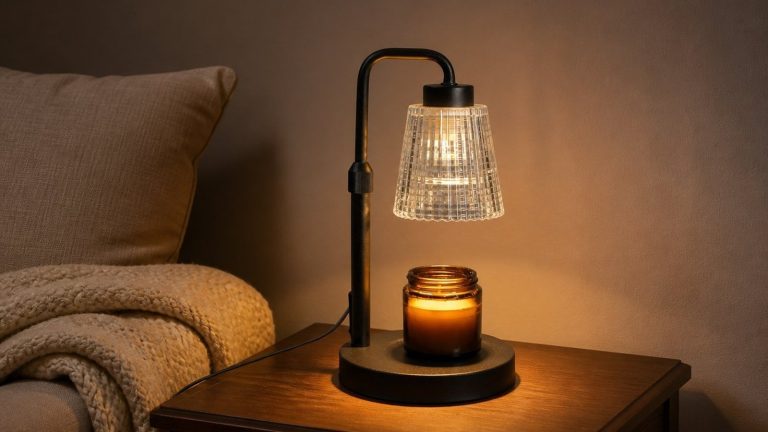
A candle warmer lamp removes those routes instead of managing them. It warms the wax from above with a bulb rather than burning a wick, so there is no flame to extinguish and nothing to blow out — our explainer on how a candle warmer lamp works covers the mechanism. The jar sits under the shade for the whole session, which means the melted pool stays in the container it came in: no wick to drip, no splatter at the moment you put it out, no reason to walk a full pool of hot wax across a room with a rug in it.

One caveat, because overselling this would be its own kind of dishonesty: a warmer is not spill-proof. Knock the lamp or the jar over and liquid wax goes wherever gravity sends it, onto carpet that will need the same four steps as any other spill — so it is worth keeping the kit within reach regardless: a bag of ice, a blunt spoon edge or plastic scraper, plain uncoated kraft paper, an iron with a working lowest setting, and a petroleum-distillate carpet solvent. What changes is how many ways wax can escape during ordinary use, which on a rug-heavy floor is the number that actually matters. If the wax landed on fabric instead, our companion guide on how to get wax out of clothes covers garments and upholstery, where you can press from the back and finish in a washing machine; and when the jar itself runs low, how to get wax out of a candle jar handles the leftover plug in the vessel. The wax bands quoted throughout come from our tested breakdown of candle wax melting points by type.
Frequently asked questions
These cover the variants the sections above do not, and every figure is a typical range rather than a guarantee. The visible questions and the FAQ schema are rendered from one registry, so readers and search systems see identical wording.
How do I remove wax from a carpet without an iron?
A hair dryer does the same job more slowly and with no metal on the pile. Harden the wax first with an ice cube sealed in a plastic bag, scrape the surface gently with a butter knife, then vacuum the loosened crumbs so you are not driving them back in. Lay a folded paper towel or absorbent cloth over what remains and run the dryer on low or medium until the wax transfers into the towel, swapping to a fresh patch as it darkens, then clean the area with rubbing alcohol or a carpet cleaner and let it air dry.
Will a carpet cleaner or steam cleaner get candle wax out?
Neither is the right first tool, and a steam cleaner can make things worse. Hot water extraction pushes softened wax deeper into the pile and toward the backing rather than pulling it up, and the heat is applied over a wide area with no absorbent blotter to catch anything. Remove the solid wax mechanically first, lift the residual film into paper with gentle heat, and only then use a spotting solution or a machine to rinse the area. A carpet cleaner is genuinely useful at the end of the sequence, when what is left is ordinary oily residue rather than wax.
How do you get candle wax out of a shag or high-pile rug?
Work strand by strand rather than area by area, because there is no flat surface to press against. Freeze the wax hard with a bagged ice pack, then flex each affected tuft between your fingers so the brittle wax cracks and falls away, and vacuum thoroughly between rounds. For the film that clings to individual fibers, wrap a strip of plain paper around a small bundle of strands and warm it briefly with a hair dryer instead of an iron, which cannot reach into deep pile without flattening it. Comb the pile back up while it dries so the treated patch does not sit lower than the rug around it.
Does candle wax leave a permanent stain on carpet?
The wax itself almost never does, but the dye in it sometimes will. Undyed wax lifts out completely because it sits on and between the fibers rather than bonding to them, which is why the mechanical steps do most of the work. Pigmented wax is a separate problem, and a colored shadow that survives a solvent and a diluted-alcohol pass may not come out at home. The one genuinely permanent outcome is heat damage: a patch of synthetic pile that has fused and gone shiny cannot be restored by any cleaning process, which is why the iron never touches the carpet directly.
How do you get candle wax off a hardwood or laminate floor?
Change the tool rather than the temperature. Let the wax cool until it is completely hard, then slide a plastic scraper or the edge of an old card underneath it and lift it away, never a knife or any metal blade, which will gouge the finish. Soften any remaining film with a hair dryer on low and wipe it up with a soft cloth, then clean the spot with a product made for that floor's finish and dry it immediately. Keep wet mops and steam mops away entirely, and on laminate or vinyl be especially quick to dry, because the seams are the weak point.

GODONLIF Candle Warmer Lamp — Black (Classic)
The classic GODONLIF candle warmer lamp — a tabletop lamp that melts your jar candle from above for clean, flame-free fragrance. Warm light, full scent, no smoke or soot.
Shop the classic warmer lampBrowse all Candle Warmer Lamps →
Sold and shipped by GODONLIF — free shipping within the contiguous US. Price and availability are shown on the product page.
Sources and evidence limits
The carpet procedure comes from a land-grant university textile program and a flooring retailer’s published stain guide; the blot-not-scrub and pretest disciplines from the carpet industry’s own trade body; the fiber melting points from a peer-reviewed study that measured commercial carpet yarns rather than from marketing copy; the wood-floor rules from the wood flooring association. Every URL was checked on August 6, 2026. One guide that went offline was replaced and checked on October 17, 2026. Temperatures are typical ranges and shift with wax grade, fiber blend and dye load, and a carpet manufacturer’s own care sheet outranks anything here. This is general home-care information, not a warranty-safe procedure for installed flooring.
- University of Georgia Extension, “Remove Stains From Candle Wax, Paraffin” (carpet procedure for blended, wool and synthetic fibers; bagged ice; warm iron “not hot”; petroleum-distillate solvent; alcohol at 1:2). https://site.extension.uga.edu/textiles/care/stain-removal/remove-stains-from-candle-wax-paraffin/ (retrieved August 6, 2026).
- Carpet One Floor & Home, “How to Get Wax Out of Carpet” (kraft/butcher paper; the fiber-may-melt warning; freeze-and-shatter route; vacuum chips before they melt; manufacturer-contact and warranty caution). https://www.carpetone.com/about/stains/stain-removal/how-to-get-wax-out-of-carpet (retrieved August 6, 2026).
- The Carpet and Rug Institute, “Cleaning and Maintenance” (act quickly; work from the edges to the center; blot, do not scrub or use a brush; pretest; rinse with clear water; deep clean every 12–18 months). https://carpet-rug.org/carpet-for-homes/cleaning-and-maintenance/ (retrieved August 6, 2026).
- Anne E. Kisler-Rao, “Comparison of Nylon, Polyester, and Olefin Fibers Using FTIR and Melting Point Analysis,” Journal of the American Society of Trace Evidence Examiners (JASTEE), Vol. 6, Issue 1, 2015 — Table 1 measured melting points, including Shaw Industries and Allied Signal carpet yarns. https://astee.s3.amazonaws.com/422443_JASTEE_2015_6-1_Kisler-Rao.pdf (retrieved August 6, 2026).
- Rowenta USA, “How to Choose the Right Iron Temperature Settings for Fabrics” (all iron temperatures charted above). https://www.rowentausa.com/blog/post/ironing-basics-temperature (retrieved August 6, 2026).
- National Wood Flooring Association, “Maintenance” (clean spills immediately with a dry or slightly damp cloth; use a cleaner matched to the finish; avoid wet mops and steam mops, which damage the finish and the wood). https://woodfloors.org/maintenance/ (retrieved August 6, 2026).
- The Spruce, “Spilled Candle Wax on Your Carpet? 4 Easy Steps to Get It Out, From a Cleaning Pro” (bagged ice; scrape and vacuum the loose wax before ironing; warm iron, not hot; no steam; spot-test a hidden area). https://www.thespruce.com/how-to-get-candle-wax-out-of-carpet-8733825 (retrieved October 17, 2026).
- GODONLIF, “Candle Wax Melting Point” (soy 49–54°C, beeswax 62–65°C, paraffin 46–68°C; converted to Fahrenheit in the chart above). https://godonlifstore.com/candle-wax-melting-point/ (retrieved August 6, 2026).
- GODONLIF, “How to Get Wax Out of Clothes” (companion guide for garments, upholstery and washable fabric). https://godonlifstore.com/how-to-get-wax-out-of-clothes/ (retrieved August 6, 2026).
- GODONLIF, “How to Get Wax Out of a Candle Jar” (companion guide for the leftover plug in the vessel). https://godonlifstore.com/how-to-get-wax-out-of-candle-jar/ (retrieved August 6, 2026).
You may also like