News
Candle Warmer With Timer: Auto Shut-Off Models & How to Set One

Jul
Features & Buying
The timer is the feature people most often wish they had bought. Here is what a built-in auto shut-off actually does, how to set it in seconds, and which models earn the upgrade.
Some candle warmers turn off automatically, but many do not. A candle warmer with timer shuts itself off after the window you choose; an auto shut-off has one fixed cutoff, often 8 hours.
Key takeaways
- A candle warmer with timer switches itself off after a set window, commonly 2, 4, 6, or 8 hours, so nothing depends on memory.
- Timer vs. auto shut-off: a timer lets you choose the run length; a basic auto shut-off is one fixed cutoff, often 8 hours.
- Setting it takes seconds: pick the interval on the dial or button, and an indicator light confirms it is counting down.
- Nearly all real warmers plug in (a bulb or element draws roughly 15 to 25 W), so battery models are rare and cannot sustain melting heat.
- Cheap to run: at 15 to 25 watts and the 2024 US average of about 16.5 cents per kWh (EIA), an 8-hour session costs only two to four cents.
- Planning to run one while you are asleep? That is a separate safety question: see leaving a candle warmer on overnight.
A candle warmer with timer is simply a warmer lamp (or a warming plate) that powers down on its own after a set number of hours, instead of running until you remember to switch it off. On better lamp models you choose the window, typically 2, 4, 6, or 8 hours, and an indicator light counts it down; on simpler ones a single auto shut-off trips at a fixed cutoff. Either way the appeal is the same: the flame-free fragrance of a jar candle, without the low-grade worry of a device left on. If you are new to the category, our candle warmer lamp guide covers the basics and how a candle warmer lamp works explains the top-down heat; this page is about one feature, the timer, and why it is the one worth insisting on.
01Do candle warmers come with a timer?
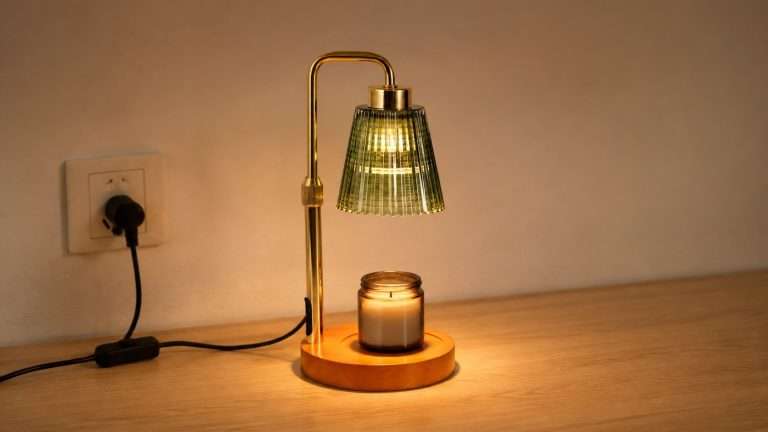
A timed candle warmer is the version of this product that ends the session for you, and the honest answer to whether the one you are looking at qualifies is usually buried below the title. One that does qualify is our cut-glass model, a timer-equipped adjustable warmer lamp: you set the brightness and a run time, and it switches off when the time is up.
Some do, many do not, and it is the single feature buyers most often wish they had checked before ordering. A true timer model lets you choose how long the lamp runs and then cuts the power for you. A basic model gives you only a manual on/off switch, so it warms until you come back and turn it off. Between those two sits the fixed auto shut-off: no interval to pick, just a single cutoff the maker has set, usually around eight hours. One widely sold plate model, for instance, melts the candle to release fragrance and is programmed to switch itself off automatically after eight hours (Candle Warmers Etc.).
Because the word “timer” gets used loosely on listings, it pays to read the fine print. Look for an explicit run window (the 2, 4, 6, or 8-hour language), a small indicator light, and a control you can actually see in the photos: a rotary dial, a labelled button, or a switch on the base. If a product page only says “on/off,” assume there is no timer at all; if it says “auto shut-off” with no interval, assume a single fixed cutoff rather than an adjustable one.

02Timer vs. auto shut-off: what the labels mean
Whether you end up with an automatic shut off candle warmer or a true timer decides how much say you have once the lamp is on, and it is the one distinction the fine print rewards you for reading.
“Timer,” “automatic shut off,” and “auto shut off candle warmer” get printed almost interchangeably, but they describe two slightly different things. A timer is adjustable: you decide the run length. An auto shut-off is fixed, so the lamp always cuts out after the same interval, whether you want it to or not. Both remove the need to babysit the lamp; the difference is how much say you get.
| Feature | Timer model | Auto shut-off (fixed) | Manual (no timer) |
|---|---|---|---|
| Choose the run length | Yes, often 2, 4, 6, 8 h | No, one fixed window | No control |
| Typical cutoff | You set it | ~8 hours | Runs until switched off |
| Confirms it is counting down | Indicator light | Indicator light | Switch position only |
| Restart after cutoff | Re-select the interval | Unplug ~2 min, cycle power | n/a |
| Best for | Set-and-leave rooms | Simple homes, tight budgets | Rooms you are sitting in |
Why does either matter? Because the flame-free promise of a warmer only holds if the appliance is used sensibly, and open-flame candles remain a real ignition source. Candles caused an annual average of 5,894 US home structure fires between 2020 and 2024, along with 63 deaths, 532 injuries, and $286 million in direct property damage, and more than half of those fires started when something that could burn sat too close to the flame (NFPA). A warmer already removes the flame; a timer or auto shut-off removes the second variable, a heat appliance left running longer than you meant.
03How do you set the timer on a candle warmer?
You do it in three moves: switch the lamp on, select a run window on the dial or button, and confirm the indicator light is counting down. Setting the timer is genuinely a few-seconds job, and the routine is nearly identical across lamp and plate models. The only real variable is whether your unit has an adjustable dial or a single fixed cutoff.
Before the countdown matters, the lamp has to do its real job, which is bringing the wax to melting temperature. Most paraffin and soy blends begin to soften between about 115 and 154°F (46 to 68°C), according to candle-wax melting-point references, so the warmer needs a few minutes on full power to open a shallow pool across the surface before you dial the light down. Set the window longer than that warm-up: a 2-hour window suits a quick scent refresh, while 4 to 8 hours matches an evening at home.

Seat the candle and switch on
Center a lidless jar on the base under the shade, then flip the power switch. Give the base a moment to register that a session has started.
Choose your interval
On a multi-setting model, rotate the dial or press the button through the 2, 4, 6, and 8-hour options. On a fixed auto shut-off model there is nothing to pick; the countdown begins the instant you switch on.
Check the indicator light
A small light tells you the timer is armed and counting down. If it is not lit, the lamp is either off or the dial is between positions; nudge it until the light holds.
Set the brightness (optional)
If the lamp is dimmable, start at full to build a melt pool, then drop to a gentle glow. The dimmer changes the light, not the timer; the countdown runs regardless. Both features assume the lamp is plugged in; for whether a cord-free version exists at all, see cordless and battery candle warmers. For how far down to take it when the lamp is standing on a nightstand, see our guide to running a warmer lamp as a bedside night light.
Walk away
The lamp powers down on its own at the end of the window. Re-select the interval next time; on fixed models, just switch on again.
04What should you look for in a candle warmer with a timer?
Look for a real, labelled run window and an indicator light first, then the fundamentals that decide whether the lamp lasts. A timer alone does not make a good lamp. When you are comparing a candle warmer lamp with timer against the rest of a shortlist, the timer is one box on a longer checklist; the others decide whether the lamp is a keeper or a drawer-filler.
- A real timer, not just a switch. Confirm an explicit run window and an indicator light. Vague “auto” wording with no interval usually means a single fixed cutoff at best.
- Height-adjustable arm. Candles vary in height. An adjustable arm keeps the bulb the right distance above the wax whether the jar is short or tall.
- Dimmer. A dimmer lets the lamp build a pool fast on full, then settle to a soft glow, useful precisely because a timer means it will be left to run.
- Standard replaceable bulb. A common fitting such as a GU10 or G9 halogen costs pennies to replace, so a worn bulb never strands the whole lamp.
- Stable, weighted base. The base holds a glass jar full of wax; favor real heft and a non-slip bottom that will not tip.
- Safety certification. Look for testing by a recognized lab, the small line on the listing that confirms the electrics were checked.
Work down that list and the field narrows quickly. For scored picks across budgets, including which ones pair a proper timer with the rest of the checklist, see our companion piece on how to choose a candle warmer lamp.
05Is a candle warmer lamp with a timer worth it?
For most buyers, yes. The honest answer depends on how you use candles. If you only ever light a warmer while sitting right beside it, a manual model is fine and a little cheaper. For everyone else, anyone who starts a lamp and then moves on to something else, the timer quietly earns its small upcharge.
With a timer
- Powers off on its own after your chosen window
- Nothing depends on you remembering
- Doubles as a set-and-leave fragrance source
- Indicator light shows it is counting down
Without a timer
- Runs until you switch it off by hand
- Easy to forget on a busy morning out
- Best only in a room you are sitting in
- Slightly cheaper up front
Running cost barely enters the decision. According to the U.S. Energy Information Administration, the 2024 average residential electricity price was about 16.5 cents per kilowatt-hour, and a warmer draws only 15 to 25 watts. Run one through a full 8-hour window and it uses about a fifth of a kilowatt-hour, which comes to roughly two to four cents per session, or on the order of $8 to $12 a year if you run it every day. The timer mostly protects against forgetting, not against a big power bill.
It is worth being clear about the trade-off, too. A warmer is not a perfect stand-in for a lit candle. Because it melts wax gently instead of burning it, the fragrance is softer and more localized; some sellers estimate a warmer gives off only about 60 to 80% of the scent throw you would get from an open flame (Chix & Wix). What a timer model buys you is flame-free, soot-free, set-and-leave convenience, and what you give up is a little of that far-corner reach. For most rooms that is a fair swap; if you scent a large open-plan space, size up the candle or run the lamp a little longer.

GODONLIF Fluted Glass and Walnut Adjustable Candle Warmer Lamp
An adjustable candle warmer lamp with a thick fluted glass shade over an oval walnut finish wood base. It warms a jar candle with a bulb instead of a wick, and the height, the brightness, and the timer all adjust.
See a lamp with a real timerBrowse all Candle Warmer Lamps →
Sold and shipped by GODONLIF — free shipping within the contiguous US. Price and availability are shown on the product page.
06Wax warmer with timer: the same idea, a smaller dish
A wax warmer with timer works on exactly the same principle as a candle warmer with timer; the only real difference is what sits on it. Instead of a whole jar candle, a wax warmer melts a small dish of scented cubes, and many wax-melt warmers use a heated plate rather than an overhead lamp. The mechanics are otherwise identical: an electric warmer melts wax flame-free, with a built-in cutoff so it does not run indefinitely. If you are deciding between the two formats, our candle warmer vs wax warmer comparison lays out which suits cubes and which suits jars.
Two practical notes carry over. First, a plate warmer often relies on the same fixed eight-hour auto shut-off as the plug-in candle plates, so if you want to choose the run length, check for an adjustable timer rather than a single cutoff. Second, a shallow dish of melts reaches temperature faster than a deep jar, so a shorter 2 or 4-hour window is usually plenty. Every timer tip on this page applies to both formats.
07Frequently asked questions
Do candle warmers have a timer?
Some do and many do not, so it is worth checking the listing before you buy. Lamp-style models increasingly include a built-in timer that lets you pick a run window, commonly 2, 4, 6, or 8 hours, while simpler warmers offer only a manual on/off switch or a single fixed auto shut-off. If running the lamp unattended matters to you, treat a timer or auto shut-off as a must-have feature rather than a bonus.
How do you set the timer on a candle warmer?
Switch the lamp on, then select your interval. On a multi-setting model you rotate a dial or press a button through the 2, 4, 6, and 8-hour options; on a fixed auto shut-off model the countdown simply begins when you flip the switch. An indicator light confirms the timer is active and counting down, and the lamp powers off on its own at the end of the window. You re-select the interval the next time you want it running.
Are there candle warmers that are battery operated?
Almost all real candle warmers plug into a wall outlet, because the halogen bulb or heating element that melts the wax draws roughly 15 to 25 watts, more than a battery can sustain for hours. Products marketed as battery-operated are usually flameless LED candles that only mimic a glow, not devices that melt a real jar candle. For genuine flame-free melting with a timer, plan on a plug-in model.
What is the difference between a timer and auto shut-off on a candle warmer?
They overlap, but a timer lets you choose the run length, while an auto shut-off is a single fixed cutoff the maker sets for you, often eight hours. A timer model is the more flexible of the two; an auto shut-off model is the simpler, usually cheaper safeguard. Both spare you from a device left running indefinitely, which is the point of either feature.
Is a candle warmer lamp with a timer worth it?
For most buyers, yes. The timer is the feature owners most often say they wish they had, because it removes the one recurring chore, remembering to switch the lamp off, and lets the lamp double as a set-and-leave fragrance source while you move about the house. If you only ever run a candle while sitting beside it, a manual model is fine; for everyone else, the small upcharge for a timer pays for itself in peace of mind.
Sources & further reading
- National Fire Protection Association (NFPA), “Candle fires” fire statistical report: candles caused an annual average of 5,894 US home structure fires from 2020 to 2024, with 63 civilian deaths, 532 injuries, and $286 million in direct property damage; more than half started when something that could burn was too close to the candle. nfpa.org, candle fires research. Retrieved 2026-07-07.
- National Fire Protection Association (NFPA), “Safety with candles” consumer guidance: current wording that more than half of home candle fires begin when a candle is placed too close to combustible material such as curtains, drapes, or bedding. nfpa.org, safety with candles. Retrieved 2026-07-07.
- U.S. Energy Information Administration (EIA), “Electric Sales, Revenue, and Average Price”: 2024 US average residential electricity price of about 16.5 cents per kilowatt-hour (16.48 cents in the annual retail tables). eia.gov, electricity sales, revenue and average price. Retrieved 2026-07-07.
- Candle Warmers Etc., “Original Warmer with Auto Shut Off” product page: the warmer melts scented candles to release fragrance and is programmed to shut off automatically after eight hours. candlewarmers.com, original warmer with auto shut off. Retrieved 2026-07-07.
- Wikipedia, “Candle warmer”: an electric device that melts a candle using a bulb positioned above (lamp) or a heated plate below; bulbs commonly fall in the 15 to 25 W range. en.wikipedia.org, Candle warmer. Retrieved 2026-07-07.
- Hywax, “Wax Melting Point” guide: paraffin wax melts at roughly 46 to 68°C (about 115 to 154°F), with common soy blends in a comparable range, the temperature a warmer must reach to release fragrance. hywax.com, wax melting point. Retrieved 2026-07-07.
- Chix & Wix, “Warming Up Candle Scents: How Fragrance Differs Between Burning and Warming”: estimate that a candle warmer releases roughly 60 to 80% of the fragrance strength of an open flame, because warming disperses scent more gently than burning. chixandwix.com, warming up candle scents. Retrieved 2026-07-07.
- GODONLIF product specifications: GU10 halogen bulb, dimmer, height-adjustable arm, and built-in timer, as listed on the GODONLIF candle warmer lamp guide. Retrieved 2026-07-07.
You may also like