


News
Is a Candle Warmer Lamp Bright Enough to Use as a Night Light?

Aug
Living With One
People buy a candle warmer lamp for the scent and then discover they have also bought a lamp. Is a candle warmer lamp bright enough to use as a night light? Easily — the dimmer is the whole story after dark, and here is how much light it actually gives and how to set one up beside a bed.
Key takeaways
This page is about the light: how much of it there is, whether it suits a bedroom, and how to run the lamp after dark. How long you may run it, and what the timer is rated for, are separate questions with their own pages.
- Brightness is not the problem — restraint is. The bulb in this class of lamp is a 25 to 50 W halogen, a real lamp bulb, so at full output it is far brighter than a plug-in night light.
- The dimmer is the night-light control. Turning it down moves the lamp from “room light” into the low glow that sleep guidance actually asks for.
- Dimming costs you scent. The bulb is also the heater, so less light means less heat into the wax and a quieter throw. That trade is the single thing to understand here.
- Point it away from the pillow. The tips Northwestern’s newsroom published with its 2022 sleep study put it plainly: amber or red light is less stimulating than white or blue, and the source should be kept far away from the sleeping person.
- Duration is a different article. For how long a session may run, read leaving a candle warmer on overnight; for what the cutoff options are, see the candle warmer timer guide.
Is a candle warmer lamp bright enough to use as a night light? Yes — and on most models the honest answer is that it is too bright, which turns out to be the useful thing to know. A warmer lamp is not a pilot light with a fragrance gimmick bolted on; it is a small table lamp whose bulb happens to point down into a candle jar. At full output it will light a nightstand, a book and a good part of the floor beside the bed. The skill is in taking it back down again. This page covers the light side of living with one after dark: how much you get, whether it belongs in a bedroom, what you give up when you dim it, and the setup that works. What it deliberately does not cover is how long a session may safely run — that has its own guide, and nothing here changes a word of it.
01Can I Use a Candle Warmer as a Night Lamp? The Short Answer
Can I use a candle warmer as a night lamp? Yes, and it is one of the most common unplanned uses of the product. If you mean to use one that way, start with the models we group as small lamps for a nightstand, which all dim right down and run a timer. The lamp is already on the nightstand, already switched on in the evening, and already throwing a warm pool of light through a ribbed glass shade — at which point the distinction between “warmer” and “lamp” stops mattering to the person in the room. The design does not fight this. The shade is translucent glass rather than opaque metal, the bulb sits high on an arch, and the light lands on the table around the jar rather than into your eyes.
What separates it from a purpose-built night light is control and duration, not capability. A plug-in LED night light is dim, fixed and cheap, and it stays on until you unplug it. A warmer lamp is bright, adjustable and on a timer, which means it can be anything from a reading lamp to a barely-there ember depending on where you leave the dial — and then it ends the session on its own. Used as a night lamp, it is the adjustable one that stops; that is the whole difference in one sentence. In numbers: a 25 to 50 W halogen at full output, dimmable down to a bedside glow, with a countdown timer — up to twelve hours on our flagship — deciding when it all stops. Keeping a nursery lit through the night was also a job for the Victorian fairy lamp, a candle under a small glass shade and a different object altogether, which we cover in our guide to what fairy lamps were used for.
Which of the three flame-free formats you actually want falls out of one question — whether you need the light, the scent, or both at once:
Night Light Warmers: A Plug-In Wax Warmer or a Dimmed Lamp?
The phrase night light warmers usually means something smaller than this lamp: a plug-in wax warmer, a small shell that fits straight into a wall outlet, heats a few wax melts in a small dish on top, and gives off a glow that lets it double as a night light. Plug-in wax warmers are a genuinely different object. A plug-in lives on an outlet rather than a nightstand, so it can light a hallway or a bathroom the way a plug-in LED night light does; it warms melts, not a jar; and whether it ever switches itself off depends on the model, since the outlet-mounted kind covered in our guide to how long you can leave a wax warmer on often has no timer at all.
A dimmed candle warmer lamp makes the opposite trade. It stays on one surface, warms the jar candle you already own (or melts in a heat-safe dish you add), and, on a model with a dimmer and a timer, lets you decide how low the glow goes and when the session ends. Choose by the job: a little light and scent in a hallway or bathroom suits the plug-in, though one with no shut-off is not something to leave running all night; scent and a low glow beside the bed for part of the evening suits the dimmed lamp. The two scent formats are compared in full in candle warmer vs wax warmer.
02How Bright Is It, Really — and What “Bright Enough” Means After Dark
Start with the hardware. A lamp-style warmer heats the wax with a halogen bulb hanging above the jar, and for the arch-style units built for standard jar candles the common range is 25 to 50 W, as covered in our candle warmer light bulb guide. That is an order of magnitude more electrical power than the fractional-watt LED inside a plug-in night light, and it behaves like it. Nobody who has switched one on at full brightness in a dark bedroom asks whether there is enough light; they reach for the dimmer.
The more useful question is what “enough” means at night, and here there are real numbers to steer by. In a 2022 laboratory study from Northwestern University published in PNAS, healthy adults slept one night under overhead room lighting at 100 lux and one night in dim light below 3 lux; the single lit night raised nighttime heart rate and next-morning insulin resistance compared with the dim night. Those two figures make a usable ladder. Bright office lighting rarely reaches about 500 lux, according to the Sleep Foundation; a full moon at ground level delivers only 0.05 to 0.2 lux at mid-latitudes, per the measurement survey by Kyba, Mohar and Posch in Astronomy & Geophysics (2017).
Sources: 100 lux and <3 lux sleep conditions, Mason et al., PNAS 119(12), 2022; ~500 lux office figure, Sleep Foundation, “Light and Sleep”; moonlight range, Kyba, Mohar & Posch, Astronomy & Geophysics 58(1), 2017. Retrieved August 8, 2026.
Look at how quickly the bars collapse. The distance from an office to a lit bedroom is a factor of five; the distance from that lit bedroom to a properly dark one is a factor of thirty-plus, and from there to moonlight another factor of twenty. Human eyes do not experience it that way — a room at 3 lux still feels navigable once you are dark-adapted — which is why brightness is so easy to misjudge after sunset. The practical test is the one Phyllis Zee, the study’s senior author, gave when the results were published: if you are able to see things really well, it is probably too light.
Held against that ladder, a warmer lamp at full output is firmly in the top half and a warmer lamp dimmed right down is somewhere in the bottom. There is no dial marking to tell you where; there is only the room. Turn it down until the shapes of the furniture are legible and the print on a book is not, and you are in roughly the right place. The same test decides a living room meant to stay dim all evening, where the question turns into how many low lights a room needs rather than how low one goes, and we answer it in our guide to a dark academia living room.

The clearest evidence that the brightness lands in night-light territory is that buyers describe it that way without being asked. Neither review below was answering a question about lighting; both volunteered it.
My candles last so much longer than burning them. The light is like a night light bright! Fantastic invention!
I use it as a nightlight. Perfect nightlight!
Read together they set the ceiling and the use in one go: bright enough that the comparison occurs to people, and already being used for the job by at least some of them. Two mentions out of a hundred reviews is not a trend — it is a confirmation that the question in this article’s title is one real owners arrive at on their own.
Source: two verified Amazon reviews of the GODONLIF Candle Warmer Lamp (ASIN B0CTJGJL2T), United States, both May 2026. The first quotation is from the body of review ID R1QMRZ0ASRF13Y. The second is not a single sentence from the page: it is the title and then the body of review ID R38N8RDHKK1PBD, in that order, run together as one quotation. Every word is verbatim from those reviews.
03Is a Candle Warmer Lamp Good for a Bedroom?
Is a candle warmer lamp good for a bedroom? On the two counts a bedroom actually cares about — no open flame and adjustable light — it suits the room better than the thing it replaces. A burning candle on a nightstand is the classic bad idea for a reason: the National Fire Protection Association puts US home candle fires at roughly 5,894 a year, and about 36% of them start in a bedroom, with combustible material left or brought too close being the leading factor. A warmer lamp has no flame to bring anything close to. That is the same position our safety pages take, and this page adds nothing to it. One kind of bedroom comes with a rulebook attached, and whether a residence hall allows one is a separate question from whether it is safe.
The light side is where a bedroom is fussier than a living room. A lamp that reads as decor in a lounge has to survive being three feet from your face at midnight, which puts the emphasis on three things: how low the dimmer goes, whether the glow is warm rather than white, and whether the session ends by itself. Warm colour is not a nicety here. Blue light has a significantly larger effect on melatonin and circadian rhythm than longer-wavelength light, as the Sleep Foundation summarises the evidence, and the tips Northwestern’s newsroom published alongside the study recommend amber or red-orange light rather than white or blue. An amber or coloured glass shade over a halogen filament is, by accident of design, close to the recommended end of that spectrum.
First-party count: the 100 most recent five-star Amazon reviews of the GODONLIF Candle Warmer Lamp (ASIN B0CTJGJL2T), held in-house; counted August 8, 2026. A review counts towards a theme if its title or body contains any word in that theme’s list below, matched whole-word and case-insensitively, each review counted once per theme — so every bar can be reproduced from the dataset. Timer or auto shut-off (33): timer, timers, auto shut, auto-shut, shut off, shuts off, shut-off, shutoff. Dimmer or brightness control (24): dimmer, dimmable, dim, dims, dimming, brightness. Evening, mood or cozy lighting (13): cozy, cosy, mood, ambiance, ambience, ambient, relaxing, calming, soothing, evening, evenings. Looks like decor, not hardware (7): decor, decoration, decorative, aesthetic, aesthetics, elegant, classy, stylish, chic. Office or desk placement (4): office, desk. Bedroom, nightstand or bedside (3): bedroom, nightstand, night stand, bedside, night table. The words “night light” (2): night light, nightlight, night-light.
The two bars at the top are the answer to the bedroom question. A third of these owners raise the timer and a quarter raise the dimmer, entirely unprompted — those are the two controls a bedroom needs, and they are the two features buyers notice. The bars at the bottom are worth reading honestly the other way: bedroom placement is a minority use so far. Most of these lamps are living in living rooms and on desks, and the bedside case is a smaller, quieter group whose reviews happen to be unusually specific about light. If the desk in question is at work rather than at home, permission comes before placement — our page on using a candle warmer at the office covers the rules that decide it.
Among the three reviews in that sample that name a bedroom, this one is the plainest. It is short, and the brevity is the point: nothing about the lamp turned out to need explaining once it was on the nightstand.
Love this candle warmer. Works very well in our bedroom. Our bedroom has never smelled so good
Note what the review is and is not saying. It is a verdict on scent in a small enclosed room, which is where a warmer lamp is at its strongest — and it says nothing about running the lamp while asleep, which is the question the next two sections and our overnight guide handle separately.
Source: verified Amazon review of the GODONLIF Candle Warmer Lamp (ASIN B0CTJGJL2T), United States, May 2026. Review ID R1EZX7V544O5S — excerpted verbatim from the review.
One placement note that belongs to the next page rather than this one: where the lamp sits on the surface matters as much as how bright it is, and the surface itself has requirements. Our guide to where to put a candle warmer lamp covers nightstand clearances and what to stand it on; the only bedroom-specific addition here is directional. Put it on the far side of the nightstand, so the pool of light falls away from the pillow rather than across it.
04Do Candle Warmers Make the Room Smell With the Light Turned Down?
Do candle warmers make the room smell? Yes, and in a closed bedroom they do it faster and for longer than the same candle burning, because none of the fragrance is being consumed by a flame. But the answer changes once you start dimming, and this is the trade nobody warns you about at the checkout: on a lamp-style warmer the bulb is both the light and the heater. There is one control for two jobs. Turn the brightness down and you turn the heat into the wax down with it, the melt pool shrinks, and the throw quietens. Which of the two you actually came for at bedtime, the light or the scent, decides how you set the lamp, and we start from that question in our guide to using candles for sleeping.
That is not a fault. It is the reason a dimmer is worth paying for at all — it is a fragrance-intensity dial that happens to also be a brightness dial. It only becomes a problem when you expect it to do both jobs at once at opposite ends of its travel, which is what “a strong scent all night at night-light brightness” would require. The workable pattern is sequential rather than simultaneous.
| Setting | Light in the room | Heat into the wax | What it is good for |
|---|---|---|---|
| Full | Reading light beside the bed | Builds the melt pool fastest | The first stretch of the evening, while you are still up |
| Mid | Warm pool on the nightstand | Holds an established pool | Winding down; scent still clearly present |
| Low | Glow; shapes legible, print not | Slower, shallower melt | Night-light duty with a quieter throw |
| Off | None | None — the bulb is the heater | Nothing; there is no heat-only mode on a lamp |
Run it bright for the first half-hour with the door shut, then take it down. The room holds the fragrance long after the pool has stopped growing, so the strong setting is doing its work early and the low setting is only maintaining. If you want more out of the same jar, the levers are the candle and the pool rather than the dial — our guide to making a candle smell stronger goes through them. And if you want scent in a completely dark room, the format you want is not a lamp at all but a plate warmer, which heats from below and emits no light; the plate versus lamp comparison lays out that choice.
05What Are the Cons of Candle Warmer Lamp Use at Night?
What are the cons of candle warmer lamp use once the room is dark? Three of them are real, and none of them are the one people expect. The first is the coupling just described: you cannot have maximum scent and minimum light at the same time. The second is that the lamp is a considered object on one surface, not a fixture — it does not cover a hallway, a bathroom and a child’s room the way three cheap plug-ins do — so if whole-house wayfinding is the actual job, keep the plug-ins for the corridors. If the house has a baby in it, the room that gets scented at all is a separate decision from the room that gets lit, and we keep the room holding the cot out of the first list in our page on candles while pregnant and once the baby is home. The third is that it ends. A timer is the feature that makes the lamp comfortable to leave running, and it is also the reason the room is dark again at three in the morning, once the countdown window — twelve hours at most on our flagship — has closed.
A warmer lamp at the bedside
- Brightness adjustable from reading light to faint glow
- Warm, long-wavelength light through coloured glass
- Ends the session on its own via the timer
- Scents the room while it is on
- One surface only; not a whole-house solution
- Dark again once the timer closes it out
A plug-in LED night light
- Costs a few dollars; put one in every room
- Runs all night without attention
- Fixed brightness, usually with no dimmer
- Often cool white — the wavelength to avoid at night
- No scent, no atmosphere, no reason to look at it
- Stays on whether or not anyone needs it
Are There Any Downsides to Candle Warmers You Only Notice After Dark?
Are there any downsides to candle warmers that stay invisible until the lights go out? Two, and both are small. The first is the bulb itself: a halogen filament is a point source behind ribbed glass, so a warmer lamp throws a patterned glow with visible bright and dark ribs rather than the flat wash of a diffused night light. In daylight that texture is the reason people buy the shade; at 2 a.m. on a bedroom ceiling some people find it busy. The second is that halogen bulbs have a finite rated life, and hours you spend using the lamp as a light are hours you are also spending as a heater — running it long and low every night gets you to the spare bulb sooner than evening-only use would. Spare GU10 halogen bulbs are the cheap insurance against that. Neither is a reason not to do it; both are worth knowing before you decide the lamp has a fault.
The honest limitation is bigger than either, and it comes from the same research that makes the case for dimming. The Northwestern group’s finding was that light during sleep is measurable in the body the next morning, and the practical guidance published with it was not “dim it” alone but also to keep the light source well away from the sleeping person. A lamp on a nightstand is, by definition, close. The way to respect that finding is not to abandon the lamp but to be deliberate: aim it away, run it low, and let the timer rather than your memory decide when the room goes dark. If you are weighing whether to run one while you are actually asleep, that decision belongs to our overnight guide, which treats it at proper length.
06The Bedside Setup That Works
Everything above collapses into four moves. None of them are about the product’s specifications; they are about where the light goes and who decides when it stops.
Put it on the far side of the nightstand
Push the lamp to the outside edge so the arch leans away from the bed. The pool of light should fall onto the table and the floor beside it, not across the pillow. This is the one change that costs nothing and does the most. That move settles where the lamp sits; how tall it should stand beside the bed is the other axis, and we measure it in our guide to sizing a lamp for a nightstand.
Start bright, then take it down
Run the dimmer at full for the first twenty to thirty minutes with the bedroom door shut, so the melt pool forms and the room loads with scent. Then bring it down. The fragrance stays; the light does not need to.
Find your low setting once, then stop fiddling
Turn it down until the outline of the room is legible and the print in a book is not. That is the band this lamp is good at. Mark where the knob sits if it helps; you will use the same position every night.
Set the timer before you get into bed, not after
Choose the window — on our flagship, anything up to the twelve-hour countdown — while you are still standing up, rather than reaching for the control on the pole once the room is already dark. The timer is what turns “a lamp I left on” into “a session that ended” — and which windows your model offers is covered in the timer guide.

Done in that order, the lamp stops being a fragrance device you happen to see and becomes the last light on in the house — which, for a small handful of the people who wrote the reviews counted above, is what it quietly turned into anyway. If you are still choosing hardware, the features that matter for this use are a genuine dimmer, a timer with a window you like, and a shade in a colour you want to look at; our guide to choosing one scores models on all three, and how a candle warmer lamp works explains the top-down heat underneath it all.
07Watch It After Dark
Frequently asked questions
These are the questions that come up once the lamp is already on the nightstand. Where a question is really about duration rather than light, the answer says so and points at the page that owns it.
Is a candle warmer lamp bright enough to use as a night light?
Comfortably, and at full output it is usually brighter than you want. A lamp-style warmer heats the wax with a halogen bulb in the 25 to 50 W range, which is a real lamp bulb rather than the fractional-watt LED inside a plug-in night light, so at full brightness it lights the nightstand, a book and the floor beside the bed. The useful setting is much lower: turn the dimmer down until the shapes of the room are legible and print is not, which is the band a night light is meant to occupy. Point the glow away from the pillow and let the timer end the session rather than leaving it running to sunrise.
Is it okay to sleep with a candle warmer on?
That is a duration and placement question rather than a brightness one, and our guide to leaving a candle warmer on overnight is where the site answers it in full; nothing on this page changes that position. What this page adds is the light side. In a 2022 Northwestern study published in PNAS, a single night of 100-lux room light during sleep raised nighttime heart rate and next-morning insulin resistance compared with sleeping under 3 lux, and the tips Northwestern's newsroom published with the study recommend amber or red-orange light rather than white or blue and keeping the source well away from the sleeping person. Dimming the lamp, standing it on the far side of the nightstand and letting the timer close the session all pull in that direction.
Can I leave a candle warmer lamp on all night?
How long a session may run belongs to our dedicated overnight guide and to whatever window your model's timer is rated for, so read those before planning an all-night run; the timer guide sets out which cutoff options are commonly offered. What this page adds is a reason you may not want to on light grounds alone. Sleep guidance is consistently to keep the sleeping space dark, and a pattern many owners describe is a bright first half-hour to build the melt pool, a dim glow through the evening, and the timer closing it out rather than a lamp burning until morning.
Can you use a candle warmer lamp with the light off?
Not on a lamp-style warmer, because the bulb is the heater. The halogen lamp hanging above the jar radiates heat down into the wax, so switching the light off switches the melting off with it. That is also why the dimmer is a joint control rather than two separate ones: turn the brightness down and you turn the heat into the wax down at the same time, which is the single trade to understand when running one at night. If you want scent in a completely dark room, the format that does that is a plate warmer, which heats the jar from below and emits no light at all.
Do I need a separate night light if I have a candle warmer lamp?
For getting your bearings inside the bedroom itself, usually not: a dimmed warmer lamp puts out plenty of light for finding a glass of water or the door. Where it does not replace one is coverage and continuity. A night light is a cheap fixture you can put in a hallway, a bathroom and a landing at the same time, while a warmer lamp is one considered object on one surface, and its timer is designed to end the session rather than run to sunrise. Plenty of owners keep both, with the lamp handling the evening and a plug-in LED handling the small hours.
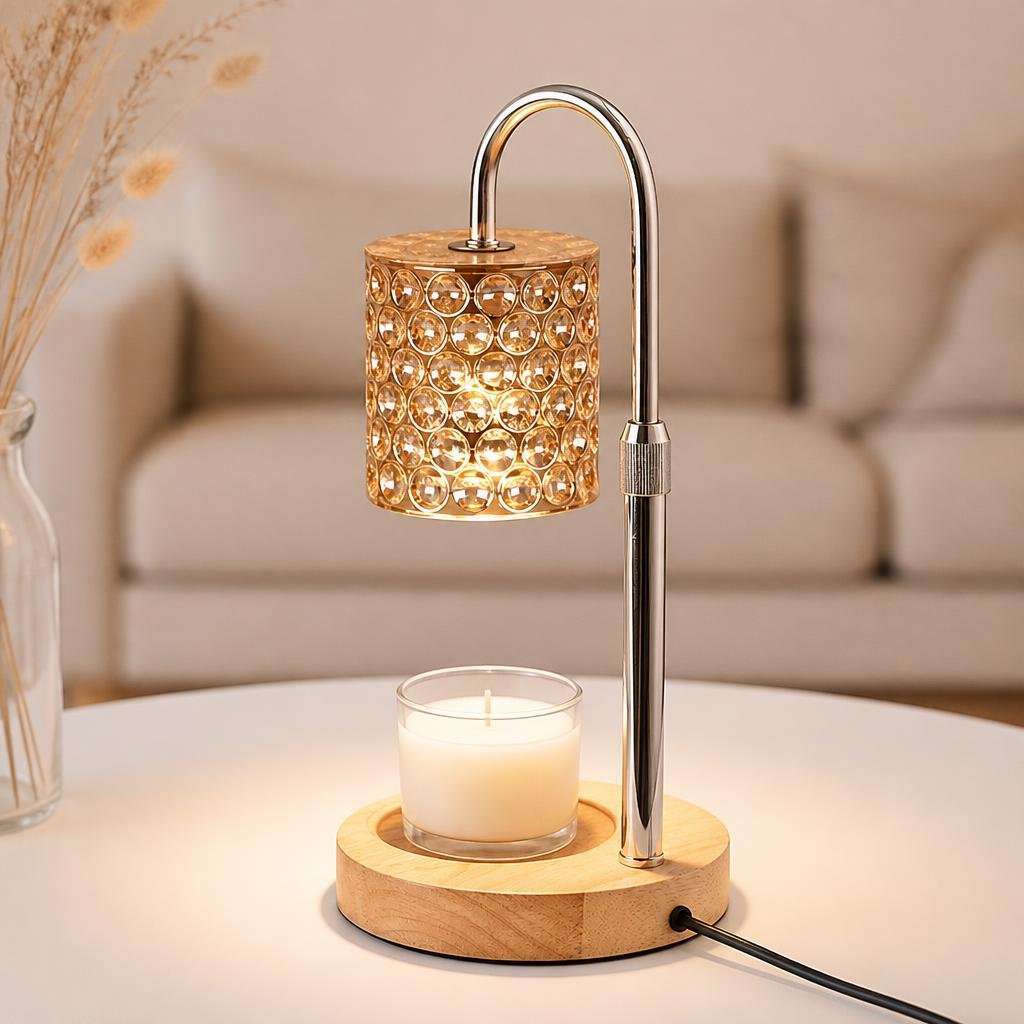
Nightstand Lamp
A GODONLIF nightstand lamp is a candle warmer lamp built for the last hour of the day: a small pool of warm light beside the bed, plus the scent of your own jar candle, and no flame to blow out.
See the nightstand lampsSold and shipped by GODONLIF — free shipping within the contiguous US. Prices are shown on each product page.
Sources and evidence limits
Sleep and light claims come from the primary study or the publishing institution’s own release rather than from secondary round-ups. Two academic sources are cited in plain-text form because their publishers block automated access; the DOI and volume details are given so they can be looked up directly. Each linked page was checked on August 8, 2026.
- Mason IC et al., “Light exposure during sleep impairs cardiometabolic function,” Proceedings of the National Academy of Sciences 119(12): e2113290119 (2022), doi:10.1073/pnas.2113290119 — one night of 100 lux room light during sleep versus dim light below 3 lux; increased nighttime heart rate, higher sympathovagal balance and increased next-morning insulin resistance. Cited as a plain-text academic reference; pnas.org refuses automated retrieval.
- Northwestern University, “Close the blinds during sleep to protect your health,” news release, March 2022. The release carries an unsigned list of practical tips — amber or red-orange light is less stimulating than white or blue, and the source should be kept far from the sleeping person — which this article attributes to the newsroom rather than to any named researcher. Separately, the study’s senior author Phyllis Zee is quoted in her own words: “if you’re able to see things really well, it’s probably too light”. news.northwestern.edu — close the blinds during sleep (retrieved August 8, 2026).
- Sleep Foundation, “Light and Sleep: Effects on Sleep Quality,” medically reviewed by Abhinav Singh, MD (short-wavelength blue light has a significantly larger effect on melatonin and circadian rhythm than longer-wavelength light; bright office lighting rarely reaches about 500 lux while daylight reaches up to 10,000 lux; low illuminance and warm colour temperature support winding down). sleepfoundation.org — light and sleep (retrieved August 8, 2026).
- Kyba CCM, Mohar A & Posch T, “How bright is moonlight?”, Astronomy & Geophysics 58(1), article 1.31 (2017) — measured full-moon illuminance of 0.26 lux horizontally under optimal supermoon conditions, with 0.05 to 0.2 lux typical for most full moons at mid-latitudes. Cited as a plain-text academic reference; academic.oup.com refuses automated retrieval.
- National Fire Protection Association, “Safety with candles” — home candle-fire statistics (approximately 5,894 U.S. home structure fires started by candles per year; roughly 36% start in a bedroom; the leading factor is combustible material left or brought too close). nfpa.org — safety with candles (retrieved August 8, 2026).
- GODONLIF first-party review dataset: the 100 most recent five-star Amazon reviews of the GODONLIF Candle Warmer Lamp (ASIN B0CTJGJL2T), held in-house. Theme counts in this article were produced by keyword search across each review’s title and body, counting each review once per theme; the three quoted reviews are reproduced verbatim with their review IDs. Counted August 8, 2026.
- GODONLIF, “Candle Warmer Light Bulb: Halogen vs LED, Wattage and Replacement” (the 25 W to 50 W halogen range for the arch-style small-lamp class, and why the bulb is the heat source rather than a separate element). godonlifstore.com — candle warmer bulb guide (retrieved August 8, 2026).
- GODONLIF, “Can You Leave a Candle Warmer On Overnight?” — the site’s standing position on session length, unattended operation and the role of the twelve-hour timer. This article defers to it on every duration question. godonlifstore.com — leaving a candle warmer on overnight (retrieved August 8, 2026).
- GODONLIF, “Candle Warmer With Timer and Auto Shut-Off” — what the timer and auto shut-off labels mean, the run windows commonly offered, and how to set them. godonlifstore.com — candle warmer timer guide (retrieved August 8, 2026).
Evidence limits: the Northwestern study is a small laboratory experiment in healthy young adults over single nights, not a study of candle warmer lamps or of any household lamp, and it measured overhead room lighting rather than a shaded bedside source — it establishes that light during sleep is measurable in the body, not how much light a particular lamp puts into your eyes. No illuminance figure in this article was measured on a GODONLIF unit; the lux ladder is a reference scale to judge a room by, not a product specification, and we do not publish a lumen rating we have not measured. The review counts describe our own five-star sample and are therefore selected by definition: they show what satisfied owners choose to mention, not what all owners experience. Nothing here is medical or sleep advice, and nothing here changes the safety or duration position set out in our overnight guide.
You may also like


