News
Where Should I Put My Candle Warmer Lamp? A Room-by-Room Placement Guide

Aug
Placement & Spaces
Where should I put my candle warmer lamp? A warmer is a small appliance with a hot bulb, a heated wax pool and a cord — so the surface it stands on, the space around it, and the building you live in all get a vote. Here is how to pick the spot once and stop second-guessing it.
Key takeaways
Placement is four decisions, not one: the surface under it, the clear space around it, the cord run to the outlet, and whether your building allows the thing at all. That fourth decision is the hardest one at work, where three separate rulebooks apply; we work it through in our guide to candle warmers at the office.
- Surface: flat, hard, heat-tolerant and level — sealed wood, stone, tile, metal or glass. Never fabric, never a wobbly stack.
- Space, not depth: the lamp’s base is only about 5.5 in (14 cm) across, so depth is never the problem. Budget the empty halo around it instead.
- Dorms: the ban is on open flame, and it is near-universal — but whether a warmer counts varies school by school, and some campuses ban halogen lamps separately.[2][4]
- The reason placement matters: the NFPA counts about 5,894 U.S. home candle fires a year, and roughly 36% of them start in a bedroom.[1]
Where should I put my candle warmer lamp? It is the first question people ask after unboxing one, and the honest answer is that four separate constraints have to agree before a spot is a good spot. The lamp needs a surface that will not scorch, tip or mark; it needs empty space around the shade, not just under the base; it needs a cord run that nobody trips over; and if you rent, or live in campus housing, it needs to be allowed. This guide works through all four, room by room, and then handles the two situations where the answer is genuinely different — a residence hall and a rented apartment.
01Where Is the Best Place to Put a Candle Warmer? The Short Answer
Where is the best place to put a candle warmer? On a flat, hard, level surface at roughly sitting-eye height, with a hand’s width of clear space on every side, within reach of a wall outlet, and out of the path people and pets actually walk. A side table beside a reading chair, a bedside table, a console behind a sofa, and the back third of a kitchen counter all satisfy that description. Base sizes vary a little across our arch-style candle warmer lamps, so measure the one you own before you clear the shelf. A bedding-adjacent stack of books, a fabric runner and the front lip of a counter do not. In numbers: the base is only about 5.5 in (14 cm) across and the lamp stands roughly 12 in (30.5 cm) tall, so what you are really budgeting is a clear patch of surface about 12 inches square — which the narrowest published dorm desk, at 19 inches deep, and a standard 25.5-inch kitchen counter both swallow with room to spare.
The reason to be strict about it is that a warmer lamp is quiet about its hazards in a way an open flame is not. There is no flame to watch, so the two real risks are easy to forget: the shade and bulb assembly run hot enough to matter if something soft drapes over them, and the jar underneath holds a pool of liquid wax that will run if the lamp is knocked. Our measurements of how hot a candle warmer actually gets cover the temperature side; this article covers the geography.
| Test | What you are checking | Fails when |
|---|---|---|
| 1. Surface | Hard, flat, level, heat-tolerant, and stable when nudged | Cloth runners, wobbly nesting tables, a stack of books, unsealed or waxed wood |
| 2. Halo | Clear space on all sides and above the shade | Curtains, a low shelf overhead, a bed’s throw blanket, paper piles |
| 3. Cord | A direct run to a wall outlet with no tension on the plug | Cord under a rug, across a doorway, or pulled taut off a table edge |
| 4. Permission | Your lease, housing contract or building rules | Campus housing that names warmers, or a lease with a broad open-flame clause |
Put your hand flat where the lamp will stand
If your palm does not sit level and steady, the base will not either. Do this before you measure anything — it eliminates most candidate spots in a second.
Sweep a hand’s width clear on every side
Move whatever is within that ring: tissues, a book jacket, a trailing plant, the corner of a throw. The halo is the placement, more than the footprint is.
Look up before you look down
A shelf, cabinet or hanging fabric directly above the shade is the constraint people miss, because the heat goes up and the lamp is roughly 12 in (30.5 cm) tall.
Run the cord last, and run it slack
Plug into a wall outlet with enough slack that a tug on the cord moves the cord, not the lamp. Then switch on and leave it there — a fixed spot is what makes the habit safe.
02What Surfaces Can You Put a Candle Warmer On
What surfaces can you put a candle warmer on? Any hard, flat, heat-tolerant material that will not flex under about 2 lb (0.9 kg) of metal and glass: sealed hardwood, stone, quartz, tile, laminate, tempered glass, and metal are all fine. The two things that actually go wrong are heat transfer through the jar into a finish that cannot take it, and a surface that lets the lamp move. Everything in the “avoid” column below fails one of those two tests.
Worth being precise about the heat, because it is often overstated and occasionally understated. Do candle warmers go from top or bottom? In a top-down arch lamp the heat source is the bulb above the candle, not a plate below it — so the surface is warmed indirectly, by the base of a jar that has been sitting under a 25–50 W halogen bulb. That is mild on stone or sealed wood and still enough, over months of daily use, to dull a wax-polished antique or leave a ring on an oiled finish. A coaster of cork, slate or felt-backed stone removes the question entirely and costs nothing.
Good surfaces
Hard, flat, stable
- Sealed or lacquered hardwood, veneer and laminate
- Stone, quartz, granite, marble and tile
- Tempered glass and metal side tables
- Any of the above with a cork or felt-backed coaster
Surfaces to avoid
Soft, unstable or flammable
- Table runners, placemats, doilies and any fabric
- Unsealed, oiled or wax-polished wood
- Wobbly nesting tables, plant stands and stacked books
- Thin plastic trays and anything that flexes when pressed

Bookshelves, Bookcases and the Shelf Above
One surface that deserves a mention on its own is the top of a bookshelf or a dresser with a shelf above it. It looks like a perfect spot — it is out of reach, it is flat, and the light is flattering. It usually fails the halo test, because a shelf 8 or 10 inches above the shade turns the space between them into a heat trap and puts paperbacks directly in it. If the spot you love has something overhead, measure the gap before you commit.
Is it safe to put a lamp under a shelf? For a candle warmer lamp, a shelf close above the shade is the arrangement to avoid, because the heat goes up and the gap between the two fills with it. The better bookcase spot is the open top of a low case with nothing above it at all. That clears the overhead half of the halo test, and it works when the top sits at roughly sitting-eye height and the case stays put when you nudge it; a freestanding case that rocks fails the surface test before the halo test even starts.
Treat the books themselves as part of the halo. A row of paperbacks is paper, and paper piles are one of the things the halo test exists to keep away, so the hand’s width of clear space applies to the nearest spine on either side as much as to anything overhead. Do not raise the lamp on a stack of books either; a stack of books is one of the surfaces that fails test 1.
Then the cord. On a bookcase the easy mistake is letting it hang taut over the front edge of the shelf, which is the same failure as a cord pulled tight off a table edge in test 3. Give it enough slack that a tug moves the cord, not the lamp, and plug it straight into a wall outlet.
03How Much Counter Space Does a Candle Warmer Take Up — and Will It Fit on a Nightstand?
How much counter space does a candle warmer take up? Less than almost anyone expects. The GODONLIF arch lamp stands on a round base about 5.5 in (14 cm) across, reaches roughly 12 in (30.5 cm) tall, and weighs about 2 lb (0.9 kg) — a footprint smaller than a coffee mug’s coaster.[9] Set that against the surfaces people actually consider and the gap is almost comic.
Lamp footprint from the GODONLIF product specification; desk depths from Ohio University Housing and South Dakota State University published residence-hall furniture dimensions; countertop depth from the U.S. standard 24 in base cabinet plus a 1–1.5 in overhang. Retrieved August 4, 2026.
Read the chart the right way round and it changes the question. Depth is never the binding constraint — a lamp that needs 5.5 inches will sit on the narrowest published dorm desk with 13 inches to spare. What you are really budgeting is the clear space: the halo from test 2, plus room for your hand to lift a hot jar off the base without brushing anything. On a standard kitchen counter — 25.5 inches deep, a 24-inch base cabinet plus its overhang[8] — plan on roughly a 12-inch square of surface you keep empty, and put it in the back third where nothing gets slid past it.
Will it fit on a nightstand?
How big is a candle warmer lamp — will it fit on a nightstand? Yes, on essentially any nightstand, and the height is the number that matters more than the width. At about 12 inches tall the lamp sits below eye level for someone sitting up in bed, which is the point: you want to see the glow, not the bulb. The two failure modes on a bedside table are both about neighbours, not size — a phone charger cable snaking under the base, and bedding that reaches the tabletop when the covers are thrown back. Height and shade width are the other half of that table, and the numbers to measure against before buying any bedside lamp are set out in our guide to what size lamp for a nightstand.
Are Candle Warmer Lamps Worth It — and Do They Really Work?
Are candle warmer lamps worth it for the surface they claim? On the numbers above, yes: a 5.5-inch base that fits even the narrowest published dorm desk buys a warm bedside light and a scented room with no flame to watch — the pairing buyers report in the reviews quoted on this page. And do candle warming lamps really work? Yes: the bulb warms the wax pool from above until the fragrance lifts — the same top-down mechanism from section two — with no wick ever lit.
Buyers describe the fit in the same terms the chart implies: the object is smaller than the space they had set aside for it.
It’s cute, compact, and fits perfectly on my stand without taking up too much space. The warm light gives my room a cozy vibe, especially at night.
Note which two things are being reported together — the fit and the light. That pairing is why bedside tables are the most common placement, and why the halo rule matters most there: the spot people want is the one closest to soft furnishings.
Source: verified Amazon review of the GODONLIF Candle Warmer Lamp (ASIN B0CTJGJL2T), United States, April 2026. Review ID R5U2I89F3834L — excerpted verbatim from the review.
04Room by Room: Where the Spot Usually Is
Every room has one placement that is obviously right and one that is tempting and wrong. The pattern repeats: the right spot is a hard surface at the edge of where people sit; the wrong one is wherever soft material lives. One room breaks that pattern, because the air itself is being pulled out of it: in a bathroom the order in which the damp and the fragrance are dealt with matters more than the shelf they sit on, which is why it gets its own sequence in our bathroom scent plan. A meditation corner, all cushions and blankets at floor height, is the hardest test of the soft-material rule, and our guide to small meditation room ideas places the light there.
In a bedroom, the bedside table wins and the dresser is second — keep the lamp on the side of the table away from the bed, because bedding thrown back when the covers come off is the one soft material that routinely reaches a tabletop, and never on a windowsill behind a curtain; at about 12 in tall it sits below eye level for someone reading in bed, which is exactly where you want the glow. In a living room, a side table beside the chair people read in beats the coffee table, because a coffee table is where feet, blankets and board games end up — and a side table gives the roughly 12-inch square of clear top the lamp actually needs. In a kitchen, the back third of the counter — on a standard 25.5-inch countertop that still leaves the working depth free — away from the range and the sink, is the only sensible spot; the scent also travels best from there, because the room already moves air. At a desk or home office, put it on the far corner from your writing hand, behind the plane where paper gets stacked — the 5.5-inch base fits even a 19-inch dorm desk with a laptop’s width to spare, so a full-size desk barely notices it.

Those two numbers are the reason a placement article exists at all. The bedroom is simultaneously the room where candle fires concentrate and the room where people most want a warm light burning late; going flame-free resolves most of that tension, but it does not repeal the halo rule. If you are weighing how long the lamp should stay on once it is in the right spot, that is a separate decision covered in our guide to leaving a candle warmer on overnight, and the household-safety side — reach height, curious hands and paws — is in our candle safety guide for homes with kids and pets.

05Why Are Candles Banned in Dorms — and Where Does a Warmer Land?
Why are candles banned in dorms? Because a residence hall is a high-density building full of people who sleep at irregular hours, and an open flame in one room is a life-safety problem for the whole floor. Housing offices write the rule as a flat prohibition rather than a set of conditions, and they usually extend it past lit candles: Texas A&M’s Residence Life policy bars “candles, incense, oil lamps, and other devices which use an open flame (including potpourri pots)” from residence halls and university apartments alike,[2] and the University of Rochester goes further, stating that even unburnt candles may not be kept in the halls.[5]
Where warmers land is genuinely school-specific, and this is the part that trips students up. Four published policies, read side by side, give four different answers — from an explicit carve-out for bulb warmers to an explicit ban on them.
| Institution | Candles / open flame | Warmers |
|---|---|---|
| Texas A&M University | Prohibited, including potpourri pots | Ceramic wax warmers permitted if the bulb is 25 W or less and the wax is made for a warmer; never left unattended[2] |
| University of Nebraska–Lincoln | Prohibited | Only warmers with an enclosed heating element and automatic shut-off[3] |
| McKendree University | Prohibited, including candles with burnt wicks | Light-bulb candle/wax warmers are the only type allowed — but halogen lamps are separately prohibited[4] |
| University of Rochester | Prohibited, including unburnt candles | Wax melters/warmers prohibited; halogen bulbs prohibited[5] |
Read that table honestly and it contains a problem for us, not just for you. A top-down arch lamp of the kind we make runs on a 25–50 W halogen GU10 bulb, because halogen radiates the heat that melts the wax — an LED in the same socket stays cool and does nothing. So on a campus like McKendree’s, where bulb warmers are the one permitted category and halogen lamps are separately banned, the two rules point in opposite directions and only the housing office can resolve it. At Rochester the answer is simply no. If your handbook bans halogen or requires an enclosed element with auto shut-off, the compliant device is a plate-style warmer rather than a lamp — the two families are compared in our candle warmer plate vs lamp breakdown. We would rather say that than sell you a policy violation.
How to Light a Candle in a Dorm Room
How to light a candle in a dorm room has an unsatisfying but consistent answer: in almost every U.S. residence hall, you cannot, and the workaround people search for does not exist. There is no compliant way to light a wick in a building whose fire policy prohibits open flame — a jar lid, a glass hurricane and a “just for a minute” do not change the rule, and a triggered smoke detector in a shared building is a fire-department callout, not an inconvenience. The route that actually works is to stop lighting anything: warm the candle you already own from above, if your handbook allows a warmer, or switch to a reed diffuser if it does not.
Is a Candle Warmer Lamp Too Big for a Dorm Room or Small Apartment?
Is a candle warmer lamp too big for a dorm room or small apartment? No — and the chart above is the evidence. The narrowest residence-hall desk in Ohio University’s published furniture list is 19 inches deep, and the standard is 24 inches;[6] South Dakota State publishes 22-inch desks across most of its halls.[7] A 5.5-inch base leaves room for a laptop beside it on any of them. In a small room the real constraint is not floor area but outlets: dorm rules commonly restrict extension cords, so pick the surface nearest a wall socket and let that decide the spot.
06Can You Use Candle Warmers in Apartments?
Can you use candle warmers in apartments? Almost always yes, and far more often than you can burn a candle there. A warmer is an ordinary plug-in appliance; the clauses landlords write are aimed at ignition sources, so a lease that says “no candles or open flames” is not usually describing a lamp with a bulb in it. The wording is what matters, though, and it varies: some leases prohibit open flame specifically, others use a broad “nothing that increases the risk of fire or the rate of fire insurance” clause that a cautious property manager could read widely.
The practical move is to read the lease once, search it for “candle”, “open flame” and “appliance”, and if the language is broad, send one email and keep the reply. That paper trail costs nothing and settles the question for the length of the tenancy. Everything else about apartment placement is the same as anywhere else, with one addition worth naming: in a small unit the lamp is closer to a smoke detector than it would be in a house, and while a warmer produces no smoke or soot, a jar candle that has previously been burned can still carry residue on the wick — so put the lamp on the far side of the room from the detector and trim the wick before its first warming session. Whether the lease permits a lit candle in the first place is a different question with a different answer, read clause by clause in our guide to whether candles are allowed in apartments.
The buyer feedback that touches room type is unusually consistent about where the device fits best — and unusually blunt about where it does less.
absolutely love really great for an office, bedroom, or apartment not so much for a house works really well and makes my room smell amazing each time i put a candle under the light
That second clause is the useful half. A single warmer lamp scents the room it is standing in, not a floor plan; in an apartment or a single room that is the whole job, while in a larger house it reads as under-powered unless you place one per room you actually use.
Source: verified Amazon review of the GODONLIF Candle Warmer Lamp (ASIN B0CTJGJL2T), United States, May 2026. Review ID R1ZU4PB812I30J — excerpted verbatim from the review.
07Can I Use a Candle Warmer Lamp Outside on the Patio?
Can I use a candle warmer lamp outside on the patio? Treat a warmer lamp as indoor equipment and the patio answers itself. This is an electrical question before it is a fragrance question: a decorative table lamp standing on an outdoor surface meets dew, humidity and wind-blown rain that indoor furniture never sees, and running one from an indoor socket through a doorway means a cord across a threshold, which is exactly the arrangement extension-cord rules exist to prevent. If you use one outside at all, keep it under full cover, stay with it while it runs, and carry it back indoors when you go — never leave it out overnight or in weather.
There is a second, quieter reason the patio disappoints even when the weather is dry. A warmer lamp works by holding a shallow pool of wax at a low, steady temperature so the fragrance lifts gently — a mechanism that depends on still air. Outdoors, moving air carries the scent away as fast as it is released, so you get the light and almost none of the smell. If you want the lamp near an open door on a still evening, keep it on the inside of the threshold; it will scent the doorway far better than it would scent a patio.
08Settle the Spot in Five Minutes
Run the four tests from the top of this page in order — surface, halo, cord, permission — and give the job to the first spot that passes all four. You are looking for surprisingly little: a hard, level patch roughly 12 inches square for a base that is only 5.5 in (14 cm) across, nothing soft or overhanging within a hand’s width of a lamp about 12 in (30.5 cm) tall, and a wall socket close enough that the cord lies slack. Put your palm flat where the lamp will stand, sweep the ring clear, look up, plug in — then stop moving it. A fixed spot, chosen once, is what turns a safe placement into a safe habit.
Frequently asked questions
These cover the placement questions the sections above only touch in passing — the campus one people search most, plus the surfaces, sockets and scent-spread details that decide a spot once the safety tests are passed.
Can you have a candle warmer in a dorm?
It depends entirely on your school's housing handbook, and the published answers genuinely differ. Texas A&M permits ceramic wax warmers if the heating bulb is 25 W or less and the wax is manufactured for a warmer; the University of Nebraska-Lincoln allows only warmers with an enclosed heating element and an automatic shut-off; McKendree allows light-bulb warmers as the one exception to its open-flame ban; the University of Rochester prohibits wax warmers outright. Search your own handbook for three separate words, namely candle, warmer and halogen, because a school can permit a warmer and still ban halogen lamps, and a top-down warmer lamp runs on a halogen bulb. If the handbook is silent, email housing and keep the reply.
Can a candle warmer lamp sit directly on a wooden dresser or a painted shelf?
Yes on sealed, lacquered or veneered wood and on fully cured painted surfaces, as long as the top is flat and does not flex when you press it. The heat that reaches the furniture is indirect, arriving through the base of the warmed jar rather than from a hot plate underneath, but it is steady, and months of daily use can dull an oiled, waxed or antique finish. A cork or felt-backed stone coaster settles the question for a couple of dollars. Unsealed and oil-finished wood is the one surface worth avoiding outright.
Can I put a candle warmer on a bookshelf?
Yes, if the spot passes the same four tests as any other, and a bookshelf is where the halo test usually fails. A shelf 8 or 10 inches above the shade turns the gap into a heat trap with paperbacks sitting in it, so the open top of a low bookcase, with nothing overhead, is a better choice than a shelf inside one. Keep a hand's width of clear space between the lamp and the nearest book on every side, check that the case does not rock when nudged, and run the cord slack to a wall outlet instead of letting it hang taut over the shelf edge.
Can I put a candle warmer lamp on a windowsill?
It is usually the worst spot in the room. Sills are narrow, often slightly sloped, and they sit directly beneath curtains and blinds that move in a draught, which puts fabric near a hot shade and gives the lamp somewhere to fall. Direct sun on the jar also softens the wax unevenly, so the melt pool behaves differently from one day to the next. If the window is the view you want, put the lamp on a table near it rather than in it.
Does a candle warmer lamp have to be plugged straight into a wall outlet?
Straight into the wall is the right default, and it is test 3 in this guide for a reason: a loose plug or a worn outlet drops power whenever the cord is nudged, so move to a firm outlet and skip slack power strips. If a strip is unavoidable, use one that plugs directly and tightly into the wall rather than into another strip, and check that the lamp's own plug does not sag in the socket. In campus housing the answer is often no by rule rather than by physics: housing policies commonly cap extension cords at six feet, require three-prong grounded cords, forbid running cords under rugs or fixing them to furniture, and send certain appliances straight into the wall. Read your handbook's electrical section first, then pick the surface nearest a wall socket and let the outlet decide the spot.
Where should I put my candle warmer lamp so the scent reaches the whole room?
Near the room's natural air movement, but never in a draught. A side table a few feet from a doorway, or the back of a kitchen counter, spreads fragrance far better than a corner behind furniture, because the air already circulates there. Height helps as well: a surface at seated-eye level releases scent into the part of the room people actually occupy, while a low coffee table lets it pool near the floor. What does not help is air blowing across the jar, because a fan or an open window carries fragrance off faster than the warm wax can release it.
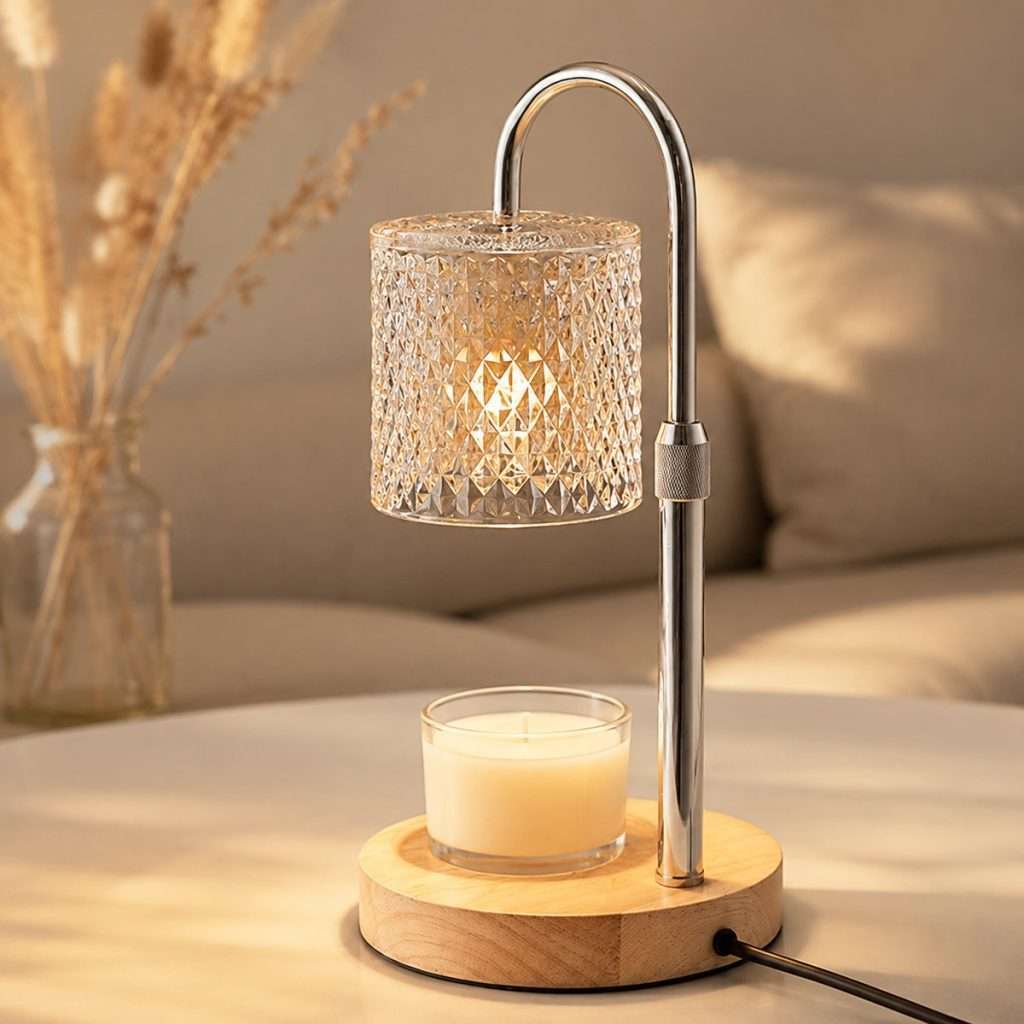
GODONLIF Cut Glass and Wood Adjustable Height Candle Warmer Lamp
An adjustable height candle warmer with a faceted cut glass shade on a round natural wood base. It melts your jar candle with a warm bulb instead of a wick, and both the brightness and the timer adjust.
Shop the adjustable-height warmer lampBrowse all Candle Warmer Lamps →
Sold and shipped by GODONLIF — free shipping within the contiguous US. Price and availability are shown on the product page.
Sources and evidence limits
Fire statistics from the National Fire Protection Association; campus rules quoted from the four institutions’ own published housing policies; furniture depths from two universities’ published residence-hall dimension pages; countertop depth from the U.S. cabinet standard. Each link was checked on August 4, 2026.
- National Fire Protection Association, “Safety with candles” — home candle-fire statistics (approximately 5,894 U.S. home structure fires started by candles per year; roughly 36% start in a bedroom; the leading factor is combustible material left or brought too close). https://www.nfpa.org/education-and-research/home-fire-safety/candles (retrieved August 4, 2026).
- Texas A&M University Residence Life, “Candles / Wax Warmers” (open-flame devices including potpourri pots prohibited in residence halls and university apartments; ceramic wax warmers permitted only with a heating bulb of 25 W or less and wax manufactured for a warmer; never to be left unattended while on). https://reslife.tamu.edu/on-campus-housing-policies/candles/ (retrieved August 4, 2026).
- University of Nebraska–Lincoln University Housing, policy library, “Candles” (candles, incense and other flame-emitting articles prohibited; only candle warmers or potpourri burners with an enclosed heating element and an automatic shut-off allowed). https://housing.unl.edu/housing-dining-policy-library/items-your-space/candles (retrieved August 4, 2026).
- McKendree University Residence Life, “Residential Safety and Prohibited Items List” (open-flame objects including candles with burnt wicks prohibited; light-bulb candle/wax warmers the only type of warmer allowed on campus; halogen lamps and lamps with combustible shades prohibited; extension cords limited to six feet). https://www.mckendree.edu/student-life/res-life/life/Residential_Safety_and_Prohibited_Items_List.php (retrieved August 4, 2026).
- University of Rochester Office for Residential Life & Housing Services, “Fire Safety and Prohibited Items” (candles prohibited including unburnt candles, along with anything with an open flame or that burns such as incense and wax melters/warmers; halogen bulbs and lights prohibited). https://www.rochester.edu/reslife/upperclass/policies/fire-safety.html (retrieved August 4, 2026).
- Ohio University Housing and Residence Life, “Residence Hall Rooms & Furniture” (most desks 42″L × 24″W × 30″H; Bromley Hall desks 19″W; suite computer desks 48″L × 24″W × 30″H). https://www.ohio.edu/housing/rooms-furniture (retrieved August 4, 2026).
- South Dakota State University Housing and Residential Life, “Room and Furniture Dimensions” (residence-hall desks 42″ × 22″ × 30″ and 44″ × 22″ × 30″; dressers 37″ × 22″ × 30″). https://www.sdstate.edu/housing-residential-life/room-furniture-dimensions (retrieved August 4, 2026).
- SlabWise, “How deep are countertops? Standard depths explained” (standard countertop depth 25–25.5 in: a 24 in base cabinet plus a 1–1.5 in overhang, the NKBA-codified U.S. baseline). https://slabwise.com/guides/how-deep-are-countertops (retrieved August 4, 2026).
- GODONLIF, product specification for the Candle Warmer Lamp — Matte Black (Arch): base 14 × 14 cm (5.5 in), height 30.5 cm (12 in), weight 0.9 kg (2 lb); ships with two GU10 bulbs. https://godonlifstore.com/product/godonlif-candle-warmer-lamp-series/ (retrieved August 4, 2026).
Evidence limits: the four housing policies quoted here are the published rules of four institutions and are not a survey — they are cited to show the range of outcomes, not a national pattern, and any handbook can change between academic years, so your own school’s current text governs. Lease language varies by property and jurisdiction and nothing here is legal advice. The NFPA figures are national annual averages for home structure fires started by candles and describe open-flame candles, not warmers; a warmer lamp removes that ignition source but remains a mains-powered appliance with the ordinary electrical and tip-over considerations of one. Furniture depths are the published dimensions of two universities’ current stock and vary by hall.
You may also like