News
What Candles Are Non Toxic, and Are Candles Toxic at All? A Nontoxic Candle Label Guide

Aug
Safety & Labels
“Nontoxic” is a marketing word, not a regulated one. Here is what a candle label is actually required to tell you, what it is free to leave out, and how to read the four lines that matter.
Are candles toxic? No candle is fully non-toxic: anything burned gives off combustion by-products, and “non-toxic” has no US definition.[1] One rule is settled: since October 15, 2003, US metal wick cores may hold no more than 0.06% lead.[4] What candles are non toxic in practice? Ones whose wax you can name, heated without a flame.
Key takeaways
These are the nontoxic candle basics worth carrying into a store: the phrase itself has no regulatory definition, the label is required to tell you very little, and the two decisions genuinely in your hands are which wax you buy and whether you set it on fire.
- “Nontoxic” is not a defined category. The FTC treats it as a claim that must be backed by “competent and reliable scientific evidence” if challenged — it is not certified or pre-approved by anyone.[1]
- The label owes you three things: what the product is, how much is in it, and who made it. Wax type, blend ratio, and fragrance ingredients are not on that list.[2][3]
- Lead wicks are the one settled question. Since October 15, 2003 a metal wick core may not exceed 0.06% lead by weight in the US.[4]
- “Fragrance” is one word covering thousands. The 2025 IFRA Transparency List catalogs 3,691 fragrance and functional ingredients in worldwide use.[7]
Search nontoxic candle and you will get a thousand confident lists and almost no definitions. That is not an accident. “Nontoxic” is a marketing word that sits in a regulatory gap: no US agency certifies it, no standard defines it, and the label on the jar is required to disclose far less than most shoppers assume. This guide does the boring, useful thing instead of ranking brands — it walks the four lines on a candle label (wax, wick, fragrance, soot), shows exactly what each one is and is not allowed to hide, and ends with the one change that does more than any label ever will. That change is heating the wax instead of burning it, which is all an electric candle warmer does.
01Are Candles Toxic? The Short Answer
Not in the absolute way the word suggests, and not at zero either. Where would any toxicity come from? Two places: combustion, and fragrance. In 2021, a peer-reviewed chamber study in Environment International ran 24 burning experiments and, as its authors expected, detected a multitude of emissions, some from the flame and some from evaporated fragrance.[10]
Are candles toxic to humans in normal home use? The study, which candle trade bodies co-funded, estimated room levels below indoor guidance values in most cases, with exceptions in some cases for nitrogen dioxide, acrolein and benzo[a]pyrene.[10] That is an estimate for particular candles in a particular room, not a verdict on yours, and whether it adds up to toxic candles is a question of dose, not of brand. What changes when the flame is taken away, and what does not, is covered in our look at whether a warmer lamp cuts emissions.
02What Makes a Candle Non Toxic, and What Makes Candles Toxic
Start with the word on the label itself, “nontoxic.”
It means whatever the brand that printed it wants it to mean. There is no federal definition of a nontoxic candle, no certification body that audits the claim, and no test a candle has to pass before the word goes on the jar. Compare that with “organic” in the grocery aisle, which is tied to a specific certification scheme, and you can see the gap. On a candle, “nontoxic” is closer to “artisanal” than to “USDA Organic” — an adjective, not a status.
That does not make every brand using it dishonest. Plenty of makers who say “nontoxic” have made genuinely thoughtful choices about wax and fragrance, and they use the only word shoppers actually search for. The problem is that a careful brand and a careless one are allowed to print the identical word, and nothing on the package lets you tell them apart. Which is why the useful skill is not finding the right label word — it is knowing which four lines on the jar carry real information and which are decoration.
What “nontoxic” on a candle comes with
- No federal definition of the word
- No certification body that audits it
- No test the candle has to pass first
- An FTC case, after the fact, if it misleads[1]
What the four label lines can tell you
- Which wax family is in the jar
- What the wick is made of
- Roughly how heavily it is fragranced
- Still nothing about what reaches your air
Why Nobody Has to Prove a Nontoxic Candle Claim
Three different agencies touch candles, and none of them owns the question you are asking. The Federal Trade Commission’s Green Guides say plainly that it is deceptive to misrepresent that a product is non-toxic, and that a marketer making the claim needs competent and reliable scientific evidence that the product is safe for both people and the environment.[1] That sounds strict, and on paper it is. But the FTC does not review or approve claims before they ship — it acts afterward, if someone complains and a case is brought. In practice the word goes on the jar first and gets questioned almost never.
Federal packaging law is narrower still. Under the Fair Packaging and Labeling Act, a consumer commodity’s label has to identify what the product is, state the net quantity of contents, and name the manufacturer, packer, or distributor and its place of business.[2] That is the list. The Consumer Product Safety Commission, which is the agency that actually regulates candles, focuses on hazard: cautionary labeling where a hazardous substance is involved, a conformance statement for metal-cored wicks, and a set of voluntary ASTM standards (F2058 for cautionary labeling among them) that most of the industry follows without being legally compelled to.[3] Nothing in that structure requires a candle to name its wax or its fragrance.
| Item | Required? | Where the rule lives |
|---|---|---|
| What the product is | Required | Fair Packaging and Labeling Act, 15 U.S.C. §1453 |
| Net quantity of contents | Required | Fair Packaging and Labeling Act, 15 U.S.C. §1453 |
| Maker’s name and place of business | Required | Fair Packaging and Labeling Act, 15 U.S.C. §1453 |
| Metal wick core within the lead limit | Required | 16 CFR §1500.17(a)(13); CPSC candle guidance |
| Fire-safety cautionary label | Voluntary standard, widely followed | ASTM F2058, referenced by CPSC |
| Wax type and blend ratio | Not required | No federal rule |
| Fragrance ingredients | Not required | No federal rule |
| Evidence behind “nontoxic” or “clean burning” | Not pre-approved | FTC Green Guides §260.10 — enforced after the fact |
Read that table once and the whole category makes more sense. The parts of a label that are legally pinned down are the commercial basics and one specific hazard. Everything a shopper hunting for a nontoxic candle actually wants to know sits in the unregulated half — which is exactly why the marketing is loudest there.
03Which Candles Are Non Toxic? Four Lines on the Jar Decide It
Which candles are non toxic is not something a jar can settle, because the label owes you very little.[2] It can carry four lines, and those four decide how much you can know.
| Line | What the rules pin down | What you can still check |
|---|---|---|
| Wax | Nothing; wax type is optional[2] | Is the wax named precisely? |
| Wick | Lead in a metal core, 0.06% at most[4] | Material, then trim it |
| Fragrance | Nothing; no ingredient list[3] | Scent strength and run time |
| “Clean burning” | Nothing; not pre-approved[1] | Wick length and drafts |
Line One: What Type of Candles Are Non Toxic? Wax by Wax
No wax is non toxic by name. In the 2021 study, unscented palm, paraffin, soy and stearin candles behaved very similarly and no wax showed a consistently better emission profile, as our look at whether soy candles are toxic details; fragrance moved the numbers more.[10] Paraffin is refined from petroleum and soy wax is hydrogenated soybean oil,[11] while beeswax, which the study did not test, is the comb wax secreted by worker honeybees.[12]
The wax line is the first thing worth reading, and the first place vagueness is doing work. A jar that says “soy wax” is telling you something. A jar that says “soy wax blend” is telling you noticeably less, because no federal rule defines a minimum soy content for that phrase — the only backstop is the FTC’s general prohibition on deceptive claims, applied after the fact.[1] Two candles can carry the same “blend” wording and contain very different proportions of what you thought you were buying.
The instinct this produces, that soy is safe and paraffin is not, is where most nontoxic candle advice goes wrong. Paraffin’s side of it is taken apart in our full look at whether paraffin wax is toxic. The short, honest version: the measured safety gap between common candle waxes is much smaller than the aisle implies. So the reason to read the wax line is not to find a magic wax. It is a transparency test. A brand that names its wax precisely is a brand willing to be checked; a brand that hides behind “blend” or “premium wax” has told you something about itself, if not about its chemistry.
| Label word | Legally defined? | What it can still leave open | Better question to ask |
|---|---|---|---|
| “Nontoxic” | No | Whether anything was ever measured | Nontoxic compared with what, and tested how? |
| “Clean burning” | No | Refers to visible soot, not to chemistry | Does the brand name the wax and the wick? |
| “Soy blend” | No minimum soy content | How much of the jar is actually soy | What percentage is soy? |
| “Lead-free wick” | Effectively the legal baseline since 2003 | Nothing — it is true of every compliant candle | Is the wick cotton, paper, or wood? |
Line Two: The Wick, the One Thing US Law Settled
Here is the rare piece of good news, and it is the reason “lead-free wick” on a modern label is less impressive than it sounds. In April 2003 the Consumer Product Safety Commission finalized a ban on metal-cored candlewicks containing lead and candles made with them, effective October 15, 2003. Under 16 CFR §1500.17(a)(13), a metal wick core manufactured or imported on or after that date may not contain more than 0.06% lead by weight of the metal core.[4][6]
The numbers behind that rule explain why it mattered. In the rulemaking record, CPSC laboratory investigations indicated that candles with lead-cored wicks could emit more than 3,000 micrograms of lead per hour while burning, and CPSC staff concluded that children exposed to indoor air from candles emitting 430 micrograms per hour or more could reach blood lead levels above 10 micrograms per deciliter.[5] That is a genuine, measured, resolved hazard — and it is resolved. A compliant candle sold in the US today already clears it, which is why “lead-free wick” describes the floor rather than a feature.
So what is worth checking on the wick line now? Material, not legality. Cotton and paper wicks are the common default; wooden wicks crackle and burn wider; some wicks still use a non-lead metal core for stability, which remains legal. None of those choices is a health verdict on its own — but wick condition matters a great deal for soot, which is the next line.
Line Three: Fragrance, One Word Covering Thousands
“Fragrance” is the single least informative word on a candle, and it is not required to be there at all. When a brand does print it, it is a category label, not an ingredient. The scale of what sits behind it is easy to underestimate: the 2025 edition of the International Fragrance Association’s Transparency List, published in July 2025, catalogs 3,691 ingredients used worldwide in fragrance creation — 3,312 fragrance ingredients plus 379 functional ingredients such as antioxidants, preservatives, and solvents.[7]
Ingredient counts: IFRA Transparency List, 2025 edition (published July 9, 2025). Disclosure requirement: Fair Packaging and Labeling Act, 15 U.S.C. §1453, and CPSC candle business guidance — neither requires a fragrance ingredient list on a candle. Retrieved August 2, 2026.
That last bar is the whole point of this article in one mark. Thousands of materials are in legitimate use; a candle label is required to name none of them. This is not a scandal — fragrance formulas are trade secrets across the entire industry, and the materials themselves sit under IFRA’s own restriction standards. It simply means the fragrance line cannot be read as evidence in either direction, and a nontoxic candle claim resting on it is resting on nothing you can inspect. If fragrance load is your concern, the actionable levers are choosing lighter scents, favoring brands that publish more than they must, and controlling how much you run the product — not decoding a word that was never designed to inform you.
Phthalate Free Candles: What That Claim Narrows, and What It Leaves Untouched
The most common way brands try to make the fragrance line concrete is to sell phthalate free candles, and it is worth being exact about what that phrase does and does not settle. It is a carve-out, not a disclosure: it names one family of materials the formula excludes while leaving the other thousands in the same undisclosed bucket as before. Set against the IFRA count above, excluding one family still leaves a fragrance line you cannot inspect.[7]
It also sits under the same enforcement gap as every other line on the label. Nothing obliges a candle to list fragrance ingredients in the first place, so there is no printed list against which a phthalate-free claim could be checked by a shopper.[2] The FTC’s Green Guides do reach claims like this one — an unqualified benefit claim is deceptive if the seller cannot substantiate it — but that is enforcement after the fact, not verification at the shelf.[1] Treat it the way you would treat any other narrowing claim: better than silence, weaker than a brand that publishes its whole formula, and no substitute for controlling how much fragrance you run and for how long.
In 2021 the candle industry’s own research consortium — the European Candle Association, the National Candle Association and seven fragrance houses — funded a peer-reviewed emissions study, and its methods section records the advisory board settling on a 5% fragrance load by weight as most representative of the US and European market. Run that against a standard 10 oz jar and the single word “fragrance” stands for roughly half an ounce of material — none of which a US label is required to itemize.
That is a scale marker, not a safety verdict: it tells you how much Line Three leaves unstated, not whether any of it belongs there.
Source: Salthammer et al., Environment International, vol. 155 (2021), article 106590 — industry-funded (ECA, NCA and Latin American candle associations); §2.1 documents the advisory-board 5% by weight fragrance load. Retrieved August 2, 2026.
Line Four: Soot, and What “Clean Burning” Is Really Claiming
Candles sold as clean burning candles are making a claim about visible smoke, and it is the one label word where the underlying science is unusually settled — just not in the direction the marketing implies. According to the National Candle Association, candle soot is composed primarily of elemental carbon particles and is similar to the soot given off by kitchen toasters and cooking oils, and is chemically different from the soot produced by burning diesel fuel, coal, or gasoline.[8] The industry group has an obvious interest here, so treat it as their position rather than an independent verdict — but the mechanism it describes is not controversial.
What is genuinely useful is their account of the cause. Consumers often assume sooting comes from the wax, the fragrance, or the dye; the NCA’s position is that in a properly formulated candle, wick length and flame disturbance are the primary factors, and that if the wick grows too long or a draft breaks the flame’s teardrop shape, unburned carbon escapes as visible smoke.[8] Their prevention list is correspondingly unglamorous: trim the wick to about ¼ inch before every use, keep the candle out of drafts, and keep the wax pool free of debris.[8]

Notice what this does to “clean burning” as a label claim. If soot is mainly driven by how the candle is run rather than what it is made of, then no wax formulation can promise you a clean burn, and no jar can be sold as clean-burning independent of the person holding the wick trimmer. The claim describes a possible outcome, not a property. What that soot then does to the room it is made in — the plume on the wall, where it lands and how it comes off — is a separate question we take apart in how to avoid candle soot on walls.
If soot is mostly a wick-and-airflow event rather than a property of the wax, you would expect buyers to describe it that way unprompted — and to pin it to one specific moment rather than blame the jar in general. That is what they do. A verified buyer of our own warmer lamp set out the sequence plainly:
So when I light a candle the normal way, it smells nice after a while of burning and then when you blow it out, the nice scent is overpowered by the smoking wick smell and the smoke lands on everything around it. With this candle warmer, I don’t have that problem.
Take that as evidence for exactly what it covers: visible smoke and the film it leaves on nearby surfaces, arriving at the moment of extinguishing rather than steadily throughout the burn. That is the outcome a “clean burning” label points at and cannot guarantee, because the deciding variables — wick length, drafts, how the flame is put out — sit with the person holding the candle rather than with the formula in the jar. It is not a claim about what else ends up in the air: as the section on heat below sets out, taking away the flame takes away combustion, not every emission.
Source: verified Amazon review of the GODONLIF Candle Warmer Lamp (ASIN B0CTJGJL2T), titled “No more candle smoke,” May 2026 — review ID RJUCK0CUN2C4S. Quoted verbatim from the reviewer’s own words, unedited; verified purchase, not an Amazon Vine review.
04How to Know if a Candle Is Non Toxic: Four Checks
How to know if a candle is non toxic comes down to four checks, and the fourth is not on the label at all.
Read the wax line for precision, not virtue
“Soy wax” or “coconut-soy, 100% soy” beats “soy blend” or “premium wax” — not because one wax is safe and another is not, but because a brand willing to be specific is a brand willing to be checked.
Read the wick line for material
Cotton, paper, or wood are the usual answers, and the lead question was settled by regulation in 2003. Then trim it to about ¼ inch and keep it out of drafts — that does more for soot than the label ever will.
Treat the fragrance line as unreadable, and adjust load instead
You cannot audit “fragrance,” so control the variable you can: pick lighter scents, run them for shorter stretches, and open a window. Brands that voluntarily publish more than the law demands are worth rewarding.
Decide how you will heat it — this is the big one
A warmer lamp melts the wax with a bulb instead of a flame, so the entire combustion category comes off the table. It is not a promise of clean air, but it is the largest single change available to you, and it is yours to make regardless of what the jar says.
Step four gets the next section to itself.
05The Variable the Label Never Covers: How You Heat It
Every line above describes what you buy. None of them describes the larger variable, which is what you do next. Burning a candle means combustion; warming it means no combustion at all — and that distinction moves indoor-air outcomes more than any wax swap on the shelf. A flame also makes carbon monoxide, and how much carbon monoxide a candle actually releases has its own page, with the arithmetic. Flame-free heating is not emission-free either, as 2025 research on warmed scented wax showed,[9] and the two methods are compared head to head on scent, safety, and running cost in our candle warmer vs. candle breakdown. There is no point repeating that here; the relevant conclusion for label-reading is simply this.
What the label decides
- Which wax family is in the jar
- Wick material, within the 2003 lead limit
- Roughly how heavily it is fragranced
- Nothing about how much of it reaches your air
- Nothing you can verify without trusting the brand
What your method decides
- Whether there is combustion at all
- How hot the wax surface actually gets
- How fast the fragrance is driven off
- How much fresh air is in the room
- Still not a guarantee of zero emissions
Put bluntly: the column on the right is the one you control completely, and the one no brand can misrepresent to you. Shoppers chasing a nontoxic candle spend nearly all their attention on the left column, where the information is thinnest and the marketing is heaviest. Incense is a different emissions story: the research on incense smoke covers it.
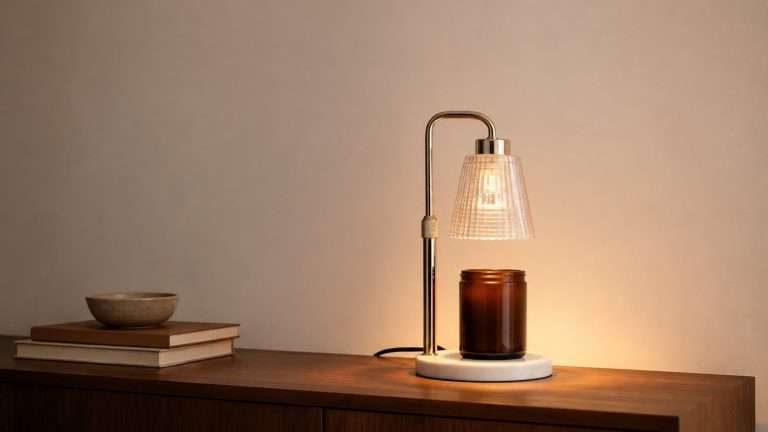
The gentle-heat route is easier to watch than to describe: in the short below, a jar candle releases its fragrance under a warmer lamp — no flame, no smoke point, just warmed wax.
06The Most Conservative Route: A Wax You Can Name, and No Flame
If you want a rule of thumb for picking the healthiest candles to burn that survives contact with an actual store shelf, it is that one. Choose a candle whose maker will tell you exactly what is in it, go lighter on fragrance than you think you need, and then remove the combustion step entirely. The check itself, in the order the label presents it, is the four-step list above.

Two honest limits before you act on any of this. First, flame-free is not emission-free — warming a heavily fragranced candle still puts fragrance compounds into the room, which is precisely why step three sits before step four. Second, an appliance is still an appliance: if you plan to run one for long stretches or overnight, read our rules for leaving a candle warmer on overnight first, because a timer and a clear surface matter more than any label claim on the candle underneath it. If you would rather start from hardware than from theory, our bestselling warmer lamp finishes are the same model in different rooms.
Frequently asked questions
These answers stay inside what the primary documents actually establish, and they treat every regulatory statement as US-specific unless noted.
Is "nontoxic candle" a regulated term in the US?
No. No US agency defines, certifies, or pre-approves a nontoxic candle, and no test has to be passed before the word goes on a jar. The closest thing to a rule is the FTC's Green Guides, which say it is deceptive to misrepresent a product as non-toxic and require the marketer to hold competent and reliable scientific evidence that it is safe for people and the environment. That standard is enforced after the fact, if a claim is challenged, so in practice the phrase reaches shelves unreviewed. Treat it as a brand's own summary of its choices, not as a status anyone verified.
Are essential oil candles the safest candles to burn?
Not automatically. "Natural" and "low-emission" are different questions, and essential oils are still volatile aromatic compounds that heat, evaporate, and react with indoor air like any other fragrance. They are also unregulated as a candle-label term, so an essential-oil claim tells you about sourcing rather than about what reaches your air. If a lighter fragrance load is what you actually want, that is achievable either way: choose subtler scents, run the candle for shorter stretches, and ventilate the room. Buying on the label word alone does not get you there.
Do candles sold today still have lead wicks?
Compliant candles sold in the US should not. Since October 15, 2003, 16 CFR 1500.17(a)(13) has banned metal-cored candlewicks and candles made with them unless the metal core contains no more than 0.06% lead by weight, so a "lead-free wick" claim on a current label describes the legal baseline rather than an upgrade. The realistic exceptions are old stock, secondhand or vintage candles, and items brought in from outside the US market. If a candle predates the ban or has unclear origins, the safest move is simply not to burn it.
What does "clean burning" actually mean on a candle label?
Less than it implies. It is an undefined marketing phrase about visible smoke rather than a chemistry certification, and no recipe can deliver it on its own. The National Candle Association attributes sooting mainly to how far the wick has grown and whether moving air is breaking up the flame, rather than to the wax, dye, or fragrance in the jar. That puts the result largely in your hands instead of the brand's: shorten the wick to roughly a quarter inch before each burn, move the candle away from vents and doorways, and clear any debris out of the melt pool.
Is a candle warmer lamp a good nontoxic candle alternative?
It removes the largest variable, which is combustion, and that is a real difference rather than a marketing one: a warmer lamp melts the wax with a bulb, so there is no flame, no wick to trim, and no soot. What it is not is a promise of zero emissions. Warming a heavily fragranced candle still releases fragrance compounds into the room, so the sensible pairing is a lighter scent, a modest run time, and some fresh air. Think of it as the one lever no candle label can manage for you, not as a clean-air guarantee.
Are there any 100% non-toxic candles available?
No. Whatever the jar says, "100% non-toxic" is the brand's own summary, not a status anyone verified, and anything burned gives off some by-products. The nearest thing on a shelf is a candle with a named wax and wick and little or no fragrance, warmed rather than burned: fewer by-products, not none.
Which are the healthiest candles to burn?
We do not rank candles as healthy, and no label can show that one is. The most defensible pick is a candle whose maker names the wax precisely and keeps the fragrance light; between waxes the measured differences are small, so the label's precision matters more than which wax it names. The biggest single change is not burning it at all.
Do candles produce carbon monoxide poisoning?
A burning candle does release some carbon monoxide, because no flame burns completely, but whether that ever adds up to poisoning depends on how many wicks are lit, how big and how well ventilated the room is, and for how long, and we work through that arithmetic with the published emission rates on our page on whether candles release carbon monoxide.
Which scented candles are safe for health?
No label can answer that, and we do not name brands. Are scented candles toxic, then? The fragrance line is the hardest one to judge: a US candle label does not have to list fragrance ingredients, and the single word "fragrance" can stand for any mix drawn from the 3,691 ingredients on IFRA's 2025 Transparency List. What can be measured is load: in a 2021 chamber study, unscented candles produced lower emissions of combustion by-products than scented ones. So the practical answer is a lighter scent from a brand that publishes more of its formula than the law requires.

Candle Warmer Lamps
A GODONLIF flameless candle warmer lamp melts your jar candle from above with a dimmable bulb — an electric candle warmer, not an open flame — so the same candle lasts far longer and melts evenly with no tunnelling.
Browse flame-free warmer lampsSold and shipped by GODONLIF — free shipping within the contiguous US. Prices are shown on each product page.
Sources and evidence limits
Regulatory statements come from the primary rule text or the agency’s own guidance rather than from secondary summaries; ingredient counts come from the trade body that publishes them; soot mechanics are attributed to the industry association that states them. Each link was checked on August 2, 2026; the three sources added in October were retrieved October 12, 2026.
- US Federal Trade Commission, Green Guides, 16 CFR §260.10, “Non-toxic claims” (deceptive to misrepresent a product as non-toxic; marketer needs competent and reliable scientific evidence of safety for people and the environment). ecfr.gov — 16 CFR §260.10 (retrieved August 2, 2026).
- Fair Packaging and Labeling Act, 15 U.S.C. §1453 (required label statements: identity of the commodity; name and place of business of the manufacturer, packer, or distributor; net quantity of contents). law.cornell.edu — 15 U.S.C. §1453 (retrieved August 2, 2026).
- US Consumer Product Safety Commission, “Candles” business guidance (FHSA cautionary labeling where applicable; metal-cored wick conformance statement; voluntary consensus standards including ASTM F2058 for cautionary labeling). cpsc.gov — candles business guidance (retrieved August 2, 2026).
- 16 CFR §1500.17(a)(13), banned hazardous substances (metal-cored candlewicks and candles with such wicks manufactured or imported on or after October 15, 2003, unless the metal core contains no more than 0.06% lead by weight of the core). ecfr.gov — 16 CFR §1500.17 (retrieved August 2, 2026).
- Federal Register, “Metal-Cored Candlewicks Containing Lead and Candles With Such Wicks,” final rule, April 18, 2003, effective October 15, 2003 (CPSC laboratory investigations indicating emissions of more than 3,000 µg of lead per hour; staff conclusion regarding 430 µg per hour and blood lead above 10 µg/dL in children). federalregister.gov — final rule 03-9255 (retrieved August 2, 2026).
- US Consumer Product Safety Commission, “CPSC Bans Candles With Lead-Cored Wicks,” news release, 2003. cpsc.gov — 2003 news release (retrieved August 2, 2026).
- International Fragrance Association, IFRA Transparency List, 2025 edition, published July 9, 2025 (3,691 ingredients in worldwide use: 3,312 fragrance ingredients and 379 functional ingredients). ifrafragrance.org — about the Transparency List (retrieved August 2, 2026).
- National Candle Association, FAQs and candle-science pages (candle soot as primarily elemental carbon, similar to toaster and cooking-oil soot and chemically different from diesel or coal soot; wick length and flame disturbance as the primary sooting factors; trim to ¼ inch, avoid drafts, keep the wax pool clear). candles.org — FAQs (retrieved August 2, 2026).
- GODONLIF, “Is Paraffin Wax Toxic? What the Science Actually Says” (wax-emissions evidence, the 2009 benzene claim, and the 2025 flame-free nanoparticle research). godonlifstore.com — is paraffin wax toxic (retrieved August 2, 2026).
- Salthammer, T. et al., “Measurement and evaluation of gaseous and particulate emissions from burning scented and unscented candles,” Environment International, vol. 155 (2021), article 106590 (abstract; §4 on wax and fragrance). Industry co-designed, peer-reviewed. candles.org — full text (PDF) (retrieved October 12, 2026).
- National Candle Association, “Elements of a Candle: Wax” (paraffin from petroleum refining; soy wax from hydrogenated soybean oil). Industry body, cited for wax identities only. candles.org — elements of a candle: wax (retrieved October 12, 2026).
- Bradbear, N., Bees and their role in forest livelihoods, FAO Non-Wood Forest Products 19 (2009), ch. 10 (beeswax secreted by young worker honeybees to build comb). fao.org — production and trade of beeswax (PDF) (retrieved October 12, 2026).
Evidence limits: every regulatory statement here describes US federal rules as of July 2026 and may differ elsewhere or change; state-level rules such as California’s Proposition 65 can add disclosure duties this article does not cover. The absence of a labeling requirement is documented from the FPLA’s own list of required statements and CPSC’s candle guidance, not from an agency statement that ingredient disclosure is forbidden. The lead-emission figures are from CPSC’s rulemaking record for candles that are now banned in the US, not measurements of candles currently on sale. Soot descriptions are the National Candle Association’s stated position, and that body represents the industry. Nothing here is a health guarantee or medical advice: no candle, warmed or burned, emits nothing, and anyone with asthma, a respiratory condition, or chemical sensitivities should raise indoor-air questions with a clinician rather than rely on a label word.
You may also like