


News
Do Candles Release Carbon Monoxide? The Measured Rate, and When It Starts to Matter
Sep
Indoor Air
Do candles release carbon monoxide? Yes, and the amount has been measured rather than guessed: 6.1 to 15.6 milligrams an hour per candle across twenty-four chamber experiments. This page turns that rate into parts per million in a room you can picture, sets it beside the World Health Organization, EPA and CPSC numbers, and names the four things that would have to change before any of it mattered.
Key takeaways
This page is about the gas, not about symptoms. If a candle gives you a headache, carbon monoxide is almost certainly not the cause, and the fragrance and irritant side of that question is worked through separately in our page on why candles trigger headaches.
- Yes, and the rate is published. A 2021 chamber study measured 6.1 to 9.3 mg of carbon monoxide per hour from unscented candles and 7.5 to 15.6 mg/h once fragrance was added.[1]
- The room decides the concentration, not the candle. In the study’s own reference room, 30 m³ at half an air change an hour, the highest-emitting candle it tested holds about 1.0 mg/m³, or 0.9 ppm.[1]
- That sits inside ordinary household background. The EPA puts average levels in homes without gas stoves at 0.5 to 5 ppm, and 5 to 15 ppm near a properly adjusted gas stove.[5]
- An alarm is not designed to notice it. Alarms built to UL 2034 must stay silent through 30 ppm for eight hours and must sound at 70 ppm within 60 to 240 minutes.[4]
- The honest caveat cuts against the reassuring reading. The same study that found carbon monoxide comfortably below every guideline also found long-term values for benzo[a]pyrene and acrolein exceeded or partly exceeded.[1]
Search this question and you meet two answers, neither of which is checkable. One says candles are a hidden source of carbon monoxide in your home and you should be worried. The other says candles are perfectly safe and moves straight to a shopping list. The measurements exist, they are public, and they support neither position without qualification. What they support is arithmetic: a per-candle emission rate, a room volume, a ventilation rate, and a set of published thresholds. Put those four numbers together and the answer stops being a matter of opinion.
01Do Candles Release Carbon Monoxide? The Short Answer
Yes. Burning anything carbon-based produces some carbon monoxide, because no flame achieves complete combustion, and a candle is no exception. The quantity is what the argument is actually about, and it has been quantified: between 6.1 and 15.6 milligrams an hour per candle, depending on the wax and whether the wax is fragranced.[1] A milligram an hour is a very small number to hold in your head, so the rest of this page converts it into the unit your alarm and your health guidelines are written in, which is parts per million in the air of an actual room.
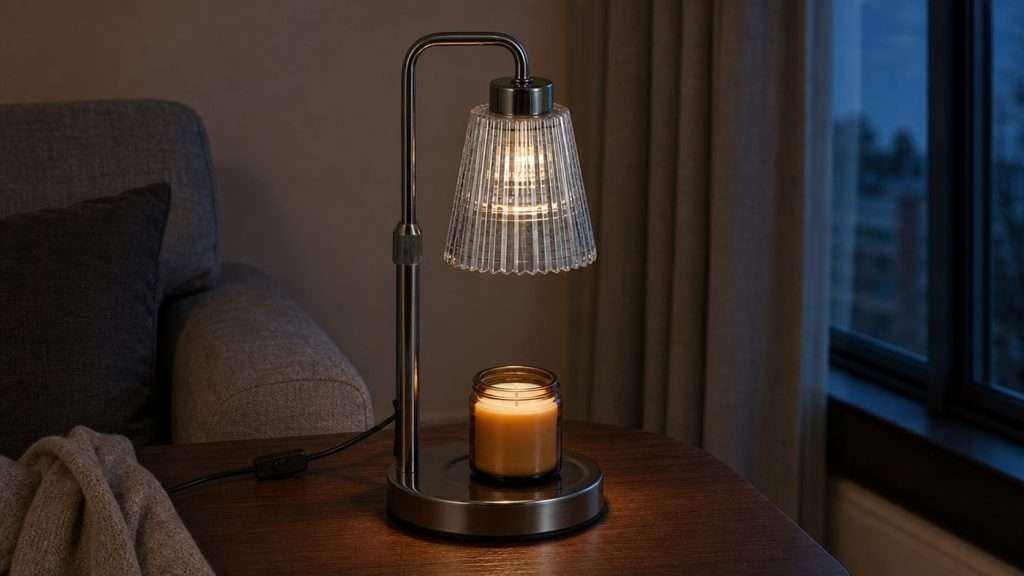
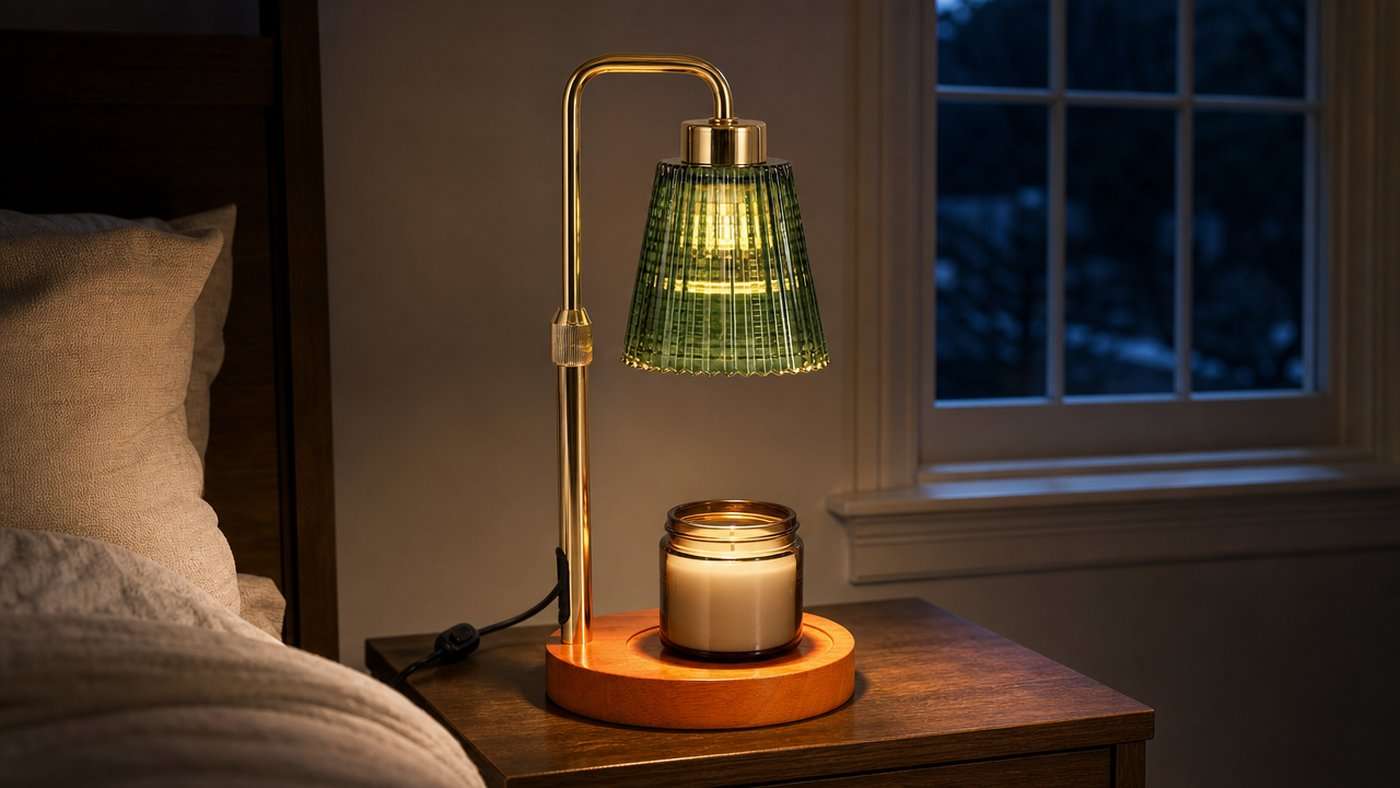
The preview of where that lands: one candle in an ordinary living room adds roughly one part per million, which is inside the range the EPA reports for homes that have no gas appliance at all.[5] The concentration at which a certified alarm is required to sound is seventy times higher.[4] None of that makes the question silly. It relocates it: the risk is not in the candle, it is in the four variables that multiply the candle, and section five names all four. Of the four, the room does the most work, and a small bedroom with the door shut is exactly where warmer lamps for a bedroom make sense: with no wick alight, they add no carbon monoxide to it. Everything else on this page is the working.
02Do Candles Emit Carbon Monoxide? What Twenty-Four Chamber Experiments Measured
In 2021, a team led by Tunga Salthammer at the Fraunhofer WKI institute published the measurement in Environment International, and it remains the most tightly controlled candle emissions dataset we could find.[1] Four candles at a time burned for seven hours inside an 8 m³ stainless steel chamber ventilated at two air changes an hour, with carbon monoxide tracked continuously by a photoacoustic detector down to a limit of 0.2 ppm. Four waxes were tested against five fragrance families plus an unscented control set, giving twenty-four experiments in total. Wicks were chosen individually so that every combination burned at a comparable 3.5 to 4.5 g of wax an hour with no visible soot, which matters: the study measured candles burning properly, not candles burning badly.
The version of this question people actually type into a search box, does candles produce carbon monoxide, is grammatically broken and asks exactly the right thing. Table 4 of that paper answers it per candle, per hour, corrected for chamber background. Two patterns come out of it. Fragrance raises the number, which the authors state outright: candles without fragrance additives produce lower emissions of combustion by-products than candles with fragrance, because many fragrance constituents have a considerably more complex combustion chemistry than the fuels do.[1] And the wax barely matters, which is the finding most buying guides get backwards. In the authors’ words, no individual wax was shown to have a consistently better emission profile than the others.[1] If you have been switching waxes to solve this, our page on whether paraffin wax is toxic covers why that lever moves less than the label implies.
| Wax | Unscented control | Range across five fragrance families | What the fragrance adds |
|---|---|---|---|
| Palm | 6.1 mg/h | 7.9 to 10.6 mg/h | Up to 74% more |
| Paraffin | 7.2 mg/h | 9.4 to 13.5 mg/h | Up to 88% more |
| Stearin | 7.5 mg/h | 7.5 to 10.3 mg/h | Up to 37% more |
| Soy | 9.3 mg/h | 12.1 to 15.6 mg/h | Up to 68% more |
Our own emissions ledger already carried one line of this. The comparison table in whether a candle warmer is better than burning lists carbon dioxide and carbon monoxide as coming from combustion of the wax, present continuously while a candle is lit and absent from a warmer lamp, and cites the 6 to 9 mg/h band from the unscented controls.[8] That page answers whether the gas is emitted. It never answered whether the amount emitted can hurt anyone, which is a different question with a different set of numbers, and it is the one this page exists to settle.
03Can Candles Give Off Carbon Monoxide at a Level You Would Feel? The Arithmetic
Not in a room of normal size at a normal ventilation rate, and the conversion that shows why takes one line. A steady emission into a ventilated space settles at a concentration equal to the emission rate divided by the room volume multiplied by its air changes per hour. Salthammer’s team ran exactly this calculation to assess exposure, and the reference room they chose was 30 m³ at an air exchange rate of 0.5 per hour, which is a small living room that is neither sealed nor drafty.[1] The EPA notes that ASHRAE recommends a ventilation rate of 0.35 air changes per hour for new homes, so 0.5 is a fair middle and 0.35 is a defensible worst case for a modern, tight, closed room.[6]
Run the highest-emitting candle in the entire study, the soy and oriental combination at 15.6 mg/h, through that reference room and it settles at about 1.0 mg/m³. Using the conversion the World Health Organization applies in its own guideline table, 1 ppm equals 1.165 mg/m³, that is 0.9 ppm.[2] One important qualifier travels with that figure: settling takes time. At 0.35 air changes an hour the room needs roughly nine hours to reach 95% of its steady-state value, which is why every scenario worth worrying about later in this page involves duration rather than intensity. An evening never gets there. A night, in a closed room, does.
Forty-one candles is not a safety margin anybody needs to defend. It is the arithmetic refusing to produce a scary answer, and reporting that honestly is more useful than manufacturing a caveat. The number that deserves attention is not the ceiling but the slope: the concentration scales linearly with how many candles are lit, and inversely with how big and how ventilated the room is. Halve the room and you double the figure. Close the door and you can more than double it again. That is where a real answer lives.
04Candles and Carbon Monoxide Against the Published Health Limits
Set that 0.9 ppm beside the thresholds and the scale of the gap becomes visible. The World Health Organization’s indoor air quality guidelines give four averaging times for carbon monoxide: 100 mg/m³ (85.8 ppm) over 15 minutes, 35 mg/m³ (30.0 ppm) over one hour, 10 mg/m³ (8.6 ppm) over eight hours and 7 mg/m³ (6.0 ppm) over 24 hours.[2] Those are not injury thresholds. They are derived to keep carboxyhemoglobin, the fraction of your blood’s hemoglobin bound to carbon monoxide instead of oxygen, at or below 2%, a level chosen because above it the evidence shows ST-segment changes and reduced time to angina in people with ischaemic heart disease.[2] They are protective values with the vulnerable in mind, which is exactly what you want to be measured against.
The Consumer Product Safety Commission describes the symptom floor in blunter terms: most people will not experience any symptoms from prolonged exposure to carbon monoxide levels of approximately 1 to 70 ppm, though some heart patients might experience an increase in chest pain, and it is above a sustained 70 ppm that headache, fatigue and nausea become noticeable.[3] The study’s authors ran their own compliance check against the same guideline framework and reported that all individual compliance factors for carbon monoxide were below one, meaning every short-term peak concentration they modeled came in under the corresponding guide value.[1]
Sources: candle figures calculated from the per-candle emission rates in Salthammer et al. 2021 using that paper’s own reference room;[1] household ranges from the EPA;[5] guideline values from the WHO;[2] the alarm threshold from the CPSC’s UL 2034 conformance report.[4] Guideline values apply to an average sustained over the stated period, not to a momentary reading. Retrieved September 12, 2026.
Read the two household bars against the candle bars and the calibration arrives on its own. Neither the EPA nor the CDC lists candles among the sources of carbon monoxide in a home. The EPA names unvented kerosene and gas space heaters, leaking chimneys and furnaces, gas water heaters, wood stoves and fireplaces, gas stoves, generators and other gasoline-powered equipment, car exhaust from an attached garage, and tobacco smoke.[5] The CDC names gas- and oil-burning furnaces, portable generators, charcoal grills, small engines, stoves, lanterns and fireplaces.[7] That is not an oversight in either list. It is what a rate of fifteen milligrams an hour looks like next to appliances that exist to burn fuel.
05Can Candles Cause Carbon Monoxide Poisoning? Four Situations That Change the Answer
Only if several things go wrong together, and the four variables are the four terms in the equation from section three. Nothing about the candle changes; what changes is the room, the count, the clock and the baseline. Working through them in order of effect is more useful than a warning, because three of the four are things you set without thinking about them.
The room shrinks and the door closes
Volume and ventilation sit in the denominator, so they do the most work. Dropping from a 30 m³ room at 0.5 air changes an hour to a closed 22.7 m³ bedroom at 0.35 roughly doubles the same candle’s contribution.
One candle becomes several
Emission scales linearly with how many wicks are alight. A display of four is four times a single jar, and a decorative cluster of six or eight is where the arithmetic first meets a published guideline value rather than passing far beneath it. Anyone hoping a cluster like that will also warm the room meets the same multiplication from the other side, and the watts it adds up to are worked out in our guide to how much heat a candle produces.
The session runs all night rather than all evening
A closed room needs about nine hours to reach steady state, so an unattended overnight burn is the only ordinary scenario that gets there. Our note on running a warmer overnight covers what unattended actually means for an appliance.
Something that burns fuel is already running
Candles add to a baseline rather than creating one. The EPA puts air near a properly adjusted gas stove at 5 to 15 ppm and near a poorly adjusted one at 30 ppm or higher, which runs from about five to thirty times what one candle contributes and is the reason a genuine problem is never the candle.
| Scenario | Added concentration | Against the WHO values |
|---|---|---|
| One candle, 30 m³ living room, 0.5 ACH | 1.0 mg/m³ (0.9 ppm) | About 15% of the 24-hour value |
| One candle, closed 22.7 m³ bedroom, 0.35 ACH | 2.0 mg/m³ (1.7 ppm) | About 28% of the 24-hour value |
| Four candles, same closed bedroom | 7.9 mg/m³ (6.8 ppm) | Just over the 24-hour value |
| Six candles, same closed bedroom | 11.8 mg/m³ (10.1 ppm) | Just over the 8-hour value |
Two honest readings of that table, and dropping either one would be selling rather than explaining. The first is that even the worst row is a precautionary long-term average being crossed, not a poisoning: it sits at roughly a seventh of the concentration at which the CPSC says symptoms become noticeable.[3] The second is that a steady-state figure assumes the exposure is sustained for the whole averaging window, so six candles for two hours is not the same event as six candles for a night. The row that should change behavior is row three onwards combined with row four of the flow above, and the fix in every case is a door, a window, or fewer wicks.
06Would a Carbon Monoxide Alarm Ever Sound Because of a Candle?
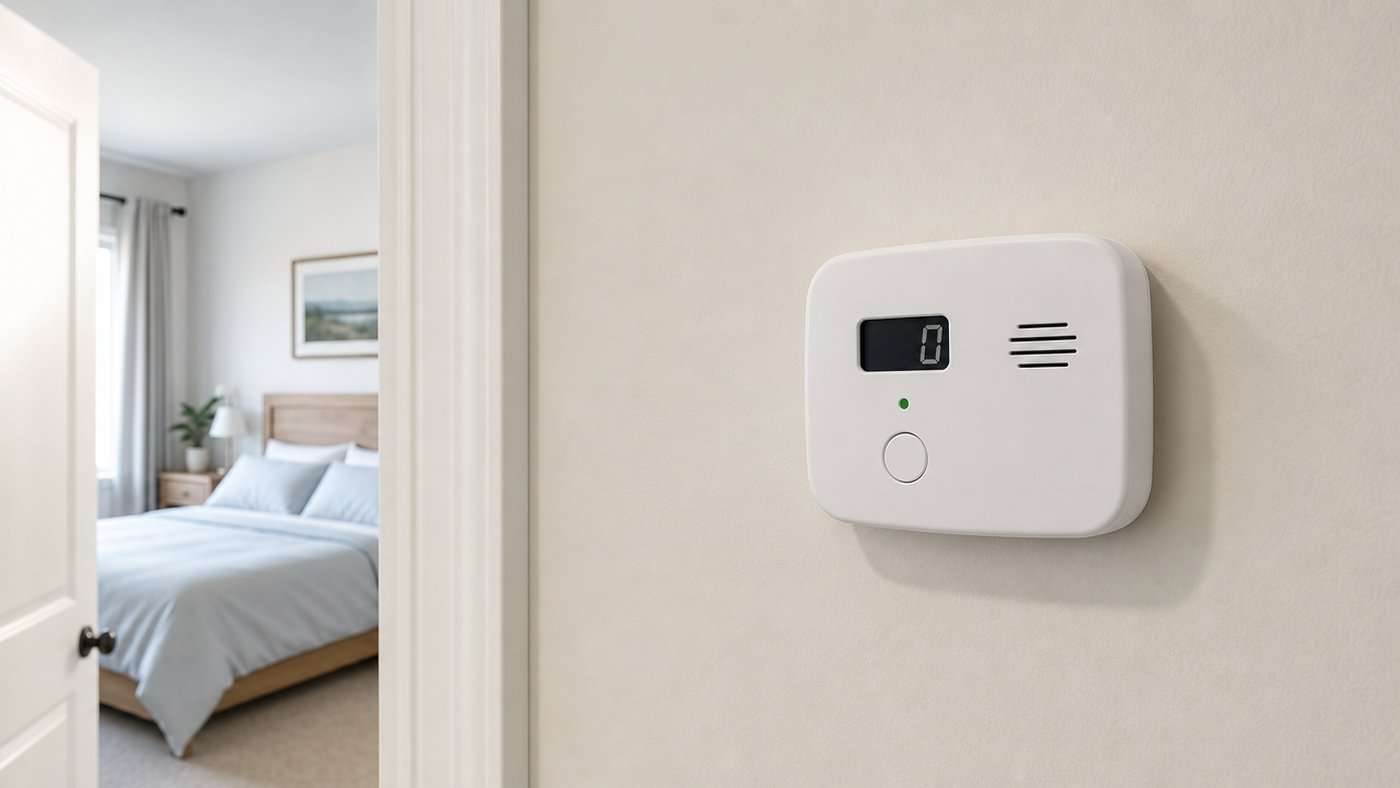
No, and the standard is written specifically to make sure of it. Alarms certified to UL 2034 are tested at four concentrations, and the pass criterion is a response window rather than a simple trip point. At 70 ppm the alarm must activate between 60 and 240 minutes, at 150 ppm between 10 and 50 minutes, at 400 ppm between 4 and 15 minutes, and against a rapid rise of 16 ppm a minute toward 480 ppm between 19 and 30 minutes.[4] The lower bound of each window is deliberate. As the CPSC’s testing report puts it, the requirement includes a period of time in which the alarms cannot activate, so that nuisance alarms from transient levels of carbon monoxide are prevented, and the standard separately requires that alarms exposed to 30 ppm for eight hours, or in another test for thirty days, must not activate at all.[4]
That design decision is what makes the alarm a useful instrument here. Thirty parts per million in the closed bedroom modeled above would take roughly eighteen of the highest-emitting candles in the study burning at once, and even then the alarm is built not to respond. So the practical rule runs the other way around from what people expect. A sounding alarm is never evidence about your candles, and treating it as a candle problem is the dangerous mistake. The CPSC’s guidance is to install alarms meeting the current UL 2034 standard on every level of the home and outside sleeping areas, interconnected where possible so that one sounding sets off the rest,[3] and its instruction for the moment one goes off puts one action before every other: if you suspect carbon monoxide poisoning, get outside to fresh air immediately, and then call 911.[9]
Symptoms are the other instrument, and they belong to clinicians rather than to us. The CDC lists headache, dizziness, weakness, upset stomach, vomiting, chest pain and confusion, describes the pattern as flu-like, and notes that infants, older adults and people with chronic heart disease, anemia or breathing problems are more likely to become ill from a given exposure.[7] Two things follow. If those symptoms clear when you leave the house and return when you come back, that is a reason to call your doctor and have the house checked, not a reason to think about candles at all. And if a scented candle gives you a headache while nobody else in the room is affected, the mechanism is fragrance and irritants rather than this gas, which our page on why candles cause headaches takes apart properly.
07What Taking the Flame Away Actually Removes
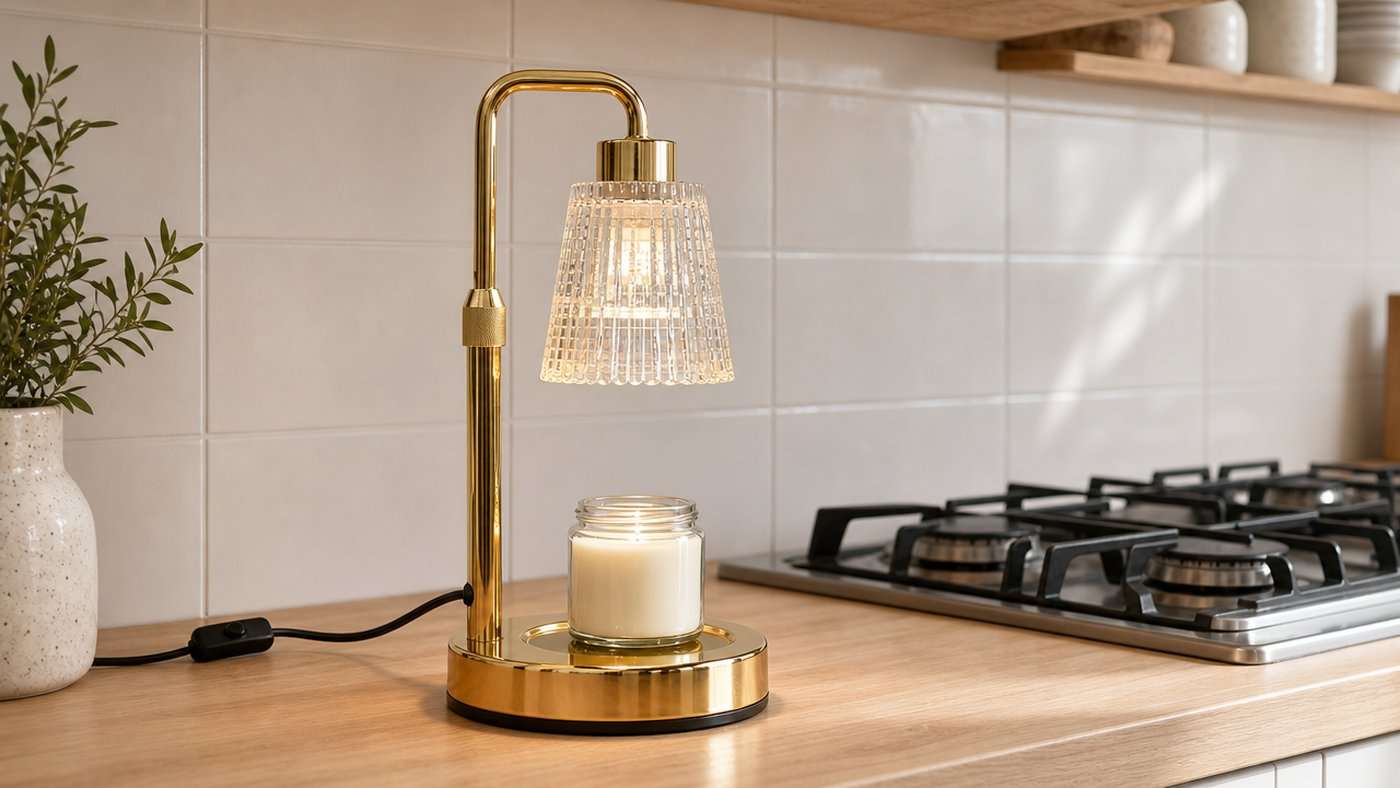
The whole combustion column, and nothing else. Carbon monoxide is not a candle ingredient that a better candle could omit. It is a product of incomplete oxidation at the flame, which is why no wax choice made a consistent difference in the chamber and why fragrance load only mattered once fragrance molecules were being drawn into the flame and decomposed there.[1] A warmer lamp melts the same wax with a dimmable bulb from above, at a wax-pool temperature our page on how hot a candle warmer gets merges from manufacturer guidance at roughly 100 to 160 °F, or 38 to 71 °C. There is no flame, no oxidation of wax vapor, and therefore no combustion products to measure. The everyday differences between the two methods, scent throw and running cost included, are in our candle warmer versus candle comparison.
A jar with a wick in it
- Costs nothing to run
- 6.1 to 15.6 mg of carbon monoxide an hour
- Nitrogen dioxide, soot and PAHs on the same list
- Emissions rise with fragrance load, not fall
- Releases fragrance into the room
The same jar under a lamp
- No combustion, so no combustion products
- Nothing to sound an alarm, ever
- A dimmer, so scent output is a dial rather than a switch
- Uses mains electricity
- Releases fragrance into the room, exactly as before
The last row on both sides is deliberately identical, because it is the row that does not move. Warming scented wax still puts fragrance compounds into the air, and a 2025 study of scented wax melts found that warming can release more of them than burning does, since heating maximizes the wax surface area.[8] If your worry is carbon monoxide specifically, taking the flame away answers it completely. If your worry is the smell itself, or a reaction to it, this appliance is not an answer at all, and pretending otherwise would be the kind of overselling this page has spent eight sections avoiding.
08What This Page Cannot Settle
Every number here is an inference stretched slightly past what its source measured, and the stretches are worth naming. The emission rates come from candles specifically manufactured for the study and burned with individually chosen wicks producing no visible soot, so they describe a candle behaving well rather than the one tunneling in a draft on your windowsill. The study also received financial and advisory support from three candle trade associations, with major fragrance houses represented on its advisory committee, which does not make its data tables wrong but does mean it was not built to find a problem. The steady-state arithmetic in sections three and five assumes a perfectly mixed room, a constant emission rate and an unchanging air exchange rate, none of which is exactly true of any real room.
Two limits cut against the reassuring shape of this page, and they belong here rather than in a footnote. First, the same safety assessment that put carbon monoxide comfortably below every applicable guide value also reported that for benzo[a]pyrene, an indicator of incomplete combustion, and for acrolein, the long-term concentrations set by the WHO and the US EPA were exceeded or partly exceeded.[1] Carbon monoxide being fine is not the same claim as candle smoke being fine, and anyone reading this page as a general clearance is reading it wrong. Second, no chamber study we could find has measured a warmer lamp itself, so the zero in the combustion column of our comparison follows from the absence of combustion rather than from a direct measurement of an appliance. Anyone with a heart or respiratory condition, a suspected exposure, or an alarm that has sounded needs a clinician and a fire department, not an article.
The short below keeps to the order this article does. It opens where section one opens: yes, a candle makes carbon monoxide, and the rate has been measured rather than guessed: 6.1 to 15.6 milligrams an hour per candle. Section two is where that number comes from, the most tightly controlled candle emissions dataset we could find. Section three does the arithmetic: run the highest-emitting candle in the entire study through the reference room and it settles near one part per million. Section four sets that beside the published limits, where most people will not experience any symptoms from prolonged exposure to carbon monoxide levels of approximately 1 to 70 ppm. Section five names the four things that would have to change — what changes is the room, the count, the clock and the baseline. Section six explains why an alarm is built not to notice a candle: the pass criterion is a response window rather than a simple trip point. Section seven is the useful part: carbon monoxide is not a candle ingredient that a better candle could omit, it is a product of the flame, so removing the flame removes the whole combustion column and nothing else. The short closes where section eight does: every number here is an inference stretched slightly past what its source measured, and two of the study’s own findings cut against the reassuring reading.
Frequently asked questions
These answers stay inside what the cited sources establish, and none of them is medical advice or a substitute for a working alarm.
Can you get carbon monoxide poisoning from candles?
Not from candles alone in any room a person would normally sit in, judging by the published emission rates. Poisoning is a dose problem, and the dose is set by how many wicks are alight, how big the room is, how well it is ventilated and how long the exposure lasts. The Consumer Product Safety Commission puts the level at which symptoms become noticeable at a sustained 70 parts per million, and reaching that with candles alone in a small closed bedroom would take dozens of them burning at once. The people for whom smaller margins matter are the ones the CDC names as more susceptible: infants, older adults, and anyone with chronic heart disease, anemia or a breathing condition. If flu-like symptoms appear at home and clear when you leave, that calls for a doctor and a fire department, not a candle audit.
Does burning candles produce carbon monoxide differently when the flame smokes or tunnels?
Almost certainly yes, because soot and carbon monoxide come out of the same failure. Both are products of incomplete combustion, so a flame starved of oxygen, guttering in a draft or running on an over-long wick converts less of its wax cleanly and more of it into the by-product list. The chamber study behind this article cannot put a number on that, and inventing one would be worse than admitting it: its wicks were selected specifically so that every candle burned with no visible soot, which means the published rates describe a well-behaved flame rather than a struggling one. The practical reading is that visible black smoke is a signal worth acting on. Trim the wick back, move the candle out of the draft, and stop guessing about the invisible half.
Do burning candles use up the oxygen in a closed room?
Not at any rate you could detect at household scale. In the chamber study behind the figures used here, four candles burned for seven hours in an 8 cubic meter steel chamber, a far denser candle load than any living room, and oxygen was logged continuously and reported at 21% with only slight variation across the whole test. That chamber was ventilated at two air changes an hour, so it is not a sealed-room experiment, and we are not claiming it as one. The point survives anyway: a bedroom holds two to three times that air volume with a fraction of the flames, and the idea that a candle exhausts the air in a room comes from confined spaces of a different order, such as a vehicle. The useful question is what a flame adds, not what it removes.
Where should a carbon monoxide alarm go in a home where candles are used?
In the same places it belongs in any home, because candles do not change the answer. The Consumer Product Safety Commission recommends installing alarms that meet the current UL 2034 safety standard on every level of the home and outside sleeping areas, choosing battery-operated units or ones with battery backup, and interconnecting them where possible so that one sounding sets off the rest. Placement follows sleeping areas rather than wherever you burn things because the dangerous case is an overnight exposure from a fuel-burning appliance or a blocked flue, when nobody is awake to notice symptoms. An alarm is also the only way to answer this question for your own house rather than by arithmetic done on someone else's.
If carbon monoxide is not the problem, is the carbon dioxide from candles?
Not on the same evidence, and the study checked. The candles in that chamber emitted carbon dioxide at roughly 6,400 to 12,400 milligrams an hour each, which works out at several hundred to well over a thousand times their carbon monoxide output, and carbon dioxide is the expected product of wax burning properly rather than a sign of anything going wrong. When the authors ran their exposure model against published indoor thresholds, every individual compliance factor for carbon dioxide came out below one, meaning the modeled short-term peaks stayed under the guide value. The lever governing both gases, and everything else in indoor air, is the same one. An open door does more for a room than any choice between one wax and another.

Lamps for Bedroom
These lamps for bedroom tables and dressers do two jobs at once: they give you a soft, dimmable glow in the evening, and they melt a jar candle from above so the whole room smells the way you want it to.
Bedroom lamps with nothing alightSold and shipped by GODONLIF — free shipping within the contiguous US. Prices are shown on each product page.
Sources and evidence limits
Emission rates are read from the primary study’s own data tables rather than from secondary summaries; guideline values are quoted from the issuing bodies. Concentrations attributed to candles in sections three, four and five are our calculation from those rates, not measurements. Each link was checked on September 12, 2026.
- Salthammer, T.; Gu, J.; Wientzek, S.; Harrington, R. & Thomann, S., “Measurement and evaluation of gaseous and particulate emissions from burning scented and unscented candles,” Environment International, vol. 155 (2021), article 106590, published May 6, 2021. Peer-reviewed and open access. Its acknowledgment credits three candle trade associations for financial and advisory support and names major fragrance houses on the advisory committee, while the authors declare no known competing financial interests; both are reported here so the reader can weigh them. 24 experiments, four waxes crossed with five fragrance families plus unscented controls, in an 8 m³ stainless steel chamber at 2 air changes an hour, burn rates targeted at 3.5 to 4.5 g/h with no visible soot. Table 4 carries the per-candle carbon monoxide rates used throughout this page (6.1 to 9.3 mg/h unscented, 7.5 to 15.6 mg/h scented); Figs. 5 and 6 carry the reference room used for exposure modeling (V = 30 m³, AER = 0.5 h⁻¹) and the compliance factors, all below one for carbon monoxide. The conclusions supply the three statements quoted in sections two and eight, on fragrance raising by-product emissions, on no wax having a consistently better profile, and on benzo[a]pyrene and acrolein exceeding their long-term WHO and US EPA values. candles.org — full text (PDF) (Retrieved September 12, 2026).
- World Health Organization, WHO Guidelines for Indoor Air Quality: Selected Pollutants (Geneva, 2010), chapter 2, carbon monoxide. Source for the four guideline values used in section four and in the chart: 100 mg/m³ (85.8 ppm) for 15 minutes, 35 mg/m³ (30.0 ppm) for 1 hour, 10 mg/m³ (8.6 ppm) for 8 hours and 7 mg/m³ (6.0 ppm) for 24 hours; for the conversion factor of 1.165 mg/m³ per ppm at 20 °C used in our arithmetic; and for the derivation basis, that carboxyhemoglobin levels should not exceed 2%, chosen because COHb elevated above 2% caused ST-segment changes and decreased time to angina. ncbi.nlm.nih.gov — WHO indoor air quality guidelines, carbon monoxide (Retrieved September 12, 2026).
- US Consumer Product Safety Commission, “Carbon Monoxide Fact Sheet.” Source for the symptom floor quoted in sections four and five, that most people will not experience any symptoms from prolonged exposure to levels of approximately 1 to 70 ppm while some heart patients might experience an increase in chest pain, and that symptoms become noticeable as levels rise and remain above 70 ppm; and for the alarm placement guidance in section six, to install alarms meeting the current UL 2034 standard on every level of the home and outside sleeping areas, interconnected where possible. The same sheet records that more than 200 people in the United States die each year from carbon monoxide produced by non-automotive consumer products. cpsc.gov — carbon monoxide fact sheet (Retrieved September 12, 2026).
- Brookman, Matthew J., Carbon Monoxide Alarm Conformance Testing to UL 2034: Standard for Safety for Carbon Monoxide Alarms, Phase I, FY 2012 Test Results, Directorate for Laboratory Sciences, US Consumer Product Safety Commission, March 2014. Staff report, not reviewed or approved by the Commission. Source for the UL 2034 Section 39 response windows in section six and in the chart (70 ppm: 60 to 240 minutes; 150 ppm: 10 to 50 minutes; 400 ppm: 4 to 15 minutes; a 16 ppm-per-minute rise to 480 ppm: 19 to 30 minutes), and for the statement that the criteria include a period in which the alarms cannot activate so that nuisance alarms from transient levels are prevented, with alarms required not to activate at 30 ppm for 30 days or 8 hours depending on the test. cpsc.gov — UL 2034 conformance testing, Phase I (PDF) (Retrieved September 12, 2026).
- US Environmental Protection Agency, “Carbon Monoxide’s Impact on Indoor Air Quality,” in its July 2026 revision. Source for the household background ranges used in the key takeaways, the chart and sections four and five: average levels in homes without gas stoves vary from 0.5 to 5 ppm, levels near properly adjusted gas stoves are often 5 to 15 ppm, and those near poorly adjusted stoves may be 30 ppm or higher. Also the source list quoted in section four, which names unvented kerosene and gas space heaters, leaking chimneys and furnaces, gas water heaters, wood stoves and fireplaces, gas stoves, generators, garage car exhaust and tobacco smoke, and which does not include candles. epa.gov — carbon monoxide’s impact on indoor air quality (Retrieved September 12, 2026).
- US Environmental Protection Agency, “The Inside Story: A Guide to Indoor Air Quality.” Source for the ventilation figure used in section three: the American Society of Heating, Refrigerating and Air-Conditioning Engineers recommends a ventilation rate of 0.35 air changes per hour for new homes, and where there is little infiltration, natural ventilation or mechanical ventilation, the air exchange rate is low and pollutant levels can increase. epa.gov — the inside story, a guide to indoor air quality (Retrieved September 12, 2026).
- US Centers for Disease Control and Prevention, “Carbon Monoxide Poisoning Basics,” in its January 2026 revision. Source for the annual burden and the symptom and risk lists in sections four and six: more than 400 Americans die from unintentional carbon monoxide poisoning not linked to fires each year, more than 100,000 visit an emergency department and more than 14,000 are hospitalized; symptoms are headache, dizziness, weakness, upset stomach, vomiting, chest pain and confusion, described as flu-like; infants, the elderly and people with chronic heart disease, anemia or breathing problems are more likely to get sick. Its source list names gas- and oil-burning furnaces, portable generators, charcoal grills, small engines, stoves, lanterns and fireplaces, and does not include candles. cdc.gov — carbon monoxide poisoning basics (Retrieved September 12, 2026).
- GODONLIF, “Are Candle Warmers Better Than Burning?” Source for the emission comparison table quoted in section two, which lists carbon dioxide and carbon monoxide as products of combustion of the wax, present continuously while a candle is lit and absent from a warmer lamp, and for the summary of the 2025 Purdue wax melt study referenced in section seven. This is our own page and the least authoritative source used here; the underlying emission figures on it come from the study cited at [1]. godonlifstore.com — are candle warmers better than burning (Retrieved September 12, 2026).
- US Consumer Product Safety Commission, Carbon Monoxide Information Center. Source for the single instruction quoted in section six and used in the response chain there: if you suspect carbon monoxide poisoning, get outside to fresh air immediately, and then call 911. The same page repeats the placement guidance given in [3] and adds that batteries should be checked regularly. cpsc.gov — carbon monoxide information center (Retrieved September 12, 2026).
Further reading on this site — background rather than evidence cited above: candle warmer versus candle covers the everyday differences between the two methods, and how hot a candle warmer gets gives the wax-pool temperature band referenced in section seven.
Evidence limits are set out in section eight. The single largest one: every concentration attributed to a candle on this page is calculated from a published emission rate using a simple steady-state model, not measured in anyone’s home. Treat the figures as the right order of magnitude rather than as a reading from your own room, and treat a certified alarm as the only instrument that can actually tell you what is in the air you are breathing.
You may also like


