News
Can You Leave a Candle Warmer On Overnight? 4 Safety Rules

Jun
Safety & Health
No open flame. No fire-from-tipped-candle risk. But a candle warmer lamp is still an electrical appliance — and a few simple precautions make all the difference. Here’s the honest, reassuring answer.

Key takeaways
- Yes, you can leave a candle warmer on overnight — with the right unit and the right setup.
- No open flame means the biggest candle fire risk (NFPA: ~5,894 US home fires/yr) is removed entirely.
- Four precautions cover the rest: certified unit · stable surface · clear cord and area · timer.
- A built-in 12-hour auto-shutoff timer is the single most important safety feature for overnight use.
- Leaving a wax warmer on overnight without a timer risks overheating once the wax runs dry — the timer solves this.
The question “can you leave a candle warmer on overnight” comes up constantly — and for good reason. The whole appeal of a candle warmer lamp is that it runs quietly in the background, filling a room with fragrance without demanding your attention. That set-and-forget quality is exactly what makes it the anchor for keeping a home smelling good all day. But if you’re about to fall asleep, you want an honest answer, not marketing reassurance. Here it is: yes, you can — and it’s far safer than sleeping near a burning candle — but it is still an electrical appliance, and three minutes of setup makes all the difference.
01The short answer
To be precise about what “safe” means here: a candle warmer lamp eliminates the single largest fire risk associated with candles — the open flame — while substituting the standard risk profile of a low-wattage household appliance. The remaining precautions are the same ones you’d apply to a nightlight or a humidifier.
02Why it’s far safer than a burning candle
The National Fire Protection Association reports an average of 5,894 US home candle fires per year, resulting in 63 deaths, 532 injuries, and $286 million in property damage annually. The leading causes: candles left unattended or burning while occupants slept, candles placed too close to combustibles, and candles knocked over. A candle warmer lamp removes all three root causes at once:
- No open flame — nothing to ignite a curtain, bedding, or a knocked-over candle jar.
- No tipping hazard from a lit wick — the lamp sits on its own stable base and heats from above.
- No unattended flame — there is no flame at all, and a timer makes the appliance self-supervising.
This is the core of why is it safe to leave a candle warmer on has a very different answer than “is it safe to leave a burning candle on.” The risk categories are genuinely different in kind, not just degree. One of those categories is the air itself, and a wick left burning all night is the single scenario where the trace output of one candle is worth doing the arithmetic on — we do it in our page on candles and carbon monoxide.

03The four precautions that matter
A candle warmer lamp is a low-wattage electrical appliance. Everything in our candle warmer lamp range is that kind of appliance, so the four checks below apply to whichever one you own. Curious exactly how little that costs to run all night? Our real monthly cost breakdown has the numbers. It deserves the same care you’d give any other appliance you leave running while you sleep. Four checks cover the relevant risks completely:
Use a UL- or ETL-listed unit
UL (Underwriters Laboratories) and ETL (Intertek) certification means the product has been independently tested for fire, electric shock, and thermal hazards. A listed unit carries a mark on the label. Non-listed imports may skip thermal cutoffs entirely — the certification is the single most important purchase criterion for overnight use.
Place on a stable, heat-resistant surface
A bedside table, dresser, or nightstand made of wood, stone, or solid composite works well. Avoid soft, uneven, or fabric-covered surfaces where the base can shift. (Exact bulb, wax and plate readings are in our candle warmer temperature guide.) The lamp’s dish gets warm — not hot enough to scorch a wooden surface, but not something to rest on a paperback book or a pile of fabric.
Keep the cord and surrounding area clear
Route the cord so it can’t be pulled or tripped over. Leave at least 12 inches of clearance around the lamp — no draping curtains, no scarves, no bedding piled close. The lamp’s arch lifts the bulb well above the jar, but adequate clearance is still standard appliance practice.
Never cover it
The halogen bulb needs to radiate heat upward and outward. Covering the lamp with anything — a cloth, a decorative shroud, a box — traps heat and is a fire hazard. Leave the arch and bulb fully exposed at all times during operation.
04Why the 12-hour timer is the hero feature
The cleanest solution to overnight electrical-appliance anxiety is an automatic shutoff. The GODONLIF candle warmer lamp includes a built-in 12-hour countdown timer: set it before you fall asleep and the lamp shuts itself off, regardless of whether you remember in the morning. You don’t rely on memory, a smart plug, or waking up to check. Whether the scent itself is doing anything for you in the last hour before you drift off is a separate question from whether the lamp is safe to leave running, and we take that one up in our guide to candles and scent at bedtime.
This is where the “can you sleep with a candle warmer on” question resolves itself practically: yes, because the lamp shuts itself off. Twelve hours covers a full night’s sleep with room to spare. For other auto shut-off models and how to set the timer on each, see our candle warmer timer guide. You get the fragrance as you drift off; the lamp handles the rest. How much light that leaves in the room is a separate question, and we take it up in using a candle warmer lamp as a night light. The models people most often put beside a bed are grouped as bedside warmer lamps.

For context: the CPSC recommends never leaving portable heating appliances on while sleeping unless they have been specifically designed and tested for unattended operation. A built-in timer with automatic shutoff is precisely what “designed for unattended operation” looks like in practice.
05How Long Can You Leave a Candle Warmer On? The 12-Hour Ceiling
Two versions of this question reach us. The first is about the appliance: how long can you leave a candle warmer on before the hardware minds? On a UL- or ETL-listed lamp, the timer is the ceiling and not the electronics — twelve hours in one session, longer than a full night of sleep. The second is about the jar: how long can I leave my candle warmer on before the wax stops giving anything back? That answer depends on how much wax is left, and it is the shorter of the two limits.
The wax level is what actually sets the shorter ceiling. A jar with at least half an inch (13 mm) of wax remaining will run a full twelve-hour cycle happily — there is enough material to keep the dish loaded and the melt pool shallow. A jar down to its last quarter inch (6 mm) is a different case: cap that session at two to three hours, because a near-dry vessel is the one genuine overheating path anywhere on this page. It is the same check flagged before bed in the four precautions above, and it is worth thirty seconds with the lid off. Fragrance runs on its own clock: the throw is strongest in the first three to four hours once the pool has fully liquefied, and after that you are mostly buying ambient warmth rather than more scent. Leaving the lamp on all night is a comfort decision, not a strength one. A plug-in or plate wax warmer is a different appliance with a different ceiling, and the published run times for wax warmers are collected separately.
Across consecutive nights, reset the timer for each session rather than letting any lamp run around the clock, and give the bulb a chance to cool between runs — halogen life is measured in operating hours, so a lamp that is never switched off simply reaches the end of its rated life sooner. If you are trying to stretch a favourite jar across a season, our guide to how long a candle lasts sets out the arithmetic.
Sources: National Candle Association candle safety rules (four-hour maximum burn); GODONLIF 12-hour countdown timer specification and in-house wax-level testing.
06Warmer lamp vs. burning candle overnight: side by side
| Risk factor | Burning candle | Candle warmer lamp |
|---|---|---|
| Open flame | Yes — primary ignition source | No flame at all |
| Tipping fire risk | High — lit wick can ignite surface | None — lamp base is stable; no flame |
| Unattended guidance | NFPA: never leave unattended or burning while sleeping | Appliance-grade; timer enables safe unattended use |
| Auto-shutoff | None — burns until wax or wick is gone | Built-in 12-hour countdown timer |
| Soot / smoke | Yes — especially with low trimmed or long wick | None — no combustion |
| Fragrance throw | Strong initially, fades as wick recedes | Consistent gentle throw throughout session |
| Wax consumption | Faster — flame burns wax away | Slower — wax is warmed, not burned |
The verdict from the table is plain. A burning candle left unattended overnight is explicitly against NFPA safety guidance. A candle warmer lamp operated per manufacturer instructions — certified unit, clear surroundings, timer set — is a different category of risk entirely.
07Can You Leave a Candle Warmer Unattended? Asleep vs. Out of the House
“Can I leave a candle warmer unattended” arrives from two very different situations, and they deserve two different answers. Asleep in the next room, you are unattended in the technical sense only — you are twenty feet away, and a smoke alarm is on duty. Out of the house for eight hours, nobody is there to notice anything at all, and the pets and the kids are alone with it. The electrical question is identical; the supervision question is not.
The answer is still yes, and the four precautions above do not change: a listed unit, a stable heat-resistant surface, a clear cord and clear surroundings, nothing covering the lamp. Leaving the house adds two more. First, set the timer to the hours you will actually be gone rather than winding it to the maximum — a four-hour errand deserves a four-hour setting, not twelve. Second, clear the tipping radius: the cat that never goes near the nightstand while you are in the room will treat it as a springboard once the room is empty, so give the lamp a wide, uncluttered surface, and our notes on candle safety with kids and pets cover the rest. This is also where the CPSC wording quoted above earns its keep: a unit “specifically designed and tested for unattended operation” is precisely what a built-in automatic shutoff certifies, which is why an empty house is not the same problem as an unattended flame.
One combination is genuinely worth avoiding: a jar down to its last traces of wax and a lamp left running while nobody is home. Top the jar up before you leave, or set a timer short enough to finish before the dish runs dry — the same wax-level ceiling described in the section above.
08The ideal overnight setup in three steps
That’s the full overnight routine. No checking, no worrying, no waking up wondering whether you left it on. The lamp takes care of itself.
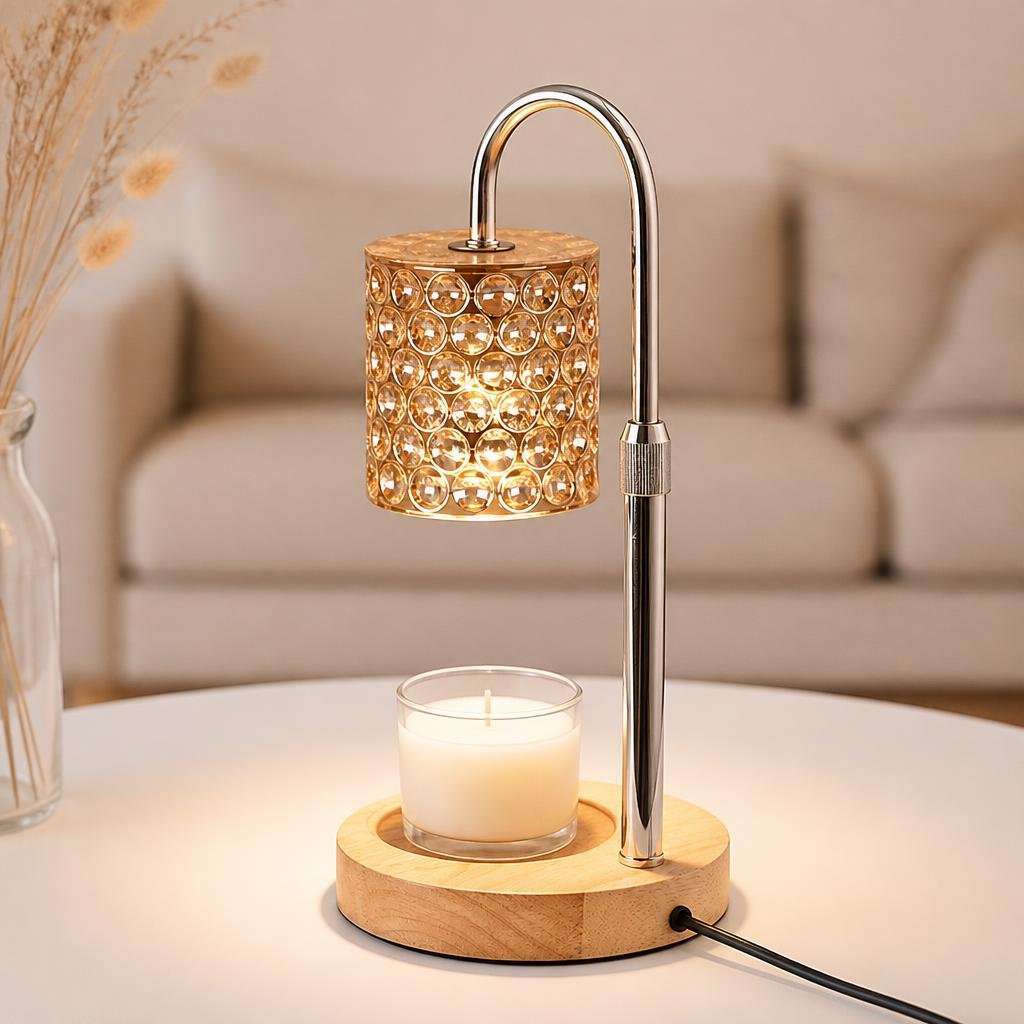
GODONLIF Round Crystal and Wood Small Candle Warmer Lamp
A small candle warmer lamp whose shade is built from rows of round crystals, set on a round natural wood base. Height adjustable, dimmable, and on a timer, and it melts a jar candle with a bulb instead of a wick.
Shop the small bedside warmer lampBrowse all Candle Warmer Lamps →
Sold and shipped by GODONLIF — free shipping within the contiguous US. Price and availability are shown on the product page.
09See it in action
10Frequently asked questions
Can you leave a candle warmer on overnight?
Yes — with the right precautions. A candle warmer lamp has no open flame, which removes the single biggest candle fire risk. Use a UL- or ETL-listed unit, place it on a stable heat-resistant surface, keep the cord and surrounding area clear, never cover it, and ideally set the built-in timer so it shuts itself off. With those steps in place, leaving a candle warmer lamp on overnight is far safer than sleeping with a burning candle.
Is it safe to leave a candle warmer on while you sleep?
It is significantly safer than burning a candle while you sleep, because there is no open flame. The NFPA reports roughly 5,894 US home candle fires per year, most involving unattended or sleeping occupants. A candle warmer lamp eliminates that ignition source entirely. The remaining considerations — cord placement, surface stability, listing certification — are standard electrical-appliance precautions.
Is it safe to leave a candle warmer on for hours or all day?
Most UL- and ETL-listed candle warmer lamps are designed for extended use. The GODONLIF lamp’s 12-hour timer is the safest approach: it runs as long as you need and then shuts off automatically, so you never rely on memory. Avoid running any electrical appliance indefinitely without a shutoff; the built-in timer solves this.
What happens if you leave a wax warmer on overnight without a timer?
The wax will melt completely and, if the vessel runs dry, the dish and any remaining fragrance compounds will overheat. Prolonged overheating is the main risk of leaving a wax warmer on overnight without supervision. A built-in 12-hour auto-shutoff timer prevents this entirely.
Can you sleep with a candle warmer on in your bedroom?
Yes, provided the unit is UL- or ETL-listed, is placed on a stable nightstand away from bedding and curtains, and has its timer set. The GODONLIF lamp’s 12-hour timer means it will shut off on its own — you fall asleep with fragrance and wake up without worrying whether you left it on.
How long can I leave a candle warmer on?
On a UL- or ETL-listed lamp the practical ceiling is one 12-hour session, which is exactly what the GODONLIF timer is built to deliver — longer than a full night’s sleep. The real limit is the wax, not the electronics: a jar with at least half an inch of wax left will run a full 12-hour cycle happily, while a jar down to its last quarter inch should be capped at two to three hours so the dish is never heating a near-dry vessel. Reset the timer for each session rather than leaving any lamp running around the clock.
Can I leave a wax warmer on when I’m not home?
Yes — if it is a UL- or ETL-listed unit with an auto-shutoff timer, and you set that timer to the hours you will actually be away rather than to the maximum. Two things change once the house is empty: nobody is there to notice a knocked-over jar, and pets have unsupervised access to whatever surface it stands on, so clear the area around the warmer and keep it off narrow ledges. Check the dish before you leave, too — a wax warmer running a nearly empty vessel is the one scenario where overheating is a genuine risk, and a timer set short solves it.
Can I sleep with a candle warmer on?
Yes, with the same precautions as any overnight use, and the timer is the one doing the work while you are asleep. Use a UL- or ETL-listed lamp on a stable nightstand, keep at least 12 inches clear of bedding and curtains, never cover it, and set the 12-hour timer before you lie down so the lamp shuts itself off. Check the jar first as well: one with at least half an inch of wax left will run a full cycle, while one down to its last quarter inch should get a two- to three-hour setting instead.
Can you leave a candle on all night?
No. A burning candle left on overnight goes against NFPA safety guidance, which is never to leave a candle unattended or burning while you sleep, and the National Candle Association recommends burning a candle for no longer than four hours before letting it cool for at least two. Candles left unattended or burning while occupants slept are among the leading causes of the roughly 5,894 US home candle fires a year. A candle warmer lamp is a different case: it warms the same jar with no flame, and its 12-hour timer switches it off on its own.
Sources & further reading
- National Fire Protection Association — Candle fires: statistics and safety guidance. (5,894 home fires/yr average; unattended and sleeping-occupant causes.)
- U.S. Consumer Product Safety Commission — Home fire safety: portable heating and appliance guidance.
- National Candle Association — Your foolproof guide to burning a candle correctly. (“In general, it is recommended that candles do not burn for longer than four hours and cool for at least two hours before relighting.” Source for the four-hour burning-candle ceiling in the session chart above.)
- Underwriters Laboratories (UL) — What UL certification means: testing for fire, shock, and thermal hazards.
- Intertek / ETL — ETL listed mark: North American safety certification.
- Patra, S. S., Jiang, J., Liu, J., Steiner, G., Jung, N. & Boor, B. E. (2025) — “Flame-Free Candles Are Not Pollution-Free: Scented Wax Melts as a Significant Source of Atmospheric Nanoparticles”. Environmental Science & Technology Letters 2025, 12(2), 175–182 (Purdue University). Heated scented wax reacts with indoor ozone to form nanoparticles — ventilate and choose clean fragrance.
- U.S. EPA — Volatile organic compounds and indoor air quality.
You may also like