News
How to Make Your House Smell Good Without Burning a Candle

Jul
Home Fragrance
A great-smelling home isn’t about spraying something pretty over the top. It’s about removing what’s off, then layering a clean scent that lasts — and you can do the whole thing flame-free.
How to make your house smell good: clear odors at the source and ventilate, two core indoor-air strategies the EPA lists, then keep one gentle scent running steadily. Warming a jar candle instead of burning it keeps that going with no flame; from 2020 to 2024, candles caused an annual average of about 5,894 US home fires (NFPA).
Key takeaways
- The core of how to make your house smell good: remove first, scent second — deodorize at the source and ventilate before you add fragrance, or you are only masking.
- Layer one steady, low-level scent rather than a single burst, so a room smells good all day instead of for an hour.
- Go flame-free: a candle warmer lamp melts a soy candle from above for a clean, lasting scent — no flame, no soot, no smoke.
- Match the scent to the room: citrus for kitchens, calm lavender for bedrooms, warm woods for the living room.
- Honest nuance: flame-free is far cleaner, but not particle-free — keep the air moving and choose well-made fragrance.
The honest answer to how to make your house smell good is a two-step habit, not a stronger spray: first remove odors at their source and air the room out, then layer one steady, low-level scent. Done in that order — ideally flame-free — a home smells genuinely clean all day, not like air freshener fighting last night’s dinner. Whatever supplies that steady low-level scent also sits out in the room all day, which is why we treat it as a cozy-room decor piece rather than as a cleaning-cupboard item.
01How do you make your house smell good? The two-step method
Fragrance layered over odor just smells like fragrance-plus-odor, so order beats product. Step one is subtraction: empty and rinse the trash bin, run the garbage disposal with a citrus peel, wash soft furnishings and pet bedding, and open the windows about ten minutes to exchange the stale air. Ventilation is the most underrated move in a fresh-smelling home — the U.S. Environmental Protection Agency lists it, alongside controlling the source, as a core strategy for healthier indoor air (EPA). Only once the air is neutral does step two — addition — actually work.
Step two is where most guides stop at “light a candle.” We would rather you skip the flame and warm one instead (more on that below). Either way the principle holds: aim for a soft, constant presence, not a one-time blast — a gentle, even glow rather than a flashbulb.
02Why does my house smell even when it looks clean?
Because “clean-looking” and “odor-free” are two different things, and your own nose is working against you. Odor hides in places a quick tidy misses: the disposal and drains, a damp dish cloth, the laundry hamper, shoes, pet bedding and overripe fruit. Clear those first and half the battle is won before any fragrance goes near the room.
The second reason is biological. Your sense of smell adapts to any constant odor within minutes and then only reports changes — an effect called olfactory adaptation, or “nose-blindness.” That is why you cannot smell your own home but a guest clocks it from the doorway. Spray a freshener over a lingering smell and the two fade into the background together. The fix is not more spray; it is to remove the source, then reset your nose by stepping outside for fifteen minutes.
03How to make your house smell good without candles (well, without burning them)
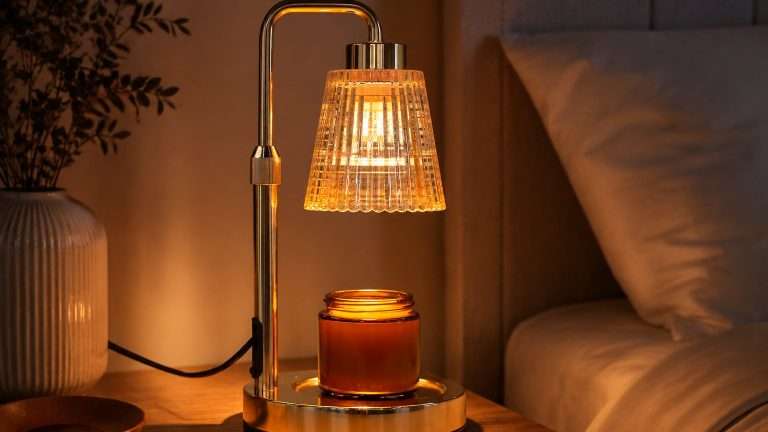
Here is the flame-free centerpiece. A candle warmer lamp sits over an ordinary jar candle and melts the surface from above with a warm bulb — no wick lit, no flame. The fragrance lifts off gently and steadily, so one soy candle scents a room all evening and keeps going far longer than burning would, because the wax is warmed, not consumed. Set it where the air moves, dim it low, and let it run.
The temperatures explain why the scent is also cleaner. A candle flame burns at roughly 1,000 °C, hot enough to combust the fragrance oil along with the wax; a warmer bulb only takes the wax surface to about 50–60 °C for soy (a surface near 100–160 °F), so the fragrance evaporates intact instead of being partly incinerated (GODONLIF). Buyers notice it: across the hundred most recent five-star Amazon reviews of our flagship lamp, about one in three mentions the scent filling the room, and the most-praised feature is the dimmer and timer that let it run all evening unattended.

04Which scent should you use in each room?
A house that smells good tells a consistent story room to room, not one loud note everywhere. The quickest way there is to match the scent family to what each room is for — bright and clean where you cook and wash, calm where you sleep, warm where you gather. The table below is the cheat sheet we hand new customers. Choosing a warm, woody scent to fill the room? Our profile of what sandalwood smells like is a good place to start.
| Room | Best scent family | Why it works |
|---|---|---|
| Kitchen | Citrus — orange blossom & tangerine | Cuts cooking odors and reads as “clean” |
| Living room | Warm & woody — amber, sandalwood, vanilla | Cozy and welcoming, good for guests |
| Bedroom | Calm florals — lavender | Relaxing; a wind-down cue before sleep |
| Bathroom | Fresh citrus or light floral | Bright and neutralizing |
| Entryway | Your signature scent | The first impression of the whole home |
The bedroom row is the one with research behind it: scents such as lavender have been associated with improved, deeper sleep in several studies, though the Sleep Foundation notes the evidence is still evolving (Sleep Foundation). So treat fragrance as a wind-down cue, not a sleep drug — a lavender candle warmed low for the hour before bed, then switched off, beats one left running all night. Tempted to leave a warmer on while you sleep? Read our honest take on running a candle warmer overnight first. Scent is the layer most bedroom makeovers reach for last; the three before it are all light, and we set them out by height in our guide to cozy bedroom lighting ideas.
05What are the best flame-free ways to make your house smell good naturally?
There is no single winner — the trick is to layer methods that work on different timescales. A stovetop simmer pot (citrus peel, cinnamon and herbs in water) is a free, natural burst for when guests are on the way. A reed diffuser gives a constant, low whisper of scent for weeks per bottle with zero effort. And a warmer lamp is the anchor in the middle: strong enough to carry a room, gentle and safe enough to leave running all evening. The end of that evening is where a jar candle runs into its own contradiction, because it has to be put out at exactly the hour the scent would matter most, and we work through that in our guide to scent at bedtime without a flame. If the reed diffuser in that mix starts to fade, our answer to how long does a reed diffuser last covers the bottle, the reeds and the room.
Approximate hands-off run time per session; a reed diffuser is continuous-but-low and measured in weeks per bottle, so it sits outside this per-session view. Sources: GODONLIF product testing and category guides (retrieved 2026-07-21).
Read the chart as a decision, not a leaderboard: a spray resets a room in seconds but is gone by the time you sit down, while a warmer lamp quietly holds a scent across the hours you are actually home. Combine the rhythms — a quick simmer pot before guests, a reed diffuser in the hallway, a warmer lamp anchoring the living room — and the house smells good at every hour. That anchoring instinct is older than any of these methods, as our piece on hearth meaning traces from Old English to the modern living room. Our lamps pair the dimmer with a 12-hour auto-off timer, so “let it run” never becomes “forgot it overnight.” Weighing a warmer against an oil unit? Our candle warmer vs diffuser comparison breaks down the tradeoffs.

06How do you keep a house smelling good all the time?
Consistency comes from layering small habits, not one heroic scent. Keep the subtraction daily — trash, disposal, air the rooms — and keep the addition steady, not strong. Running a scent low and long is what makes a home smell good all the time: a gentle, consistent fragrance keeps reading as “fresh,” while a heavy blast is the constant signal your nose files away within the hour.
Two rules follow. First, use a source you can safely set and forget — a dimmable warmer lamp on a timer is built for it. Second, rotate your fragrances between rooms or weeks so none becomes wallpaper to your senses. That rotation is the quiet secret behind homes that always smell inviting: not stronger, they just never let you go nose-blind.

Candle Warmer Lamps
A GODONLIF flameless candle warmer lamp melts your jar candle from above with a dimmable bulb — an electric candle warmer, not an open flame — so the same candle lasts far longer and melts evenly with no tunnelling.
Browse candle warmer lampsSold and shipped by GODONLIF — free shipping within the contiguous US. Prices are shown on each product page.
07Is flame-free really safer and cleaner?
Mostly yes, and the safety case is the strongest part. Burning brings an open flame, soot that dulls the air and your ceiling, and wax used up fast. Warming gives the same fragrance with none of it: the flame — and the fire risk that rides with it — is gone, no smoke or soot, and the same candle lasts two to three times longer because the wax is melted, never consumed. The risk you remove is well documented: over 2020–2024 the National Fire Protection Association attributes an annual average of about 5,894 US home fires to candles, causing roughly 63 deaths and $286 million in property damage a year (NFPA). A warmer takes that category off the table — a big reason it is the easier flame-free habit around kids and pets.
Now the honest caveat, because a guide that only sells the upside is not worth much. Flame-free does not mean particle-free. A 2025 Purdue University study in Environmental Science & Technology Letters found that heated scented wax can react with indoor ozone to form airborne nanoparticles — “no flame” is not “nothing in the air.” The takeaway is the habit this guide opened with: keep air moving and choose clean, well-made fragrance over cheap, heavily-dyed wax. It is no reason to return to an open flame — that trades a small particle question for a documented fire risk. Flame-free is cleaner, not magic, and an honest answer to how to make your house smell good owes you that context. The same honesty is owed to the ritual many people reach for instead of a candle, so we read the measured evidence on whether incense is bad for you rather than the headlines about it.
08See it in action
Frequently asked questions
These cover what people ask most about how to make your house smell good and keep it that way — the routine, the flame-free swap, and the honest limits.
How can I make my house smell good all the time?
Make it a layered habit, not a one-off blast. Remove odors at the source every day (trash, drains, fabrics, pet bedding), air each room out for about ten minutes, then keep one steady, low-level scent running. A candle warmer lamp is ideal for the all-day part because it melts a jar candle gently and evenly for hours instead of fading after one burst. Rotate scents between rooms or weeks so your nose never tunes them out.
How do you make your house smell good without candles?
The flame-free routine for how to make your house smell good is: deodorize at the source, ventilate, then add scent with no fire. Warm a soy candle on a candle warmer lamp, run a reed diffuser, or simmer citrus peel and cinnamon on the stove. Warming a candle releases its full fragrance with no flame, no soot and no smoke, so you get the scent of a candle without ever lighting one.
Why does my house smell bad even when it looks clean?
Two reasons. First, odor hides in places a tidy-up misses: the trash can and disposal, drains, damp dish cloths, laundry, pet bedding, and soft furnishings that hold smells. Second, you go nose-blind: your sense of smell tunes out any constant odor within minutes and only reports changes, which is why a guest notices your home from the doorway and you cannot. Clean the hidden sources and step outside for fifteen minutes to reset your nose.
How do I make my house smell good with pets?
Clean at the source first: litter, bedding, floors and the pet itself. Keep air moving, and choose a flame-free, low-soot scent so there is no smoke to bother sensitive animal airways. Warming a clean soy candle on a warmer lamp avoids the open flame entirely. Keep the candle, cord and any essential oils out of a pet's reach, and check the ASPCA's guidance, since some fragrance ingredients are not pet-safe.
What scents make a house feel cozy and warm?
Warm, sweet and woody notes feel the coziest: vanilla, amber, sandalwood, and orange blossom, with lavender for calm. Match the scent to the room, using fresh citrus in kitchens and bathrooms and soft florals or vanilla in bedrooms and living rooms. Keeping the level low and steady, rather than overpowering, is what actually reads as cozy rather than cloying.
Sources & further reading
Air-quality guidance comes from the EPA and American Lung Association; candle-fire figures from the NFPA and National Candle Association; the particle caveat from a 2025 Purdue study; sleep-and-scent context from the Sleep Foundation; warmer temperatures from our in-house explainer. Non-academic links were checked on 2026-07-21.
- U.S. Environmental Protection Agency — Improving Indoor Air Quality: source control and ventilation as core strategies for healthier indoor air.
- American Lung Association — What Makes Indoor Air Unhealthy?: fragrances and VOCs among indoor pollutant sources — context for choosing clean fragrance and keeping air moving. Retrieved 2026-07-21.
- National Fire Protection Association — Candle fires: home candle-fire statistics — an annual average of ~5,894 US home fires, ~63 deaths and ~$286M in property damage (2020–2024). Retrieved 2026-07-21.
- National Candle Association — Candle Safety Tips: baseline safe-handling guidance for candles. Retrieved 2026-07-21.
- Patra, S. S., Jiang, J., Liu, J., Steiner, G., Jung, N. & Boor, B. E. (2025) — “Flame-Free Candles Are Not Pollution-Free: Scented Wax Melts as a Significant Source of Atmospheric Nanoparticles.” Environmental Science & Technology Letters 12(2), 175–182 (Purdue University): why we still recommend ventilation and clean fragrance even without a flame.
- Sleep Foundation — Smell and Sleep: Can Certain Scents Help You Sleep?: scent, relaxation and the bedroom — background for the lavender-for-bedrooms advice. Retrieved 2026-07-21.
- ASPCA — Animal Poison Control: keeping fragrance products pet-safe, as referenced in the FAQ. Retrieved 2026-07-21.
- GODONLIF — How a Candle Warmer Lamp Works (in-house explainer, fact-checked against NFPA data): the science behind the ~50–60 °C melt, no-soot and 2–3× candle-life claims in this article.
You may also like