News
Do Candle Warmers Make Candles Last Longer? Wax Life vs. Scent Life

Jul
Wax Life vs. Scent Life
Do candle warmers make candles last longer? A warmed candle can stay physically full after its fragrance fades—and honest testing matters more than a universal “2×” or “3×” claim.
Key takeaways
A candle warmer usually preserves more physical wax than burning because there is no flame consuming that wax as fuel. But a full-looking jar is not proof that the fragrance will last two or three times longer.
Useful scent life depends on what you measure: wax mass, hours with noticeable fragrance, number of sessions, or cost per satisfying session. No controlled evidence supports one universal multiplier across candles and warmers.
- Wax life: usually much longer under a warmer because combustion is absent.
- Scent life: finite because volatile fragrance compounds still leave the melt pool.
- Best comparison: track equal candles, equal rooms, equal session lengths, and a defined scent threshold.
- Best habit: use the lowest effective heat and manage only the cooled, scent-depleted surface layer as directed.
Do candle warmers make candles last longer? They usually make the physical wax last longer because an unlit candle is not feeding a flame. They do not guarantee a fixed increase in fragrance hours. Wax can remain in the jar after the volatile scent compounds in its upper layer have largely evaporated.
That wax-life versus scent-life distinction is the missing piece in most “2×,” “3×,” or “5×” claims. The mechanism supports physical preservation. The multiplier requires a controlled comparison that accounts for the candle, warmer, room, heat, and the definition of “finished.”
01Do candle warmers make candles last longer?
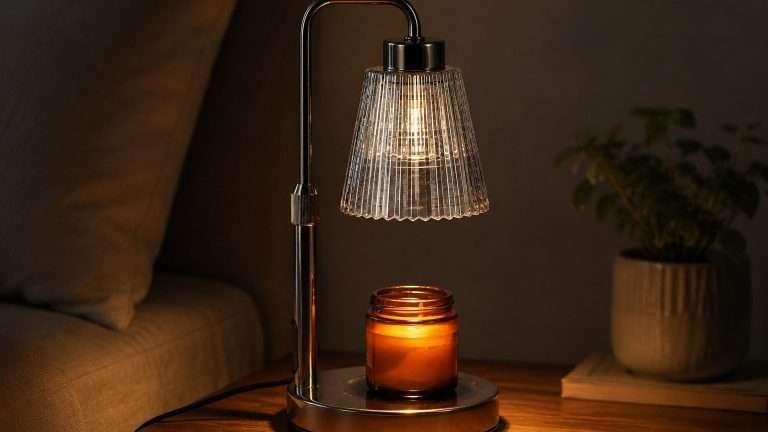
Yes for physical wax, often—but not as a universal fragrance multiplier. Burning steadily lowers the wax level because wax vapor fuels the flame. Warming mainly changes the exposed wax from solid to liquid, so most of its mass stays in the vessel and can cool into a solid again. That is the only job our candle warmer lights are built to do: hold the surface just past its melting point and leave the rest of the jar alone.
Fragrance is different. The compounds responsible for scent are intended to leave warm wax and enter the air. Once the exposed layer has released much of those compounds, the jar can look almost unchanged while the room smells weaker. An honest answer must report both outcomes.
Under a warmer, only the 6–10% fragrance load[7] leaves the jar; a flame consumes nearly all of the wax as fuel. Retrieved 2026-07-13.

02Why does candle wax stay in the jar under a warmer?
In a burning candle, heat melts wax near the wick, the wick draws the liquid upward, and the wax vapor reacts with oxygen in the flame. The National Candle Association’s science explanation describes that fuel cycle and the different zones of the candle flame.[1] A controlled combustion study likewise treats burning rate as a function of the wick, flame, oxygen transport, and wax fuel.[2]
A warmer supplies external heat to the jar instead (our guide to how a candle warmer lamp works walks through the full sequence). With no lit wick, the warmed wax is not continuously pulled into a combustion zone. Some volatile material leaves, but the bulk wax can melt, cool, and solidify repeatedly. That is why visual jar volume alone exaggerates how much usable fragrance remains. The opposite case, a jar whose level visibly drops week by week, is a combustion story we unpack in what burning does to the wax.
Burned candle
- Wax melts near the wick
- Liquid moves up the wick
- Wax vapor supports combustion
- Jar level steadily falls
Warmed candle
- External heat melts the surface
- Wick remains unlit
- Fragrance evaporates from the pool
- Most wax remains and re-solidifies
03What does “last longer” actually mean?
It can mean at least four different things: how long wax remains, how many sessions produce noticeable scent, total hours above a chosen scent threshold, or how much a satisfying fragrance session costs. A claim that reports only jar fullness answers the first question while implying all four.
The cleanest consumer measure is “satisfying scent-hours”: total hours during which the fragrance remains clearly noticeable at a fixed location in the same room. It is still subjective, but defining the threshold before testing is better than deciding afterward because one method looks favorable.
| Metric | What it measures | What it misses |
|---|---|---|
| Wax mass remaining | Physical preservation | Whether the remaining wax still smells |
| Number of sessions | Repeat usability | Different session lengths or heat levels |
| Satisfying scent-hours | Useful fragrance duration | Personal sensitivity and room effects |
| Cost per satisfying hour | Economic value | Electricity, bulb, and warmer purchase assumptions |
04How long do candles last on candle warmers?
How long does a candle last under a candle warmer? There is no single hour number, but there is a defensible way to bound it. Under a warmer the wax is not consumed as fuel, so the burn hours printed on the candle stop acting as a ceiling: a 7 oz single-wick jar rated 35 to 45 burn hours can still look almost full long after those hours have passed. What runs out instead is the fragrance load — typically 6 to 10% of the candle’s mass — leaving the exposed layer.
So the practical answer is measured in sessions, not in a multiplier. Log satisfying scent-hours with the two-candle test later in this guide, and treat the top layer as finished after two consecutive weak sessions at the same room, setting, and pool depth. Two things stretch the calendar life: a warmer has no four-hour session ceiling — that limit belongs to an open flame, see our burn-time ranges by candle size — and a shallower pool releases the same fragrance load more slowly. No public dataset reports scent-hours for warmed candles, which is why this guide gives you a method and a bound instead of a headline number.
The other two ways people ask it get the same answer. How long does a candle last with a candle warmer? As long as its fragrance load keeps producing satisfying sessions, because the wax itself is not being spent. How long does a candle last in a candle warmer that heats the jar from below? Count sessions the same way, with one caveat from the design section below: a bottom plate can warm more of the jar at once, which may release the fragrance from a larger volume and use it up sooner.
05How does fragrance leave warmed candle wax?
Fragrance oils contain volatile compounds that move into the air more readily as the wax warms. Peer-reviewed indoor-air research has measured volatile organic compound emissions from scented candles during unlit and burning phases, showing that emissions depend on product formulation and operating state.[3] Under a warmer, the liquid surface becomes the release area.
Heat and exposed area matter. A hotter or deeper pool can release scent faster, which may feel stronger in the short term but may also deplete the active layer sooner. Room airflow, volume, and background odors then determine how concentrated the fragrance feels at your nose.
06Top-down versus bottom warming: why the active layer matters
A top-down lamp begins with the exposed surface and can leave deeper wax solid during a moderate session. A bottom plate begins at the vessel base and may warm a larger vertical portion of the jar as heat moves upward. Neither geometry guarantees longer scent life, but each changes how much wax is active at once.
Top-down control can be useful when the height and dimmer let you maintain a shallow pool. Bottom warming can be simple and effective with a compatible vessel, but heating more wax than needed may release fragrance from a larger volume. Consumer Reports’ 2025 comparison included both lamp and plate formats and also noted that bulbs and shades can become hot.[5]


07When is the top wax layer fragrance-depleted?
A practical sign is repeatable weak fragrance after the usual melt pool forms under the same room conditions and heat setting. One weak session is not proof: an open window, a colder room, olfactory fatigue, or a smaller pool can also reduce perceived throw.
If several controlled sessions remain weak, switch the warmer off and follow the device maker’s cooling and wax-handling instructions. Some manufacturers advise carefully pouring off a melted depleted layer into a suitable metal or glass container. Never pour wax down a drain, move dangerously hot wax, or improvise if the manual gives different directions. A fragrance-depleted layer is not the same thing as worthless wax, and what leftover wax is still worth covers the options once it is out of the jar.
08How can you measure whether warming lasts longer?
Use two identical new candles from the same batch: burn one according to its candle label and warm the other according to the warmer manual. Keep room, location, session length, and evaluation distance as consistent as possible. Record start and end mass with a kitchen scale, plus scent strength at fixed intervals.
Define “usable” before the first session—for example, at least two of three adults can clearly identify the fragrance from the same chair. Stop each method when it no longer meets that threshold in two consecutive sessions. This will not be a laboratory study, but it is far more informative than comparing a full-looking warmed jar with an empty burned jar.
Match the candles
Same product, batch if possible, starting mass, and room.
Define the scent threshold
Choose a fixed seat, rating scale, and minimum acceptable result before testing.
Run equal sessions
Follow each product’s instructions and log duration, setting, wax mass, and observations.
Report both outcomes
Compare wax remaining and satisfying scent-hours as separate numbers.
09Does warming remove every indoor-air emission?
No. Warming removes the lit wick and its combustion soot, but fragrance compounds are supposed to enter the room. A 2025 Purdue-led experiment warmed 15 scented wax products for about two hours and observed ultrafine particle formation when emitted terpenes reacted with indoor ozone.[6] The unscented wax in that experiment did not create the same terpene-driven signal.
The study did not establish the health outcome of typical warmer use and called for more toxicology research. The responsible conclusion is narrow: flame-free is not emission-free. Ventilate as needed, use only as much fragrance as the room requires, and reduce or stop use if someone experiences irritation.
10What mistakes shorten useful scent life?
Excess heat, unnecessarily deep melt pools, very long sessions, and warming a large wax volume for a small room can release fragrance faster than needed. Poor measurement also creates false conclusions: changing rooms, settings, or session lengths makes one jar look better without testing the method.
Another mistake is assuming a nearly full jar needs no maintenance. If the exposed layer is scent-depleted, repeatedly melting only that layer can produce little fragrance. Follow the manual’s cooled-wax or melted-layer instructions rather than increasing heat indefinitely.
- Do not start at maximum by default. Begin moderately and increase only if the pool or scent is insufficient.
- Do not judge by wax level alone. Record satisfying scent-hours.
- Do not keep heating because the jar looks full. Fragrance can be depleted while wax remains.
- Do not pour hot wax down a sink. Follow safe handling and disposal instructions.
11How should you manage a scent-depleted wax layer?
For each session, center a compatible candle, select the lowest setting that builds an adequate surface pool, and stop when the room reaches the desired fragrance. Let the device and wax cool fully before evaluating the next step.
When several comparable sessions produce weak scent, consult the manual. If it permits removing a depleted layer, prepare an appropriate heat-safe container, handle the wax only at the instructed temperature, and keep it out of drains. If the manual does not explain layer management, contact the manufacturer rather than inventing a method.
Worth separating from this page: a pool that turns liquid quickly is not the same as a candle being used up quickly, which we untangle in why a candle seems to melt way too fast under a warmer.
Frequently asked questions
These answers avoid a universal life multiplier and keep physical wax preservation separate from useful fragrance duration. That distinction is the article’s central measurement rule.
The visible FAQ and FAQPage schema are rendered from one registry, so search systems receive the same wording that readers see.
Do candle warmers make candles last longer?
They usually preserve the physical wax because there is no flame consuming it as fuel. That does not guarantee a fixed increase in fragrance hours. Scent life varies with the candle formula, melt-pool size, heat level, warmer design, room conditions, and session length.
How long do candles last on candle warmers?
There is no single hour figure. Because a warmer never consumes the wax, the burn hours printed on the jar stop being the limit — a 7 oz single-wick jar rated 35 to 45 burn hours can stay almost full well past that. What ends the run is the fragrance load, roughly 6 to 10% of the wax, leaving the exposed layer. Count sessions rather than hours, and stop when two consecutive sessions smell weak.
Why does the wax stay in the jar under a candle warmer?
Warming mainly changes wax from solid to liquid. Burning is different: liquid wax travels up the wick, vaporizes, and reacts with oxygen to sustain the flame. Without that combustion cycle, most of the wax mass remains in the container.
How do you know when the warmed wax has lost its scent?
If the usual melt pool forms but the room fragrance is noticeably weak across a normal session, the exposed layer may be fragrance-depleted. Let the unit and wax cool, then follow the warmer manufacturer's instructions before removing any wax or starting another layer.
Does a top-down candle warmer preserve scent better than a bottom warmer?
A top-down lamp can heat only the upper layer while leaving deeper wax solid, whereas some bottom warmers heat more of the jar. That can give you more control over the active melt pool, but the result still depends on the device, candle, and heat setting.
Should you pour off the top layer of wax when the scent fades?
Only after switching the warmer off and following its handling instructions. Some lamp-warmer makers advise pouring warm, fragrance-depleted wax into a suitable metal or glass container. Never pour wax down a drain, handle dangerously hot wax, or improvise if the manual says otherwise.

Candle Warmer Lamps
A GODONLIF flameless candle warmer lamp melts your jar candle from above with a dimmable bulb — an electric candle warmer, not an open flame — so the same candle lasts far longer and melts evenly with no tunnelling.
Lamps that melt without consuming the waxSold and shipped by GODONLIF — free shipping within the contiguous US. Prices are shown on each product page.
Sources and evidence limits
Primary combustion and emissions sources explain why wax mass and fragrance release diverge. Independent testing provides practical product observations; manufacturer guidance is used only for operating and layer-management context.
URLs were checked on July 12, 2026. We found no controlled evidence supporting one universal “2×,” “3×,” or “5×” fragrance-life multiplier across candle formulas, warmer designs, heat settings, rooms, and user thresholds.
- National Candle Association, “Candle Science.” https://candles.org/candle-science/ (retrieved July 12, 2026).
- Combustion and Flame, “Experimental study of the burning rate of candles.” https://www.sciencedirect.com/science/article/pii/S0010218023000135 (retrieved July 12, 2026).
- Environment International, “Emission of volatile organic compounds from burning candles.” https://www.sciencedirect.com/science/article/pii/S0160412021002154 (retrieved July 12, 2026).
- Candle Warmers Etc., “Frequently Asked Questions.” https://www.candlewarmers.com/faq/ (retrieved July 12, 2026; manufacturer guidance).
- Consumer Reports, “Best Candle Warmers.” https://www.consumerreports.org/home-garden/best-candle-warmers-a3573874634/ (retrieved July 12, 2026).
- American Chemical Society, “Scented wax melts may not be as safe for indoor air as initially thought.” https://www.acs.org/pressroom/presspacs/2025/february/scented-wax-melts-may-not-be-as-safe-for-indoor-air-as-initially-thought.html (retrieved July 12, 2026).
- The Flaming Candle, “Candle Fragrance Load Guide” (typical fragrance load about 6–10% of candle mass by wax type). https://www.theflamingcandle.com/what-does-the-maximum-fragrance-load-or-fragrance-of-a-wax-mean/ (retrieved July 15, 2026; manufacturer guidance).
- Environmental Science & Technology Letters, “Nanoparticle Formation from Scented Wax Melts.” https://pubs.acs.org/doi/10.1021/acs.estlett.4c00986 (retrieved July 12, 2026).
- Candle Warmers Etc., “How to Get the Best Fragrance Throw.” https://www.candlewarmers.com/how-to-get-the-best-fragrance-throw/ (retrieved July 12, 2026; manufacturer guidance).
You may also like