News
Why Is My Candle Melting Way Too Fast in the Warmer?

Jul
Troubleshooting
A melt pool that goes deep and liquid within minutes is a heat problem, not a wax problem. Here is how to tell which of three different complaints you actually have, and how to take the heat back down without losing the scent.
Key takeaways
Almost every version of this complaint resolves once you separate two things people say interchangeably: how fast the wax turns liquid, and how fast the candle gets used up. Under a lamp those are not the same event, and only one of them is a real loss.
- Melted is not consumed. A warmer lamp changes the wax from solid to liquid. It does not burn it as fuel the way a wick does, so the level in the jar should barely move.
- Fast and deep means too much heat. The usual causes are the shade sitting low over the jar, the dimming left at full, a narrow jar that concentrates heat, and a soft wax.
- If the level really is dropping, a flame is involved. That is a different diagnosis with different fixes: wick length, drafts, and session length.
- Honest limit: a cooler pool is a quieter pool. Turning the heat down to slow the melt also softens the scent, so you are choosing a balance rather than fixing a defect.
If you have caught yourself asking “why is my candle melting way too fast in the warmer,” the useful first move is not to change anything on the lamp. It is to work out which of three different problems you have, because they wear the same sentence and pull in opposite directions. One is a pool that turns liquid faster and deeper than you expected. One is a jar that seems to be emptying. One is a scent that is strong for two evenings and then flat. The first is nearly always fixable in under a minute, the second usually means a wick has been lit somewhere in the story, and the third is a temperature question. This guide separates them, then works through the heat controls in the order that costs you the least fragrance. The first of those controls is distance rather than brightness: on a height-adjustable warmer lamp, you raise the shade before you touch the dimmer.
01Three Different Problems Wear the Same Sentence
“Melting too fast” is a description of speed, but people reach for it to describe at least three distinct observations, and the fixes barely overlap. Before adjusting anything, look at the jar and decide which of these you are actually watching. The distinction matters because two of the three are normal behaviour that only needs tuning, while the third means the candle is being burned rather than warmed.
The quickest diagnostic is a mark and a wait. Put a strip of tape on the outside of the jar level with the top of the solid wax, run the lamp for an evening, let everything set overnight, and look again in the morning. If the wax has re-solidified back at the tape, nothing was lost — you watched a phase change and the candle is intact. If the line has genuinely dropped, wax left the jar, and no lamp does that.
| What you are seeing | What it actually is | Is anything lost? | Where the fix lives |
|---|---|---|---|
| The whole surface goes liquid within minutes, pool looks deep | Too much heat reaching the wax | No wax. Some fragrance is released faster than you intended | Shade height, dimming, session length, jar choice |
| The wax level in the jar is visibly dropping week to week | The candle is being burned, not warmed | Yes — wax is being consumed as fuel | Wick length, drafts, how long it stays lit |
| Strong for two evenings, then noticeably flat | Fragrance driven off the top layer faster than it can be replaced | Scent, not wax | Lower heat, shorter sessions, stir or swap the top layer |
| Pool is deep on one side, solid on the other | Uneven heating or an off-centre jar | Nothing yet, but the unheated wax may never be used | Centre the jar under the shade; check the surface is level |
Notice that only the second row involves losing anything you paid for. That single distinction removes most of the alarm from this question, and it is worth understanding properly rather than taking on trust, because it also explains why the other two rows are tuning problems rather than faults.
02Warmed Wax Changes State — It Is Not Used Up
A wick-lit candle is an engine that runs on its own body. Michael Faraday laid this out in his Royal Institution Christmas lectures, published in 1861 as The Chemical History of a Candle: the flame melts a small pool, the liquid wax climbs the wick by capillary action, and at the top it is vaporised and burned. The wax is the fuel. That is precisely why a burning candle gets shorter — the material is leaving as combustion products, and it is not coming back.[4]
A warmer lamp does none of that. It puts gentle heat onto the surface from above, taking the wax past its melting point and no further, which is why the surface under a lamp sits at roughly 100 to 160°F rather than at flame temperatures, as we measured in our guide to how hot a candle warmer gets.[6] Nothing is oxidised and nothing leaves the jar except fragrance vapour. Turn the lamp off and the same wax sets again in the same jar. That is also the mechanism behind a warmed candle outlasting a burned one, which we cover separately in do candle warmers make candles last longer.[8]
Under a flame
- Wax is drawn up the wick and burned — it leaves the jar permanently
- The level drops every session; the jar empties
- Speed is set by wick size, drafts and burn length
- Heat is self-regulating — the flame finds its own temperature
Under a warmer lamp
- Wax melts and re-solidifies; the level stays where it was
- Nothing is consumed but the fragrance you smell
- Speed and depth are yours to set
- Nothing self-regulates — if you leave it hot, it stays hot
That last line on the right is the whole reason this article exists. A flame settles into an equilibrium on its own; a lamp holds whatever setting you left it on. So a pool that forms “too fast” is not the lamp malfunctioning, it is the lamp doing exactly what it was set to do. The rest of this page is about changing the setting.
03Why the Pool Goes Deep and Liquid So Quickly
Four things decide how much heat actually lands on the wax, and they stack. The first is how close the heat source sits above the surface — the single biggest lever, and the one most people never touch after unboxing, because the arch arrives at whatever height it was packed at. The second is the dimming level; running at full when you do not need full output is the most common reason a pool goes glassy in ten minutes.
The third is the jar itself. A narrow vessel concentrates the same heat onto a smaller surface and holds it, while a wide, shallow jar spreads it out and loses more to the room. The fourth is the wax. Softer blends go liquid at lower temperatures than harder ones, so the same lamp at the same setting produces a very different pool in a soft container wax than in a firmer one — the ranges are laid out in our reference on candle wax melting point.[7] Room conditions sit underneath all four: a jar in direct afternoon sun or above a radiator starts from a warmer baseline.

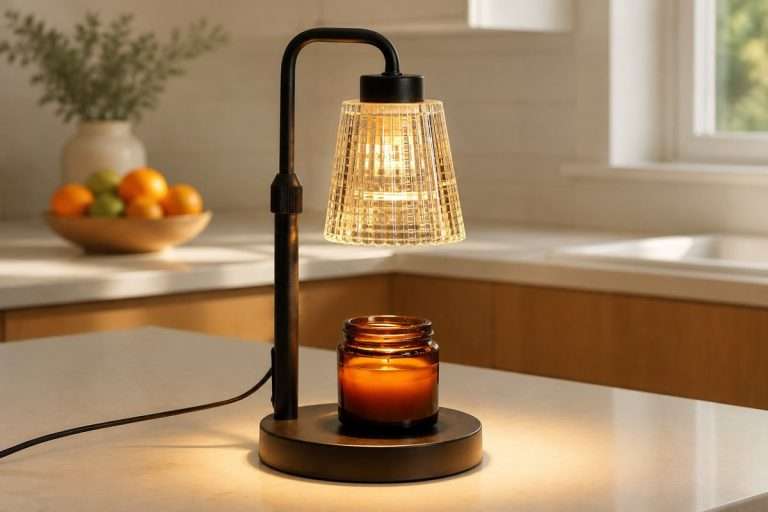
The gap in that photograph is the adjustment worth making first. Raising the arch reduces the heat arriving at the wax surface substantially for a small movement, because the shade both radiates and traps warm air over the jar — lift it and you lose both effects at once. If your model’s arch does not move, or you are unsure which height suits a given jar, the sizing and fit guidance lives in our complete guide to candle warmer lamps and in best candles for a warmer lamp, which covers which jar shapes behave predictably under a lamp.
04Why Is My Candle Burning Too Fast? The Flame Side of the Same Question
If the tape test showed a genuinely falling wax level, you are asking a different question — why is my candle burning too fast — and it deserves a straight answer before we come back to lamps. Three factors dominate, and none of them is the candle being defective.
The first is wick length. A long wick makes a tall flame, and a tall flame melts and consumes wax faster while producing soot. The National Candle Association’s guidance is specific: trim the wick to 1/4 inch before each use, precisely to prevent high flames and soot.[1] The second is moving air. The NCA advises keeping candles away from drafts — not near open windows, fans, or air vents — because a flame pushed sideways burns hotter and unevenly, working down one side of the jar.[1] The third is simply session length, and here the NCA also notes that around 75% of candle users burn a candle for four hours or less at a time, which is a reasonable ceiling to hold yourself to.[2]

There is a safety dimension to fast, tall-flame burning that is worth stating plainly rather than leaving as a footnote. The National Fire Protection Association puts the U.S. annual average at 5,894 home candle fires, and identifies a lit candle left within reach of something combustible as the leading contributing factor.[3] A flame leaning toward a curtain in a draft is exactly that scenario. The NCA also advises stopping a burn while about 1/2 inch of wax still remains, which protects the container from the heat of a flame at the bottom of a jar.[1] Moving that candle onto a lamp is not the only answer, but it is the answer that removes the ignition source entirely — and it is why we treat a warmer as the durable fix for uneven, hollowed-out burns in our guide to candle tunneling.
05Take the Heat Down, in This Order
Work through these in sequence rather than changing everything at once, because each step costs you a different amount of fragrance and you want to stop at the first one that works. The order below is deliberately from cheapest to most disruptive.
Raise the arch before touching anything else
Lift the shade so there is a visible, deliberate gap above the jar rim rather than the shade hovering over it. This is the largest single change in heat delivered and it costs you almost nothing in scent, because the pool still forms — it just forms more gently.
Bring the dimming down a step
If your lamp is dimmable, stop running it at full by default. Take it down one step, give it twenty minutes, and look at the pool. Full output is for a cold room or a stubborn wax, not for every evening.
Shorten the session and use the timer
A pool that is already full does not need more heat to keep smelling — it needs to stop gaining depth. Set the timer rather than running the lamp all evening, and let the wax set between sessions.
Change the jar, not the lamp
If the pool still runs deep at the lowest useful setting, the vessel is concentrating the heat. A wider, shallower jar with a firmer wax behaves far more predictably under the same lamp than a narrow one in a soft blend.
06What Owners Actually Reach For
The advice above is only worth as much as the controls people genuinely use, so we counted. Across the 100 most recent verified five-star reviews of our flagship warmer lamp on Amazon — all verified purchases, all of the black finish, written between 12 March and 24 May 2026 — we counted how many reviews mention each term. The timer is named most often, just ahead of scent itself; height adjustment and dimming are each named by a smaller minority; and 39 of the 100 reviews name at least one of the three heat controls unprompted.[5]
GODONLIF first-party sample: 100 verified five-star Amazon reviews of ASIN B0CTJGJL2T (Black), reviewed 12 March to 24 May 2026, counted by case-insensitive literal substring match on review title plus body — the stems counted are timer; scent/fragranc/smell; height/adjust; melt; dimm. A five-star sample is selected to exclude complaints and cannot show how common a problem is — it shows only which features owners volunteer. Retrieved July 30, 2026.
Two readings of that chart are fair and one is not. It is fair to say that heat control is not an exotic adjustment — a large minority of satisfied owners bring it up without being asked, which suggests reaching for the dimming or the height is the normal way to use one of these lamps rather than a workaround. It is also fair to note that no review in the sample used the words “too hot” or “overheating” at all. What would not be fair is to read that zero as evidence that overheating never happens: a five-star sample excludes the people most likely to say it. The honest conclusion is narrower — among owners who are happy, the controls are part of the routine.
07The Honest Trade-off: A Cooler Pool Is a Quieter Pool
Everything in section five reduces heat, and heat is what releases fragrance from wax. So each step down the list buys you a slower, shallower melt at some cost in throw. That is not a flaw in the advice; it is the actual shape of the choice, and pretending otherwise would set you up to be disappointed by your own fix. Warmer wax releases more fragrance more quickly and empties the top layer sooner; cooler wax releases less and lasts longer at that level. There is no setting that gives you both at once.
Where you want to land depends on which complaint brought you here. If the pool was alarming you but the scent was fine, take one step and stop — you will barely notice the difference in the room. If the scent was disappearing after two evenings, you are looking at the temperature-and-fragrance relationship directly, which we cover in how hot a candle warmer gets. And if you overcorrect and end up with a pool that is too quiet, the fixes run in the opposite direction — our guide to making a candle smell stronger is the mirror image of this page, and the two are meant to be read against each other.
08When It Is Not the Heat at All
Three situations look like a heat problem and are not. The first is a jar sitting off-centre, so one side of the surface gets most of the output and the other stays solid — the pool looks wrong, but the cause is placement. The second is a candle whose surface was already uneven when it went under the lamp; the lamp will melt what it can reach and leave the rest, and the result reads as “melting strangely” rather than “melting fast”.
The third is the opposite failure — a lamp that has stopped delivering heat properly, which usually presents as a pool that never forms rather than one that forms too fast. That is a separate diagnosis with its own checklist, and we keep it in our candle warmer troubleshooting guide. If a lamp is genuinely faulty rather than mis-set, contact us first — GODONLIF products carry a 12-month warranty, and you can reach the team at inquiry@godonlifstore.com or on WhatsApp. We would rather sort it out directly than have you work it out alone.
Frequently asked questions
These cover the edges the sections above do not: what a normal pool depth looks like, whether a fast melt wastes the candle, and what to do with wax that has already been over-warmed.
Why is my candle melting way too fast in the warmer?
In almost every case it is too much heat arriving at the wax, not a fault. Check the three inputs in this order: how close the shade sits above the jar rim, whether the lamp is running at full dimming, and how long each session lasts. A narrow jar or a soft wax blend will amplify all three. The reassuring part is that a fast melt under a lamp costs you no wax at all, because the lamp only changes the wax from solid to liquid and it sets again afterwards. If the wax level in the jar is genuinely dropping week to week, that is a different problem and means a wick is being lit somewhere.
How deep should the melt pool be under a candle warmer lamp?
Aim for a pool that reaches the full width of the jar but stays shallow, on the order of a few millimetres rather than a visible layer of liquid you could dip a finger into. Full width matters because it is what keeps the surface releasing scent evenly; extra depth adds very little fragrance and mostly just stores heat. If your pool looks like a deep bath rather than a wet film, raise the arch a little and give it twenty minutes before judging the result.
Does a fast melt waste the candle?
No wax is lost, but fragrance is. The wax itself is only changing state under a lamp, so the jar keeps its contents. Fragrance oil is volatile, though, and a hotter pool drives it off faster, so the top layer can go noticeably flat after a couple of long, hot sessions while the wax underneath is still fully scented. Running cooler and shorter is what stretches the scented life of a jar, not any change to the wax.
Can I fix a candle that has already been over-warmed?
Usually yes, if it is only the top layer that has gone flat. Let the jar set completely, then gently scrape or stir the surface so fresher wax from just below is exposed, and run the lamp cooler afterwards. If a large amount of wax has pooled unevenly and set into a slope, warm it just until the surface goes liquid, switch the lamp off, and let it re-level as it cools. Do not add water, and do not try to pour liquid wax out of the jar.
Is it bad to leave a candle warmer lamp on for hours?
It is not a fire risk in the way an open flame is, because there is no ignition source, but it is the main reason people end up with a pool that is deeper and hotter than they wanted, and it is the fastest way to flatten the scent of the top layer. Use the timer instead of running it all evening. A lamp does not self-regulate the way a flame does, so it will hold whatever setting you walked away from.
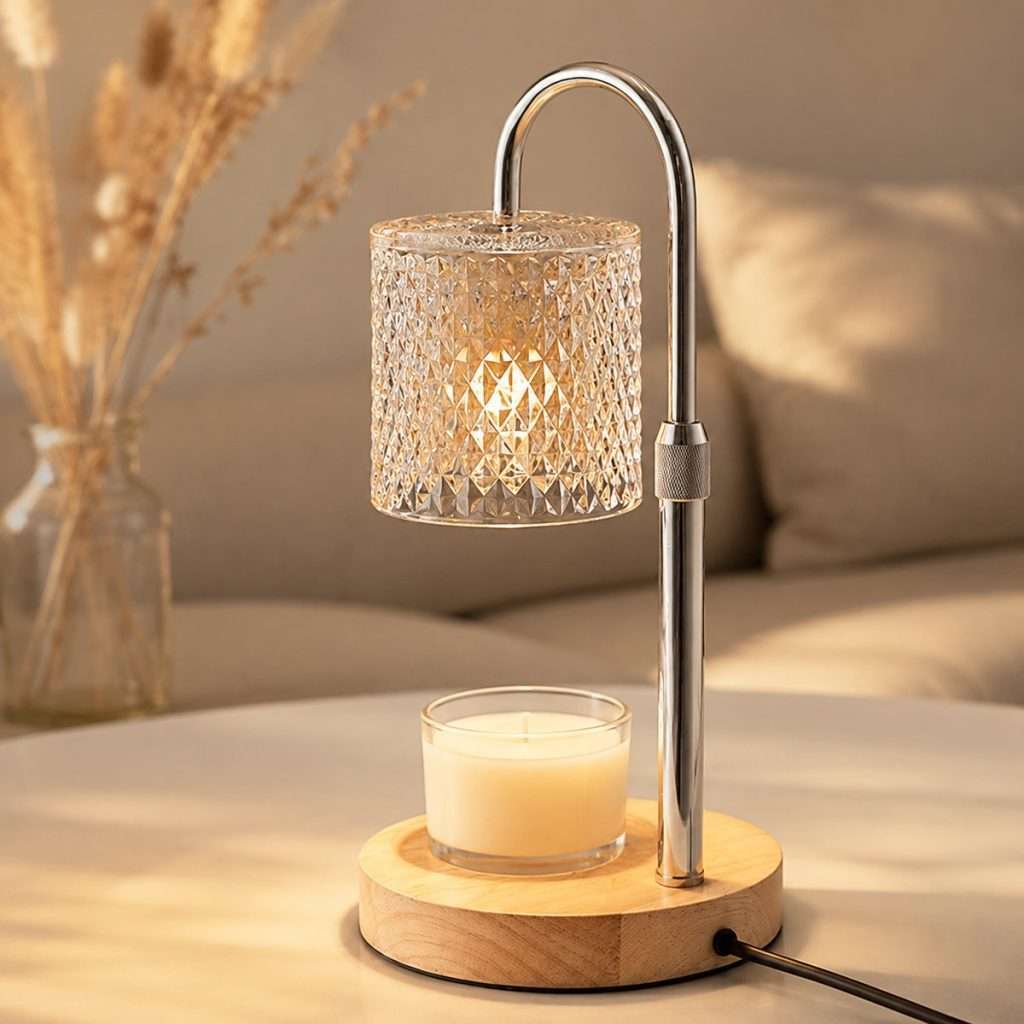
GODONLIF Cut Glass and Wood Adjustable Height Candle Warmer Lamp
An adjustable height candle warmer with a faceted cut glass shade on a round natural wood base. It melts your jar candle with a warm bulb instead of a wick, and both the brightness and the timer adjust.
See the adjustable-height lampBrowse all Candle Warmer Lamps →
Sold and shipped by GODONLIF — free shipping within the contiguous US. Price and availability are shown on the product page.
Sources and evidence limits
Candle-care rules and usage statistics come from the National Candle Association; the home-fire figure comes from the National Fire Protection Association; the combustion mechanism is Faraday’s classic account; the review counts are our own first-party sample. Each link was checked on July 30, 2026.
- National Candle Association, “Candle Fire Safety” (trim the wick to 1/4 inch before each use to prevent high flames and soot; avoid drafts — do not place candles near open windows, fans or air vents; stop burning when 1/2 inch of wax remains). https://candles.org/fire-safety-candles/ (retrieved July 30, 2026).
- National Candle Association, “Facts & Figures” (approximately 75% of candle users burn a candle for four hours or less per session; fragrance rated “extremely important” or “very important” by 75% of candle buyers; more than 10,000 scent varieties available to U.S. consumers). https://candles.org/facts-figures/ (retrieved July 30, 2026).
- National Fire Protection Association, Marty Ahrens, “Home Candle Fires” (U.S. annual average of 5,894 home candle fires; the leading contributing factor is a lit candle placed within reach of something combustible). https://www.nfpa.org/education-and-research/home-fire-safety/candles (retrieved July 30, 2026).
- Michael Faraday, The Chemical History of a Candle, Royal Institution Christmas Lectures 1860–61, published 1861, Lectures I–III (molten wax is drawn up the wick by capillary action, vaporised and burned — the wax is the candle’s fuel). Cited as a text; no URL.
- GODONLIF first-party review sample: the 100 most recent verified five-star Amazon reviews of ASIN B0CTJGJL2T (Black finish), reviewed between 12 March and 24 May 2026, retrieved on July 30, 2026 and counted by case-insensitive literal substring match on review title plus body. Counts by stem: timer 33; scent/fragranc/smell 32; height/adjust 14; melt 13; dimm 10; “too hot” or “overheat” 0; 39 reviews contain at least one of timer, dimm, height or adjust. Reproducible against the stored sample.
- GODONLIF, “How Hot Does a Candle Warmer Get?” (wax-surface temperature of roughly 100 to 160°F under a warmer lamp, flame-free). https://godonlifstore.com/how-hot-does-a-candle-warmer-get/ (retrieved July 30, 2026).
- GODONLIF, “Candle Wax Melting Point: What Temperature Does Candle Wax Melt?” (melting ranges by wax type; softer blends liquefy at lower temperatures than harder ones). https://godonlifstore.com/candle-wax-melting-point/ (retrieved July 30, 2026).
- GODONLIF, “Do Candle Warmers Make Candles Last Longer? Wax Life vs. Scent Life” (why warmed wax is not consumed the way burned wax is, and what that does to usable life). https://godonlifstore.com/do-candle-warmers-make-candles-last-longer/ (retrieved July 30, 2026).
Evidence limits: the NCA usage figures are self-reported survey data describing U.S. candle users in aggregate, not measurements of any individual candle. Our review counts are literal term matches on a five-star-only sample, which is selected to exclude dissatisfied buyers — they show what happy owners volunteer, never how common a problem is. Melt-pool behaviour varies with wax blend, vessel geometry, fragrance load and room temperature, so every number here is a starting point for your own tape test rather than a specification. Removing an open flame removes one ignition source; it does not make any warmed candle safe to leave unattended, and a warmer lamp still belongs on a stable, heat-tolerant surface with clearance around it.
You may also like