News
What Does Sandalwood Smell Like? A Full Scent Profile

Jul
Scent Education
What does sandalwood smell like? Warm, creamy, and softly woody, with a milky sweetness that sets it apart from sharper woods like cedar. Here is the full scent profile, the chemistry behind it, and how prized Mysore sandalwood differs from the Australian kind.
Key takeaways
What does sandalwood smell like? Warm, creamy, and softly woody, with a faint sweet-balsamic edge and a smooth, almost milky texture. That signature creaminess comes from two molecules, alpha- and beta-santalol, which is why sandalwood reads rounder and softer than a sharp wood like cedar.
- The scent in a phrase: warm, creamy, milky-soft wood, lightly sweet and balsamic, never sharp or gourmand.[6]
- What causes it: alpha- and beta-santalol; real East Indian oil holds 41 to 55% alpha-santalol and 16 to 24% beta-santalol by ISO standard.[1]
- Mysore vs Australian: Indian S. album is creamy at 70 to 90% total santalol; Australian S. spicatum is drier and greener at roughly 20 to 40%.[4]
- Enjoy it flame-free: as a heavy base note, sandalwood releases best under a gentle 100 to 160°F warmer that never scorches it.[8]
What does sandalwood smell like? In one line, it is warm, creamy, and softly woody, with a faint sweet-balsamic edge and a smooth, milky texture that keeps it from ever turning sharp. It is the archetypal base note of the woody fragrance family,[6] the quiet, skin-close warmth you notice hours into a candle or a perfume rather than the bright hit you get at first sniff. This guide walks through the full profile, the chemistry that causes it, and the honest differences between prized Indian Mysore sandalwood and the more common Australian kind. That soft, rounded warmth is also why sandalwood is one of the scents we suggest for our relaxation gift lamps.
01What Does Sandalwood Smell Like?
The short answer is a warm, creamy, woody scent that feels soft and rounded rather than sharp. Across perfumery sources the descriptors are remarkably consistent: milky, buttery, faintly sweet, lightly balsamic, subtly musky, and gently spicy.[3][4] Clive Christian, describing its olfactive family, calls sandalwood simply creamy, warm, and soft.[6] Crucially, it is not sharp like cedar or pine, and it is not a sweet gourmand like vanilla, even though both vanilla and sandalwood can read as creamy.
What sets sandalwood apart is how it behaves once it is on your skin, on fabric, or filling a room. It sits low and close, more of a steady hum than a loud announcement, and it lasts. That is because sandalwood is a base note, the slowest and heaviest tier in a fragrance, so the smooth, buttery warmth tends to reveal itself gradually and then linger long after brighter notes have faded. If you have ever caught a soft, woody sweetness on a scarf the next morning, that lingering trace is exactly the part of a blend sandalwood is doing.
02The Scent, Note by Note
Sandalwood’s creaminess is not a vague impression; it has a named chemical cause. The two molecules that carry most of the scent are alpha-santalol and beta-santalol, the aromatic sesquiterpenes that define real sandalwood oil.[3] Together they carry the soft, milky, woody character.[3] That combination is why your nose reads “creamy wood” instead of “dry wood.”
The numbers behind that are strict. Under the international standard ISO 3518, genuine East Indian sandalwood oil (Santalum album) must contain roughly 41 to 55% alpha-santalol and 16 to 24% beta-santalol, and reach at least 90% total free alcohols to qualify as the real thing.[1] That high santalol load, over 70% and often quoted as high as 90% for top Indian oil, is up to three times what many other sandalwood species carry, and it is the single biggest reason Mysore-grade oil smells so smooth.[3][4] So when people ask what sandalwood smells like in perfume, the honest answer is: it depends heavily on how much real santalol is in the bottle. More santalol, more of that buttery, milky creaminess; less of it, and the wood reads drier and sharper.
| Measure | East Indian — S. album (Mysore) | Australian — S. spicatum |
|---|---|---|
| Total santalol | 70–90% | ~20–40% |
| α-santalol (ISO 3518) | 41–55% | Lower |
| β-santalol | 16–24% | Lower |
| Scent character | Creamy, rich, rounded | Drier, greener, sharper |
03Which Fragrance Family Is Sandalwood In?
Sandalwood sits squarely in the woody fragrance family, and within it, it is the classic creamy base note.[6] Fragrances are usually built in three tiers: bright top notes you smell first, heart notes in the middle, and base notes that form the foundation and last longest. Base notes are the anchor, and sandalwood is one of the most valued anchors there is, partly because its creamy body extends the life of the more volatile notes stacked on top of it. In note-longevity terms, top notes typically flash off in about 5 to 15 minutes, heart notes hold for roughly 2 to 4 hours, and base notes carry on for 6 hours or more.[5] On skin or fabric, sandalwood can linger far longer still; Clive Christian notes that base notes in the most concentrated perfumes can persist for 12 to 24 hours.[6]
That slow-burn behavior is the key to enjoying sandalwood well, and the chart below makes it visible. Because the scent lives in the heavy, slow-to-emerge base, it rewards patience and steady warmth rather than a quick, hot blast, a point we return to when we talk about warmer lamps. That patience is also most of what people are buying when a jar carries a relaxation label, and we weigh the label against the published evidence in our page on what stress relief candles do.
Source: Fragrance-note longevity, FragranceX note guide; base-note persistence of 12 to 24 hours corroborated by Clive Christian (retrieved 2026-07-22).
04Mysore vs Australian Sandalwood: Why They Smell Different
Not all sandalwood smells the same, and the biggest split a shopper meets is Indian Mysore versus Australian. Indian sandalwood (Santalum album, the classic “Mysore” benchmark) is the creamy, milky, faintly sweet version, with a soft woodiness that melts into a buttery warmth and gentle musky depth.[4] Australian sandalwood (Santalum spicatum) reads noticeably drier and greener, with earthy, resinous, slightly sharp qualities and even a faint cedar-like edge.[4] The difference is chemistry, not marketing: Indian S. album carries about 70 to 90% total santalol, while Australian S. spicatum runs closer to 20 to 40%, which is why the Australian wood tastes, to the nose, thinner and more astringent.[4]
Behind the santalol gap is a raw-yield gap. S. album simply packs more fragrant oil into its heartwood than its cousins do, which is why it became the prized standard in the first place. The chart below shows typical heartwood oil concentration by species: the Indian tree sits at the top, the Australian one near the bottom, with Fijian and New Caledonian species in between.
Source: Heartwood oil concentration by Santalum species, Australian Forestry plantation studies (Brand et al.; Moretta et al.), retrieved 2026-07-22.
05The Honest Part: True Mysore Is Scarce, and That Is Why Most Candles Smell “Close, Not Exact”
Here is the part most scent guides skip. Real Mysore-grade sandalwood is genuinely rare and getting rarer. Santalum album is listed as Vulnerable on the IUCN Red List, driven by over-exploitation, smuggling, and habitat loss.[2] It is also achingly slow to grow: the tree is famously said to need around three decades to develop its full fragrant heartwood, which is why the supply crunch has lasted a generation and shows no sign of easing.[7] Scarcity plus slow growth is a recipe for high prices.
Those prices are steep. Genuine Indian Mysore oil is quoted at roughly €1,900 to €4,700 per kilogram, while Australian sandalwood oil runs closer to €185 to €465 per kilogram, an order-of-magnitude difference.[4] That economics is exactly why most affordable “sandalwood” candles and melts are built from Australian sandalwood or from synthetic santalol molecules rather than pure Mysore oil, and honestly, that is normal and fine. Even a sandalwood candle melted gently on our own warmer lamp is almost always a fragrance-oil blend engineered to smell warm and creamy, not a vial of rare distilled S. album. The goal at home is the same lovely creamy-woody experience; it just rarely comes from the single most expensive raw material on earth, and any guide that implies otherwise is selling you something.
06What Sandalwood Pairs With
Part of why sandalwood is everywhere is that it plays well with almost everything. Its usual partner on the earthy side is patchouli, and our guide to what patchouli smells like covers why that note divides a room the way sandalwood never does. As a soft, creamy base it acts like a neutral canvas that flatters brighter partners. With florals such as rose and jasmine it turns romantic and powdery; with warm notes such as vanilla, amber, and tonka it becomes cozy and enveloping; with citrus and bergamot it lifts and reads fresh and clean; and with oud, leather, or spice it gains smoky depth.[3][4] Because it leans neither overtly masculine nor feminine, it is one of the most reliably unisex materials a blender can reach for. Blending is a ratio problem rather than an instinct one, which is why we published twelve fall blends by drop ratio instead of a list of moods.
Those pairings also explain why the same “sandalwood” label can smell so different from one product to the next: the companion notes reshape the read as much as the sandalwood itself. If you like experimenting, a warmer is a low-commitment way to explore combinations, and it is worth understanding a warmer lamp versus a reed diffuser as two different ways to keep a soft, woody scent in the air.
07How to Enjoy Sandalwood at Home, Flame-Free
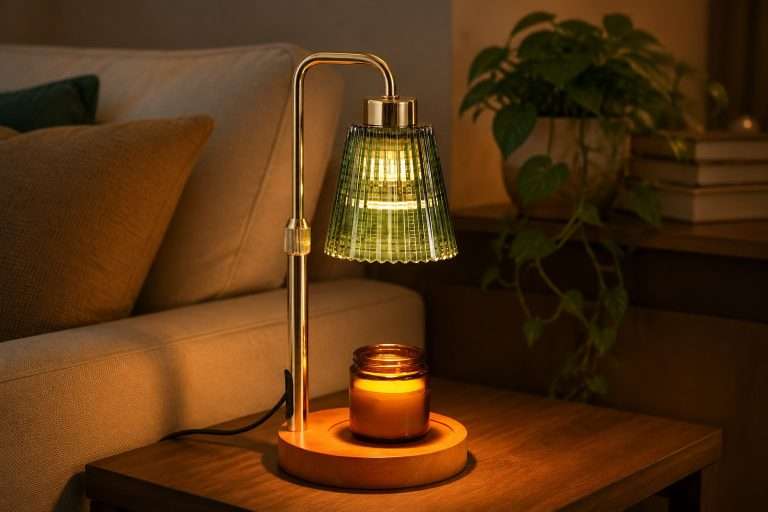
Because sandalwood is a heavy base note, it genuinely benefits from low, steady heat. A candle warmer lamp holds the wax surface at roughly 100 to 160°F, far below a candle flame near 2,552°F and well under paraffin’s flash point around 392°F.[8] That gentle band gives sandalwood’s slow, heavy santalol molecules time to volatilize and drift out fully, without a hot flame flashing off the delicate top of the blend or scorching the wax. If you want the mechanics, our guides on how a candle warmer lamp works and the exact gentle 100 to 160°F heat it uses cover the heat path in detail, and it is one of the easiest ways to enjoy sandalwood flame-free.

One honest guardrail matters here: a warmer maximizes the release of the scent already in the wax. It cannot add sandalwood, deepen the fragrance, or change the blend a candle maker chose; it simply melts the wax evenly so more of what is already there reaches your nose. A useful side effect is that gentle melting tends to make a sandalwood candle last longer than burning it down, so a good creamy-woody candle stretches further. Set the dimmer to the lowest level that still fills your room, and let the slow base note do its work over an evening. Sandalwood is also the note most often burned as a stick for exactly that purpose, and what the relaxation evidence does and does not cover is taken apart in our guide to whether incense sticks relax you.
08Shopping for a Sandalwood Candle or Wax Melt
Go in with realistic expectations and the label gets easier to read. Since genuine Mysore oil is rare and costly, the word “sandalwood” on a candle almost always means a fragrance-oil blend built to smell warm and creamy, which is perfectly good; it just is not a promise of pure S. album. Look for named companion notes that tell you the direction, such as creamy, milky, amber, or vanilla for a cozy version, or cedar and musk for a drier one. Treat a cheap candle that leans hard on the words “Mysore” or “pure Indian sandalwood” with healthy skepticism, because the raw material economics we covered above make that combination unlikely. Our roundup of the best candles for a warmer lamp is a good place to start choosing.
Format matters too. Sandalwood comes as jarred candles, tapers, and increasingly as wax melts, and sandalwood wax melts in particular pair naturally with a warmer because there is no wick to burn at all. Whichever you pick, remember the takeaway from the chemistry: you are buying a creamy, woody, base-note experience, and the gentlest way to get all of it out is low, steady, flame-free warmth.
Frequently asked questions
These answers cover the specific sandalwood questions people search for most, and they stay separate from the profile above so nothing is simply repeated.
What does sandalwood smell like compared to vanilla?
People often expect sandalwood to smell like vanilla because both read as creamy and soft, but they sit in different scent families. Vanilla is a sweet, edible gourmand note, while sandalwood is a dry, creamy wood with only a faint balsamic sweetness rather than a sugary one. Sandalwood is smoother and far less foody, which is why it works in fresh and woody blends where vanilla would feel like dessert.
Is sandalwood a masculine or feminine scent?
Sandalwood is essentially gender neutral. It has been worn across genders and cultures for centuries, and it anchors both traditionally masculine blends, alongside leather and oud, and traditionally feminine ones, alongside rose and jasmine. That soft, woody warmth is what makes it such a flexible unisex base, which is part of why it appears in so many modern fragrances.
Why does my sandalwood candle smell different from sandalwood perfume?
They are usually built from different materials. Most candles use fragrance-oil blends engineered for a strong scent throw when heated, while a fine perfume may use real santalol or essential oil designed to unfold slowly on skin. The candle is tuned to fill a room and the perfume to evolve over hours, so the same named note can read quite differently between the two.
Is red sandalwood the same scent as white sandalwood?
No, and this is a common mislabel. Aromatic sandalwood comes from the Santalum genus, often called white sandalwood, and that is the creamy, woody scent people mean. Red sandalwood is a different tree, Pterocarpus santalinus, prized for its color and used as a dye and in woodwork, and it is nearly scentless. If a product leans heavily on the words red sandalwood, check what it actually smells of.
Does sandalwood take time to develop, or hit right away?
It builds gradually. Sandalwood is a base note, so it emerges slowly and deepens over time rather than announcing itself immediately the way a bright citrus top note does. It is often the scent you still notice hours later, lingering low and warm, which is one reason a steady, gentle heat source suits it better than a quick, hot burst.
Is sandalwood scent calming?
Sandalwood is widely associated with relaxation and has a long history in meditation and aromatherapy traditions, and many people find its warm, grounding character soothing. That said, we make no medical claim. Enjoy it as a comforting, cozy scent rather than a treatment, and pay attention to what genuinely feels relaxing for you.
What does sandalwood incense smell like?
The material is the same, so the core reads the way it always does: warm, creamy, and softly woody, with a faint sweet-balsamic edge and a milky texture rather than the sharpness of cedar. The difference is the format: incense burns its wood or resin instead of warming it, so a smoky, ashy layer sits over the santalol notes and the heat flashes off the most delicate part of the blend. If the creamy base is what you are after, the gentle 100 to 160°F band of a warmer lamp releases more of it than combustion does.

GODONLIF Leather Cone Shade Wooden Candle Warmer Lamp
A wooden candle warmer lamp with a cone-shaped leather shade and a wood base. Bulb heat melts your jar candle from above, so you get the scent with no flame and no smoke.
Shop the leather and wood warmer lampSold and shipped by GODONLIF — free shipping within the contiguous US. Price and availability are shown on the product page.
Sources and evidence limits
Scent descriptors and chemistry come from a perfumer’s guide, a perfume house, an international oil standard, and a perfumery comparison; the conservation status comes from the IUCN; warmer temperatures come from our own fact-checked guide. Each external link was checked on July 22, 2026. One source that went offline was replaced and checked on October 17, 2026.
- ISO, “ISO 3518 — Oil of sandalwood (Santalum album).” iso.org (retrieved July 22, 2026; alpha- and beta-santalol composition standard).
- IUCN Red List, “Santalum album” (assessment, Vulnerable). iucnredlist.org (retrieved July 22, 2026).
- Experimental Perfume Club, “What Does Sandalwood Smell Like? Indian, Australian and Synthetic Sandalwood Explained.” experimentalperfumeclub.com (retrieved October 17, 2026; perfumer’s guide to santalols, species, and pairings).
- Scento, “Sandalwood in Perfume: Indian Mysore vs Australian Compared.” scento.com (retrieved July 22, 2026; santalol %, price per kg, scent descriptors).
- FragranceX, “Fragrance Notes Explained” (top, middle, and base note longevity). fragrancex.com (retrieved July 22, 2026; page publicly reachable, blocks automated fetchers).
- Clive Christian, “What Is Sandalwood Scent?” (olfactive family, base note, persistence). clivechristian.com (retrieved July 22, 2026).
- Première Peau, “Sandalwood: The 30-Year Tree Crisis.” premierepeau.com (retrieved July 22, 2026; maturation time and supply crisis).
- GODONLIF, “How Hot Does a Candle Warmer Get?” (warmer, flame, and flash-point temperatures). godonlifstore.com (internal guide, retrieved July 22, 2026).
Evidence limits: scent is subjective, and the descriptors here are the consensus across perfumery and standards sources rather than a single measurement. Santalol percentages and per-kilogram prices vary by grade, harvest, and supplier, so the figures above are typical ranges, not fixed quotes; the price comparison is given in euros as reported by the source. The heartwood oil-content chart draws on Australian Forestry plantation studies of cultivated trees and represents typical yields, which shift with tree age and growing conditions. A candle warmer changes only how much scent is released from the wax; it cannot add fragrance or alter a blend, and no medical or therapeutic benefit is claimed for sandalwood.
You may also like