News
Candle Warmer vs Diffuser vs Reed vs Plug-In: An Honest Home-Scent Comparison

Jul
Compare
Four flame-free ways to scent a room, one honest verdict: which wins on scent throw, running cost, safety and upkeep – and the moments a diffuser is genuinely the smarter buy.
Key takeaways
- Candle warmer vs diffuser: a lamp melts a jar candle you already own; a diffuser mists water and oil. Different fuel, different mechanism.
- Scent throw: plug-ins and diffusers hit hardest and fastest; a warmer lamp builds gradually; reed diffusers are gentlest.
- Cost: a reed diffuser uses zero electricity; the rest run cents to a couple of dollars a month, but consumables matter more than watts.
- Pet safety: the ASPCA flags diffuser mist on cats’ fur as a real risk – not shared by the other three, but ventilation still matters for all.
- Honest nuance: a 2023 study found plug-in warmers measurably raise indoor VOC levels in poorly ventilated rooms – flame-free was never the same claim as emission-free.
TL;DR. A candle warmer lamp melts a jar candle you already own, no water, no wick; a diffuser mists water and oil. Neither wins outright – diffusers spread scent faster and switch easily, warmers add warm light and use candles you love, and reed and plug-in options trade power for simplicity.
Type candle warmer vs diffuser into a search bar and you’ll get a hundred opinions and very little honesty. We make candle warmer lamps, so treat that as a declared bias – but a fair answer has to include two contenders most head-to-heads skip: the reed diffuser evaporating quietly on a shelf, and the plug-in warmer humming in a bathroom outlet. Here’s how all four compare on scent, cost, safety and upkeep, including the moments a diffuser is genuinely the smarter buy.
01Candle Warmer vs Diffuser: What’s Actually the Difference?
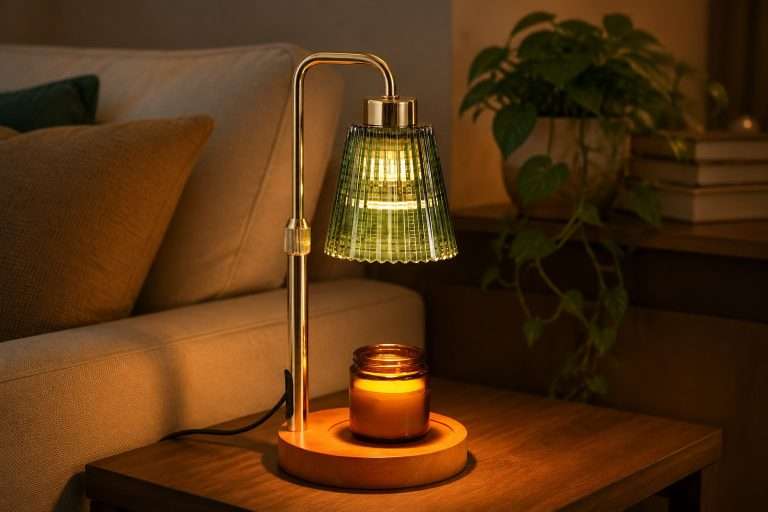
All four methods here skip the open flame that traditional lit candles carry – the cause behind an average of 5,894 US home candle fires a year, per the National Fire Protection Association. Beyond that, a candle warmer lamp and a diffuser share almost nothing. A warmer melts a jar candle you already own with a bulb above the wax; GODONLIF’s own lamp runs a 50-watt GU10/MR16 halogen bulb over the jar, with no dish for loose wax melts and no water reservoir. The bulb is the only part of that description our top-down candle warmers hold constant; the shade, the pole and the base change from model to model. A diffuser instead mists water and a few drops of essential oil using an ultrasonic plate – wax and heat versus water and oil.
That difference in inputs drives everything else here. A candle warmer is locked to whatever scent is in the jar until it’s spent, but needs no daily refill. A diffuser switches fragrances in the time it takes to swap an oil bottle, but its water tank needs topping up often, and mineral scale on the ultrasonic disc is a known nuisance after months on hard tap water. Both are flame-free by design – either clears that bar. See our candle warmer vs. burning a candle comparison for that specific question.
Candle warmer lamp
- Doubles as warm, dimmable light
- No water, no descaling, ever
- Locked to one scent until the jar is spent
- No dish for loose wax melts, out of the box
Diffuser
- Switch scents in seconds
- Adjustable intensity, adds humidity
- Needs frequent water refills
- Ultrasonic disc needs periodic cleaning
02Where Do Reed Diffusers and Plug-Ins Fit In?
A reed diffuser is the simplest of the four: a bottle of fragrance oil with porous reeds standing in it, drawing oil upward by capillary action and releasing it as it evaporates off the exposed tips. There’s no cord and nothing to switch on, so nothing to adjust beyond flipping or adding reeds. As testers at Homes & Gardens have found, a typical bottle lasts a few weeks to a few months depending on its size and reed count – when it runs dry, you buy another. For the setup, the flips and where the bottle should sit, see our guide to how to use a reed diffuser.
A plug-in warmer takes the opposite approach: a small resistive heating element, drawing only a few watts, heats a pre-filled oil cartridge inside a wall unit until it evaporates. It’s the closest thing to true set-and-forget fragrance – no tank, no candle, no reeds – which is why it lives in bathrooms and hallways. The tradeoff, covered below, is that continuous heat-driven evaporation is also the method most closely linked to raised indoor VOC levels.
03Diffuser vs Candle: What Changes When There’s a Flame
Every method above is flame-free, which invites the obvious follow-up: how does any of it compare with simply lighting the candle? Framed as diffuser vs candle, the split is mist against combustion. A diffuser breaks water and a few drops of oil into a cool aerosol and holds that output steady for as long as the tank lasts, at whatever intensity you set. A flame does the opposite – it burns the wax as fuel, so the throw arrives within minutes and then tapers as the jar drains and the surface tunnels. Strongest first hour, shortest useful life.
The rest of the ledger runs in both directions. A candle needs no outlet, no tank and no refill bottle, which none of the powered methods can claim, and it is the only one of the five that puts real light on the table. Against that sits the variable none of the four flame-free contenders carry at all: US fire departments answer an average of 5,894 home candle fires a year, causing 63 deaths, 532 injuries and $286 million in direct property damage (NFPA). A diffuser’s roughly 15-20 cents a month of electricity buys the absence of that entire category. If you want the same trade with a warmer lamp in place of the diffuser, we settled that separately in candle warmer vs. burning a candle.
Reed Diffuser vs Candles: Both Unplugged, Only One Needs Watching
Narrow it to reed diffuser vs candles and you get the only pairing here where neither side touches an outlet. Reeds wick fragrance oil up their porous cores and release it as it evaporates, running unattended for a few weeks to a few months per bottle (Homes & Gardens). A jar candle puts far more scent into the room per hour and adds live light, but only while somebody is there to watch it, and it consumes itself doing so. That is the entire trade: reeds for a bathroom, a rental, or a room you walk away from; a candle for the hour you are actually sitting in it.
Reed diffuser
- Runs unattended – nothing to switch off
- Zero electricity, zero flame
- Gentlest throw of any method here
- New bottle every month or two
Lit jar candle
- Strongest immediate throw, plus real light
- Needs no outlet, works in a power cut
- Has to be watched – 5,894 US home candle fires a year (NFPA)
- Burns itself away and often tunnels
04Scent Throw: Which Method Actually Fills a Room?
For raw intensity, a plug-in warmer and a diffuser set on high are usually strongest, since both actively push scent into the air rather than waiting on ambient heat or passive evaporation. A candle warmer lamp lands in the middle: give it ten to twenty minutes to build a melt pool and the throw is real, but it climbs gradually. A reed diffuser is the gentlest by design – fine for a bathroom, easily lost in a large living room.
Stronger isn’t automatically better, though. The common complaint about diffusers and plug-ins isn’t that they’re too weak, it’s that a high setting in a small bedroom turns cloying within the hour. A candle warmer’s slower build plateaus at a level people find easier to live with all evening – not because it’s the most powerful option here, but because its ceiling is more forgiving.

05Running Cost: Watts, Refills, and What You Replace
On electricity alone, a reed diffuser wins outright at zero. Independent wattage testing by EcoCostSavings found a typical ultrasonic diffuser drawing about 7.3 watts, working out to roughly 15 to 20 cents a month for a couple of hours of daily use. A candle warmer lamp’s 50-watt halogen bulb draws more per hour it’s on, and a plug-in’s heating element is commonly cited around 2 to 4 watts, though makers rarely publish an exact figure.
Electricity was never the real cost driver, though – consumables are. A diffuser needs ongoing oil bottles; a plug-in needs its own branded refill cartridges, often the pricier habit. A reed diffuser’s bottle is a one-time purchase every month or two. A candle warmer lamp’s main running cost is simply the jar candles most owners already buy anyway, plus an occasional GU10 bulb rated for 1,000 to 2,000 hours – call it years of evenings, not months.
06Is a Diffuser Safe Around Pets?
Generally, yes, according to the ASPCA – using an oil diffuser briefly in a room your pet can’t access or knock over is not likely to cause a problem. The caveat is real, though: cats process certain essential-oil compounds less efficiently than dogs or people, and the micro-droplets a diffuser mists into the air can settle on fur and get ingested during grooming, a different exposure route than simply smelling a scent. The ASPCA is also explicit that birds shouldn’t be exposed to a diffuser at all, given how sensitive their respiratory systems are.
The other three methods sidestep that droplet-on-fur route, since none aerosolize liquid oil the way a diffuser does. That’s not a clean bill of health, though – warmed wax, evaporating reed oil, and a heated plug-in cartridge still put fragrance compounds into the air a pet breathes. The rule stays the same regardless of method: ventilate, and don’t assume flame-free means worry-free.
07What About Indoor Air Quality?
Plug-in warmers carry the least favorable air-quality profile of the four, and it isn’t just marketing spin from competitors – it’s measured. Researchers tested 60 UK homes, sampling indoor air over three-day windows with a plug-in diffuser switched on, then off, against paired control homes.
That doesn’t mean plug-ins are unsafe, or a reason to swear off home fragrance – it’s a reason to treat ventilation as part of the setup, the same advice the EPA gives for any scented product used indoors. And it’s worth being even-handed: candle warmers aren’t exempt either. Separate research on heated scented wax has found it can generate its own airborne nanoparticles, so “flame-free” was never the same claim as “emission-free” for any method here, ours included.
08Maintenance: What You Actually Have to Do
A candle warmer lamp asks the least of you day to day: swap the jar candle when it’s spent, wipe the dish if wax residue builds up, and replace the bulb every year or two. No water means nothing to descale and nothing to grow mold in if you forget about it.
A diffuser is the highest-upkeep of the four – tanks need refilling every session or two, and the ultrasonic disc benefits from a periodic vinegar-water rinse to stop mineral scale dulling its output. A reed diffuser only needs an occasional flip or reed swap. A plug-in needs nothing beyond a fresh cartridge, though the housing itself is disposable once its heating element fails.

09So, Which One Should You Actually Buy?
If you already buy or collect jar candles and want warm, dimmable light along with the scent, the candle warmer lamp is built for exactly that. If you want to change fragrances on a whim, blend your own oil combinations, or add humidity to a dry room, a diffuser is genuinely the better tool – not a consolation prize, the correct answer for that use case.
If you rent, can’t run a cord where you want the scent, or just want the lowest-effort option in a small bathroom, a reed diffuser or plug-in warmer will outperform either electric option on convenience alone. There’s no single winner, only a better fit for what you’re trying to do. For more ideas, see our guide to making your home smell amazing without a flame.
Match the Method to Your Home
- A cat lives here, or you keep birds: the ASPCA warnings above are about diffuser mist landing on fur and reaching birds’ lungs. A warmer lamp, a reed bottle or a plug-in sidesteps that particular route; a diffuser still works in a room the cat can’t get into. Keep the room aired out whichever you pick.
- Your lease or dorm rules ban open flames: none of the four burns anything, but a flame clause is not the only clause. Five of the seven campus policies we read for our guide to candle warmers in dorms ban halogen bulbs, which rules a halogen warmer lamp out there. Check the written policy, then decide on the other lines of this list.
- You already own a shelf of jar candles: the warmer lamp. It works through stock you have paid for instead of starting a refill habit.
- You want a different scent most nights, or the air is dry: a diffuser.
- You want scent and no glow: reeds if you want it silent and unplugged, a plug-in if you want it stronger. A lamp is the wrong buy for a spot where light would bother you.
- There is no outlet where the scent needs to be: reeds, or a candle you stay with.
- You want a real flame, or you are out on the patio: keep lighting the candle and stay in the room while it burns. None of the flame-free options gives you a live flame, and that is fine if the flame is what you are after.

10The Four Methods, Side by Side
The full comparison in one place, including the two methods most warmer-vs-diffuser articles leave out. If you are wondering whether you can skip the diffuser and put the oil straight into the lamp, we answer that separately in using essential oils in a candle warmer.
| What matters | Candle warmer lamp | Diffuser | Reed diffuser | Plug-in warmer |
|---|---|---|---|---|
| Mechanism | Bulb melts a jar candle from above | Ultrasonic disc mists water + oil | Reeds wick oil upward, passive | Heating element warms an oil cartridge |
| Needs electricity? | Yes, ~50W bulb | Yes, ~12W typical | No | Yes, ~2-4W |
| Typical running cost | A few dollars a year | ~15-20 cents/month | One-time bottle cost | Lowest of the powered options |
| Scent throw | Medium, builds steadily | Strong, adjustable | Gentle, best for small rooms | Strong, consistent |
| Maintenance | Swap candle, bulb occasionally | Refill water often, descale disc | Flip/replace reeds periodically | Swap oil cartridge |
| Doubles as decor/light | Yes | Some models | No | No |
| Flame | None | None | None | None |
| Best for | Jar-candle lovers wanting ambiance | Switching scents often, adding humidity | Bathrooms, renters, zero power | Small rooms, set-and-forget |
If one column matches your household almost exactly, that’s the honest answer – not whatever a single “winner” verdict claims.
Each Method: Best Owner, Real Price, Deal-Breakers
Candle warmer lamp. Suits people who already buy jar candles and want light with the scent on a nightstand, desk or side table. The cost is one scent per jar until that jar is done, a cord to an outlet, and a 50-watt bulb that pulls more power per hour than anything else here. Skip it if you mostly use loose wax melts (there is no dish out of the box), if you change scents every night, or if you would rather not have a lamp glowing in that spot.
Diffuser. The tool for scent-switchers, oil blenders and dry rooms. You pay for it in upkeep: a tank to refill every session or two, a disc to descale, and a steady supply of oil. Not recommended in a room your cat can get into, and keep it away from birds altogether (ASPCA). Also a poor fit if you know you will forget the water.
Reed diffuser. Good for bathrooms, rentals and shelves nowhere near an outlet. Its price is the weakest throw of the four plus a new bottle every few weeks to a few months (Homes & Gardens). Pass on it for a big living room. It also cannot be switched off, so it keeps releasing scent on the days nobody is home.
Plug-in warmer. Made for small bathrooms and hallways where you want to set it once and forget it. What you give up: you are tied to that brand’s refill cartridges, and the whole housing goes in the bin when its heating element fails. Avoid it in a stuffy, poorly ventilated room, which is exactly where the 2023 UK study measured its VOC bump.
11What Moving to a Warmer Lamp Involves: Price, Bulbs, Jar Fit, Setup
Say the list above landed you on the lamp. The whole move is usually one purchase, and the jar candles already on your shelf come along for free.
The Price Tag
Candle warmer lamps in our shop run from $29.99 for the black classic to $89.99 for the leather cone shade model, at prices checked on October 14, 2026. Shipping is free on every order, with no minimum, to the contiguous 48 US states; we can’t ship to Alaska, Hawaii, US territories or outside the US. Pick the flagship series or an adjustable model (both include bulbs) and bring your own jar candles, and the lamp is the only purchase.
Bulbs: What They Are and How Often They Go
Our top-down lamps take the GU10 bulb described at the top of this page. The flagship series and our two adjustable-height models come with two bulbs in the box, so the spare is already on hand, and a replacement twists in. On frequency, the maintenance section above puts it at roughly every year or two of evening use, in line with the 1,000 to 2,000 hours a halogen GU10 is typically rated for (our candle warmer bulb guide). When the spare runs out, a two-pack of GU10 halogens is $6.99 in our shop.
Jar Sizes the Lamps Handle
Ordinary jar candles are what these lamps are built around; the flagship’s listing puts it as any standard jar, no special candle needed. Height is the thing to check. If your jars run tall or wide, choose a model whose arm adjusts: the fluted glass and walnut lamp and the cut glass and wood lamp ($34.99 each) both slide up and down, and the flagship’s arch raises to clear big, wide jars.
What Happens to Your Candle Stash
They are the reason to switch. A jar candle you have been lighting goes straight under the lamp as it is, and you never strike a match for it again. Wax cubes are a different story. Our jar lamps come without a wax dish, so if you want to melt cubes under one, you set a heat-resistant dish of your own on the base. We don’t sell that dish.
The First Time You Switch It On
- Take the lid off and set the jar on the base, in the recess if your model has one, centered under the bulb.
- On an adjustable model, slide the shade to the height you like over the jar.
- Switch on. If your model has brightness and timer controls, set them now.
- Give it the ten to twenty minutes a melt pool needs before you judge the throw.
Where to Go From Here
If the lamp fits how you live: start with the candle warmer lamp series ($32.99 to $49.99), or browse every shade and base in the full range. Big jars? Go straight to one of the adjustable models above.
If it doesn’t add up for you: keep what you have. A diffuser used for switching scents or adding humidity is already the right tool, and reeds or a plug-in that cover a bathroom well don’t need replacing. Nothing in this comparison says you have to change.

Candle Warmer Lamps
A GODONLIF flameless candle warmer lamp melts your jar candle from above with a dimmable bulb — an electric candle warmer, not an open flame — so the same candle lasts far longer and melts evenly with no tunnelling.
See the candle warmer lamps we makeSold and shipped by GODONLIF — free shipping within the contiguous US. Prices are shown on each product page.
12See a Candle Warmer Lamp in Action
13Frequently Asked Questions
Is a candle warmer better than a diffuser?
Neither wins outright – they solve different problems. A candle warmer lamp melts a jar candle you already own and doubles as warm light; a diffuser mists water and oil so you can switch scents in seconds. Choose the warmer if you love jar candles and want ambiance; choose the diffuser if you want to change scents often or add humidity to a dry room.
Can you run a candle warmer and a diffuser in the same room?
Yes. Just avoid running both at full strength in a small space, since two active fragrance sources can quickly turn overpowering. Give each device its own side of the room, and if anyone in the house is scent-sensitive, run only one at a time.
Which uses less electricity, a diffuser or a candle warmer lamp?
A diffuser, on paper. Most ultrasonic diffusers draw around 12 watts, costing roughly 15 to 20 cents a month for a couple of hours daily. A candle warmer lamp’s 50-watt bulb pulls more power per hour, though most owners only run it for an evening, so real-world yearly costs for both stay in the low single digits of dollars.
Are essential oil diffusers safe around cats and dogs?
Generally, yes, in a secured area your pet can’t reach, per ASPCA guidance. Cats deserve extra caution, since their livers process certain oil compounds less efficiently than dogs or humans, and misted droplets landing on fur can be ingested during grooming. Birds shouldn’t be exposed to any diffuser at all.
Do reed diffusers actually work without any electricity?
Yes – reeds draw fragrance oil upward by capillary action and release it as it evaporates, no power or heat involved. The tradeoff is strength: a reed diffuser is the gentlest of the four methods here, better suited to a bathroom than a large living room.
Diffuser vs candle: which one actually smells stronger?
A lit candle, at least for the first hour. A flame heats the wax far hotter than a diffuser’s cool mist, so the throw peaks fast – then fades as the wax burns away and the jar tunnels. A diffuser holds a steadier, adjustable output for as long as the tank lasts and lets you change scent in seconds. Raw strength belongs to the candle; control, consistency and no open flame belong to the diffuser.
Is a candle warmer better than a diffuser for scent?
Candle warmer vs diffuser: which is better for scent comes down to reach versus staying power. A diffuser actively pushes scent into the air, so it fills a room faster and lets you dial the intensity up or down or swap fragrance in seconds. A candle warmer lamp builds its throw gradually as the melt pool forms, then holds a steadier level that stays easier to live with across a whole evening, using a jar candle you already own. Pick the diffuser for speed and control; pick the warmer for a scent you can sit with for hours.
Sources & further reading
- ASPCA, The Essentials of Essential Oils Around Pets. Retrieved 2026-07-09.
- National Fire Protection Association, Safety with Candles (avg. 5,894 US home candle fires/yr). Retrieved 2026-07-09.
- Warburton, T. et al., Impact of plug-in fragrance diffusers on residential indoor VOC concentrations, Env. Science: Processes & Impacts (2023). Retrieved 2026-07-09.
- US EPA, Can the Use of Fragrances Indoors Cause Health Impacts? Retrieved 2026-07-09.
- EcoCostSavings, Diffuser Wattage, Amps & Running Costs (independent test). Retrieved 2026-07-09.
- Consumer Reports, Best Candle Warmers, Tested. Retrieved 2026-07-09.
- Homes & Gardens, Best Reed Diffusers, Tested. Retrieved 2026-07-09.
- GODONLIF product specifications, Candle Warmer Lamp series. Retrieved 2026-07-09.
You may also like