News
Essential Oils in a Candle Warmer: What Actually Happens

Aug
Using One Well
Search essential oil in candle warmer and you get drop counts, not mechanics. Putting essential oils in a candle warmer changes how long the scent lasts, what the jar looks like afterwards, and — if there is a cat in the house — who else has to metabolise it. Here is what the heat, the chemistry and the veterinary references actually say.
Key takeaways
This page is about neat oil meeting a heated wax pool. If you are choosing hardware rather than fillings, our candle warmer versus diffuser comparison owns that decision.
- It is a performance problem before it is a safety problem. Neat oil floats on the pool instead of dissolving into it, and the best-smelling molecules leave first.
- The temperatures overlap. Published flash points for sweet orange and grapefruit sit around 43 °C (109 °F), inside the band a lamp holds the wax surface in.[5]
- Fragrance oils are engineered for wax; essential oils are not. That is a formulation argument, not a purity one.
- Cats are the real hard stop. Cats are deficient in the enzyme glucuronyl transferase, the pathway most mammals use to clear phenols.[1]
- There is a right tool. Melts already scented with essential oils, or a purpose-built oil warmer, do the job without asking one appliance to be another.
Can you put essential oils in a candle warmer? Physically nothing stops you, which is why the question keeps coming back — a warmer lamp is an open dish of hot wax under a bulb, so there is nowhere for a few drops of lavender to go except in. The interesting part is what happens next. Essential oils in a candle warmer behave like the volatile plant distillates they are: they flash off fast, they do not bind to the wax, and what stays behind changes how the jar performs afterwards. Add a cat and the calculation changes again, for reasons about feline liver enzymes rather than about the lamp.
01Essential Oil in Candle Warmer: The Short Answer
Do not pour neat essential oil into the wax pool — not because it will set the house alight, a framing we take apart below, but because it loses on every axis that matters. It smells strong for a few minutes and then nothing, it fouls the jar and the dish, and in a home with cats it introduces a concentrated exposure the animal did not agree to. Everything you wanted from those drops is available from a melt that already contains them. Which of those oils to steer around in pregnancy is a separate question from whether they belong in the wax at all, and we keep the two apart in our page on candles while pregnant.
The specifics, because “it depends” is useless here. A lamp-style warmer holds the wax surface near 100 to 160 °F (38 to 71 °C), the band our measurement guide to how hot a candle warmer gets maps in detail. Published flash points for the oils people reach for run from about 43 °C for sweet orange to about 69 °C for peppermint.[5] Those two ranges are not separated by a comfortable margin; they are the same stretch of thermometer. What the overlap produces, as section two explains, is loss of scent rather than ignition.
Which route you should take falls out of one question, and it is not a question about oils:
Can you put essential oils in a wax warmer? Physically yes, and it is still the wrong tool: a warmer holds the wax in the same temperature band as the published flash points of those oils, so the scent is gone in minutes and the dish is fouled, while the oil itself belongs in an oil warmer or a diffuser.
02What Actually Happens When You Pour Essential Oil Into a Wax Warmer
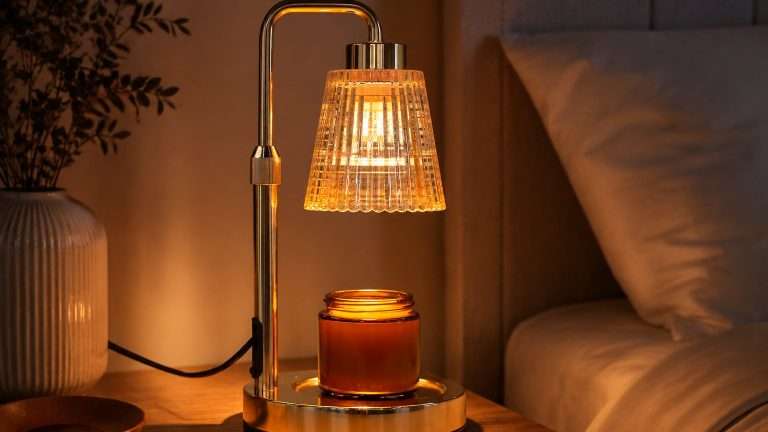
Type wax warmer essential oil into a search box and you get drop counts — five to eight, ten for a big room — and almost never a description of what those drops do once they land. Wax is non-polar and essential oil is a mixture of volatile terpenes, so the oil does not truly dissolve into a melt pool the way a candle fragrance does at manufacture. It disperses badly and floats, and the floating layer is the hottest, most exposed part of the pool, sitting directly under the bulb. A flameless wax-melting lamp is built to heat that pool and nothing else, which is why it rewards fragrance that is already dissolved in the wax.
That is why the pattern owners report is so consistent: an intense burst, then silence. The light top notes with the lowest boiling points are gone within minutes, leaving heavier fractions to oxidise slowly in a warm open dish. What remains is not the oil you bought — it is a partially oxidised film that has changed the wax surface, the same mechanism behind a jar that quietly stops throwing scent for no visible reason. If you want more from a jar, the levers are the wax, the pool and the session length, which is what our guide to making a candle smell stronger works through.

Now the fire question, stated narrowly. Flash point is the lowest temperature at which a liquid gives off enough vapour to form an ignitable mixture in air given an ignition source. It is not a self-ignition temperature. A warmer lamp has no flame and no open spark, so the dish itself is not acting as an ignition source in normal use. That is not the same as saying nothing in the fixture is hot: the bulb envelope runs far hotter than the wax it is heating, so keep oil, wicks, dropper caps and packaging off the shade and away from the bulb. And no study we could find has measured this scenario, so read the paragraph above as inference from the materials’ properties rather than as a test result. What the overlap below actually predicts is mundane, and it is about scent rather than fire: at those temperatures the oil vaporises as fast as it can, which is exactly wrong for a fragrance you wanted to last four hours.
Oil figures: Serenis (candles.org.uk), published by Newshome Candles, “Essential Oil Flash Points,” a trade table covering several dozen essential oils (retrieved August 11, 2026). Cross-check: the flammability tables published by Liberty Natural group tea tree, lavender and citrus oils at 122–140 °F and a second group including orange, lemon and eucalyptus at 102–130 °F — agreeing on citrus, about 10 °F apart on lavender. Wax-surface band from GODONLIF, “How Hot Does a Candle Warmer Get?”. Flash point varies with batch and chemotype; the safety data sheet for your bottle governs.
Two references disagreeing by ten degrees on lavender is the finding, not a flaw. Flash point belongs to the bottle in front of you, not to the plant on the label — it moves with chemotype, distillation run and how long the bottle has been open. Which is the strongest argument against dosing a hot dish by eye: you do not know the number for your bottle, and neither did the article that told you to use eight drops. Where those eight drops land as a concentration depends entirely on what they land in, which is why we worked out the drop math behind autumn blends before publishing a single recipe.
03Essential Oil vs Fragrance Oil: Which One Survives a Warmer
The essential oil vs fragrance oil question is usually argued as natural versus synthetic, which is the least useful frame available when the appliance is a heater. The useful frame is engineering. A candle fragrance oil is blended to be soluble in wax, to hold together across a temperature range, and to release over hours; its flash point is chosen deliberately during formulation. An essential oil is a plant distillate, optimised for nothing in particular and certainly not for sitting in a 60 °C dish under a halogen bulb. Trade guidance is blunt about the consequence: a low flash point means the scent goes strong quickly and then does not last. An hour set aside to unwind wants the opposite of that, a low and steady scent rather than a burst, and what a jar labeled for relaxation can and cannot be expected to do is examined in our page on whether stress relief candles work.
One nuance that does not flatter the flame-free category, which we would rather publish than have you find elsewhere: switching to formulated wax is not switching to zero emissions. When a Purdue University team published a 2025 study of 15 commercial wax melts in Environmental Science & Technology Letters, the dominant compounds released by warmed scented wax were terpenes, which reacted with indoor ozone to form particles between 1 and 100 nanometres; an unscented melt produced no terpene emissions and no nanoparticle formation.[6] Essential oils are terpenes, concentrated. A proper melt improves how long your room smells good; it exempts nobody from ventilating it.
| What goes in the dish | Mixes with the wax? | Scent over a 3-hour session | Leaves behind |
|---|---|---|---|
| Neat essential oil, dripped in | No — floats on the pool | Intense, then flat within minutes | Oxidised film on wax and dish |
| Essential oil dripped onto cold wax | Only where it pooled | Uneven; hot spots burn off first | The same film, unevenly |
| Wax melt scented with essential oil | Yes — blended at manufacture | Steady for the session | Spent wax, swaps out cleanly |
| Jar candle with candle fragrance oil | Yes — formulated for wax | Steadiest of the four | Re-set wax, reusable next time |
Read the first column against the last and the argument settles itself. The two rows that work are the two where somebody blended fragrance into wax under controlled conditions before it reached you; the two that fail are the two where that blending is being attempted, badly, in a hot open dish on a side table. For what goes in the jar rather than on top of it, see our guide to the best candles for a warmer lamp and our explainer on what wax melts are.

04Cats and Essential Oils
Searches for candle warmer cats climb every autumn, and the worry behind them is well placed but usually aimed at the wrong hazard. A warmer lamp has no flame, so the knock-it-over problem that dominates our page on candle safety with kids and pets is largely retired. What is not retired — and what belongs to the oil rather than the appliance — is metabolism. Cats are deficient in the enzyme glucuronyl transferase, and the Merck Veterinary Manual states plainly that the deficiency makes cats very sensitive to phenol and phenolic compounds, which some oils contain.[1] Glucuronidation is how most mammals conjugate those compounds and excrete them; a cat runs the same exposure through a narrower door.
VCA Animal Hospitals names the oils that recur in feline cases — cinnamon, citrus, pennyroyal, peppermint, pine, sweet birch, tea tree, wintergreen and ylang ylang — and notes cats are particularly sensitive because they have a lower number of certain liver enzymes needed to metabolise them.[2] Notice how many of those names also appear on the flash-point chart. There is a second route besides breathing: Merck records that microdroplets from an active diffuser can settle on a cat’s coat and then be absorbed through the skin or swallowed during grooming.[1] Texas A&M’s School of Veterinary Medicine made the same point in 2019 through Dr. Murl Bailey, describing aerosol diffusers releasing micro-droplets that collect on the fur of a pet cat.[4] An open dish of hot oil under a bulb is a slower version of the same thing, at cat height.

None of that makes a candle warmer lamp unsafe around cats, and we will not claim it does. It makes neat concentrated oil the variable to remove. The ASPCA Animal Poison Control Center’s 2022 guidance is that in their concentrated form essential oils can absolutely be a danger for pets, and that concentrated tea tree oil may cause issues with only seven or eight drops — roughly the dose those drop-count articles recommend adding to a warmer.[3] The same guidance treats short, supervised diffuser use in a room the animal cannot enter as unlikely to be an issue, which is a proportionate position rather than a ban. Whether the appliance itself changes that calculation, with the flame gone but the fragrance still in the room, is the narrower question we take apart in are wax warmers safe for cats.
05What to Use Instead
The good news is that what people are trying to achieve — essential-oil scent, flame free, on a side table — is entirely available. It is just not available by improvising with a candle appliance. The easiest route is a wax melt or jar candle scented with essential oils at manufacture: the blending happened at a controlled temperature with a known load, the fragrance sits through the whole wax mass instead of floating on it, and your warmer is doing the one job it was built for. Our guide to using wax melts in a lamp covers how to run them; the only extra rule for essential-oil melts is that a slightly lower dimmer setting suits their lighter fractions.
If You Really Want Oils: Use an Actual Essential Oil Warmer
An essential oil warmer — sold interchangeably as a scented oil warmer, an oil burner or an aroma lamp — is a different appliance with different dish geometry, and the difference is not cosmetic. Instead of a deep pool of wax under a downward bulb, it gives you a shallow ceramic or glass reservoir meant to hold a little water with a few drops of oil floating on it, heated gently from below. The water is the point: it buffers the heat and keeps the oil below the temperature at which it cooks, so you get slow release instead of a flash-off. An ultrasonic diffuser goes further and applies no heat at all.

The trade-off is honest and worth stating: neither of those gives you the light. A warmer lamp is also a lamp, which is most of why people own one, and an oil burner is a small ceramic object that does nothing after dark. If you want both, run both rather than asking one dish to be two products. And if a lamp has started underperforming after an oil experiment, the residue is usually the culprit — our candle warmer troubleshooting page covers cleaning it back to bare glass.

06The Four-Step Version
If you skipped to the end, this is the page in order of effect. The first step changes the outcome on its own; the rest are refinements.
Move the oil out of the wax
Nothing else matters while neat oil is still going into the pool. Put the bottle back with the diffuser and let the lamp heat wax that was already scented. This one change fixes the duration problem, the residue problem and most of the cat problem at once.
Match the filling to the appliance
Wax melt or jar candle for the lamp; water and a few drops for an oil burner or an ultrasonic diffuser. Each dish was designed around a specific viscosity and temperature, and swapping the contents is where every failure mode on this page starts.
If there is a cat, keep concentrates out of the room
Not the lamp — the bottles. Closed cupboard, no open dishes at cat height, no oil on the coat. The enzyme deficiency is permanent, so the fix is removing the source rather than supervising it.
Then tune the session
Run the dimmer high for twenty minutes to build the pool, take it down for the rest, keep some air moving, and let the timer end the session. Scent exposure scales with hours as well as strength, whichever product you settled on.
Worth doing before your next order: check whether the melts or candles you already own list their fragrance source, because “essential oil blend” and “fragrance oil” behave differently under a bulb even when the label art looks identical. If you are restocking anyway, buying one melt of each and running them on consecutive evenings tells you more about your own room than any article can — including this one.
07Watch the Short Version
Frequently asked questions
These stay inside what the veterinary references and the published flash-point data establish. Anything about a specific animal is a question for a vet, not for a lamp brand.
Can you put essential oil in wax warmer dishes or into the melted wax?
You can, but it is the weakest way to use both products. Neat oil does not blend into a melt pool the way a candle fragrance does at manufacture, so it floats on the hottest, most exposed part of the surface and evaporates far faster than you want. The practical result is a strong first few minutes and very little afterwards, plus an oily residue in the dish. A wax melt already scented with essential oils gives you the same character for the whole session.
Will essential oils damage a candle warmer lamp?
The bulb and the arch are unaffected, but the dish, the jar and the glass shade collect a sticky oxidised film that dulls the light and holds old scent into the next session. Warmers are specified for wax rather than for pooled oil, so check your own warranty terms before using one this way. If a lamp has already been used this way, wash the removable dish in warm soapy water and wipe the shade once it is completely cool.
Can you put oil in wax warmer bowls if it is fragrance oil rather than essential oil?
It behaves better than a neat essential oil because candle fragrance oils are formulated to be soluble in wax and to release slowly, but loose oil in an empty dish still has nothing to hold it and will burn off unevenly. The version that works is fragrance oil already blended into wax, which is what a wax melt is. Adding a few drops on top of an existing melt is redundant rather than harmful.
How do you get essential oil scent to last in a warmer?
Stop trying to make the warmer do it. Duration comes from the fragrance being held inside the wax matrix, which only happens if it was blended in before it reached you. Buy melts described as scented with essential oils, run the lamp bright for the first twenty minutes to build a full pool, then dim it. A lower setting after that keeps the pool alive without cooking the lighter fractions off in one go.
Is a candle warmer safe to run in a house with cats?
The lamp itself removes the open flame that makes a lit candle risky around animals, and there is no wick or hot wax to be knocked over. The thing to keep away from a cat is concentrated essential oil, not the appliance: cats metabolise phenols and terpenes poorly, and droplets that settle on a coat get swallowed during grooming. Warm scented wax rather than neat oil, keep bottles closed and out of reach, and speak to your vet before introducing any oil into a room a cat uses.

Candle Warmer Lamps
A GODONLIF flameless candle warmer lamp melts your jar candle from above with a dimmable bulb — an electric candle warmer, not an open flame — so the same candle lasts far longer and melts evenly with no tunnelling.
Browse candle warmer lampsSold and shipped by GODONLIF — free shipping within the contiguous US. Prices are shown on each product page.
Sources and evidence limits
Veterinary statements come from veterinary references, not from aromatherapy retailers. Each link was checked on August 11, 2026.
- Merck Veterinary Manual, “Toxicoses From Essential Oils in Animals.” States that cats are deficient in the enzyme glucuronyl transferase, that this makes them very sensitive to phenol and phenolic compounds which some oils contain, and that microdroplets from an active diffuser can collect on hair and then be absorbed through the skin or ingested during self-grooming. merckvetmanual.com — toxicoses from essential oils (retrieved August 11, 2026).
- VCA Animal Hospitals, “Essential Oil and Liquid Potpourri Poisoning in Cats.” Names cinnamon, citrus, pennyroyal, peppermint, pine, sweet birch, tea tree, wintergreen and ylang ylang; states cats have a lower number of certain liver enzymes necessary to metabolise these oils; lists clinical signs; gives the Pet Poison Helpline number 1-800-213-6680; states you should not induce vomiting or give activated charcoal. vcahospitals.com — essential oil poisoning in cats (retrieved August 11, 2026).
- ASPCA, “The Essentials of Essential Oils Around Pets,” Animal Poison Control Center guidance, published June 23, 2022. Concentrated (100%) essential oils can absolutely be a danger for pets; concentrated tea tree oil may cause issues with only seven or eight drops; short diffuser use in a secured area is not likely to be an issue; APCC emergency number (888) 426-4435. aspca.org — essential oils around pets (retrieved August 11, 2026).
- Texas A&M University School of Veterinary Medicine, Pet Talk, “A Scent-sitive Subject: Essential Oil Diffusers and Your Cat,” November 14, 2019, quoting Dr. Murl Bailey: aerosol diffusers release micro-droplets that may collect on the fur of a pet cat. vetmed.tamu.edu — diffusers and your cat (retrieved August 11, 2026).
- Serenis (candles.org.uk), published by Newshome Candles, “Essential Oil Flash Points” — a trade reference listing flash points in Celsius for several dozen essential oils, including the seven we quote: sweet orange 43, grapefruit 43, lemon 48, eucalyptus 49, tea tree 59, lavender 65, peppermint 69. A supplier reference rather than peer-reviewed literature, and it carries no citations of its own, which is why it is cross-checked below. candles.org.uk — essential oil flash points (retrieved August 11, 2026).
- Patra, S. S.; Jiang, J.; Liu, J.; Steiner, G.; Jung, N. & Boor, B. E. (Purdue University), “Flame-Free Candles Are Not Pollution-Free: Scented Wax Melts as a Significant Source of Atmospheric Nanoparticles,” Environmental Science & Technology Letters, ACS, 2025 (DOI 10.1021/acs.estlett.4c00986). 15 commercial wax melts in a full-scale model home; terpenes reacted with indoor ozone to form 1–100 nm particles, while an unscented melt produced no terpene emissions and no nanoparticle formation. Publisher page returns 403 to automated checks, so the ACS summary is linked. acs.org — study summary (retrieved August 11, 2026).
- GODONLIF, “How Hot Does a Candle Warmer Get?” — the wax-surface band a lamp-style warmer holds (roughly 100 to 160 °F) and the bulb and flame temperatures around it. godonlifstore.com — how hot does a candle warmer get (retrieved August 11, 2026).
- GODONLIF, “Candle Warmer vs Diffuser” — the format-level comparison of warmer lamps, plate warmers, reed diffusers and ultrasonic diffusers, including the pet section this page defers to on diffusers generally. godonlifstore.com — candle warmer vs diffuser (retrieved August 11, 2026).
Evidence limits: no study we could find has measured neat essential oil dosed into a jar candle under a warmer lamp, so section two is inferred from the materials’ physical properties — solubility, volatility, published flash points — not from a chamber measurement of that scenario. The flash-point figures are trade references with no stated methodology, and our two sources disagree by about 10 °F on lavender; treat them as an order of magnitude and read the safety data sheet for your own bottle if the number matters. The veterinary sources establish that cats metabolise phenols poorly and that concentrates and diffuser microdroplets are documented exposure routes; none of them measured a candle warmer lamp, and extending that evidence to an open dish of heated oil is our inference, not a published finding. The Purdue work measured wax melts, and we cite it for the terpene mechanism only. Nothing here is veterinary or medical advice: if you think an animal has been exposed, call a vet or a poison line rather than reading further.
You may also like