News
Hearth Meaning: Why the Word for a Fireplace Floor Means Home

Jul
Words & Home
A hearth is the floor a fire sits on. So why does the word mean home? The honest answer runs from Old English through a 17th-century tax to the living room you are sitting in — no fire required.
Key takeaways
The literal hearth is a floor: the stone or brick slab a fire is built on. The figurative hearth is everything that gathered around it — and English has carried both senses since before the Norman Conquest.
- Literal: Old English heorþ — “hearth, fireplace, part of a floor on which a fire is made.”[1]
- Figurative, and just as old: the same Old English word already meant “house, home, fireside.”[1]
- The hearth was once the census: England taxed households by counting hearths from 1662 to 1689, because a hearth could not be hidden or moved.[7]
- The fire left, the meaning stayed: in 1940 most U.S. homes were heated by coal or wood; by 2000 that was under 5%.[9]
Hearth meaning, in one line: a hearth is the fireproof floor of a fireplace — and, by a leap English made more than a thousand years ago, the home and family that gather at it. Both senses are original; neither is a modern poetic stretch. This guide traces the word from Old English heorþ through the household fire of the ancient world and the English hearth tax to the practical question that follows: what plays the part of the hearth in a house that no longer burns anything? Section seven answers it with an object rather than a fire, a candle warmer lamp, which is what our cozy room decor shelf is built around.
01Hearth Meaning: The Short Answer
What does hearth mean? Ask a builder and a poet and you get two correct answers. To the builder, a hearth is a piece of construction: the floor of a fireplace, plus the fireproof slab that extends into the room to catch embers. Dictionaries carry that literal sense into industry too — the lowest part of a metallurgical furnace is a hearth, which is where “open hearth” steelmaking gets its name.[2]
To the poet — and to most people using the word today — a hearth is home and family life, listed in dictionaries as a plain figurative sense rather than a flourish.[2] Reference works call it a metonym for the household itself, the thing that gave English “hearth and home” and “keep the home fires burning.”[3] The useful part: the second meaning is not a later decoration on the first. Both were already running side by side in Old English.
| Sense | What it points at | You hear it in |
|---|---|---|
| Literal / architectural | The fireproof floor of a fireplace, and the slab extending into the room | “Watch the sparks on the hearth” |
| The recess itself | The opening at the base of a chimney where a fire is laid | “A fire laid in the hearth” |
| Figurative / domestic | Home, household, family life | “Hearth and home,” “the family hearth” |
| Technical / industrial | The floor of a furnace or forge | “Open-hearth furnace” |
02Where the Word Comes From: Old English heorþ
The word arrives in English already meaning both things. Old English heorþ is glossed as “hearth, fireplace, part of a floor on which a fire is made,” and etymological dictionaries record its transferred use for “house, home, fireside” in the same period.[1] Behind it sits Proto-Germanic *hertha-, usefully translated as “burning place” — a name for the spot, not the flame.[1] That distinction is the whole story in miniature: the English word never named the fire. It named the place you kept one.
One layer deeper the reconstruction gets less certain, which is worth saying plainly. Etymonline traces the Germanic form to a Proto-Indo-European root meaning “heat, fire”; Wiktionary marks the same connection as only probable.[1][2] Sideways, though, the family is unmistakable — Dutch haard and German Herd are the same word, still in daily use, and English later built hearth-stone (early 14th century) and hearth-rug (1824) on top of it.[1]
| Language | Word | Sense |
|---|---|---|
| Old English | heorþ | Hearth, fireplace; also house, home, fireside |
| Old Saxon / Old Frisian | herth | Hearth |
| Dutch | haard | Hearth, fireside (still current) |
| German | Herd | Hearth; in modern use, the kitchen stove |
| Latin | focus | Hearth, fireplace; figuratively home and family |
That last row is the one that surprises people. Latin focus meant “hearth, fireplace” and stood figuratively for home and family, exactly as heorþ did. Kepler borrowed it in 1604 for the point where light rays converge, Hobbes carried that sense into English around 1650, and by 1796 it meant “center of activity.”[6] So when you tell someone to focus, you are using the Roman word for a fireplace. Two unrelated language families, one metaphor: the fire is where everything converges.
03“Hearth and Home” and “Home and Hearth”: What the Phrase Carries
Both orders are in circulation and both mean the same thing. Hearth and home is the older, more common fixed pair, listed straight in dictionaries among the word’s derived terms alongside hearthstone, hearthside and hearth tax; home and hearth is the same phrase with the halves swapped, carrying no separate sense.[2] Reference works treat the pair as the standard illustration of how a feature of a building came to stand for family unity and domestic comfort.[3]
What makes the phrase work is that it is not a repetition. “Home” is the abstraction — belonging, relationships, an address. “Hearth” is the physical anchor that makes the abstraction locatable: a specific warm spot, in a specific room, that everyone knows how to walk toward. And note what the phrase does not say. It names no flame, wood or chimney — only a place defined by warmth and gathering, which is precisely why the idiom survived the thing it was named after.
04When the Hearth Was the Household
For most of recorded history the metaphor was barely a metaphor.
The Goddess of the Hearth: Hestia, Vesta, and the Public Flame
The goddess of the hearth held a public office as much as a domestic one. In Greek practice the hearth received the first offering at every domestic sacrifice, and Hestia — the hearth personified — had her official sanctuary in the city’s public hearth, where a perpetual flame burned; when Greeks founded a colony, they carried fire from the mother city’s hearth to light the new one. Rome’s equivalent was Vesta.[4] A household that let its fire go out had failed at something closer to a duty than a chore.
The Medieval Hearth and the Curfew Bell
The medieval hearth kept the same logic in plainer clothes. Curfew comes from Old French cuevrefeu, literally “cover fire”: a bell rung around eight or nine in the evening as an order to bank the hearths and go to bed. It entered English in the early 14th century and only drifted toward “restriction on movement” in the 1800s.[5] The day ended when the fire was covered. Archaeology runs the same logic in reverse: hearths are among the clearest markers a dig can find, and the charcoal in them is what makes a settlement datable.[3] Datable objects are how candles are traced too, and the oldest firm evidence for them, a bronze stand built to hold candles, is set out in our guide to who invented the candle.
Then England made the equation official. From 1662 to 1689 the Crown taxed households by counting their hearths — two shillings per hearth per year, half at Michaelmas and half at Lady Day. Hearths were chosen for a coldly practical reason: they could be counted easily, were hard to conceal or demolish, and did not move.[7] For twenty-seven years an English household was legally defined by its fireplaces.
The returns those collectors left behind answer a question the idiom never does: how many hearths did a household actually have? Overwhelmingly, one. As the Cambridge historian Evelyn Lord puts it, in every hearth tax assessment for England and Wales the majority of tax-payers were assessed on a single hearth — 54.7% across Huntingdonshire in 1674, and far higher in individual parishes.[8]
Evelyn Lord (University of Cambridge), “Poverty and the Single hearth in Huntingdonshire,” Economic History Society working paper, from the hearth tax assessments of 1671 and 1674. Parish figures show the spread within one small county. Retrieved July 29, 2026.
Read the chart and “hearth and home” changes shape. For most households there was no a hearth among several — there was the hearth, singular, and the house was organized around it. The spread also kills any romantic flattening of the past: Conington sat at 16.6% while Morborne reached 81.2%, so the number of fires you kept was a blunt readout of what you could afford. Lord’s own caution is worth repeating — one hearth often signalled poverty, but not always, since plenty of single-hearth households sat above the exemption line.[8]
05Hearth vs. Fireplace: What a “Fireplace Hearth” Actually Is
Because the word does double duty, the compound fireplace hearth sounds redundant and is not. The fireplace is the whole assembly — firebox, surround, chimney. The fireplace hearth is one component of it: the fireproof floor the fire sits on, usually with a slab extending into the room so embers land on stone rather than carpet.[2]
The fireplace
The whole assembly
- Firebox, surround and chimney together
- What a listing means by “has a fireplace”
- Not one component you can buy
The hearth
One part of it
- The fireproof floor the fire sits on
- Plus the slab projecting into the room
- What you price when you shop for tile or stone
- Also, confusingly, a word for the home itself
The layout has changed more than the vocabulary. Pre-industrial houses often set an open hearth in the middle of the room, smoke finding its way out through a hole in the roof; only later did the fire migrate to the wall and acquire a chimney.[3] That move is quietly enormous for the metaphor. A central hearth is something a household sits around; a wall fireplace is something it sits in front of — the first step from communal fire to a warm feature you face, and eventually to no fire at all.
06How the Modern House Lost Its Fire — and Kept the Word
The disappearance is recent and measurable. In the 1940 U.S. Census, over half of housing units heated primarily with coal and another quarter with wood; by 2000, the share heated by wood or coal had fallen below 5%, with gas and electricity taking over.[9] Within two generations, the tended fire went from the normal way to keep a house warm to a rounding error.
Notice what that removed. Central heating is better at heating, and nobody is nostalgic for a cold bedroom. But a furnace is deliberately invisible and warms every room equally, which means it creates no place. The hearth’s job was never only thermal: it was a fixed point with light, warmth and a smell that told everyone where the evening was happening, and a thermostat cannot do that, because a thermostat has no location you would want to sit next to. So the word outlived its referent. That is the honest reading of hearth meaning in a modern home — the fire was the old technology, and the gathering point was the actual thing.

07Keeping the Hearth When You Have No Fire
Strip the hearth down to what it delivered and you get three things, none of which requires combustion: a warm pool of light, a scent that says someone lives here, and a fixed place people drift toward. That is a specification, and it is reachable in a rented flat with no chimney. The trap is reproducing the fire instead of the function — a screen showing crackling logs delivers none of the three.
Light comes first, because light is what turns a corner into a destination: low and warm beats bright and overhead. Scent is the second layer, and the one most people skip; our guide to making a house smell good covers the order that works — remove odors at the source first, then add one steady, low-level scent rather than a burst. Third is repetition: a hearth was a hearth because it was lit every single evening.
Pick the spot, not the object
Choose one corner people already gravitate to — the reading chair, the end of the sofa, the counter you lean on. The hearth was a location before it was equipment.
Give it a low, warm light
One dimmable light at sitting height, not overhead. A small pool of warm light is what separates a “spot” from a room with the lights on. Which height that is in a bedroom, and which of the three layers of light to fix first, is worked out in our guide to warm and cozy bedroom ideas.
Add one scent, kept gentle
A single fragrance held at a low temperature for hours reads as “someone lives here.” A strong burst does not — your nose stops registering a constant smell within minutes.
Light it at the same time each evening
Repetition is the trick. The curfew bell worked because it came at the same hour; a hearth becomes a hearth somewhere around the tenth consecutive night.
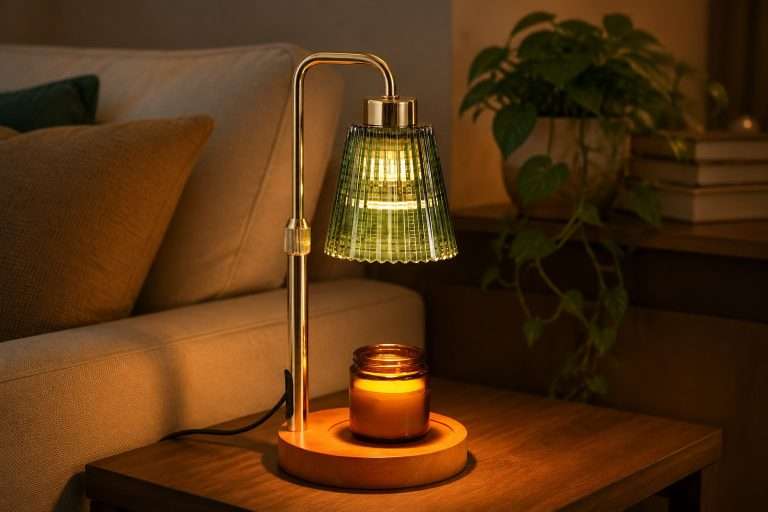
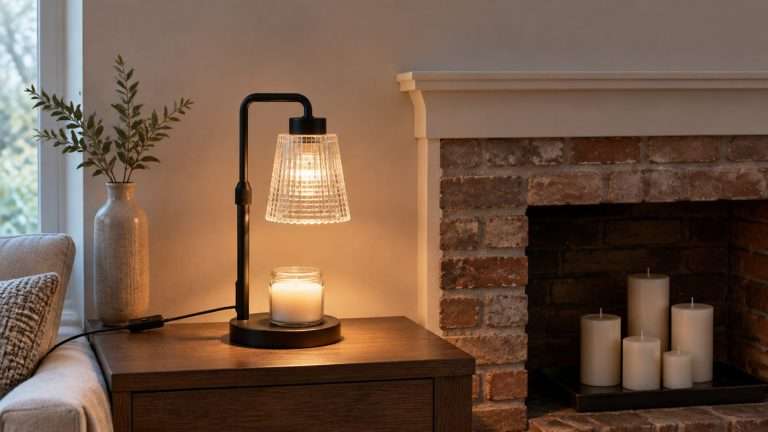
A candle warmer lamp happens to hit all three at once, which is why it sits in this article rather than a fireplace insert. It is a small lamp whose bulb melts the surface of an ordinary jar candle from above — light and scent from one object, with no wick ever lit. If you are weighing that against simply burning the candle, our candle warmer vs. candle comparison lays out the tradeoffs, and if the appeal is leaving a warm spot glowing late, read our take on running a candle warmer overnight before you make it a habit.

That is the argument of this whole article reduced to one household: take the flame out and see whether anything is actually lost. A verified buyer of the flagship lamp reports the swap held.
I honestly haven’t lit a regular candle since buying this candle warmer. It gives off the scent really well without having to worry about an open flame, and it makes the room feel cozy.
Notice what did not change. The candle is the same candle, in the same jar, in the same corner; only the heat source moved, from a wick inside the wax to a bulb above it. Two of the three things the hearth was for — the smell of a house someone lives in, and the sense that the room has a warm spot — came through without the fire.
Source: verified Amazon review of the GODONLIF Candle Warmer Lamp (ASIN B0CTJGJL2T), United States, May 2026. Review ID R2R6L0276CVWR5 — excerpted verbatim from the review.
Step four above is the one people skip, and it is the one that does the work. The curfew bell turned the medieval hearth into a fixed point by ringing at the same hour every night; a timer is that instrument with a cheaper bell. One verified buyer describes running the lamp on exactly that schedule.
It sets a nice ambiance with the added bonus of a timer! I can set the timer to come on and go off the same time daily.
Put on a schedule, the corner stops being something a person decides to switch on and becomes something the evening arrives at. That is the whole distance between a lamp and a hearth, and it costs nothing but consistency. A room that still has a real firebox starts from the other end of that distance, with the fireplace already there and simply never lit, and we style one from the grate to the mantel in our guide to a fireplace styled with candles.
Source: verified Amazon review of the GODONLIF Candle Warmer Lamp (ASIN B0CTJGJL2T), United States, May 2026. Review ID R1JVJHFZ90H1H3 — excerpted verbatim from the review.
The brand’s own name is built on the same idea, and this is a claim about atmosphere, not heat: GODONLIF reads as GOD + ON + LIF(E) — a gentle, divine warmth set upon your life — under the line “where light lives slowly.”[10] A lamp does not heat a room and is no substitute for a heating system. What it can do is the older job the word hearth has described since Old English: mark one warm place in a house, and give people a reason to sit at it. Whether a flame could do the heating instead is a question of watts rather than atmosphere, and we count them in our guide to whether candles can heat a room.
Frequently asked questions
These cover the definition questions the sections above touch only in passing — the exact wording, the idiom, and the difference between a hearth and the fireplace around it.
Hearth meaning in simple terms: what does hearth mean?
A hearth is the fireproof floor a fire is built on — the base of a fireplace, usually with a stone or brick slab extending into the room. By extension it also means the home and family life that gathered there. Both senses are old: the Old English word heorth was glossed as the fireplace floor and used for "house, home, fireside" in the same period. That is the whole hearth meaning in one line — a place first, a feeling second, and English has carried both for over a thousand years.
What does the phrase "hearth and home" mean?
"Hearth and home" means domestic life: the household, the family in it, and the comfort of being there. Dictionaries list it as a standard fixed phrase built on the word's figurative sense, alongside compounds like hearthstone and hearthside. The pairing is not a repetition. "Home" names the abstraction — belonging, relationships, an address — while "hearth" supplies the physical anchor, a specific warm spot in a specific room. Notably, the phrase never mentions flame or chimney, which is why it still works in houses that burn nothing.
Is "home and hearth" the same as "hearth and home"?
Yes. "Home and hearth" is the same fixed expression with the two halves swapped, and it carries no separate meaning. "Hearth and home" is the more common and better-established order, and it is the form listed in dictionaries among the word's derived terms. You will meet the reversed version in speech, book titles, and headlines, usually for rhythm rather than for any shift in sense. If you want the conventional form in edited writing, use "hearth and home"; either will be understood.
What is the difference between hearth and fireplace — and what is a fireplace hearth?
The fireplace is the whole assembly — firebox, surround, and chimney — while the hearth is the fireproof floor inside it, plus the slab that projects into the room so sparks and embers land on stone rather than flooring. "Fireplace hearth" names that same floor more precisely, so it is not redundant; it just specifies which part you mean, which matters if you are pricing tile or stone. Confusion arises only because the bare word "hearth" also does duty for the home itself.
Can you have a hearth in a home with no fireplace?
Not in the literal, architectural sense — that sense requires a fireplace to floor. In the figurative sense, which is the one most people use, yes: strip the hearth down and it delivered a warm pool of light, a scent that signals someone lives there, and a fixed spot people drift toward. None of those three requires combustion. A lamp at sitting height, one gentle fragrance, and the habit of switching it on at the same hour will reproduce the function, even though the fire is gone.
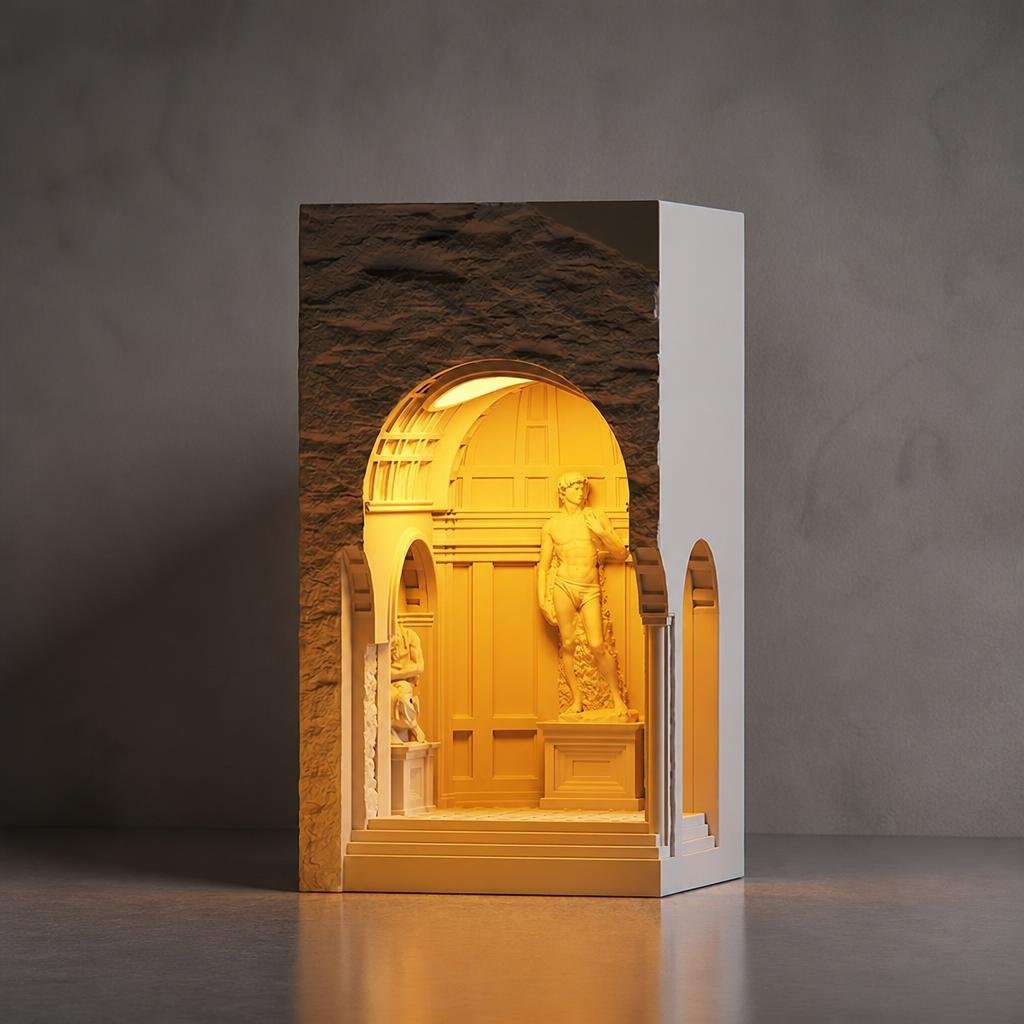
GODONLIF White Plaster David Statue Candle Warmer Lamp
A white plaster block with an arched niche cut into the front, a full David statue standing inside on a square plinth, and warm light coming out from under the vault.
A lit niche for the cornerSold and shipped by GODONLIF — free shipping within the contiguous US. Price and availability are shown on the product page.
Sources and evidence limits
Etymology from lexicographic reference works; ancient and medieval practice from encyclopedia entries; hearth tax figures from an academic paper working from the 1671 and 1674 assessments; U.S. heating history from a conference paper drawing on Census historical housing tables. Each link was checked on July 29, 2026.
- Online Etymology Dictionary, “hearth” (Old English heorþ; transferred sense “house, home, fireside”; Proto-Germanic *hertha- “burning place”; cognates; hearth-stone early 14c., hearth-rug 1824). https://www.etymonline.com/word/hearth (retrieved July 29, 2026).
- Wiktionary, “hearth” (senses: fireplace floor, chimney recess, furnace floor, and the figurative “home or family life”; derived terms including “hearth and home”; PIE root marked as probable). https://en.wiktionary.org/wiki/hearth (retrieved July 29, 2026).
- Wikipedia, “Hearth” (hearths as archaeological markers and radiocarbon material; the central open hearth giving way to the wall fireplace and chimney; hearth as metonym for home). https://en.wikipedia.org/wiki/Hearth (retrieved July 29, 2026).
- Wikipedia, “Hestia” (first offering at every domestic sacrifice; the prytaneum’s perpetual public hearth; fire carried to a new colony; Vesta as Roman equivalent). https://en.wikipedia.org/wiki/Hestia (retrieved July 29, 2026).
- Online Etymology Dictionary, “curfew” (Old French cuevrefeu, “cover fire”; the evening bell to bank the hearths; English from the early 14c.; movement sense from the 1800s). https://www.etymonline.com/word/curfew (retrieved July 29, 2026).
- Online Etymology Dictionary, “focus” (Latin focus “hearth, fireplace,” figuratively home and family; Kepler’s 1604 use; English c. 1650; “center of activity” 1796). https://www.etymonline.com/word/focus (retrieved July 29, 2026).
- Wikipedia, “Hearth tax” (1662–1689; two shillings per hearth per year, halves due at Michaelmas and Lady Day; hearths chosen as countable, hard to conceal and immovable; repealed 1689, “badge of slavery” wording). https://en.wikipedia.org/wiki/Hearth_tax (retrieved July 29, 2026).
- Evelyn Lord (University of Cambridge), “Poverty and the Single hearth in Huntingdonshire,” Economic History Society working paper (majority assessed on one hearth; Huntingdonshire 54.7% in 1674; Great Staughton 62.9%; Little Staughton 75%; Conington 16.6%; Morborne 81.2%; Bedfordshire border parishes 67.2% in 1671). https://files.ehs.org.uk/wp-content/uploads/2020/11/29060838/Lord-full-paper.pdf (retrieved July 29, 2026).
- James D. Lutz, Lawrence Berkeley National Laboratory, “Lest We Forget, a Short History of Housing in the United States,” ACEEE Summer Study, citing U.S. Census historical housing tables (1940: over half of housing units heated with coal, another quarter with wood; by 2000, wood or coal below 5%). https://www.aceee.org/files/proceedings/2004/data/papers/SS04_Panel1_Paper17.pdf (retrieved July 29, 2026).
- GODONLIF, “About” (the brand name read as GOD + ON + LIF(E), “a gentle, divine warmth, set upon your life,” and the line “where light lives slowly”). https://godonlifstore.com/about/ (retrieved July 29, 2026).
Evidence limits: etymology is reconstruction, not observation — the Germanic line from heorþ is secure, the deeper Proto-Indo-European root only probable. The hearth tax percentages are shares of assessed tax-payers in named parishes and years, not a national count of fireplaces, and exemptions are handled differently across returns; read them as a local picture. The U.S. heating figures are census-year shares by main heating fuel and say nothing about decorative fireplaces. Nothing here is a heating, safety or health claim: a candle warmer lamp is an atmosphere device, not a heat source or a substitute for a heating system.
You may also like