News
How to Make Your Bathroom Smell Like a Spa: A Bathroom Scent Plan the Extractor Fan Cannot Undo
Sep
Scent, Room by Room
A bathroom scent plan has to survive the one appliance no other room has: an extractor fan built to pull the air out of it. That single fact reorders everything. Clear the moisture, let the fan finish, and only then put fragrance into a room still enough to hold it. And because this is the room a flame is least supervised in, the heat behind that fragrance is worth choosing on purpose.
Key takeaways
This page answers one question: how to put scent into a bathroom and keep it there. Where a lamp may stand is settled in our guide to where a warmer lamp goes, and the whole-house version is in making a house smell good. What a scent does to your mood is a separate article.
- Sequence beats product. The Home Ventilating Institute asks for twenty minutes of fan time after the bathroom is used; that run is the moisture window, not the scent window.[3] Fragrance released into it is fragrance sent outdoors.
- Dry the room before you scent it. Federal guidance is to keep indoor humidity below 60 percent, ideally 30 to 50 percent, and to run the fan or open the window while showering.[4]
- This is the third most common room for a candle fire to start. In 2014–2018 an average of 920 US home fires a year began with a candle in the bathroom, 12 percent of the total.[2] The federal fire agency is blunt: do not use lit candles in bathrooms.[6]
- Almost nobody calls it a candle room, and it still burns. The candle industry’s own figures name the living room, kitchen and bedroom; the bathroom is not on that list.[7]
Search this and you get a shopping list: twelve jars, a paragraph about eucalyptus, a photograph of a bathtub nobody has washed in. The list is beside the point. The problem is not which jar you own. It is that the room is engineered to remove whatever you put into the air, on a schedule that has nothing to do with you.
01Bathroom Scent: The Short Answer Is a Plan, Not a Purchase
A working bathroom scent routine has three phases and they do not overlap. Phase one is moisture removal, which belongs to the fan and ends before any fragrance enters. Phase two is the settle: a few quiet minutes with the fan off and surfaces still warm. Phase three is the scent window, the following forty minutes, when a jar finally earns its keep. Run those out of order and you have not chosen badly — you have scented an air duct.
That ordering is not household superstition. The Environmental Protection Agency puts source control first, ahead of ventilation, and notes that local bathroom fans “remove contaminants directly from the room where the fan is located.”[5] Read that across to fragrance and it reverses neatly: whatever the fan does to the air, it does to your scent.
| Phase | Roughly when | What the room is doing | What to do about scent |
|---|---|---|---|
| Extraction | The shower, plus about twenty minutes[3] | Wet air and everything else airborne is pulled outdoors | Nothing. What is released now leaves with the steam |
| Settle | The five minutes after the fan stops | Air movement drops, surfaces still warm, humidity falling | Open the jar, switch the lamp on, start the melt pool |
| Scent window | Roughly the following forty minutes | Still air, warm surfaces, low turnover — the room holds what it gets | The entire return on the product. Sit the session inside it |
02Why a Bathroom Loses Fragrance Faster Than Any Other Room
Two properties do the damage and they compound. The first is turnover. The Home Ventilating Institute sizes bathroom extraction at one cubic foot per minute for every square foot of floor area in bathrooms up to 100 square feet.[3] That ratio is aggressive because moisture has to go somewhere: a small bathroom’s air is replaced far faster than a living room’s ever is. Fragrance molecules are not exempt.
The second is the door. A bathroom spends most of its life closed, which sounds helpful and mostly is not: a closed door with an active fan turns the room into a pressure sink, drawing replacement air under the threshold and out through the duct. The through-flow strips the scent, not the door position. The general version — a jar smelling of nothing because the room exchanges air faster than the wax can supply it — is in our page on a warmer that stops smelling.
One more thing gets one sentence: a bathroom often has an odor source of its own, and no fragrance plan works until that source is dealt with — source control applied to the obvious.[5]
03The Forty-Minute Window: When to Add Scent After a Shower
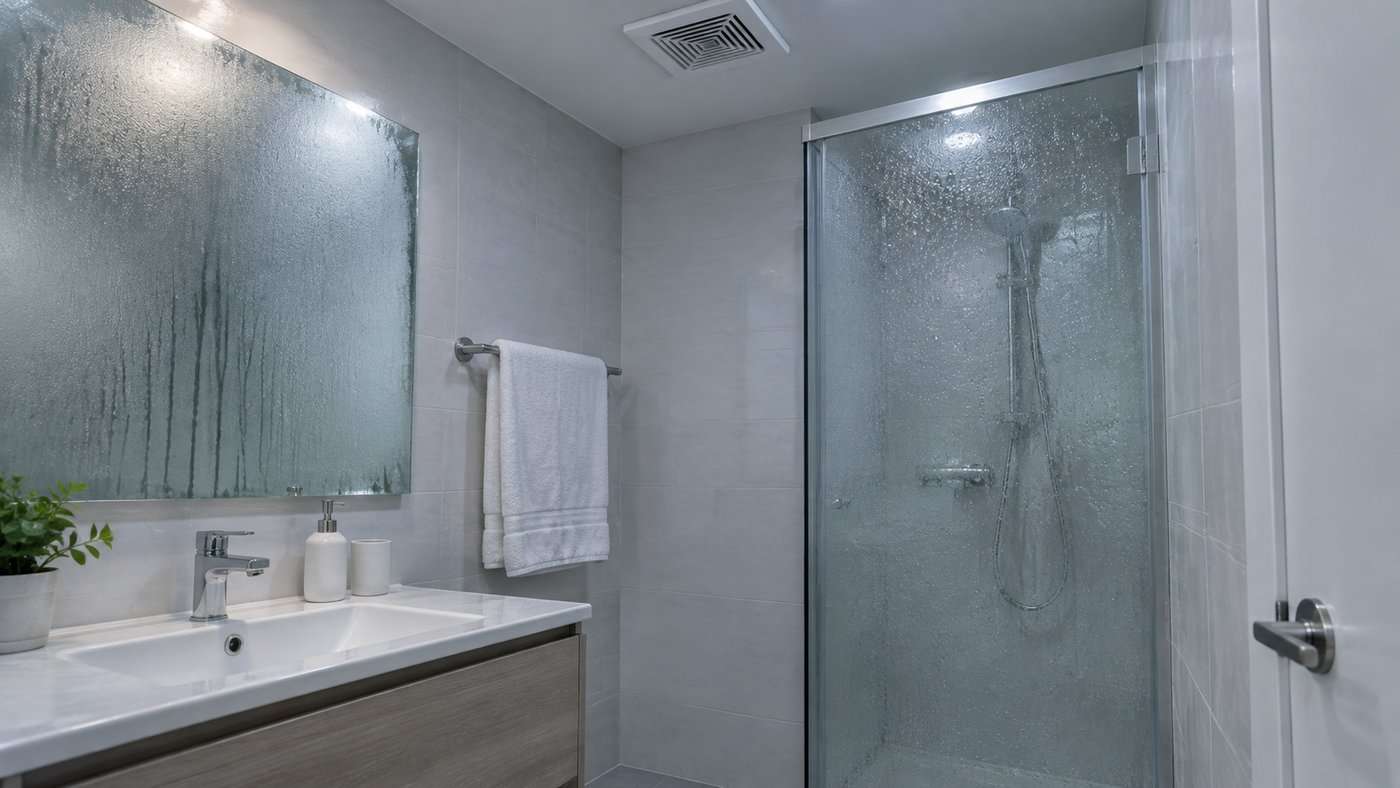
The window opens when the fan closes. The instruction is direct — “HVI recommends that the fan be left on for 20 minutes after use of the bathroom” — and those twenty minutes do real work on condensation, so they are not a step to shorten.[3] They are also the interval in which released fragrance is extracted with the steam. Wait it out. Which outlet the lamp is on, how high above the splash line and how far from the shower door are settled in our guide to where to put a warmer lamp.
Run the fan while you shower
Federal mold guidance: run the fan or open the window when showering, holding humidity below 60 percent. This step is about water, not smell.
Let the fan finish its twenty minutes
Open no jar and start no melt during the run. Extraction that clears the ceiling clears fragrance at the same rate.
Switch the fan off, wait five minutes
Air movement falls, surfaces stay warm, humidity drops. Still air over warm surfaces is what holds a scent.
Introduce the scent, and start it low
A jar under gentle heat needs ten to twenty minutes to build a melt pool. Starting at the top of the window is most of the difference.
End the session on a timer, not on memory
A bathroom is the room you leave. Whatever makes the scent should stop without you.
One note on step four: run the source at the lowest setting that reaches the whole room, because a small space concentrates fast and a level that reads as generous in a living room reads as heavy here within ten minutes. Both the low setting and the stop can be handed to the lamp: a warmer lamp that dims and also has a timer holds the low setting, then switches itself off without you in the room. If the throw is genuinely weak rather than merely gradual, that is a different problem with its own fixes, in our page on making a candle smell stronger.
04What Steam Actually Does to a Scent, Honestly
You will read everywhere that steam “carries” fragrance and makes a bathroom smell stronger. The controlled evidence is split, and pretending otherwise would be easy and wrong. In 2008, Kuehn and colleagues tested 75 volunteers in climate chambers and found odor thresholds lower — sensitivity better — in humid conditions than in dry ones.[8] In 2021, Drews and colleagues ran 50 participants through warm, cold, humid and dry combinations and found that “neither temperature nor humidity had a significant effect on olfactory test results.”[9]
Both are small, both used standardized test odorants rather than a candle, and neither ran in a bathroom. The pair gives a boundary rather than a rule: whatever humidity does to perception, it was not large enough to show up reliably across two careful attempts. That puts the weight back on the variable that is large and measurable — how fast the room exchanges its air.
The other steam idea worth retiring is turning a shower room into a simmering pot of water and aromatics. Why a warmer lamp cannot poach botanicals — no vessel, no sustained temperature, steam traveling up the arm — is in our page on a warmer as simmer pot.
05The Worst Room in the House for an Open Flame
This is the part a bathroom scent article usually skips, and it has the hardest numbers behind it. In 2014–2018, US fire departments answered an average of 7,610 home candle fires a year, causing 81 deaths, 677 injuries and $278 million in damage — about 21 a day.[1] Sorted by where they started, the bathroom sits third, behind the bedroom and living room and ahead of the kitchen.[2]
Source: Marty Ahrens, Home Candle Fires supporting tables, National Fire Protection Association, May 2020, Table 1.[2] Percentages are of all home candle fires; Table 1’s two non-room categories (13 and 6 percent) and the smaller rooms are omitted. Retrieved September 16, 2026.
Set that beside where people say they actually burn candles. The National Candle Association reports, in its published facts and figures, that “candle users say they most frequently burn candles in the living room (42%), followed by the kitchen (18%) and the bedroom (13%).”[7] The bathroom is not on that list. A room that barely registers as a candle room is still the origin of roughly one in eight home candle fires — the definition of a disproportionate outcome.
The mechanism is not mysterious. Three in five candle fires started with something combustible too close; in 16 percent the candle was unattended or abandoned.[1] A bathroom is a small hard room crowded with soft dry cloth: a towel on a rail above the vanity, a bath sheet on a hook, a curtain that moves when the door opens. It is also, by design, a room you leave. The US Fire Administration does not hedge: “Don’t use lit candles in bedrooms, bathrooms and sleeping areas,” pointing instead to flameless alternatives “which can look, smell and feel like real candles.”[6]
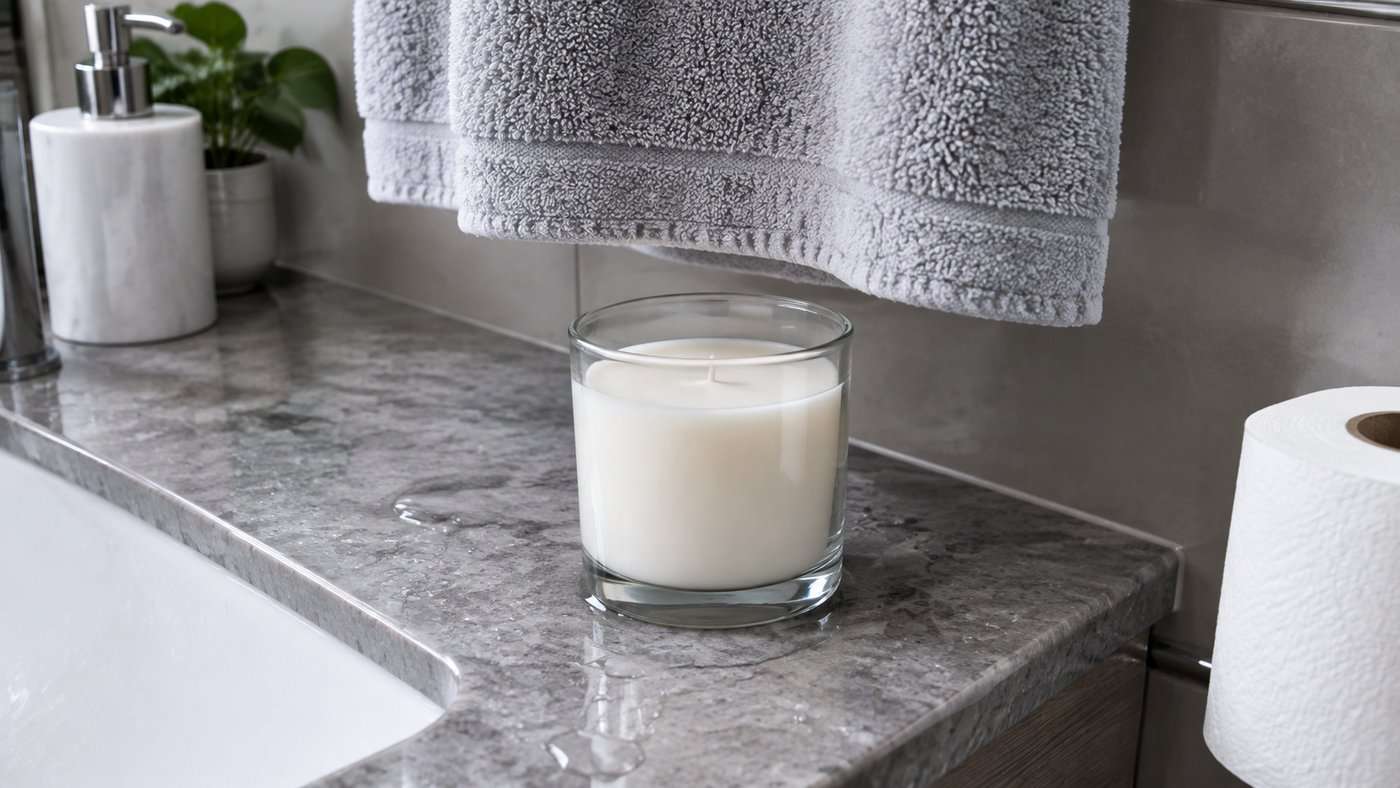
06Choosing a Scented Candle for Bathroom Use
Search for the best bathroom candles and you get a ranked list of jars, which answers a question nobody in a small damp room is asking. What matters about a candle for bathroom use is whether its output matches a space this size and whether it can run inside the forty-minute window unsupervised. Whether the scent does anything for the person in the bath, as opposed to the room, is a separate question with its own evidence, and it is taken up in our page on whether stress relief candles work. Three properties do nearly all the work, and none appears in a review headline.
Vessel size first: a jar sized for an open-plan living room is oversized here, and oversizing in a small space does not read as generous, it reads as sharp. Second, scent weight — lighter, brighter profiles read as clean here and heavier ones tend to sit, which is the reasoning behind the single bathroom row in our whole-house scent guide; that guide assigns the room a family, this page is the sequence. Third: who stops it. A lit wick needs a person present; a jar under a bulb can be handed to a timer.
A lit jar in a bathroom
- Needs someone present for the whole session
- Sits in the third leading room of origin for candle fires
- Full throw fast, then falls as the wax burns away
- Leaves soot on hard surfaces over time
- Needs no outlet, which in some bathrooms decides it
The same jar under a bulb
- Ended by a timer rather than by remembering
- No flame, so the towel-above-the-vanity geometry stops mattering
- Throw builds over ten to twenty minutes, not instantly
- Light and scent from one fixture during the window
- Needs an outlet, and bathroom outlets have their own rules
If neither column fits — a rental you cannot run a cord in, or a room you want scented with no intervention — a reed diffuser or a plug-in is a legitimate answer, and the four-way comparison is in our page on warmer against diffuser. If you go the reed route, our guide covers how to use reed diffuser sticks, from the first-day flip to where the bottle should sit.
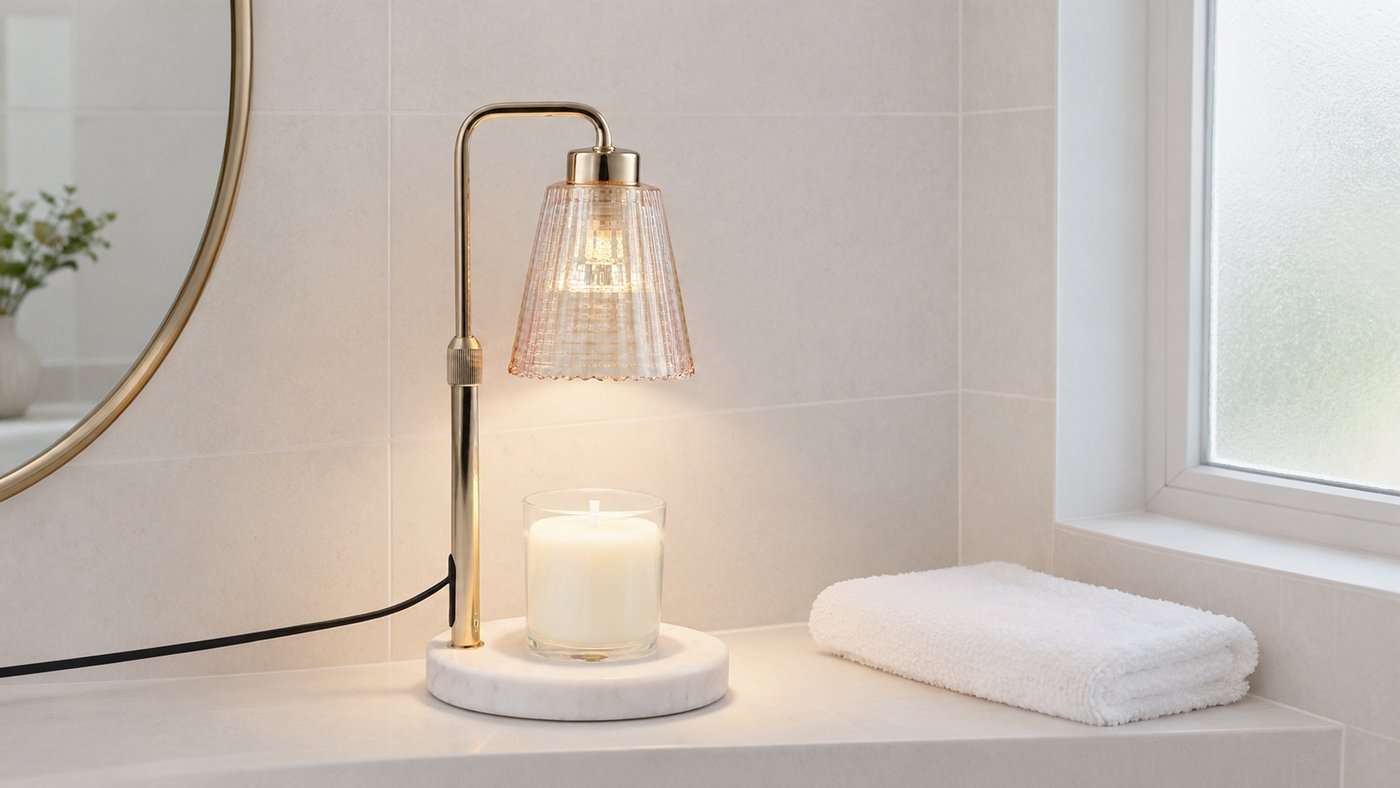
07Bathroom Fragrance Without a Flame
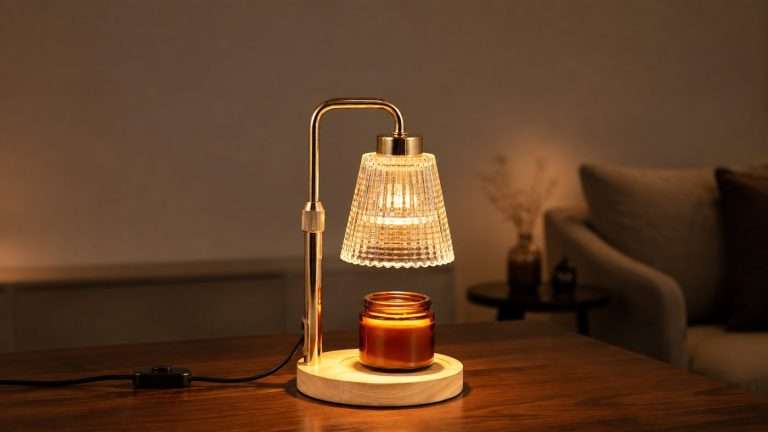
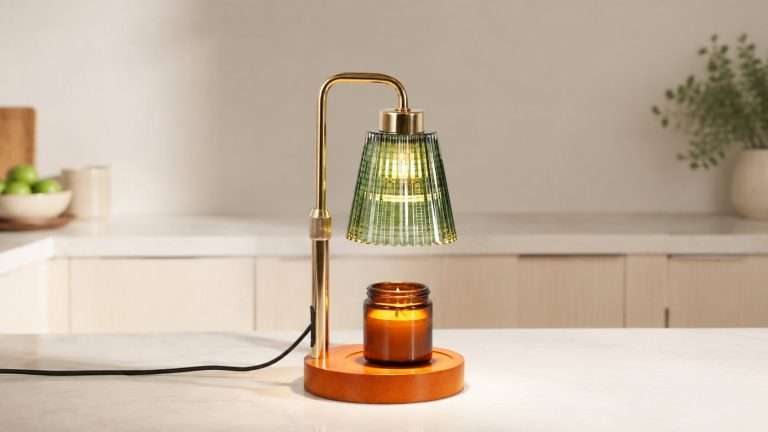
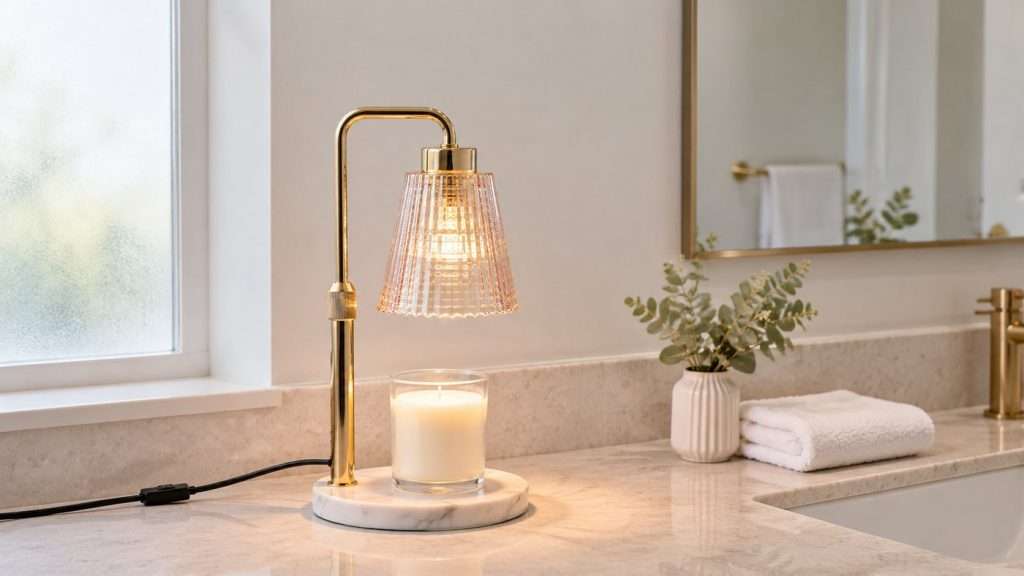
The flameless version is unglamorous, which is its advantage. Bathroom fragrance from a warmer lamp works because a bulb above the wax melts the top layer without combustion, so the jar releases its scent while nothing burns. A dimmable bulb turns strength into a setting, the difference between a small room that smells finished and one that smells overdone. A twelve-hour timer with automatic shut-off ends the session whether or not anyone comes back, which covers the 16 percent with an unattended or abandoned candle; the larger 60 percent, something combustible too close, is answered by there being no flame at all.[1] Those figures count lit candles; the lamp is still a mains-powered appliance.
What a lamp does not do is repeal the ventilation arithmetic. Run it while the fan runs and you get the same disappointing result: the instrument changed, the sequence did not. It also does not remove fragrance from the air you breathe, and anyone who reacts badly to scented products should treat a small enclosed room as the hardest case.
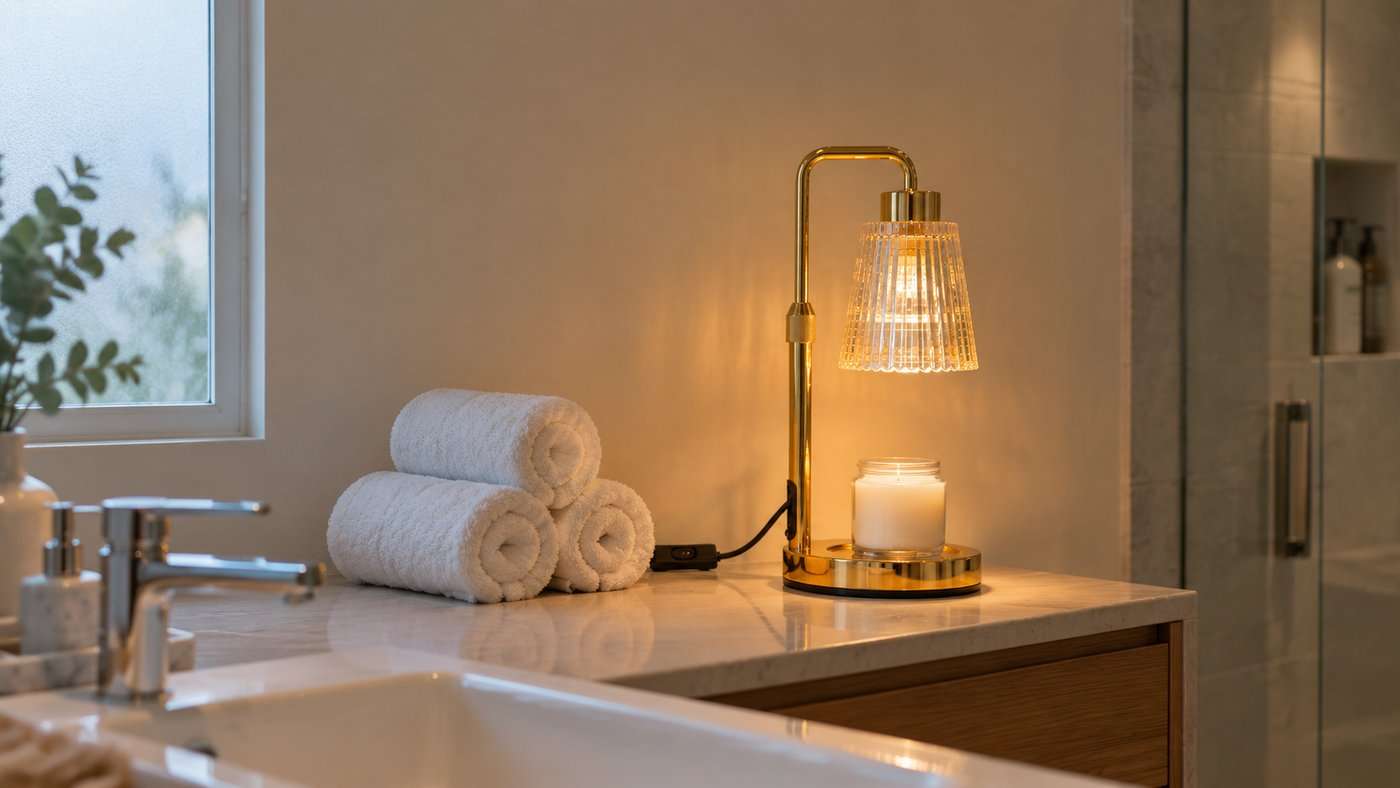

GODONLIF Candle Warmer Lamp — Black (Classic)
The classic GODONLIF candle warmer lamp — a tabletop lamp that melts your jar candle from above for clean, flame-free fragrance. Warm light, full scent, no smoke or soot.
Shop the classic warmer lampBrowse all Candle Warmer Lamps →
Sold and shipped by GODONLIF — free shipping within the contiguous US. Price and availability are shown on the product page.
08Candles in Bathroom Ideas That Survive the Fan — and What This Page Cannot Settle
Most candles in bathroom ideas are staging ideas: a grouping on the tub ledge, a cluster on a tray, a row along a windowsill. They photograph well and say nothing about whether the room smells of anything twenty minutes later. The versions that survive an extractor fan put the source where still air collects and out of the through-flow: the far side of the room from the door and the duct, one source running well instead of four running badly. Grouping unlit vessels for looks and heating a single jar for scent does both jobs.
Two honest limits. No research cited here was run in a bathroom with a scented product in it: the ventilation figures are moisture recommendations, the fire statistics count incidents rather than measure scent, and the humidity studies used test odorants in chambers.[8][9] Section three is a reasoned assembly, not a measured result. And forty minutes is a planning number — a large bathroom, an old fan or no fan behaves differently, and the only reliable calibration is your own nose across a week.
One scheduling note, since the usual time to run this plan is after a night shower. What happens to scent between that point and falling asleep is a different question, taken up in our page on candles at bedtime. This page stops at the bathroom door.
The short below keeps to the order this article does. It opens where section one opens: a working bathroom scent routine has three phases and they do not overlap, and phase one is moisture removal, which belongs to the fan and ends before any fragrance enters. Section two is why this room loses fragrance faster than any other — two properties do the damage and they compound. Section three is the forty-minute window that opens only once the fan has finished its job. Section four is honest about steam rather than romantic about it: the controlled evidence is split, and pretending otherwise would be easy and wrong. Section five is the one a bathroom article usually leaves out; this is the part a bathroom scent article usually skips, and it has the hardest numbers behind it. Section seven is the flameless version: bathroom fragrance from a warmer lamp works because a bulb above the wax melts the top layer without combustion, so the jar releases its scent while nothing burns. The short closes where section eight does, on the staging ideas that survive the fan and the ones that do not. They photograph well and say nothing about whether the room smells of anything twenty minutes later.
Frequently asked questions
These cover the variants the sections above did not, and stay inside what the cited sources establish.
How do I pick a scented candle for bathroom shelves that are always a bit damp?
Pick for the surface first and the fragrance second. A shelf that is regularly damp argues for a lidded jar rather than an open pillar or a tin, because a lid keeps condensation and dust off a wax surface that will otherwise stop taking heat evenly. Glass copes with humidity better than untreated metal, which can mark a shelf, or paper-wrapped vessels, which soften. Keep whatever you choose off the wettest surfaces entirely: a dry shelf or cabinet top holds a vessel that a splashed vanity edge will eventually stain or slide. If the vessel is porous or uncoated underneath, put a small non-slip mat under it rather than trusting a wet ledge.
Does a bathroom hold its scent better with the door open or closed?
Closed, but only once the extractor fan has stopped. While the fan is pulling, a shut door does not seal the room at all, so anything you release in that interval is on its way outside before you smell it. With the fan off, a closed door is the best container a bathroom offers, because the still air keeps the concentration up in a very small volume. The useful sequence is therefore fan on and door closed while the moisture clears, then fan off and door still closed while the scent builds, then the door opened when you want it to reach the hallway.
Can a bathroom with no window hold a scent at all?
Yes, and often better than one with a window, provided the fan is the only opening you have to manage. A windowless bathroom loses air on the duct's schedule rather than on the weather's, which makes it more predictable rather than less. The catch is moisture: with no window, that extractor fan is the entire moisture strategy, so the twenty-minute post-shower run is not optional and shortening it to reach the scent sooner trades a smell for condensation. Run the full extraction, then scent the still room afterwards. An interior bathroom with a good fan is one of the easier rooms in the house to scent once the order is right.
How long before guests arrive should I start the bathroom scent?
About forty minutes before, and not four hours before. A heated jar needs roughly ten to twenty minutes to build a melt pool and reach full throw, so starting much later than half an hour means guests arrive during the climb rather than at the top of it. Starting much earlier is worse than useless in a small room, because the concentration peaks and then either saturates the space or drains away through the fan, and you will have stopped noticing it yourself long before anybody else walks in. If the bathroom has just been used, run the fan first and count the forty minutes from when you switch it off.
Should the bathroom run the same fragrance as the rest of the house?
It does not have to, and in a small room there is a reasonable argument that it should not. A bathroom is entered briefly and separately, so a scent that differs from the hallway reads as deliberate rather than as a mistake, which is why guest bathrooms are often treated as their own scent decision. The practical constraint is weight rather than family: a fragrance that works at living-room scale can feel heavy inside a few square feet, so the same profile at a lower intensity is usually a better translation than a different profile at full strength. If you prefer one scent throughout, run it here at the lowest setting that still reaches the whole room.
Sources and evidence limits
Fire figures come from the national fire-safety research body and the federal fire administration; ventilation figures from the institute that certifies home ventilation equipment and two federal guides; usage figures from the candle trade association; the humidity findings from two peer-reviewed studies that disagree.
- Ahrens, Marty, Home Candle Fires, National Fire Protection Association, Quincy, MA, May 2020 (NFPA No. PKG34). Sections five and seven: 7,610 home candle fires a year in 2014–2018, 81 deaths, 677 injuries, $278 million in damage, about 21 a day, 60 percent with something combustible too close, 16 percent unattended. Estimates derive from NFIRS and NFPA’s fire department experience survey.content.nfpa.org — home candle fires (Retrieved September 16, 2026).
- Ahrens, Marty, Home Candle Fires: Supporting Tables, National Fire Protection Association, May 2020, Table 1, “Home Candle Structure Fires by Area of Origin, 2014–2018 Annual Averages.” Chart, key takeaways, sections four and five: bedroom 2,820 (37 percent), living room, family room or den 1,090 (14 percent), bathroom 920 (12 percent), kitchen 840 (11 percent), dining room 270 (4 percent), of 7,610. Counts area of origin, not usage.content.nfpa.org — supporting tables (Retrieved September 16, 2026).
- Home Ventilating Institute, “Bathroom Ventilation.” Key takeaways and sections one to three: “HVI recommends that the fan be left on for 20 minutes after use of the bathroom,” and “for bathrooms up to 100 square feet in area, HVI recommends that an exhaust fan provide 1 CFM per square foot.” Moisture-control recommendations; the application to fragrance is ours. hvi.org — bathroom ventilation (Retrieved September 16, 2026).
- US Environmental Protection Agency, “A Brief Guide to Mold, Moisture and Your Home.” Key takeaways and step one of section three: keep indoor humidity “below 60 percent (ideally between 30 and 50 percent) relative humidity,” and “run the bathroom fan or open the window when showering.” Concerns mold, not fragrance. epa.gov — mold, moisture and your home (Retrieved September 16, 2026).
- US Environmental Protection Agency, “Improving Indoor Air Quality.” Ordering argument, sections one and two: “usually the most effective way to improve indoor air quality is to eliminate individual sources of pollution or to reduce their emissions,” and “local bathroom or kitchen fans that exhaust outdoors remove contaminants directly from the room where the fan is located.” Page dated August 3, 2026. epa.gov — improving indoor air quality (Retrieved September 16, 2026).
- US Fire Administration, Federal Emergency Management Agency, “Candle Fire Safety,” page dated April 1, 2023. Key takeaways and section five: “Don’t use lit candles in bedrooms, bathrooms and sleeping areas,” and “consider using battery-operated flameless candles, which can look, smell and feel like real candles.” usfa.fema.gov — candle fire safety (Retrieved September 16, 2026).
- National Candle Association, “Facts & Figures.” Key takeaways and sections four and five: “candle users say they most frequently burn candles in the living room (42%), followed by the kitchen (18%) and the bedroom (13%),” with the bathroom absent. A trade association’s own research, not independent data.candles.org — facts and figures (Retrieved September 16, 2026).
- Kuehn, M.; Welsch, H.; Zahnert, T. & Hummel, T., “Changes of pressure and humidity affect olfactory function,” European Archives of Oto-Rhino-Laryngology, volume 265, pages 299–302, 2008 (DOI 10.1007/s00405-007-0446-2, PMID 17901967). Sections four and eight: 75 volunteers tested in climate chambers for butanol threshold and discrimination, thresholds lower in humid than in relatively dry conditions. A test odorant in a chamber, not a product in a home.europepmc.org — pressure, humidity and olfactory function (Retrieved September 16, 2026).
- Drews, T.; Nehring, M.; Werner, A. & Hummel, T., “The sense of smell is not strongly affected by ambient temperature and humidity: a prospective study in a controlled environment,” European Archives of Oto-Rhino-Laryngology, volume 278, pages 1465–1469, 2021 (DOI 10.1007/s00405-020-06436-3, PMID 33094385). The counterweight in sections four and eight: 50 participants tested with the Sniffin’ Sticks battery across cold/dry, cold/humid, warm/dry and warm/humid conditions, finding “neither temperature nor humidity had a significant effect on olfactory test results.” Young participants with an excellent sense of smell.europepmc.org — temperature, humidity and the sense of smell (Retrieved September 16, 2026).
Evidence limits are in section eight: nothing here measures fragrance in a real bathroom.
You may also like