News
Candle in Pumpkin: Flame, LED, or Neither — What to Put Inside a Jack-o’-Lantern

Sep
Seasonal Safety
A candle in pumpkin is the one open flame in the house that nobody is watching. It sits outdoors, on a step, at child height, next to fabric, for a whole evening, while everyone who lives there is somewhere else. It is also cooking the thing it sits inside: the heat softens the flesh and drives off water, turning a carved face into a collapsed one in days. Fire authorities and horticulture extension services reach the same recommendation from opposite directions, and neither gives you the smell you were actually after.
Key takeaways
This page is about one container: the carved cavity, and what a heat source does to it. Rules for burning candles around children and pets sit in our page on candle safety with kids and pets; unlit pillars as decoration are covered in styling a fireplace with candles.
- The flame is cooking the container. Two university extension services give the same instruction: use an electric light or a glow stick, because a flame makes the pumpkin cook on the inside and spoil faster.[4][5]
- Decoration fires are real and countable. Between 2019 and 2023, an annual average of 832 US home structure fires began with decorations, causing three deaths and 28 injuries; about a third started with candles.[1]
- The knife hurts more people than the flame. In the CPSC’s estimate of Halloween injuries treated in US emergency departments, 55 percent involved pumpkin carving itself — a corrective to treating the tealight as the only hazard.[2]
- Removing the flame does not deliver the smell. A battery light fixes ignition, soot and cooking, and produces no scent at all. The smell people associate with the season never came from the pumpkin; it belongs to a jar indoors.
Search this and you get craft posts: stencils, a note that a tealight looks prettier than an LED, a line about supervising children. What nobody writes down is the physics of the container. A carved pumpkin is a damp, nearly closed, biologically active vessel with one small vent in the lid, and it behaves nothing like a glass jar on a table.
01Candle in Pumpkin: The Short Answer
Put a cold light in it. A battery-operated candle, a puck light or a glow stick gives the same glowing face without the three problems a flame introduces, and that recommendation arrives from the fire side and the horticulture side independently. Guidance from the Office of the Illinois State Fire Marshal, drawing on National Fire Protection Association data, says to use battery-operated candles or glow sticks in jack-o’-lanterns and to teach children to stay away from open flames.[1] The US Consumer Product Safety Commission gives the same instruction, and adds that burning candles should never be left unattended.[2]
If you want a real flame anyway, the honest version is narrow: a supervised, indoor, one-evening display, lid propped enough to vent, with the clearance you would give any candle, out when you leave the room. Not a porch step, not a walkway, not a whole evening while you are out.
02What Does a Flame Actually Do Inside a Carved Shell?
It cooks it, and the extension services say so bluntly. In 2025, South Dakota State University Extension, in an article by Nick Volesky and Cody Molnar, wrote: “Use an electric light or glow stick instead of a candle. This prevents the pumpkin from ‘cooking’ on the inside, which speeds up spoilage.”[4] In 2020, Volesky, writing for Utah State University Extension, put it as: “This will prevent the gourd from ‘cooking’ and spoiling faster.”[5] Two institutions, five years apart, reached for the same verb.
A small flame does so much because a pumpkin is water held in living tissue, and warm tissue spends itself faster. In 2025, NC State Extension’s postharvest engineering guide by Mike Boyette and colleagues gave the rule: “the rate of respiration doubles for each 10 C° increase in temperature,” so at a 10 C° (18 F°) rise “the shelf life will be effectively cut in half.” Water loss is even more temperature-sensitive: “The water evaporation rate at 90°F is seven times faster than at 40°F.”[6] That work concerns cooled storage of harvested produce, so read it as the mechanism behind the extension advice, not a measurement of your pumpkin.
Carving has already made the shell fragile before any heat arrives. As the Utah State guidance puts it, “When you carve a pumpkin, it exposes the insides, making it more susceptible to infection through air flow.”[5] You have opened a sealed interior and handed airborne moulds a warm, wet, sugary surface; a flame supplies the input they were missing. The result is familiar: cut edges curl and brown, the bridges between the eyes sag, and the face slumps first. The lid underside blackens too — ordinary combustion deposit, the soot explained in our page on candle soot on walls.

03Candles for Pumpkin Carving: How Big Is the Fire Risk on a Porch?
Smaller than the internet implies, larger than zero, and concentrated in exactly the setup most people use. Candles for pumpkin carving are almost always deployed in the worst conditions a candle can be given: outdoors, at ankle height, unattended for hours, beside dry seasonal material and within brushing distance of costumes. Between 2019 and 2023, guidance from the Office of the Illinois State Fire Marshal reports, an annual average of 832 US home structure fires began with decorations, causing three civilian deaths, 28 injuries and $17 million in direct property damage; nearly half (47 percent) happened because decorations sat too close to a heat source, and about a third (33 percent) were started by candles. The same guidance flags dried flowers, cornstalks and crepe paper as highly flammable.[1] A porch display is frequently all of those things at once. The fragrance half of that display can move indoors instead, where a Halloween warmer lamp carries the season with no open flame.
The background rate matters too, because a jack-o’-lantern flame is still a household candle. The US Fire Administration states that “on average, 20 home candle fires are reported each day,” recommends battery-operated flameless candles, and gives the baseline rule: keep candles at least 12 inches from anything that burns, in stable holders, blown out when you leave the room.[3] What those rules mean with children and animals on the floor is worked through in our page on candle safety around kids and pets.
Now the corrective, because a page that counts only fires misreports the evening. In 2022, the US Consumer Product Safety Commission estimated an annual average of 3,200 Halloween-related injuries treated in US emergency departments over the preceding three years, of which 55 percent were related to pumpkin carving — the knife, not the flame. Falls and trips accounted for 25 percent, and the remaining 20 percent covered lacerations, ingestions and allergic reactions.[2]
Source: US Consumer Product Safety Commission, “CPSC Offers Safety Tips to Keep Hazards from Haunting Your Halloween,” October 18, 2022.[2] Emergency-department-treated injuries only; fires are counted separately. Retrieved September 18, 2026.
Read the two datasets together and the picture is neither panic nor complacency. The likeliest way Halloween sends someone to hospital is a slipped blade. The fire risk is real but conditional, and it sits in a setup you can decline to build — which is why every body quoted above lands on a small instruction rather than a warning.
04Which Pumpkin Carving Candle Should You Use — or Should You Use One at All?
If you want one answer: a battery-operated candle, and then put the pumpkin wherever you like. Choosing a pumpkin carving candle is really a choice between four properties — heat into the cavity, ignition source, whether it can be left alone, and whether it smells of anything. No option scores well on all four.
| What you put in | Heat into the cavity | Can it be left alone | Scent | What it costs you |
|---|---|---|---|---|
| Tealight in a metal cup | High and continuous, under the lid | No — open flame at child height | Roasted squash and soot, not spice | Display life, the lid, your attention all evening |
| Votive or small pillar | Higher, and it drips wax into the flesh | No, and likelier to tip in a gust | The same, plus wax in the cavity | Everything a tealight costs, plus cleanup |
| Battery-operated candle | Negligible, barely above room temperature | Yes, outdoors and overnight | None at all | The flicker is imitated; you buy batteries |
| Glow stick | None | Yes, nothing to knock over | None at all | One evening, then it is spent |
| Nothing, lit from outside | None | Yes | None at all | A silhouette rather than a lantern |
Two rows need a note. A votive or pillar is worse than a tealight on every count: taller, less stable, and it sheds wax into flesh you cannot clean. If you own pillars, they do better unlit as an arrangement. And the last row is not a joke — a pumpkin in the throw of a porch light reads perfectly well from the street, and the face holds its shape longer because nothing inside is heating it. How a votive, a pillar and a tealight differ in the first place, and what each one is meant to stand in, is covered in our guide to candle types.
05What Does an LED Fix, and What Does It Leave Out?
Everything on the fire and decay side, and nothing on the sensory side. A battery light removes the ignition source, which is the whole basis of the fire guidance above; it removes the deposit that blackens the lid; and it removes the heat load that makes the shell cook, which is the whole basis of the horticultural guidance. It also removes the requirement that somebody be present — the property that governs whether a decoration can sit outdoors at all.
What it cannot do is smell of anything, and that is the part craft guides skip. A lit pumpkin gives off warm squash and a little soot: a vegetable being slowly baked, nothing like the spiced scent the ritual is associated with. That scent comes from fragrance, and fragrance has never been produced by a pumpkin. So the LED does not take the smell away. It makes visible that the smell was always a separate job, needing a separate object, in a different place.

06Candles for Inside Pumpkin, or Scent in the Room?
Two different jobs wanting two different objects. Searches for candles for inside pumpkin are usually doing both at once: asking what makes the face glow, and hoping the same purchase delivers the seasonal smell. Splitting them is the most useful move available, because each half then has an easy answer instead of a compromised one. The lantern wants a cold, cheap light that can be abandoned outdoors. The smell wants a fragrance source indoors, where the air is still. The same split returns in December, when the tree is asked to carry the light and the scent at once, and what a real flame does to a drying one is worked through in our guide to a christmas tree with candles.
The job inside the pumpkin
- Must survive wind, damp and being knocked
- Must be safe to leave with nobody home
- Sits at ankle height near costumes and dry leaves
- Best served by a battery light or a glow stick
- Produces no scent worth having, whatever you choose
The job inside the room
- Still air, steady temperature, nothing to knock over
- Fragrance is the whole point, and judged by nose
- Sits on a console or shelf at adult height
- Best served by a scented jar and a heat source above it
- Can run on a timer while the door keeps opening
For the fragrance half, the seasonal recipes people ask about — the clove, orange and nutmeg family — are set out with drop ratios in our page on fall essential oil blends. One note about a jar you may already own: a candle whose wick has burned down to nothing still holds all of its fragrance, a case covered in our page on using a candle with no wick.

07A Candle for Inside Pumpkin That Never Goes Inside One
The object most people are describing when they search for a candle for inside pumpkin is a jar candle they already own, and its best place on the last week of October is a table just inside the front door. The reason is the traffic pattern: that door opens every few minutes on the one evening it matters, so the hallway air is replaced constantly and any scent source there has to run for a long stretch rather than a burst. A flame cannot do that in a hallway people keep walking through, and certainly not while the adults are out at the kerb.
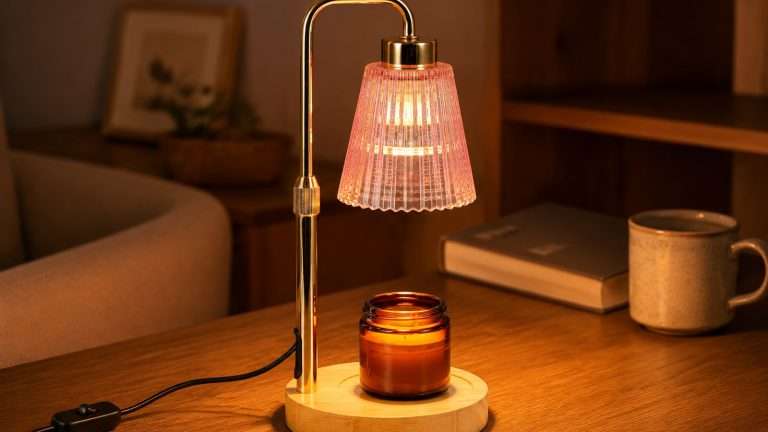
A warmer lamp handles the case because the heat comes from a bulb above the jar rather than a wick inside it. Nothing burns, so there is no flame to be brushed past and no deposit on the ceiling. It also runs far cooler than the flame it replaces: the National Candle Association puts the outer edge of a candle flame at typically 1400 degrees Celsius, or 2552 Fahrenheit, with the yellow zone running from about 1000 C at its base to about 1200 C higher up.[7] The band a warmer works in is in our page on how hot a candle warmer gets, and the unattended question in our page on leaving a warmer on overnight.
Use the jar you already own
A standard jar candle in a spiced or woody scent. A jar with no usable wick left is ideal, because warming does not need one.
Put it inside the door, not on the porch
An entry console clear of the door swing and out of reach of anyone arriving. Outdoor air moves too fast for any scent source to hold.
Start it an hour before the first knock
Wax needs time to reach a full melt pool before the throw stabilises. Switching on as the first group arrives is an hour late.
Set the dimmer low and let the timer end it
A lower setting is quieter on the nose in a hallway refilling with cold air, and a twelve-hour shut-off ends the evening on its own.
Leave the pumpkin alone
Cold light outside, warm scent inside, no heat source near the flesh. The face then holds its shape as long as the weather allows.

08What Can’t This Page Settle?
Several things worth naming. No controlled measurement of the air temperature inside a carved pumpkin under a tealight was findable, so the heating effect is described through extension guidance and the general relationship between temperature and shelf life rather than a number for your pumpkin.[4][6] Extension guidance is practice advice, not a trial with a control group. The fire figures cover decorations as a class rather than jack-o’-lanterns, so nobody can say what share began in a pumpkin.[1] The injury estimate counts only emergency-department visits, which makes every cut treated at the kitchen sink invisible.[2]
What survives those caveats is small and firm. A state fire marshal’s office, a federal consumer safety agency, a federal fire administration and two university extension services all independently recommend a cold light inside the pumpkin, for two entirely different reasons. That convergence does not rest on any disputed number.
The short version: a candle in a pumpkin does two things at once, and neither is the thing you wanted. A flame makes the pumpkin cook on the inside, and warming produce by ten degrees roughly doubles respiration and halves shelf life. On the fire side, 832 US home fires a year began with decorations, about a third started by candles, while the commonest Halloween injury is a carving cut at 55 percent of emergency-department visits. Every agency quoted lands on the same instruction: a battery-operated candle or a glow stick. The cold light has no scent, because the scent never came from the pumpkin — that half belongs in a jar inside the front door, warmed from above with nothing burning.
The short below keeps to the order this article does. It opens where section one opens, on the only version of a real flame that is defensible: not a porch step, not a walkway, not a whole evening while you are out. Section two is what the flame does to the shell itself — it cooks it, and the extension services say so bluntly. Section three sizes the fire risk honestly: smaller than the internet implies, larger than zero, and concentrated in exactly the setup most people use. Section four picks between the candles people actually buy, and the recommendation is short: if you want one answer: a battery-operated candle, and then put the pumpkin wherever you like. Section five is what that battery light does not give you — what it cannot do is smell of anything, and that is the part craft guides skip. Section six splits the question in two, because the lantern wants a cold, cheap light that can be abandoned outdoors while the smell wants still indoor air. Section seven is the indoor half: a warmer lamp handles the case because the heat comes from a bulb above the jar rather than a wick inside it. The short closes where section eight does, on what the evidence cannot settle and what it still agrees on: that convergence does not rest on any disputed number.
Frequently asked questions
These answers stay inside what the cited sources establish, and take up the cases the sections above left aside.
How to make a jack-o-lantern last longer, and does the light source change anything?
The light source is one of the few variables you fully control, and swapping a flame for a cold light is the single change with the clearest effect, because heat is what makes the flesh cook and spend itself. Beyond that, the extension-service routine is short: clean tools before carving, dip, wash or spray the finished carving with a ten percent bleach solution or another disinfectant to kill surface microorganisms, rub petroleum jelly over the exposed cut surfaces to slow moisture loss, and keep the pumpkin in the range of about fifty to sixty degrees Fahrenheit and out of direct sun. That is the whole list. Anything further belongs to a gardening guide rather than to a page about what goes inside the cavity.
Can you put a candle inside a pumpkin that has not been carved?
No, and the uncarved version is worse rather than safer. A pumpkin with only a lid cut out has no vent at the top of the cavity, so combustion gases and heat have nowhere to go except back down onto the wax and the flesh. A flame in a nearly sealed space also burns badly, which means more soot and a weaker, guttering light, and the heat that cannot escape does its cooking work on a thicker, wetter wall that then collapses inward. If the look you want is an uncarved pumpkin that still glows, the answer is a small battery light under a lid cut at the back, or a light placed behind the pumpkin rather than inside it.
Is it safe to leave a lit pumpkin on the porch overnight?
No. Every element of that sentence is a separate reason on its own: it is an open flame, it is outdoors where wind changes the flame shape without warning, it is at ground level beside doormats and dry leaves, and it is unattended for hours with nobody awake in the house to notice. Fire guidance is consistent that candles should be extinguished when you leave the room and never left burning unattended, and an overnight porch display breaks that rule for eight hours at a stretch. A battery-operated candle or a glow stick removes the question entirely, since neither can ignite anything and neither needs anyone to be awake.
Can a real candle go inside a plastic or foam craft pumpkin?
No. Craft pumpkins are made of moulded foam, resin or thin plastic, and the failure mode is not only ignition but softening and deformation well below the point at which anything catches fire. A flame inside a closed plastic shell warms the whole cavity, and the part directly above the wick gets hot enough to slump, distort or scorch, which can also tip the candle. Manufacturers of these ornaments generally supply or specify a battery insert for exactly this reason. If you want a reusable pumpkin that glows year after year, pair it with a battery light and treat the socket inside it as the only heat source it was designed to hold.
Can you put wax melts, scented wax or cinnamon sticks inside a carved pumpkin?
No, and it fails for a different reason depending on what you put underneath it. Loose wax melts or scented wax dropped into the cavity need a heat source before they release anything, and the only heat source small enough to sit in there with them is a flame, which brings back every problem the carved shell already has. Swap in a battery light and nothing melts at all, because a puck light is designed to stay cool. There is a mess argument too: wax that does soften runs down into the damp ridged flesh instead of staying in a container, and dry botanicals such as cinnamon sticks sitting beside a flame are simply more fuel at ankle height. Scented wax belongs where it was designed to work, in its own jar, warmed on a surface indoors.

GODONLIF Crowned Skull Gothic Candle Warmer Lamp
A crowned resin skull on a solid wood base, warming your jar candle from above. Both eye sockets and the nose carry the glow as soon as it is switched on.
See the crowned skull lampSold and shipped by GODONLIF — free shipping within the contiguous US. Price and availability are shown on the product page.
Sources and evidence limits
Fire figures come from a US state fire marshal’s office reporting National Fire Protection Association data, a federal consumer safety agency and the federal fire administration; pumpkin guidance from two university extension services; produce physiology from a third; flame temperatures from the trade association. Each link was checked on September 18, 2026.
- Office of the Illinois State Fire Marshal, “Halloween Safety,” reporting National Fire Protection Association data for 2019–2023. Source for the key takeaways and sections one, three and eight: 832 home structure fires a year beginning with decorations, three deaths, 28 injuries, $17 million in direct property damage, 47 percent too close to a heat source, about 33 percent started by candles; also the jack-o’-lantern and dried-decoration guidance. Covers decorations as a class. sfm.illinois.gov — Halloween safety (Retrieved September 18, 2026).
- US Consumer Product Safety Commission, “CPSC Offers Safety Tips to Keep Hazards from Haunting Your Halloween,” news release dated October 18, 2022. Source for the injury split in the key takeaways, sections one, three and eight and the chart, and for the instruction to use battery-operated lights or glow sticks rather than an open-flame candle. Counts emergency-department visits only. cpsc.gov — Halloween safety tips (Retrieved September 18, 2026).
- US Fire Administration, Federal Emergency Management Agency, “Candle Fire Safety.” Source for the quotation and the baseline rules in section three. General household guidance, not Halloween-specific. usfa.fema.gov — candle fire safety (Retrieved September 18, 2026).
- Volesky, Nick, and Cody Molnar, “Pumpkin Carving Preservation,” South Dakota State University Extension, published October 15, 2025. Source for the quotation in the key takeaways and sections two and eight, and for the FAQ preservation steps: a 10 percent bleach solution, petroleum jelly on exposed surfaces, and a 50 to 60 degree Fahrenheit display range. Practice guidance, not a controlled study. extension.sdstate.edu — pumpkin carving preservation (Retrieved September 18, 2026).
- Volesky, Nick, “Preserve Your Jack-O-Lanterns,” Utah State University Extension, published October 26, 2020. Source for the second “cooking” quotation in the key takeaways and section two, and for the decay mechanism quoted there. extension.usu.edu — preserve carved pumpkins (Retrieved September 18, 2026).
- Boyette, Mike; Simmons, Chip; Merck, Ashton & Grieger, Khara, “Introduction to Postharvest Engineering for Fresh Fruits and Vegetables, Chapter 1,” NC State Extension Publications, published April 17, 2025. Source for the respiration, shelf-life and evaporation figures in section two, the stat box and section eight. Concerns cooled storage of harvested produce; the application to a lit jack-o’-lantern is ours. content.ces.ncsu.edu — postharvest engineering (Retrieved September 18, 2026).
- National Candle Association, “Candle Science.” Source for the three flame-temperature figures in section seven. A trade association describing candle combustion in general, not a measurement of any particular candle. candles.org — candle science (Retrieved September 18, 2026).
Evidence limits are in section eight. Nothing here is a guarantee about any individual pumpkin or property, and local fire rules for outdoor decorations take precedence over this page.
You may also like