


News
How to Melt Candle Wax: Jar Candles, Wax Melts and Leftovers

Aug
How-To
How to melt candle wax comes down to one decision made before you touch anything: heat it from above rather than lighting it from within. The routine then splits three ways — a full jar candle, a handful of wax melts, and the stubborn disc left in the bottom of an old jar — and each one has its own setting, its own finish line, and its own waiting time.
Key takeaways
- Top-down heat does the whole job. A bulb on an arch warms the wax surface until it turns liquid, and that is a low bar: every common candle wax melts somewhere between about 46 and 82 °C, which is a fraction of what a flame produces.[3] The full temperature breakdown lives on our candle wax melting point page; this page is about the doing.
- Three jobs, three routines. A jar candle is melted in its own glass, wax melts go in a shallow dish, and jar leftovers need consolidating before a lamp can reach them.
- A lamp is fast; a flame is not. A matched halogen bulb builds a full melt pool in about 15 to 20 minutes.[5] A wick working on a three-inch jar takes roughly three hours to do the same thing, by the candle industry’s own rule of thumb.[4]
- Done is a look, not a clock. The finish line is liquid touching the glass all the way round. Stopping short is what causes a jar to tunnel, and no amount of extra time later undoes a rim of wax welded to the wall.
Most people never think about melting candle wax as a task with a method, because for two centuries the method was a match. You lit the thing, and the wax melted as a side effect of the fire. Take the flame out — because the wick is gone, because the room has a smoke alarm you would rather not argue with, or because candles still start an annual average of 5,894 US home structure fires, on the National Fire Protection Association’s 2020–2024 figures, with combustible material left too close to the flame as the leading contributing factor[9] — and melting suddenly becomes a thing you do deliberately, with a setting and a stopping point. Our comparison of warmers against burning covers the trade in general terms. This page is narrower: the actual sequence of actions for each kind of wax you might have in front of you.
01How to Melt Candle Wax: The Short Answer
Put the wax under a bulb, run it at full brightness until the surface is liquid edge to edge, then dim it and leave it. That is the entire operation for a jar candle. A candle warmer lamp suspends a low-wattage halogen bulb on an arch above an open container; typical units run a 25 to 50 W bulb held roughly three to five inches above the wax surface, and the bulb reaches operating temperature in about thirty seconds.[5] Nothing is lit, nothing is consumed, and the wax you started with is the wax you finish with. On a lamp whose height adjusts, such as our walnut and leopard warmer lamp, you can also move the bulb closer to the wax or further away before you dim it.
The reason this works rather than merely sounding tidy is that wax has a low bar to clear. Even the most stubborn blends in wax manufacturer Hywax’s published tables have finished melting by about 82 °C,[3] while the National Candle Association puts the yellow zone of a candle flame at roughly 1,000 °C and its outer veil at 1,400 °C.[1] A flame therefore runs more than an order of magnitude hotter than anything the wax requires, and spends the surplus on light, soot and risk. A lamp aims at the requirement and stops. If you want the hardware side of that — arch height, dimmer, timer — our candle warmer lamp guide covers the equipment; below is the procedure.
02What Is Actually Happening When You Melt Wax?
Melting candle wax is a phase change and nothing more. The solid becomes liquid, the fragrance oil dissolved in it becomes free to evaporate off the warm surface, and when the heat stops the whole thing sets again. Burning is a different event entirely: combustion, which needs the wax to first vaporise and then meet an ignition source. That distinction is why the wick matters so little here. In the National Candle Association’s description of a burning candle, the flame melts a shallow pool and “this liquid wax is then drawn up the wick by capillary action” to be vaporised and burned.[1] The wick is a fuel line to the flame. If there is no flame, there is nothing for it to feed.
The practical consequence is that melted candle wax is not a degraded or used-up substance. It is the same material, reversibly softened, which is why the same jar can be melted and re-set dozens of times. What does deplete is the fragrance: every session lets some of the oil leave, so a jar that has been run for forty hours smells weaker than one run for four, regardless of which heat source did the work. Scent strength is set at manufacture rather than by your technique — supplier guidance from CandleScience puts average fragrance load at 6% of the wax by weight[7] — so a lamp cannot make a weakly scented candle strong. It can only release what is already dissolved in there, and release it more slowly and for longer than a flame does.

03Melting a Whole Jar Candle
Take the lid off, centre the jar under the shade, and run the bulb high until the pool reaches the glass. That is the whole method, and the only step people get wrong is the last one — stopping early. A first session that ends with a small crater in the middle teaches the wax where to melt, and every session after that follows the same narrow channel. The result is tunnelling, and it happens under a lamp exactly as it happens under a flame if you cut the first session short.
Fit is the one thing to check before you buy rather than after. The jar has to stand under the shade with clearance at the rim, which rules out very tall vessels on some arches, and its diameter has to be less than the shade’s so heat lands on wax rather than on the glass wall. If the wax refuses to soften at all after twenty minutes, that is not a patience problem — it is a bulb, wattage or distance problem, and our candle warmer troubleshooting guide is the right place for it rather than this one. If that guide points to the bulb, a matched GU10 replacement bulb twists in and the lamp is back in minutes.
How Do You Melt Wax for Candles That Are Still Full?
Exactly as below, with one addition: give the first session of a brand-new jar more time than you think it needs, because that session sets the melt pattern for the life of the candle.
Remove the lid and anything decorative
Dried botanicals, glitter and cardboard inserts are all fine cold and none of them are fine warm. Take them out before the wax softens, not after.
Centre the jar and run the bulb at full
Off-centre jars melt one side first and leave a crescent of solid wax on the other. Full brightness is a starting setting, not a permanent one.
Wait for liquid to touch the glass all the way round
Expect softening within five to ten minutes and a full pool by fifteen to twenty. Check by looking at the rim, not the middle.
Dim it back and set the timer
The bulb is the heater, so dimming lowers heat as well as light. The lowest setting that still holds a liquid pool is the one that stretches the jar furthest.

04Melting Wax Melts and Tarts in a Dish
Wax melts need a vessel, and that is the only real difference from a jar. A melt is a bare cube with no container of its own, so it goes into a shallow heat-safe dish that sits under the shade — a proper warmer dish, a small ceramic ramekin, or a foil liner if you want to skip cleaning afterwards. Load one layer, not a heap: cubes stacked on top of each other insulate the ones underneath and melt unevenly. Happy Wax, which sells the things, recommends breaking up any cube heavier than about 0.55 oz rather than dropping a whole slab in.[6]
Timing is different too, and in your favour. A cube is thin and sits in direct contact with a warm dish rather than being the top centimetre of a deep jar, so it liquefies in a fraction of the time a jar needs — usually well under ten minutes. What takes longer is the useful life: Happy Wax puts a one-ounce melt at roughly 8 to 12 hours of scent throw in an electric warmer, spread across as many sessions as you like.[6] When the throw fades, the wax is still liquid and still looks perfectly good — that is the tell that it is spent, not damaged. Our pages on using a candle warmer for wax melts and how to use wax melts go further into loading and changeover.

05Melting the Wax Left in the Bottom of a Jar
Consolidate first, then melt. A thin disc of wax against cold glass at the bottom of a deep jar is the one case where a lamp genuinely struggles, because the shade is now several inches further from the wax than it was designed to be and the glass walls conduct heat away as fast as the bulb supplies it. Pooling the remnants from several jars into one shallow dish fixes both problems at once: less depth to reach across, and a vessel shaped for the job.
There are two ways to get the wax out, and they suit different jars. Warm the jar under the lamp until the disc releases from the glass and tip it into your dish in one piece, which is clean but slow on thick-walled jars. Or freeze the jar for a couple of hours and lever the puck out cold, which is fast and occasionally cracks glass, so it is a route for jars you do not care about. Either way pick out the metal wick tab and its glue dot with tweezers before melting — adhesive is not fragrance, and in a shallow dish the tab sits directly under the bulb rather than harmlessly buried. The full routine, including what to do with the empty glass, is in our guide to getting wax out of a candle jar.
Be realistic about what you get. Blended remnants smell blended, which is charming with two woody scents and unpleasant with a citrus and a vanilla. And wax that has already given up most of its fragrance oil over a long life in the original jar will not recover it in a dish. Recovered wax is best treated as a bonus session or two, not as a new candle.

06How Long Does It Take, and How Do You Know It Is Done?
Fifteen to twenty minutes for a jar under a lamp, under ten for wax melts in a dish, and hours if you are using a flame. Published warmer-lamp guidance puts surface softening at five to ten minutes and a full melt pool at fifteen to twenty for a matched bulb,[5] which matches what a bulb held three to five inches above the surface should manage. That is a single retailer’s guidance rather than a measured consensus, so treat it as a working expectation and not a specification. The flame comparison is longer than most people remember: the candle trade’s Diameter Rule allots roughly one hour per inch of container width before a wick reaches the glass, so a three-inch jar is a three-hour proposition, and a four-inch jar is a four-hour one.[4]
The number that decides whether you were successful, though, is not on any clock. It is whether liquid reached the glass. A pool that stops an inch short of the wall leaves a ring of solid wax that gets thicker every session, and the National Candle Association’s own burning guidance — trim the wick to ¼ inch, burn no longer than four hours, then let the candle cool for two — exists partly to manage this on the flame side.[2] Under a lamp you have a simpler lever: run high until the rim is wet, then dim.
Sources: FlashyBeams, “How Do Candle Warmers Work?” for the lamp figures; Armatage Candle Company’s account of the Diameter Rule (one hour per inch of container width) for the flame figures. Armatage argues the Diameter Rule is a poor design criterion for candle makers; it is used here only as a rough consumer benchmark. Retrieved August 20, 2026.
Read the two lamp bars against the three flame bars and the gap is the point: the flame figures grow with the jar because a wick has to work outward from a single point, while the lamp figures do not, because a bulb already covers the whole surface. That is also why the lamp bars carry a range and the flame bars a single estimate — the lamp numbers come from measured guidance and the flame numbers from a rule of thumb its own author warns against leaning on.
| What you are melting | Where the wax sits | Lamp setting | Typical time | What “done” looks like |
|---|---|---|---|---|
| A full jar candle | Its own glass, lid off | Full, then dim once the rim is wet | 15–20 min to a full pool | Liquid touching the glass all the way round |
| Wax melts or tarts | Shallow dish or foil liner, single layer | Full is rarely needed; mid works | Under 10 min | One even pool with no solid core left |
| Jar leftovers | Consolidated into one shallow tin | Full — thin wax on cold metal is slow | 10–15 min after consolidating | A single pool, wick tabs already removed |
| A jar you want to empty | Its own glass, then poured off | Full, in short bursts | Until the disc releases from the glass | Wax out in one piece, glass reusable |
07Four Ways Melting Candle Wax Goes Wrong
The failures are all variations on one theme: applying too much heat, too fast, from the wrong direction. The microwave is the worst of them and the most commonly suggested, because a jar candle has a metal wick tab glued to its base and metal in a microwave is a fire rather than a shortcut. The stovetop ranks second: melting wax in a pan over direct heat pushes it toward temperatures no candle needs, and wax that gets hot enough will ignite without any wick involved. A hair dryer is genuinely useful for softening a surface for ten seconds to lift a buried wick, and genuinely bad as a melting method, because it blows dust and fragrance across the room and heats the glass unevenly. A tea light underneath the jar is the fourth, and it puts a live flame under glass never designed to be heated from below.
Then there is the failure that is nobody’s technique error: over-running the wax. Scent output does not scale with heat in any useful way past the point where the pool is liquid, so cranking a dimmer to maximum for six hours buys you a hotter jar rather than a stronger room. It also burns through the fragrance load faster. The dimmer exists to be turned down, and the timer exists because most of us forget — a habit worth reading about before you leave a lamp running while you sleep.
The honest limitation, and the one we would rather say ourselves: flame-free is not emission-free. In February 2025 the American Chemical Society reported on research that tested 15 commercial wax melts in a model house and measured airborne nanoparticles 1 to 100 nanometres wide at concentrations comparable to those from combustion candles and gas stoves.[8] That study looked at wax melts specifically rather than at warmer lamps in general, and it did not measure health outcomes. But it is enough to retire the idea that melting is a null event for indoor air. The practical response is unglamorous: ventilate the room, do not run a lamp continuously all day in a closed space, and treat “no flame” as removing the ignition risk rather than as removing every consideration.

08Which Method Fits What You Have?
Answer one question — what is the wax sitting in right now — and the route follows. A candle still in its jar needs nothing but the lid off. Bare cubes need a dish. Anything thin, stuck and stranded needs consolidating before heat is worth applying at all.
The second question is what you want out of it, because that changes the setting rather than the route. Fragrance in a hurry means full brightness until the rim is wet; a long quiet evening means dimming to the lowest setting that still holds a pool. Reclaiming wax means short bursts at full and a pouring vessel ready. Same lamp, same wax, three different sessions — which is most of what there is to say about how to melt wax without a flame.
Prefer to watch it happen? The 34-second short below shows the flame-free version of everything above — a warmer lamp heating the jar from above until liquid touches the glass all the way round, in about 15 to 20 minutes instead of the roughly three hours a wick needs.
Frequently asked questions
These answers stay inside what the cited sources establish, and treat any fire-safety statement as general guidance rather than a substitute for a manufacturer’s instructions.
Can you use wax melts in a candle warmer that was built for jar candles?
Yes, and the thing that decides how well it goes is geometry rather than heat. Two measurements matter. The vessel you stand the cubes in should sit at roughly the height the wax surface of a jar would have occupied, because the arch and its height-adjust collar were set for that distance; too low and the bulb is working across a gap it was never sized for. And it should be wider than it is deep, so the bulb is asked to warm a broad thin layer rather than a small column. A saucer works better than a ramekin for exactly that reason. Warmers with a recessed dish moulded into the base are a different case: that well is already the correct vessel at the correct height, and adding a second container inside it just moves the wax further from the bulb.
Can you put wax melts under a candle warmer with no dish at all?
It works and you will regret it. Bare wax on a bare base plate leaves a hardened film that has to be softened again and wiped off while warm, and on a painted or plated finish repeated cycles of that will mark it; several manufacturers treat wax poured directly onto the appliance as outside the warranty. There is one narrow exception worth knowing: a plate-style warmer with a flat metal top can take a silicone mat, which behaves like a dish but peels the set wax off in one piece when cold. If you have already done it, the least destructive fix is to run the warmer for a couple of minutes until the film is soft, wipe it away with a paper towel, and let the surface cool completely before switching on again.
Do you have to melt all the wax in a jar, or is a shallow pool enough?
A shallow pool is enough for scent, but only if it is a full-width shallow pool. Depth is not what matters; surface area is, because evaporation happens at the top face and a pool one millimetre deep across the whole jar exposes exactly as much surface as one a centimetre deep. What you cannot get away with is width: a pool that stops short of the glass leaves a rim of solid wax that thickens every session until the usable diameter has shrunk by a third. The practical rule is to judge the rim rather than the middle, and to accept that the very first session of a new jar is the one worth being patient about, because that is the session that decides where the wax will melt for the rest of its life.
Does melting wax in a lamp change it, so it cannot be burned with a wick afterwards?
No, a jar with an intact wick can go back to being lit whenever you want, and warming it first tends to make the next lighting easier rather than harder. The reason is the surface: a lamp re-sets the wax flat and full width, so there is no crater for a new flame to drown in, which is the usual cause of a wick dying in its own pool. Trim to the standard quarter inch before lighting as normal. Two situations do complicate it. If the wick was already trimmed below the wax line or had drowned before you started warming, warming does not bring it back, and that jar is now a warm-only jar. And if you have been running long sessions, the wick will be sitting in wax that has already given up part of its fragrance load, so the relit candle smells like a part-used one, because that is what it is.
How do you keep a jar from cracking while the wax melts?
Cracks come from temperature differences across the glass, not from heat itself, so the whole answer is to avoid sharp gradients. Do not put a jar straight from a cold garage or a fridge under a bulb at full brightness; let it reach room temperature first. Do not stand a warm jar on a cold stone or metal surface, which chills the base while the top is still being heated; a wooden board, cork mat or folded cloth underneath removes that. Do not add water, ice or a wet cloth to speed cooling. And check the glass before each session, because a jar that already has a hairline flaw from a knock or from an earlier freezer trick will fail under gentle heat that a sound jar shrugs off.
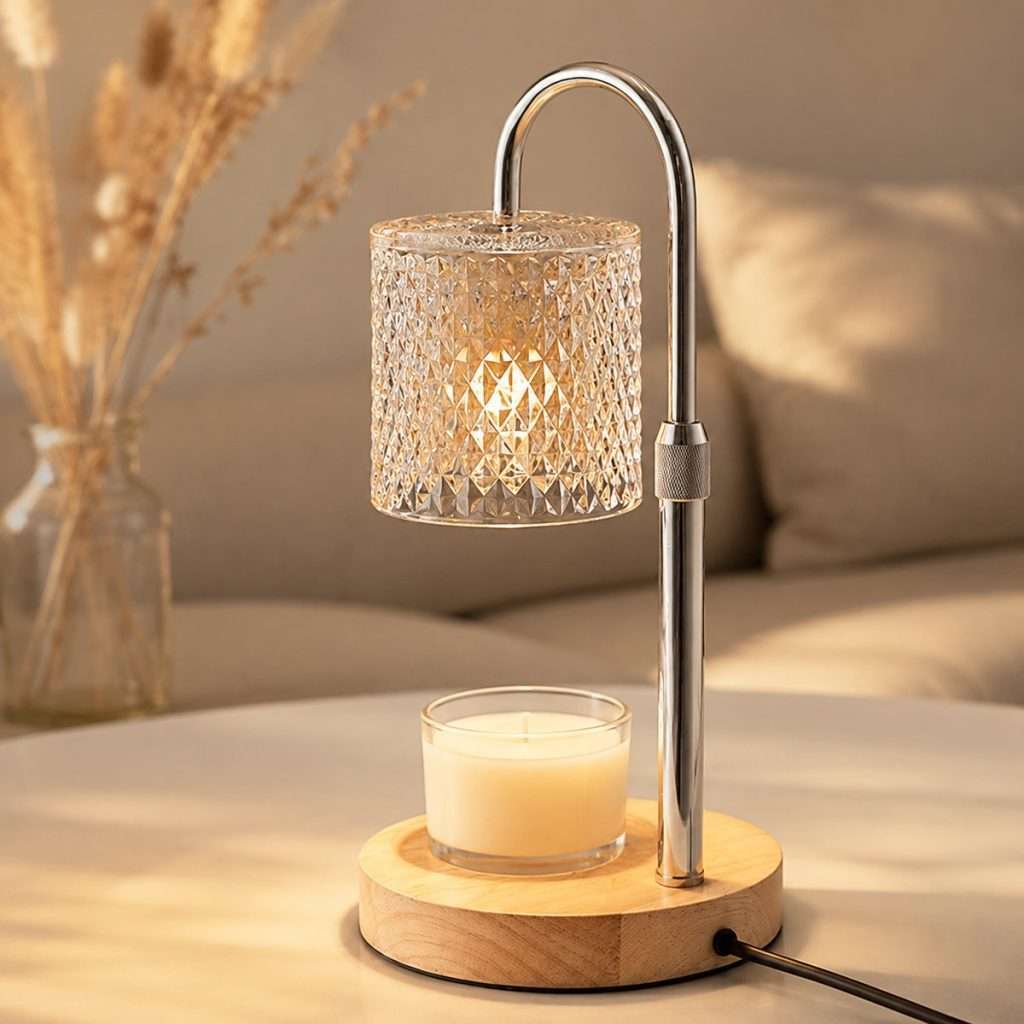
GODONLIF Cut Glass and Wood Adjustable Height Candle Warmer Lamp
An adjustable height candle warmer with a faceted cut glass shade on a round natural wood base. It melts your jar candle with a warm bulb instead of a wick, and both the brightness and the timer adjust.
Shop the adjustable-height warmer lampBrowse all Candle Warmer Lamps →
Sold and shipped by GODONLIF — free shipping within the contiguous US. Price and availability are shown on the product page.
Sources and evidence limits
Melt-pool timings come from published warmer-lamp guidance and from the candle trade’s own rule of thumb for flames; wax melting ranges from a wax manufacturer’s tables; wick mechanism, flame temperature and burn guidance from the trade association; the wax-melt air-quality finding from the American Chemical Society. Each link was checked on August 20, 2026.
- National Candle Association, “Candle Science” (wick function — “this liquid wax is then drawn up the wick by capillary action”; flame temperatures — bright yellow zone approximately 1,200 °C, outer veil typically reaching 1,400 °C). candles.org — candle science (retrieved August 20, 2026).
- National Candle Association, “Your Foolproof Guide to Burning a Candle Correctly” (trim the wick to ¼ inch before lighting; burn no longer than four hours, then allow two hours of cooling). candles.org — burning guide (retrieved August 20, 2026).
- Hywax, “Wax Melting Point” (published melting ranges for candle waxes span roughly 46–82 °C / 115–180 °F across paraffin and soy). Wax manufacturer’s published tables; the full per-wax breakdown is covered on our own candle wax melting point page rather than repeated here. hywax.com — wax melting point (retrieved August 20, 2026).
- Armatage Candle Company, “How Long Should Your Candle Take to Reach a Full Melt Pool?” (the Diameter Rule — approximately one hour of burning per inch of container diameter, e.g. about 1 hour 30 minutes at 1.5 in and about 3 hours at 3 in). Published February 2023. The author explicitly advises candle makers not to design to this metric; it is used here only as a consumer-facing benchmark for how long a flame takes. armatagecandlecompany.com — full melt pool timing (retrieved August 20, 2026).
- FlashyBeams, “How Do Candle Warmers Work? Full Guide (2026)” (a typical candle warmer lamp uses a 25–50 W halogen bulb; the bulb reaches operating temperature in about 30 seconds; a smooth pool of liquid wax forms across the surface within 15–20 minutes; roughly 3–5 inches between bulb and wax). Retailer guidance rather than independent measurement. flashybeams.com — how candle warmers work (retrieved August 20, 2026).
- Happy Wax, “How Long Do Wax Melt Scents Last?” (a one-ounce wax melt gives roughly 8 to 12 hours of strong scent throw in an electric warmer; cubes heavier than about 0.55 oz are best broken up; the brand’s own warmers offer 3, 6 and 9-hour settings with automatic shut-off). Manufacturer guidance for its own products. happywax.com — how long wax melt scents last (retrieved August 20, 2026).
- CandleScience, “How do I calculate the amount of fragrance oil I need?” (average fragrance oil usage is 6% of the wax by weight; essential-oil loads are kept at 10% or below). Supplier technical guidance. support.candlescience.com — fragrance oil calculation (retrieved August 20, 2026).
- American Chemical Society, “Scented wax melts may not be as safe for indoor air as initially thought, study finds” (February 2025; researchers tested 15 commercial wax melts in a model house and measured airborne particles 1 to 100 nanometres wide, at levels comparable to combustion candles and gas stoves). Press summary of research published in Environmental Science & Technology Letters. acs.org — scented wax melts and indoor air (retrieved August 20, 2026).
- National Fire Protection Association, “Candle fires” fire statistical report (candles started an annual average of 5,894 US home structure fires across 2020–2024, causing 63 civilian deaths, 532 civilian injuries and $286 million in direct property damage; the leading contributing factor is combustible material left or brought too close to the flame). nfpa.org — candle fires (retrieved August 20, 2026).
Further reading on this site — background rather than evidence cited above: the candle warmer bulb guide covers wattage and bulb replacement, a candle with no wick deals with jars whose ignition system has failed, and do candle warmers make candles last longer looks at what slower melting does to a jar’s lifespan.
Evidence limits: wax melting points are typical supplier ranges rather than fixed constants — additives, dye load and refining grade move every figure, and bands from different suppliers overlap. The 15–20 minute melt-pool figure is published warmer guidance, not independent chamber measurement, and it assumes a matched bulb at the intended distance; a cold room, a wide jar or a dim setting all push it out. The Diameter Rule used for the flame comparison is a rough trade heuristic whose own author argues against relying on it, so treat those three flame bars as order-of-magnitude rather than precise. The ACS wax-melt study measured particle concentrations in a model house, not health outcomes, and tested wax melts specifically rather than jar candles under lamps — we report it because it is the closest available evidence on flame-free emissions, not because it settles the question. We have not measured a lamp or a melt time ourselves. Finally, melting releases the fragrance already dissolved in the wax and cannot add any: a jar that has stopped smelling will not start again under any method described here.
You may also like


