


News
Are Candles Bad for Cats? The Flame, the Smoke and the Scent, Judged Separately

Sep
Pets & Safety
Are candles bad for cats? The question hides three risks that behave nothing like one another: an open flame in a house with the one animal that patrols the surfaces it stands on, the smoke and fine particles that exist only because something is burning, and a warm scented pool with nothing guarding it. Only the first of those can be deleted outright — and deleting it does not mean giving up candlelight.
Key takeaways
This page is about the lit candle. The appliance question — and the metabolic argument that makes cats a special case in the first place — is answered in full on our page about whether wax warmers are safe for cats, and the whole-household version covering children, cords and burning rules is our guide to candle safety with kids and pets. Neither is repeated here.
- Three risks, and only one of them disappears when the flame does. Fire and singed whiskers belong to the flame. Smoke and fine particles belong to combustion. Fragrance belongs to the jar, and it survives every change of format.
- Fire agencies name the animal explicitly. The American Humane Society, citing the National Fire Protection Association, puts roughly 750 accidental US home fires a year down to “the actions of pets or wild animals,” and around 40,000 pet deaths a year “primarily due to smoke inhalation.”[2]
- The particles do not stay next to the candle. In a 2025 study across three occupied homes, fine particulate peaked three meters away from a candle that had burned for five minutes, half an hour after it went out.[6]
- “Toxic” is carrying more weight than the sources give it. Pet Poison Helpline ties the risk to concentration — “the higher the concentration of the essential oil (i.e. 100%), the greater the risk to the cat” — and describes the hazard from passively dispersed scent as respiratory irritation.[5]
Two kinds of answer dominate this search, and neither survives contact with the sources. One treats every scented jar as a slow poisoning of the cat asleep beside it. The other waves the whole thing off as internet anxiety and recommends a nicer candle. What the veterinary and fire literature actually describes is three unrelated problems that happen to share a room: a physical one, an air-quality one and a chemical one. They have different sizes, different evidence behind them, and — the part that decides what you should actually do — different answers. Sorting them is most of the work.
01Are Candles Bad for Cats? The Short Answer
Are candles bad for cats in a way that should change what you do? Yes on one axis, arguably on a second, and not in the way most articles claim on the third. The first axis is the flame itself: an open, moving, warm thing at exactly the height a cat walks. The second is combustion — the smoke, soot and fine particles that exist only while a wick is lit, in air a cat breathes closer to the floor and for more hours a day than you do. The third is fragrance, which is where almost every article on this subject spends its time, and which is the one axis that does not care whether a flame is involved at all.
We are not going to hand you a verdict, because the sources do not contain one. No veterinary body has studied cats living with a burning candle, and the pages that sound most certain about it are quoting research about something else. What the sources do support is narrower and more useful: which risk each of the three axes carries, which of them a change of equipment removes, and which of them stays exactly where it is no matter what you buy. The mirror version of this question for the other animal on the sofa is on our page about candles in a dog household, and the two species genuinely diverge, which is why they are separate pages rather than one.
02Cats and Candles: What a Cat Actually Does Near an Open Flame
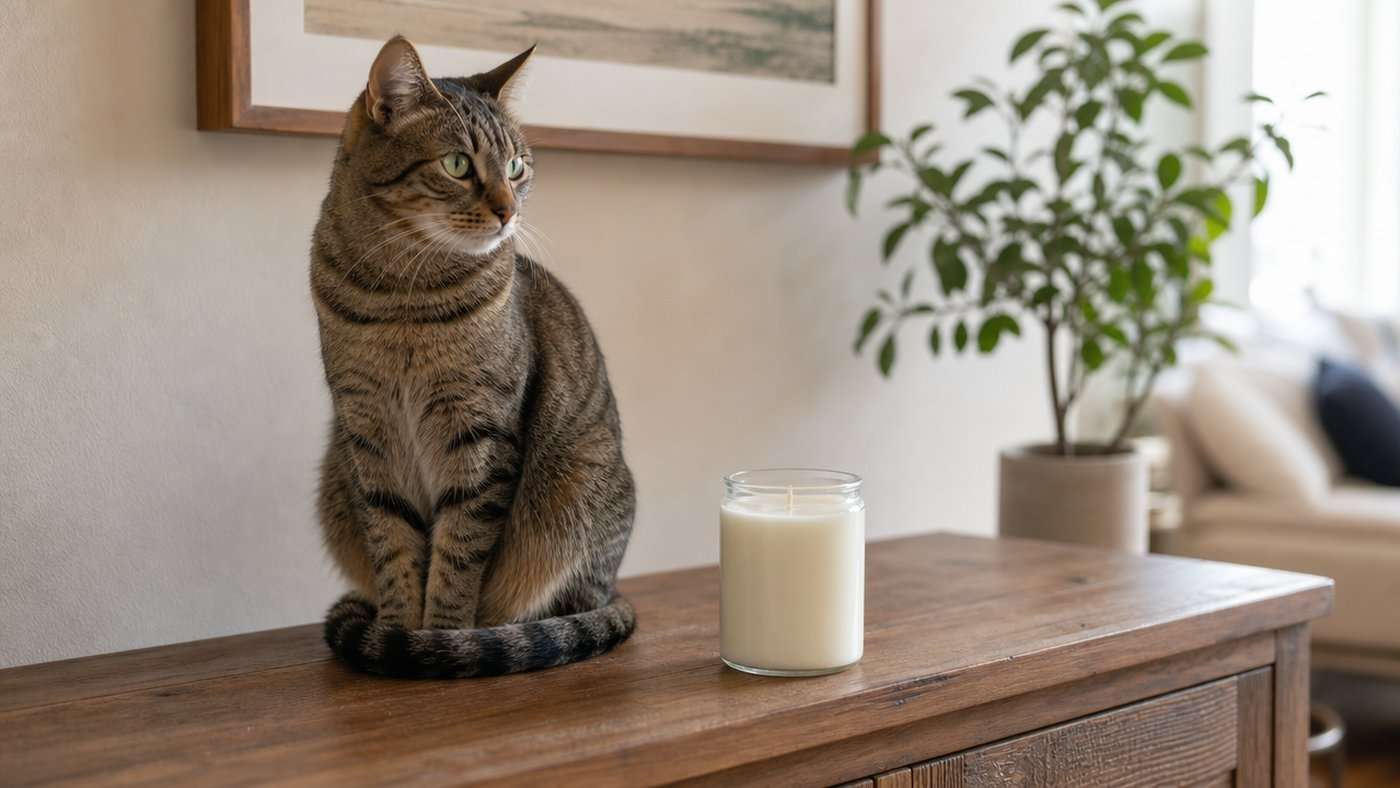
Cats and candles interact through three specific behaviors, and none of them is the deliberate approach people picture. The first is the response to movement. VCA Animal Hospitals, in its guidance on play and predatory aggression written by the veterinary behaviorists Debra Horwitz and Gary Landsberg, states the trigger plainly: “moving objects that can be stalked, chased, swatted, or pounced upon best stimulate cat play,” and it describes the sequence that follows as “the stalk, pounce, and bite, which can be extremely intense.”[3] A candle flame is small, bright, unpredictable in a draft and roughly the size of a moth. It is not a shape a cat has any reason to read as dangerous, and it sits in the middle of the category the behaviorists describe as the strongest available invitation to swat at something.
The second is the whisker. Whiskers are not decorative hairs, and understanding what they are changes how a near miss should be read. VCA describes them as vibrissae, from the Latin vibrio, “to vibrate,” and notes that they “erupt from hair follicles like other hairs, but they are coarser and thicker than regular hair and have roots that are three times deeper.”[4] Most cats carry twelve of them in four rows on each cheek, and they detect “subtle changes in air currents and transmit information about the size, shape, and speed of nearby objects.”[4] That is the mechanism a cat uses to survey a gap before committing her head to it — which is precisely why the whiskers arrive at a flame before the face does. VCA advises against trimming whiskers at all, because losing them costs a cat awareness of her own surroundings; a singed set is the same loss arriving by accident.
The third is simply where a cat spends her time. She is on the console, the mantel and the kitchen counter because those are the surfaces the flame is on, and she is there at dusk, which is when the candle is lit. That combination is why fire agencies write about the animal directly rather than treating it as an edge case. The American Humane Society, citing the National Fire Protection Association, reports that “approximately 750 accidental home fires annually can be attributed to the actions of pets or wild animals,” that “nearly half a million pets are impacted by these home fires each year in the U.S.,” and that around 40,000 of them die, “primarily due to smoke inhalation.”[2] The US Fire Administration puts the candle side of that in its own units: “on average, 20 home candle fires are reported each day.”[1] Neither figure is about cats specifically. Both describe the collision this section is about.
03Safe Candles for Cats: Format Is the Part a Cat Can Actually Move
Safe candles for cats is a phrase with no certifying body behind it, which our page on pet friendly candles works through in full and this page will not relitigate. What is worth adding here is the variable that page cannot cover, because it belongs to physics rather than to labels: the shape of the object, and how much force it takes to move it. On the flame axis, format is the difference between a spill and a fire, and it is the one thing you can judge by looking at the candle without trusting a single word printed on it.
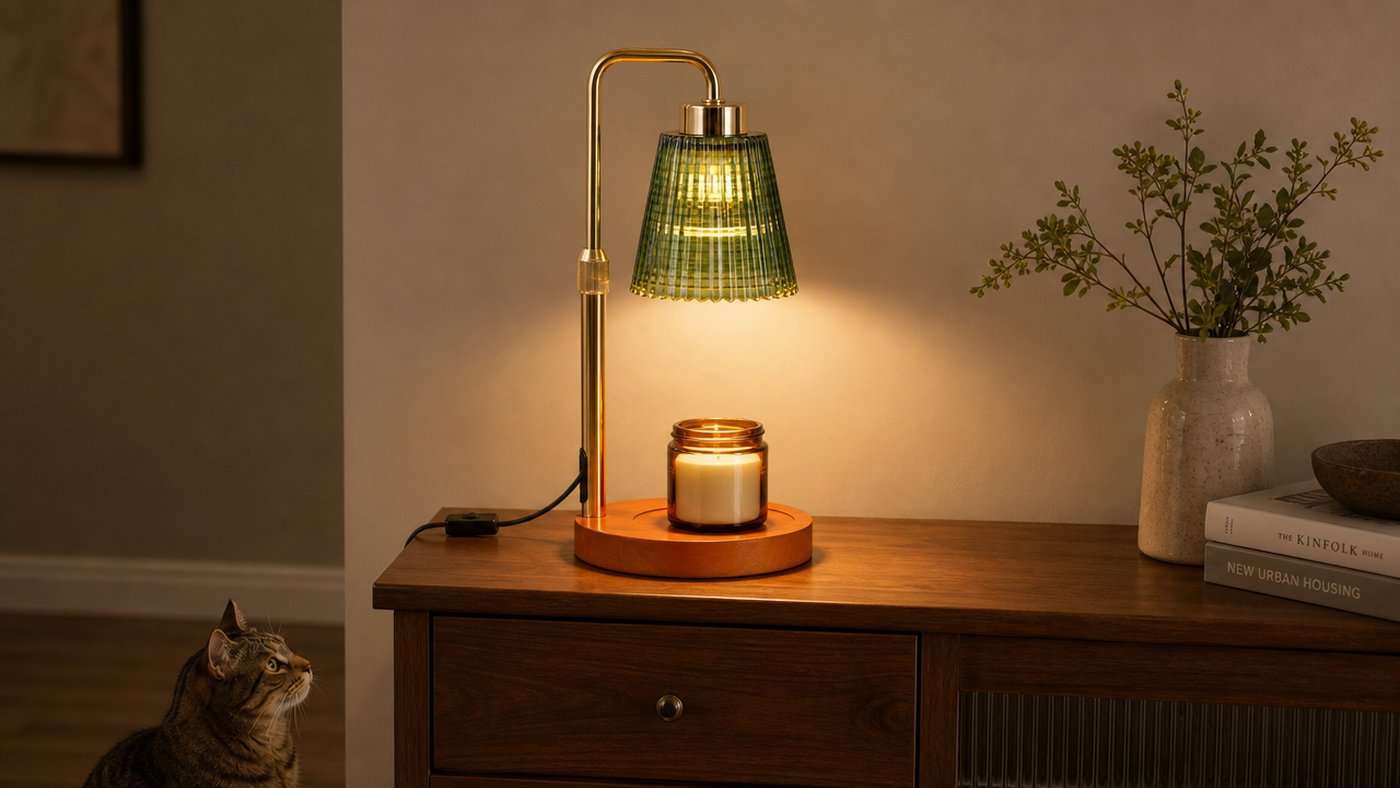
The fire authorities frame it the same way. The US Fire Administration’s guidance is to “make sure they are in stable holders and place them where they cannot be knocked down easily,” and to “keep candles at least 12 inches away from anything that burns.”[1] Read those two sentences with a cat in mind and they stop being generic. A taper in a narrow holder has a high center of mass and a small base, so a tail sweep converts it into a lit object lying on its side. A tealight sits in a thin metal cup that slides across a hard surface when a paw makes contact and offers nothing to grip. A pillar has no vessel at all, so the pool of hot wax has nowhere to go but the table. A wide, heavy jar is the opposite case on every count: low, weighted, deep-sided, and hard to move without deliberate effort. It is also the only one of the four that has an obvious next step, which is removing the flame from it entirely. That step is a bulb above the jar instead of a flame inside it, which is how warmer lamps for jar candles heat the same wax without lighting it.
A taper, tealight or pillar
- Cheap, and easy to place anywhere
- High center of mass, or no vessel at all
- Light enough to slide when a paw makes contact
- Nothing contains the pool once it moves
- The formats that fail the stable-holder test
A wide, heavy jar
- Low and weighted, so a nudge slides rather than tips
- The vessel itself contains the wax
- Deep sides keep the flame below the rim
- Still an open flame at nose height
- The only format with a flameless version of itself
None of this makes any jar safe, and the last row of that comparison is the honest one. A heavy vessel changes the probability that a cat moves the candle; it changes nothing about what happens if she reaches over the rim, and nothing at all about the two axes still to come. Format is a real lever, and it is a small one.
04Are Scented Candles Bad for Cats? The Fragrance Axis, and Who Answers It
Are scented candles bad for cats because of what the fragrance is made of? This is the axis with the most literature behind it and the most confusion attached to it, and the reason for both is that cats genuinely do process some of these materials differently. Pet Poison Helpline states the mechanism in one sentence: “cats lack an essential enzyme in their liver and as such have difficulty metabolizing and eliminating certain toxins like essential oils.”[5] The full version of that argument — which enzyme, which materials veterinary sources name, and what it means for a product you warm rather than burn — is set out with its own citations on our page about wax warmers and cats, and we are deliberately not building a second copy of that list here. One table, one place.
What belongs on this page is the calibration around it, because the mechanism is true and the conclusion people draw from it usually is not. Pet Poison Helpline attaches the risk to concentration rather than to the mere presence of a material: “the higher the concentration of the essential oil (i.e. 100%), the greater the risk to the cat.”[5] A scented candle carries a fragrance blend at a small percentage of the wax. The clinical cases that make this subject frightening are, overwhelmingly, about bottles of undiluted oil, often applied directly to the animal. Those are two different exposures separated by two orders of magnitude, and an article that quotes the second while you are asking about the first is not answering your question.
What the case reports describe
- Undiluted oil, often at full strength
- Frequently applied to the animal on purpose
- A skin or swallowed exposure, not an airborne one
- The scenario behind almost every warning you will read
What is in a scented candle
- A fragrance blend at a small percentage of the wax
- Reaching the cat through the air, from across a room
- Rarely disclosed in enough detail to check
- Studied for its emissions, not for its effect on cats
Neither column is reassuring on its own, and the gap between them is the point. The left column carries most of the evidence and describes something you are probably not doing. The right column describes what you are actually doing and carries almost no evidence at all, which is a different problem and should not be mistaken for a clean bill of health.
Are Candles Toxic to Cats? What That Word Can and Cannot Carry
Are candles toxic to cats, in the sense the word “toxic” is normally used? The sources do not say so, and they are careful about the distinction in a way that internet summaries are not. What Pet Poison Helpline describes for scent that reaches a cat through the air, rather than through skin or a swallow, is a different category of harm: “the main hazard to cats from essential oils dispersed through passive diffusers is respiratory irritation.”[5] Irritation is not toxicosis. It is real, it is worth avoiding, and it is dose-dependent and reversible in a way that liver toxicity is not. Collapsing the two into one word is how a sensible caution turns into a scare, and it is also how people end up ignoring the caution entirely once they notice the exaggeration.
There is one practice where the concentration argument stops protecting you, and it is worth naming because it is common: adding neat essential oil to the wax yourself. That moves the product from a low-percentage blend to whatever strength came out of the bottle, which is the exposure the case literature is actually about. Our page on essential oils in a candle warmer covers what happens when you do it and why the dose arithmetic changes so sharply. The short version for a cat household is that the candle you bought and the oil you poured into it are not the same risk, and only one of them is what the warnings were written about.
05What Burning Adds: Smoke, Soot and the Air a Cat Shares
This is the axis almost nobody writes about, and it is the only one that exists purely because of the flame. A wick converts wax into gas and then burns it, incompletely, and the residue of that reaction is particulate matter. The US Environmental Protection Agency reached that conclusion in a formal review a quarter of a century ago, stating flatly that “burning candles and incense can be sources of particulate matter” and flagging, for the market of the time, that “burning candles with lead-core wicks may result in indoor air concentration of lead above EPA-recommended thresholds.”[7] That report was published in 2001 and describes the products then on sale, so the lead finding should be read as a historical market observation rather than as a current one. The particulate finding is the durable part.
What has changed since is the measurement. In 2025, researchers publishing in Scientific Reports monitored three occupied homes in Seoul, ranging from 26.5 to 43.0 square meters, burned a single scented candle for five minutes with the windows closed and the ventilation off, and then tracked particles for an hour at three points: beside the candle, three meters away and six meters away.[6] The finding that matters for anyone sharing a room with an animal is not the peak height. It is where and when the peak happened.
Source: Yun, Seo, Kim and Yang, Scientific Reports, 2025.[6] Values are peaks, in micrograms per cubic meter, against each home’s own pre-lighting baseline; the fold-increases reported alongside them run from 1.18 to 1.97, so the baselines were not zero and the room was not clean before the match was struck. Three homes, one candle, five minutes of burning, windows closed and the ventilation off — a small, deliberately unventilated sample rather than a national average, and a measurement of air rather than of any animal in it. Retrieved September 7, 2026.
Two things in that data change how the question should be asked. The coarse fraction rose fastest beside the candle, peaking there within five minutes, as anyone would guess; three meters out it did not peak until ten minutes, and six meters out not until twenty. The fine fractions did not: PM2.5 and PM1 reached their highest readings three meters away, half an hour after a five-minute burn, and were still elevated six meters away, at the other end of the home.[6] Fine particles do not stay where they were made. They travel, they linger, and they end up in the parts of a room where nobody is watching the candle — which, in a cat household, is a fairly precise description of where the cat is.
How much that matters for a specific animal is the part no one can tell you. Feline lower airway disease is not rare: the Cornell Feline Health Center describes asthma as “a disease of the lower airways of the lungs that affects between 1 and 5% of cats.”[8] But Cornell is also explicit that the obvious inference has not been demonstrated in this species, noting that approaches borrowed from human asthma care, “including purifying indoor air and avoiding allergens,” have “not been rigorously tested or proven to work in feline asthma patients.”[8] Take both halves. A meaningful minority of cats have reactive airways, and there is no feline trial telling you what removing a combustion source does for them. What you can do is run the comparison in your own house.
Write down what happens now
Before changing anything, note what your cat does in the first fifteen minutes after you light a candle. Stays and sleeps, leaves the room, sits closer, sneezes, or ignores it entirely. Without that baseline the rest of this is guesswork dressed up as an experiment.
Burn an unscented candle in a ventilated room
Same duration, same place, no fragrance, window cracked. This leaves the flame and the combustion products in play and takes the scent out, so any reaction you see belongs to the first two axes rather than the third.
Warm the scented jar with nothing alight under it
Now the reverse: the fragrance is present and there is no flame and no smoke. If the cat objects to this and not to step two, the scent is your variable. If she objects to step two and not to this, the burning is.
Change one thing, and know what is not a preference
Act on whichever step produced the reaction, and change it alone so you can still read the result. One caution: leaving a room is a preference, and coughing, labored breathing, drooling or an unsteady gait is not. The second list is a phone call, not an adjustment.

06Are Candles Safe for Cats Once the Flame Is Gone?
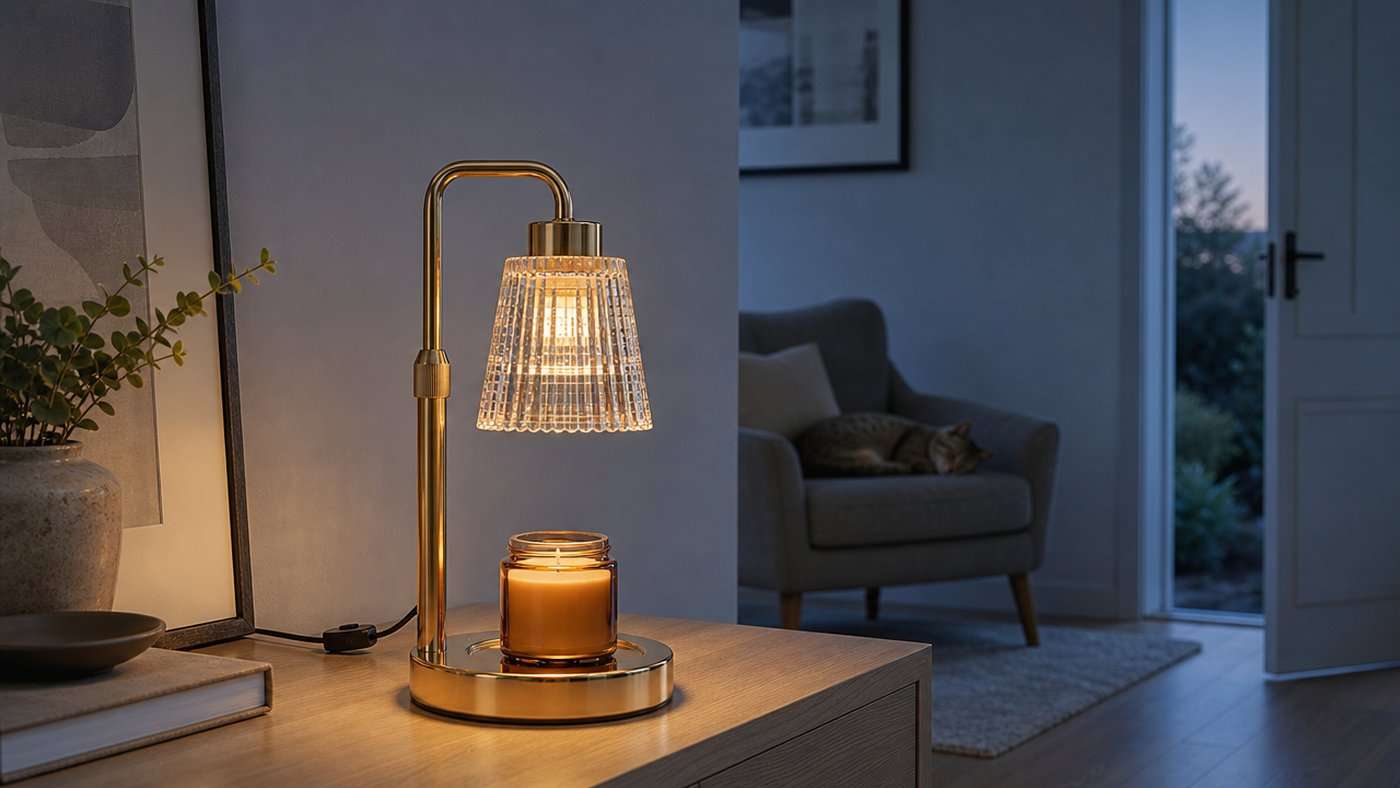
Are candles safe for cats when the same jar is warmed from above instead of burned from within? On three of the five rows below, decisively yes, because the mechanism producing the risk stops existing. On the other two, nothing changes, and any page that tells you otherwise is selling. Both fire bodies cited on this page arrive at the flameless option independently and without being asked about cats: the US Fire Administration suggests “battery-operated flameless candles, which can look, smell and feel like real candles,” and the American Humane Society’s pet fire guidance says the same thing in almost the same words.[1][2] A warmer lamp is the version of that idea that keeps the real wax and the real scent, since the heat comes from a bulb above the jar rather than from a wick inside it.
| Risk to the cat | A lit scented candle | The same jar warmed from above |
|---|---|---|
| Ignition after the candle is moved | Present; animals are tied to roughly 750 US home fires a year[2] | Removed — there is no ignition source |
| Singed whiskers on a close approach | Present; the whiskers arrive before the face does[4] | Removed — nothing to singe them |
| Smoke, soot and fine particles | Produced continuously while lit, and they travel[6] | Removed — nothing is burned |
| Fragrance in shared air | Present | Present, and unchanged[5] |
| A warm, open, scented pool | Present, but a flame sits over it | Present, and nothing sits over it |
The last row is the one worth pausing on, because it is the row that flatters nobody. Warming a jar produces a pool of liquid wax that is warm, strongly scented and completely unguarded, where burning it produces the same pool with a flame standing between the cat and the surface. On that single variable the flameless format is arguably the more inviting of the two, and no feature of any appliance fixes it. What that risk actually involves for a cat, and what to do about it, belongs to the appliance page linked in section four rather than being repeated here. The related question of running any appliance for hours while nobody is watching is covered in our note on leaving a warmer on overnight.
07Where This Page Stops and a Veterinarian Starts
Everything above is about a situation that has not gone wrong yet. If something already has, this page is the wrong document, and the sign lists and first-aid steps are set out with their citations on our page about wax warmers and cats rather than duplicated here. One instruction is worth carrying anyway, because it is the first thing to do and it costs nothing: Pet Poison Helpline states that affected cats “need to be moved immediately into fresh air, and require emergency veterinary treatment should their symptoms not quickly resolve once they are in fresh air.”[5] Fresh air first, then the phone.
We are not veterinarians, nothing on this page is a diagnosis, and the difference between a cat who dislikes a smell and a cat who is unwell is a clinical judgment rather than an editorial one. If you think your cat has been exposed to something, call the practice that knows her, or Pet Poison Helpline on (855) 764-7661.[5]
08What This Page Cannot Settle
Nobody has run the study this question deserves, so every answer available, this one included, is assembled from adjacent evidence and should be read that way. The behavioral sources describe how cats respond to moving objects and what whiskers are for; neither was written about candles.[3][4] The fire figures count incidents involving all pets and wild animals across the whole country, not cats and not candles specifically.[2] The particle measurements come from three deliberately unventilated homes with no animals in them, and describe air chemistry rather than any effect on a cat.[6] The poison-control material describes essential oils at their own concentrations, which is not the same thing as a fragrance blend dissolved in wax.[5] And the EPA review is a quarter of a century old.[7] Each is solid inside its own boundary. Stitching them into a verdict about your cat is inference, and you should discount it accordingly.
Two limits cut against our own product and belong here rather than buried. First, taking the flame away answers the fire, whisker and combustion rows of the table in section six and does nothing whatsoever for the fragrance row, so anyone whose real worry is what their cat is breathing should not read “flameless” as an answer to it. Second, and more bluntly: a warmed jar leaves a pool of hot, scented wax with nothing standing over it, which is a change for the worse on that one variable rather than a change for the better. Beyond both of those, a kitten, a cat with diagnosed airway disease, a cat with liver disease and a cat who has already reacted to something all sit outside what any general article can responsibly advise on.[8]
The short below follows the order this article does, and it keeps the three risks apart the whole way through. It opens on the flame, because that is the one with a body attached to it: the American Humane Society, citing fire-service data, puts roughly 750 accidental home fires a year down to the actions of pets or wild animals and around 40,000 pet deaths a year to smoke inhalation, while a cat’s whiskers — coarser than ordinary hair and rooted three times deeper — arrive at a flame before her face does. It moves next to fragrance, the axis no change of format removes, where Pet Poison Helpline ties the danger to dose rather than to presence: cats lack an essential enzyme in their liver, and the higher the concentration of the essential oil, the greater the risk to the cat, with the diffuser case named separately as respiratory irritation. Then it reaches what burning adds, where the fine fractions peak three meters away rather than at the candle, and feline asthma affects between 1 and 5% of cats that no candle measurement was ever taken on. It closes where the article closes: take the flame away and one of the three is gone outright — nothing left to singe a whisker, no smoke traveling into the room she sleeps in — while the fragrance stays exactly where it was.
Frequently asked questions
These answers stay inside what the cited veterinary, fire and air-quality sources establish. None of them is veterinary advice, and none replaces a call to the vet who knows your cat.
What candles are safe for cats?
There is no certified answer, so what candles are safe for cats comes down to ranking the things you can actually verify. Scent load comes first, because the fragrance is the one variable no format change removes: the lightest product that still works in the room beats the strongest one you own. Format comes second, and it is judged by weight and shape rather than by wording, since a wide heavy jar resists a paw that a taper or a tealight does not. A declared fragrance beats the single word "fragrance," because only a declared blend can be checked against anything. An unscented candle removes the fragrance variable outright and leaves the flame exactly where it was.
Can I burn candles around my cat?
Plenty of people do, and the honest framing of can I burn candles around my cat is that you are accepting three separate risks rather than one. The flame risk is real and physical, and it is the reason fire agencies suggest flameless alternatives in homes with animals. The combustion risk is small per session and cumulative across years, and it reaches parts of the room the candle does not. The fragrance risk depends on what is in the wax and how much of it you run. None of those is a prohibition, and none of them is nothing. What changes the arithmetic most is not permission or refusal but session length, ventilation and a door your cat can walk through.
Do cats like candles?
Some are drawn to them and some leave the room, and neither reaction tells you the thing you want to know. Cats are attracted to warmth and to small moving objects, which is exactly what a flame offers, so a cat settling near one is following two ordinary instincts rather than passing judgement on the product. A cat who leaves is giving you real information and it is worth acting on. But the reverse is not true: staying put is not evidence that the air is fine, because the fine particles and the fragrance are both invisible and neither produces an immediate reaction. Do cats like candles is a behavior question. Whether candles suit a particular cat is not, and the two get confused constantly.
My cat sits right beside a lit candle instead of avoiding it. Does that mean it is fine?
It means she has found a warm spot, which is a preference rather than a verdict. Cats seek heat sources and will settle closer to one than a person finds comfortable, so proximity to a candle is the same behavior as sleeping on a radiator or in a patch of sun. Two things follow. First, sitting closer means a longer exposure at a shorter distance to whatever the candle is putting into the air, so this is the cat you would think about most, not least. Second, a warm surface a cat wants to sit beside is easy to provide without a flame in the middle of it. Read the behavior as a preference for warmth and supply the warmth some other way.
Is the smoke from one candle for an hour really enough to matter for a cat?
For one hour on one evening, almost certainly not, and nobody can promise you more than that. The measurements available describe short burns in closed rooms and show concentrations rising by roughly a fifth to a doubling over the room's own baseline, which is a modest change rather than an alarming one. Two things make the question harder than a single hour suggests. Exposure is cumulative, and a cat spends far more of her life inside that room than you do. And a meaningful minority of cats have reactive airways, with no feline study establishing what a combustion source does to them either way. That is not a reason to panic about one evening. It is a reason not to treat the question as settled.

Candle Warmer Lamps
A GODONLIF flameless candle warmer lamp melts your jar candle from above with a dimmable bulb — an electric candle warmer, not an open flame — so the same candle lasts far longer and melts evenly with no tunnelling.
Browse the flameless warmer lampsSold and shipped by GODONLIF — free shipping within the contiguous US. Prices are shown on each product page.
Sources and evidence limits
The fire figures come from a federal fire agency and a national animal-welfare organization citing fire-service data; the behavior and whisker material from a veterinary hospital network; the concentration and irritation arguments from a poison-control service; the particle measurements from a 2025 journal article; the older particulate finding from a federal environmental agency; the airway-disease figures from a veterinary college. Each link was checked on September 7, 2026.
- US Fire Administration (FEMA), “Candle Fire Safety,” published April 1, 2023. Source for the daily figure quoted in section two — “on average, 20 home candle fires are reported each day” — and for the format guidance in section three: “make sure they are in stable holders and place them where they cannot be knocked down easily” and “keep candles at least 12 inches away from anything that burns.” Also the origin of the flameless suggestion quoted in section six: “consider using battery-operated flameless candles, which can look, smell and feel like real candles.” General household guidance; it does not address cats. usfa.fema.gov — candle fire safety (Retrieved September 7, 2026).
- American Humane Society, “Pet Fire Safety,” attributing its figures to the National Fire Protection Association. Source for the statistics in the key takeaways, section two and the comparison table: “approximately 750 accidental home fires annually can be attributed to the actions of pets or wild animals,” “nearly half a million pets are impacted by these home fires each year in the U.S.,” and around 40,000 pet deaths a year “primarily due to smoke inhalation.” Also recommends battery-operated flameless candles. Counts all companion animals and wildlife together, not cats separately. americanhumane.org — pet fire safety (Retrieved September 7, 2026).
- Horwitz, Debra (DVM, DACVB) & Landsberg, Gary (DVM, DACVB, DECAWBM), “Play and Predatory Aggression in Cats,” VCA Animal Hospitals. Source for the movement trigger quoted in section two — “moving objects that can be stalked, chased, swatted, or pounced upon best stimulate cat play” — and for the sequence it names, “the stalk, pounce, and bite, which can be extremely intense.” Written about play and toys, not about candles; the application to a flame is our inference from the described mechanism. vcahospitals.com — play and predatory aggression in cats (Retrieved September 7, 2026).
- VCA Animal Hospitals, “Why Do Cats Have Whiskers?” Source for the whisker anatomy in section two, the statistic panel and the comparison table: whiskers are vibrissae, from the Latin vibrio, “to vibrate”; they “erupt from hair follicles like other hairs, but they are coarser and thicker than regular hair and have roots that are three times deeper”; “most cats have 12 whiskers that are arranged in four rows on each cheek”; and they detect “subtle changes in air currents and transmit information about the size, shape, and speed of nearby objects.” The page also advises against cutting whiskers, since doing so costs a cat awareness of her surroundings. Sensory biology, not toxicology. vcahospitals.com — why do cats have whiskers (Retrieved September 7, 2026).
- Pet Poison Helpline, “Essential Oils and Cats.” Source for the enzyme sentence quoted in section four — “cats lack an essential enzyme in their liver and as such have difficulty metabolizing and eliminating certain toxins like essential oils” — for the concentration argument, “the higher the concentration of the essential oil (i.e. 100%), the greater the risk to the cat,” for the irritation distinction, “the main hazard to cats from essential oils dispersed through passive diffusers is respiratory irritation,” for the fresh-air instruction quoted in section seven, and for the number given there, (855) 764-7661. Describes essential oils at their own concentrations rather than fragranced wax. petpoisonhelpline.com — essential oils and cats (Retrieved September 7, 2026).
- Yun, H.; Seo, J. H.; Kim, Y. G. & Yang, J., “Impact of scented candle use on indoor air quality and airborne microbiome,” Scientific Reports, vol. 15, article 10181, March 25, 2025 (DOI 10.1038/s41598-025-95010-0). Source for the chart and the argument in section five: three residential homes in Seoul of 26.5 to 43.0 square meters, one scented candle burned for five minutes with windows closed and the HVAC off, particles logged for an hour at the candle, at 3 m and at 6 m. Peaks reported as PM10 39.9 at the candle at 5 min, PM10 42.8 at 3 m at 10 min, PM10 30.5 at 6 m at 20 min, PM2.5 31.1 at 3 m and 26.5 at 6 m at 30 min, PM1 28.8 at 3 m at 30 min and 23.9 at 6 m at 25 min, all in micrograms per cubic meter, with fold-increases over each home’s baseline of 1.18 to 1.97. Air chemistry only — no animals were studied, and the unventilated design is a worst case rather than a typical one. The publisher page redirects automated checks to an authentication step, so the open-access PubMed Central deposit is linked. pmc.ncbi.nlm.nih.gov — impact of scented candle use on indoor air quality (Retrieved September 7, 2026).
- Knight, L.; Levin, A. & Mendenhall, C., “Candles and Incense as Potential Sources of Indoor Air Pollution: Market Analysis and Literature Review,” US Environmental Protection Agency, report EPA/600/R-01/001, published March 1, 2001. Source for the two statements quoted in section five: “burning candles and incense can be sources of particulate matter,” and “burning candles with lead-core wicks may result in indoor air concentration of lead above EPA-recommended thresholds.” A market analysis and literature review of the products on sale at the time, now a quarter of a century old, which is why the lead finding is presented here as a historical observation rather than a current one. cfpub.epa.gov — candles and incense as potential sources of indoor air pollution (Retrieved September 7, 2026).
- Cornell Feline Health Center, Cornell University College of Veterinary Medicine, “Feline Asthma: What You Need To Know.” Source for the prevalence figure in section five — asthma is “a disease of the lower airways of the lungs that affects between 1 and 5% of cats” — and for the caveat quoted alongside it and in section eight, that approaches borrowed from human asthma care, “including purifying indoor air and avoiding allergens,” have “not been rigorously tested or proven to work in feline asthma patients.” Does not name candles, smoke or fragrance as triggers; the connection drawn on this page is ours, not Cornell’s. vet.cornell.edu — feline asthma (Retrieved September 7, 2026).
Further reading on this site — background rather than evidence cited above: candle safety with kids and pets is the whole-household version of this page, covering children, cords and the burning rules this one deliberately leaves alone.
Evidence limits are set out in section eight. The three axes described here are separable on paper and overlapping in a real room, and nothing on this page substitutes for a veterinarian who has examined your cat.
You may also like


