News
Candles in Fireplace: How to Style an Unused Firebox and Mantel Without Lighting Anything
Sep
Decorating & Display
Putting candles in fireplace openings is what almost everyone does with a firebox nobody lights any more, and the instinct is right: a fireplace with candles works, as long as the candles in the box stay unlit. Group an odd number of pillars on one tray in the back of the opening, give the mantel one tall object, and let light and scent come from the one thing that plugs in, where a socket already exists. Can you light them? You can, but a cluster of wicks in a brick recess below everyone’s sightline sits close to the worst case in the fire data, so most people should not.
Key takeaways
This page covers two surfaces you already own, plus one object that has to reach a socket. Which finish suits your room is settled in our guide to whether candle warmers are in style; the siting rules come later on this page.
- The fire statistics describe this arrangement. In 2015 the National Fire Protection Association reported that 58 percent of US home candle fires started when something that could burn was too close to the candle.[1] A cluster of pillars in a brick box, below eye level, is that geometry.
- December is the month it goes wrong. Reviewing three years of data in 2006, the US Fire Administration found that decorations become the leading material first ignited by candles in the peak month.[3]
- The mantel has a power problem, not a taste problem. Mantel shelves rarely have an outlet on them, and an extension cord is temporary: about 3,300 US home fires a year start in one.[4]
- So split the job. Mass and shadow go in the firebox, unlit. Light and scent come from one object that plugs in, standing where a plug exists.
Search the phrase and one photograph comes back forty times: a shallow opening, nine cream pillars, every wick pristine. Nobody says whether those candles are ever lit, what the wax does to the hearth slab if they are, or what to do about a mantel with no socket in reach. Those three questions, in that order.
01A Fireplace With Candles: The Short Answer
A fireplace with candles works, and the candles in the box do not get lit. Group an odd number of pillars at staggered heights on a tray, set them in the back two-thirds of the opening, give the mantel one tall object and one light source, and leave every wick alone. The arrangement reads as warmth because of mass, shadow and repetition against a dark recess. None of that needs combustion, which is lucky, since the recess is the one place you would be least able to watch a flame.
One boundary first, because the two questions look identical from outside. This page assumes the fireplace exists and you do not use it. If your home has no fireplace at all and you are building the feeling of one from nothing, that is the opposite premise, answered in our page on what a hearth actually means, which ends in a four-step routine for creating one where none exists. You already own the thing those steps try to invent.
Most fireplace candles never get lit, and that is the right outcome rather than a failure of nerve. It shortens the shopping too: if nothing burns, burn time and wax type stop mattering, and only height, diameter and colour are left.
| Surface | Holds well | Should not hold | Why |
|---|---|---|---|
| The firebox opening | Unlit pillars as a group, logs, a basket, a screen | Anything alight or anything that plugs in | No outlet, no sightline, masonry that stains |
| The hearth slab in front | A tray, a low basket, one tall lantern to the side | Textiles, anything in the walking line | It projects into the room and people step over it |
| The mantel shelf | Height, art, a small lamp if a socket is in reach | A cord stretched across open wall | Narrow, and rarely has power on it |
| The wall above the mantel | A mirror, a picture, a screen | Anything hot directly beneath it | Heat and soot rise |
02Why Does an Empty Firebox Pull the Eye So Hard?
Because it is a dark rectangle at knee height in an otherwise flat wall, and the room was arranged around it. A fireplace is a framed niche, so anything inside it reads as deliberate and anything missing reads as neglect. That is why an empty firebox looks worse than a blank wall, and why the fix is an object rather than paint.
There is a supply story underneath the question. In 2025 the US Census Bureau counted 234,000 of the 1,005,000 new single-family homes completed that year as having exactly one fireplace, fewer than a quarter of that year’s completions.[6] If you have one, it was probably inherited rather than chosen, built for a way of heating a room your house no longer uses.
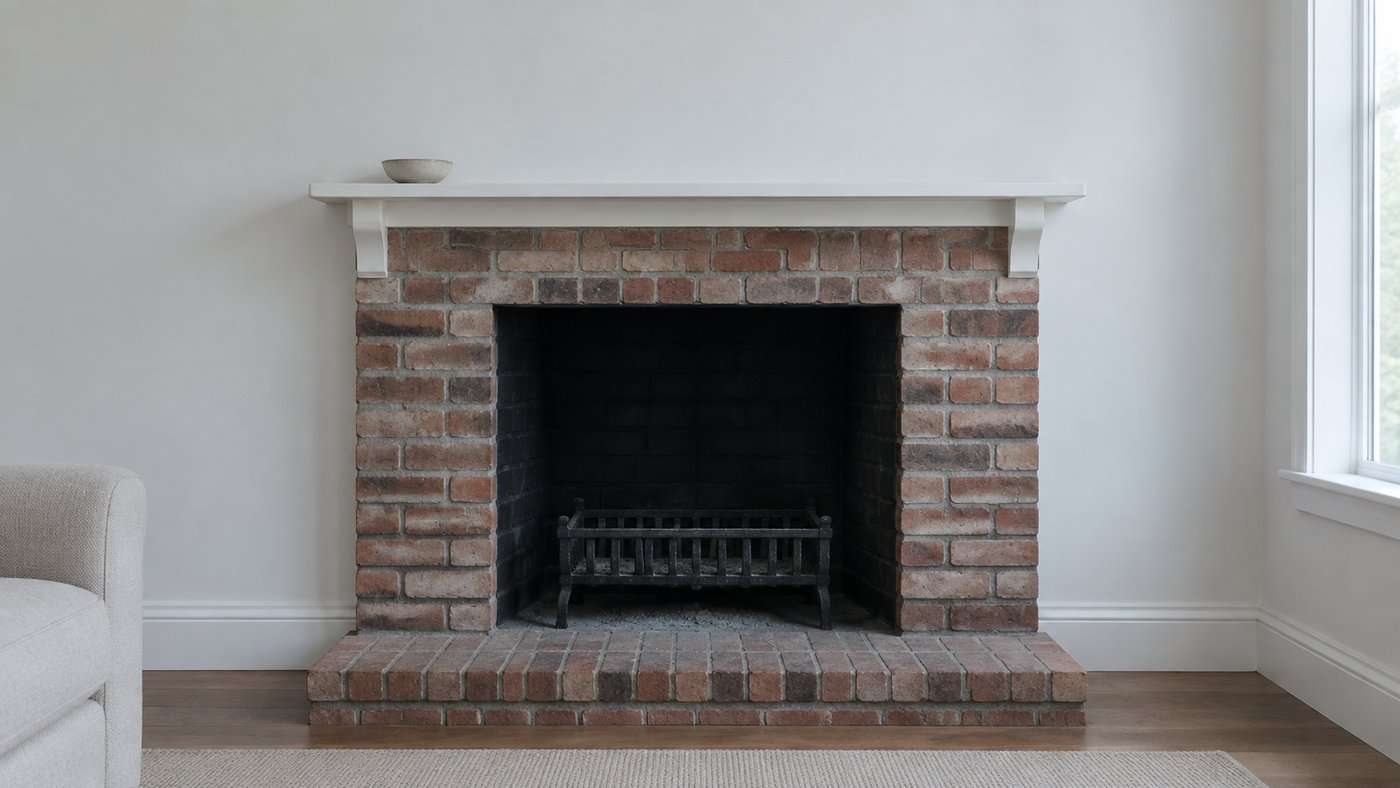
What people want back from that opening decides what goes in it. Low light, below every other lamp in the room. A sense that the house is occupied. And, in the version most will not say aloud, a smell. Two of the three can be had without fire. The third is what sends people looking for a candle, and it is the one a wick delivers worst from inside a masonry box. Scent without a flame is the job of the one object here that plugs in, a warmer lamp, and our cozy living room decor shelf is where those lamps live.
03Should You Actually Light Them? What the Fire Data Says
You can, and the arrangement everyone photographs sits close to the worst case in the incident data, so most people should not. The National Fire Protection Association’s home candle fire fact sheet, published in December 2015 by Marty Ahrens and covering 2009 to 2013, put US fire departments at an average of 9,300 home structure fires started by candles a year, causing 86 civilian deaths and 374 million dollars in direct property damage.[1] The mechanism is not exotic. Almost three in five of those fires, 58 percent, began when something that could burn was too close to the candle, and in 18 percent the candle was unattended.[1]
A firebox display moves every one of those variables at once. It packs several flames into one recess, below the sightline of anyone on a sofa, so it is the easiest thing in the room to forget. It is often dressed with dried stems, pinecones or greenery, which is what the December figures are made of: the US Fire Administration’s 2006 review found decorations become the leading material first ignited in the peak month.[3] And the clearance is one the arrangement cannot meet, since the fire service asks for at least 12 inches between a candle and anything that burns.[2] Twelve inches between each pillar is not a cluster.
Source: National Fire Protection Association, “U.S. Home Candle Fires Fact Sheet,” Marty Ahrens, December 2015, covering 2009 to 2013.[1] The living room share is 20 percent in December against 14 percent from January to November. Rooms only: an unclassified function area of the same size as the dining room, 8 percent, is omitted. Covers all home candle fires, not fireplace displays. Retrieved September 15, 2026.
The counterweight is that candles are a regulated product. A Consumer Product Safety Commission staff briefing package from August 2014 records that the voluntary standard ASTM F2417 sets requirements for stability, flame height, secondary ignition and end-of-life behaviour, with a companion standard for holders and rings.[7] A compliant pillar in a compliant holder is well behaved. That says nothing about the distance between it and the pinecone beside it, which is the variable you own and the standard does not.
04What Goes In the Firebox, and In What Order
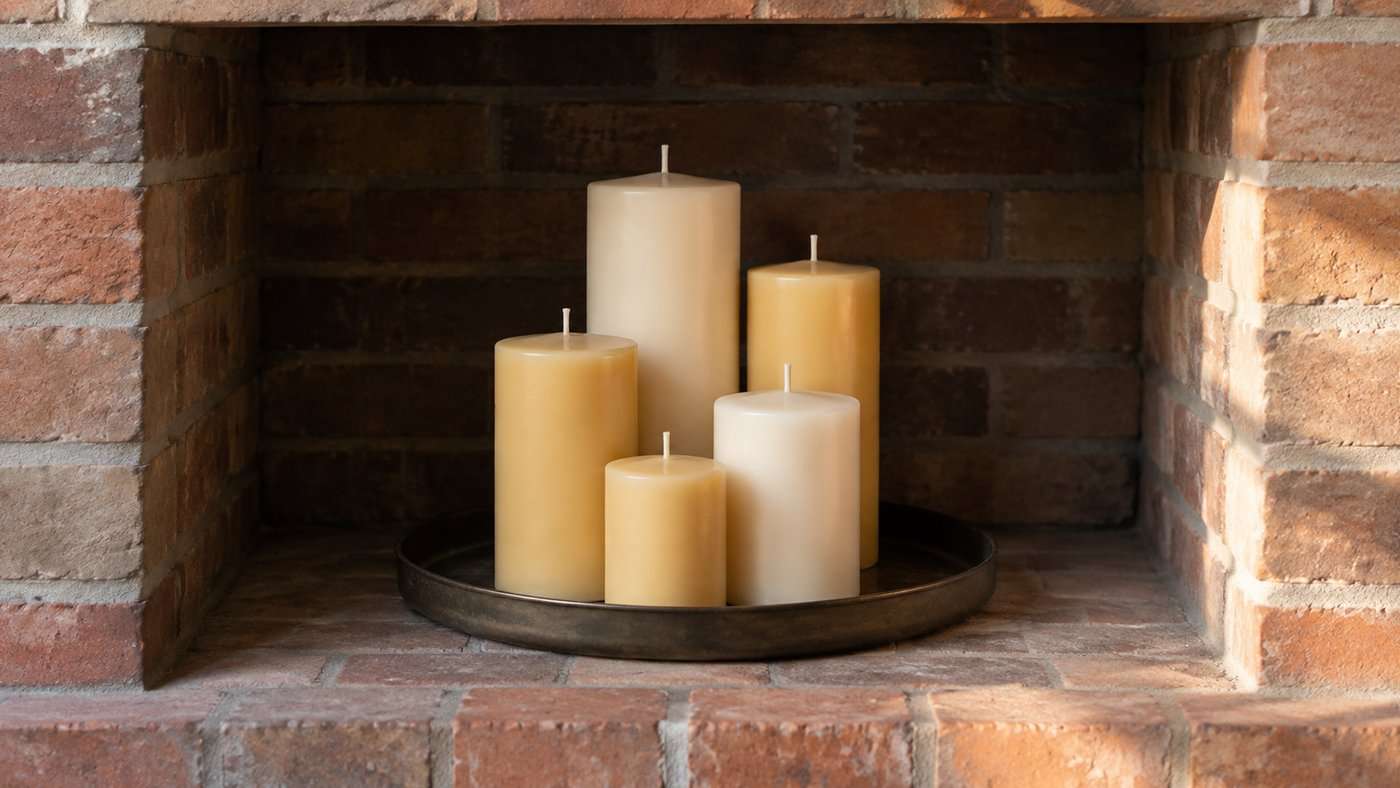
Scale first, then count, then height, then surface. Measure the opening before buying anything, because undersized pieces are the standard failure: three slim tapers in a 36-inch opening look like litter. Aim for a group spanning half to two-thirds of the opening width, with the tallest piece around half its height. Odd numbers sit better than even, and two or three diameters beat three heights of the same diameter, because the eye reads thickness before stature.
The pillar candle fireplace look survives contact with reality once two things are handled. The first is a tray: stand the group on one metal, slate or stone tray rather than on the firebox floor, so it reads as a single object and lifts out in one movement. The second is the chimney. Close the damper so the room is not venting warm air up the flue all winter, and keep the inspection anyway: the Chimney Safety Institute of America asks for a solid fuel venting system to be inspected annually by a certified sweep and cleaned or repaired whenever needed, and on our reading a flue you have stopped using is still that system.[5] A firebox full of decor is easy to treat as a closed subject. It is still a hole in the roof.
A fake fireplace with candles is the easiest version to get right: a decorative surround with no flue has no draught, no creosote and no soot history, so only the visual rules apply. A real disused masonry box differs in one way that matters. Brick and stone are porous, they already hold staining from decades of actual fires, and fresh soot is hard to reverse. Our page on how candle soot marks walls covers the mechanism; in a firebox the deposit lands where no cloth reaches. If wax has already run onto the hearth slab, let it harden fully, lift the bulk with a plastic scraper rather than a blade, and take the residue off with gentle heat and an absorbent cloth, the method set out in our page on getting candle wax off a floor.
The unlit firebox group
- Stays put for a season and asks nothing of you
- No clearance rule between pieces
- Can include dried stems, wood and greenery
- Gives you no light and no scent by itself
The same group, lit
- Needs 12 inches of clearance, which breaks the group
- Sits below the sightline of everyone in the room
- Rules out every dried and paper element beside it
- Drips wax on porous stone and leaves soot behind
- Gives you the low flicker you were after
05Candles for Fireplace Mantel Displays: The Zone With Rules
Candles for fireplace mantel arrangements answer to different constraints from the ones below, and depth is the first. A typical shelf is five to seven inches deep, so anything on it is near the front edge and anything with a wick is near whatever hangs above. Search decorating fireplace mantel with candles and you get the symmetrical version nearly every time: matched pairs at both ends, something large between them. It is safe and slightly lifeless. A group weighted two-thirds to one side, answered by a single tall piece at the other end, holds the eye longer.
Height is the second constraint, and people get it wrong in the opposite direction from the firebox. Down in the box, objects are usually too small; on the shelf they are usually too short, because the mantel competes with a mirror or a screen above it and a low row of votives vanishes against that. Where something large already hangs, stop competing: two or three pieces of real height at one end, the rest empty. How a foot-tall lamp behaves on a wide surface is covered in our page on whether warmers still read as decor.
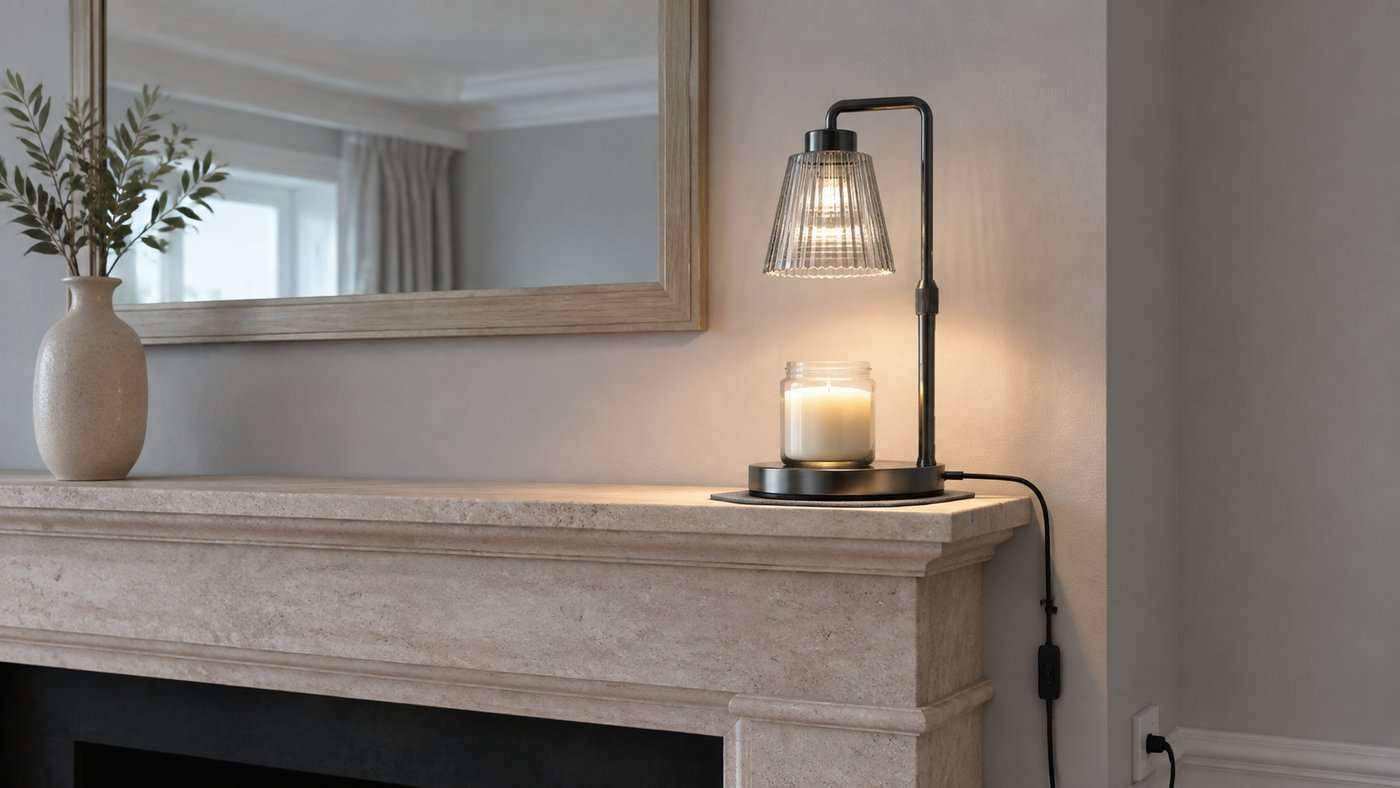
The third constraint is what the shelf is made of. An antique mantel is usually waxed or oiled timber rather than a sealed one, which is the case a warm object suits least. Which surfaces take one without complaint, which do not, and the clearance test for whatever hangs overhead are in our page on where a warmer lamp belongs. The other fire question in that room arrives in December with the tree beside the chimney breast, and we answer it in our guide to candles on a christmas tree.
06The Socket Question, Which Has To Be Answered First
Before planning anything electric on a mantel, find the nearest outlet and measure the run. We have put it plainly in our page on whether these lamps are worth it: a warmer lamp is tethered, and no socket means no scent, which rules out mantels, shelves and outdoor tables. The mantel is the most common place people want one and the most common place there is nothing to plug it into.
Three honest outcomes follow. If an outlet sits within a couple of feet of the chimney breast, run the cord down the return, clip it, and the lamp lives on the shelf. If the nearest outlet is across the room, do not solve it with a long cord: the Electrical Safety Foundation International states that an extension cord is a temporary solution rather than a long-term extension of a household’s wiring, and that roughly 3,300 home fires start in extension cords each year.[4] A cord taped along a mantel and tucked under a rug is what that warning describes.
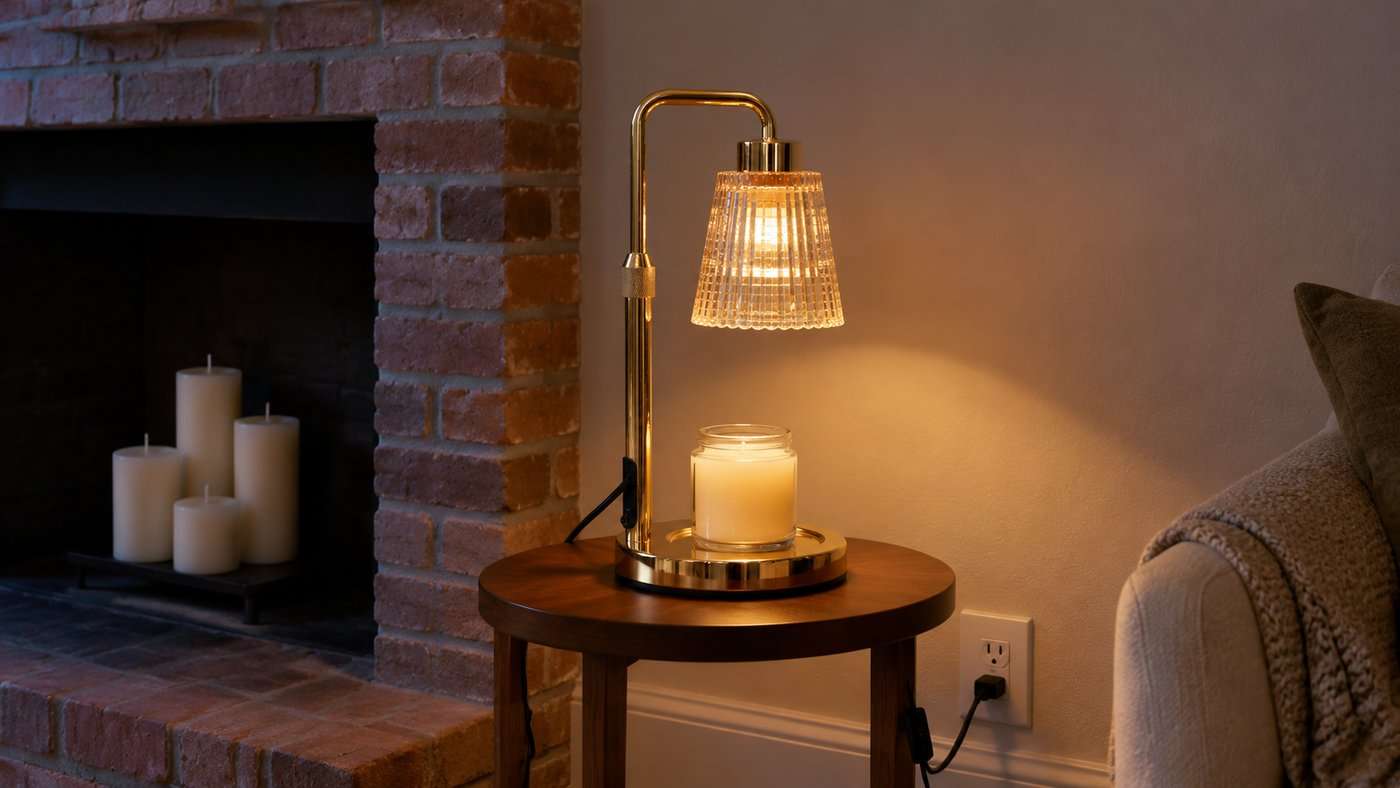
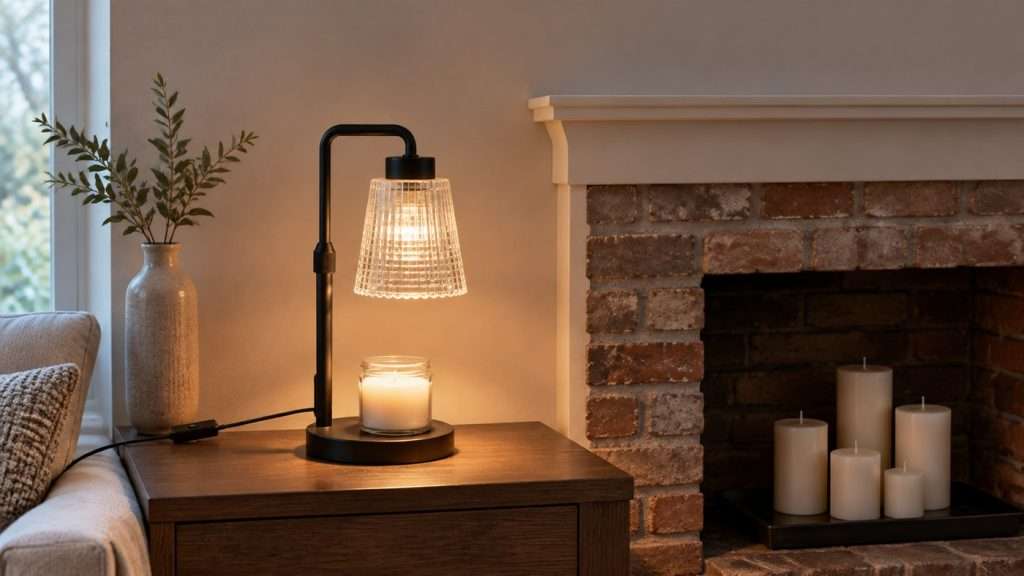
That third outcome is the one we would pick in most rooms. Put the lamp on the side table nearest the hearth, where an outlet already exists, and let the firebox keep its unlit group. Visually you lose nothing, since at seated height the lamp reads better there than on a shelf above your eyeline, and you get back what the fireplace stopped providing: warm light low in the room, and a scent that builds slowly. If there is no socket near the chimney breast at all, put unlit pillars on the mantel too and site the lamp where the power is.
07A Five-Minute Arrangement You Can Do Tonight
None of this needs a purchase to begin. Empty the box first, because scale is impossible to judge against last year’s arrangement.
Measure the opening and find the plug
Width and height of the firebox, depth of the mantel shelf, distance to the nearest outlet. That last number decides whether a lamp goes on the shelf at all.
Put one tray in before one candle
Metal, slate or stone. It defines the group, keeps it liftable in one movement, and stops wax meeting porous masonry.
Build to half the opening height, in odd numbers
Three or five pillars, at least two diameters, covering half to two-thirds of the width. Tall pieces toward the back, for depth from a seated view.
Give the mantel height at one end
Two or three tall pieces weighted to one side beat a parade of small ones, especially under a mirror. Leave the rest empty on purpose.
Close the damper, leave every wick alone
Shut the damper so the room is not venting up the flue, then put the matches away. Light and scent come from the one object that plugs in.

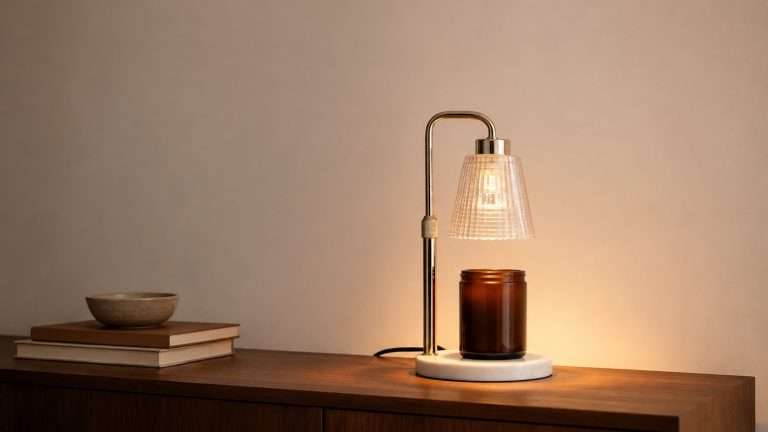
GODONLIF Leather Cone Shade Wooden Candle Warmer Lamp
A wooden candle warmer lamp with a cone-shaped leather shade and a wood base. Bulb heat melts your jar candle from above, so you get the scent with no flame and no smoke.
A decor lamp for the hearth sideSold and shipped by GODONLIF — free shipping within the contiguous US. Price and availability are shown on the product page.
08What This Page Cannot Settle
Nobody has studied decorative firebox displays as a fire risk category, so the step from “58 percent of candle fires start with something combustible too close” to “do not light nine pillars in a brick recess” is our inference from geometry rather than a measured finding about fireplaces.[1] It is a reasonable inference. It is still an inference.
The condition of your chimney is not something an article can answer either: a flue unused for a decade may be blocked, may be housing wildlife, or may be sound, and only an inspection tells you which.[5] And a warmer lamp is an atmosphere device, not a heat source, so if what you miss is the temperature, this page has not solved your problem. Our pages on candles that never need a wick and getting wax out of a jar cover what readers ask next.
The short below keeps to the order this article does. It opens where section one opens: a fireplace with candles works, and the candles in the box do not get lit. Section two is why an empty recess pulls the eye at all — a fireplace is a framed niche, so anything inside it reads as deliberate and anything missing reads as neglect. Section three is the fire data, and it is blunt: the arrangement everyone photographs sits close to the worst case in the incident data. Section four is the order of operations for the box itself — scale first, then count, then height, then surface. Section five moves up to the shelf, where a typical shelf is five to seven inches deep, so everything on it sits near the front edge and near whatever hangs above. Section six is the question that settles the mantel before taste gets a say: the mantel is the most common place people want one and the most common place there is nothing to plug it into. Section seven is the five-minute version, and it starts where the short starts — empty the box first, because scale is impossible to judge against last year’s arrangement.
Frequently asked questions
The motive, the order of decisions, the taste verdict, and two problems that arrive a month later.
Why do people put candles in their fireplace?
Because a pillar carries the idea of fire in its shape, so the arrangement works even in a photograph where every wick is obviously untouched. Nothing has to burn for the reference to land. Position is the second reason: an opening that glows from below changes the shape of a room in a way a table lamp cannot copy. Cost is the third. Pillars are cheap enough to buy five at once, they stack into a group with real depth without any of them being expensive, and one tray turns them into a single object you can lift out in one movement. Nothing else fills that opening for the money.
How to style a fireplace with candles?
Scale, count, height, then material: section four sets the order. What it does not cover is the awkward openings. If the box is shallow enough that a fat pillar would stand proud of the surround, switch to slim tapers in tall holders, or use one sculptural piece instead of a group. If it is unusually wide, build two clusters rather than stretching a single row. Leave a cast-iron grate in if it has any pattern to it and stand the tray on top; take a plain steel one out. Glass hurricanes and cloches keep dust off and buy height, but they read formal, so they suit the mantel better than the box. In spring, drop the count and swap unbleached beeswax for plain white.
Do candles look good in a fireplace?
Yes, when they are in scale, and no when they are scattered. The version that reads as cheap is a handful of mismatched votives spread across the firebox floor, or a single candle stranded in a large opening, because both leave the eye hunting for a subject. Colour matters more than most people expect: warm white, ivory, black and unbleached beeswax all sit comfortably against brick or stone, while brightly coloured or heavily fragranced novelty pillars tend to fight with the masonry behind them. A matte wax surface also photographs better against rough brick than a glossy one.
Can I put a candle warmer lamp inside the firebox instead of on the mantel?
It is the worst spot in the room, so no. Three things go wrong at once. There is no outlet inside a firebox, so the cord has to cross the hearth slab and the walkway in front of it, which is the route people step over. The lamp is roughly a foot tall and would sit below the sightline of anyone seated, so the warm glow that justifies it disappears into a recess. And dark masonry absorbs light rather than bouncing it, so what little you can see is swallowed. A warmer lamp earns its place at or slightly below seated eye level on a surface with power, where you can see the shade and the scent has open air to move through.
How do I stop a group of unlit pillar candles from looking dusty and dead?
Treat them as objects on open display, because that is what they are now. Unlit wax collects dust in a fine grey film that reads as neglect from across the room, so wipe each piece with a dry microfiber cloth every few weeks and the tray underneath at the same time. Trim each wick down to a short stub, or clip it flush, since a long virgin wick is what makes a display look staged. Keep the group out of direct sun, which yellows white wax and softens pillars until they lean. Soy and some blends develop a pale surface bloom over months, which is harmless and buffs back with a soft cloth. Replace anything that has warped rather than straightening it.
Can I put candles in my fireplace?
Yes, as a display, and that is the version this page recommends: pillars grouped on one tray in the back of an opening you no longer use, every wick left alone. Lighting them is the separate question, and the firebox is where the fire numbers point. In the National Fire Protection Association's figures, 58 percent of US home candle fires began with something that could burn too close to the candle, and the fire service's 12-inch clearance cannot be kept inside a cluster that sits below the sightline of anyone on the sofa, often beside dried stems or pinecones. A flue left unused for years still wants a certified sweep's inspection, too: only an inspection tells you whether it is blocked or sound.
Sources and evidence limits
Every link below was opened before publication. Limits are set out in section eight.
- National Fire Protection Association, “U.S. Home Candle Fires Fact Sheet,” Marty Ahrens, December 2015, covering 2009 to 2013. Source for the averages and the 58, 18 and December figures in section three, and it covers all home candle fires rather than fireplace displays. The NFPA site refuses automated retrieval, so the sheet is linked as hosted by the Illinois Office of the State Fire Marshal. sfm.illinois.gov — U.S. home candle fires fact sheet (Retrieved September 15, 2026).
- US Fire Administration, “Candle Fire Safety.” Source for the 12-inch clearance rule in section three. Public education guidance, not primary research. usfa.fema.gov — candle fire safety (Retrieved September 15, 2026).
- US Fire Administration, Topical Fire Research Series, volume 6, issue 1, July 2006, “Candle Fires in Residential Structures,” using incident data for 2002 to 2004. Source for the December finding: furniture, curtains, cabinetry and bedding lead the materials first ignited, but in December decorations do. An older window than source one, cited only for that pattern. apps.usfa.fema.gov — candle fires in residential structures (Retrieved September 15, 2026).
- Electrical Safety Foundation International, “Extension Cord Safety Tips.” Source for section six: an extension cord “is a temporary solution and is not meant to be used as a long-term extension of your household’s electrical system,” and roughly 3,300 home fires start in extension cords each year. A non-profit advocacy body, not a regulator. esfi.org — extension cord safety tips (Retrieved September 15, 2026).
- Chimney Safety Institute of America, “Preventing Chimney Fires.” Source for the annual inspection guidance in sections four and eight. A certifying trade body, so read it as industry guidance. csia.org — preventing chimney fires (Retrieved September 15, 2026).
- US Census Bureau, “New Single-Family Homes,” built on the Survey of Construction. Source for section two. Counts new construction only, so it says nothing about the existing stock. The page reports only the one-fireplace category; homes with two or more are not shown, so this is a floor rather than the total. The visualization is refreshed annually and the legacy 2021 path in the URL now serves the current year. census.gov — new single-family homes (Retrieved September 15, 2026).
- US Consumer Product Safety Commission, staff briefing package, “Petition CP04-1 and HP04-1; Request for Fire Safety Standards for Candles and Candle Accessories,” August 6, 2014. Source for the ASTM F2417 and F2601 paragraph in section three. A staff document cleared for release, not a Commission decision, and staff recommended that the petition be denied rather than that a mandatory standard be set. cpsc.gov — petition CP 04-1 staff briefing package (Retrieved September 15, 2026).
A flue unused for years is a job for a certified sweep, not an article about decorating.
You may also like